
St. Aloysius University Hosts Faculty Development Programme on Mastering Scientific Publication
NV Paulose, Chairman, Global TV +91 98441 82044
Mangaluru, – For early-career researchers, the path to publishing in a prestigious journal can feel like navigating a maze in the dark. Despite completing rigorous experiments and obtaining significant results, many face the sting of a desk rejection for reasons that seem unclear. According to Dr. Rajeev Raghavan, the problem is often not the science itself, but how it is framed and presented to the world.
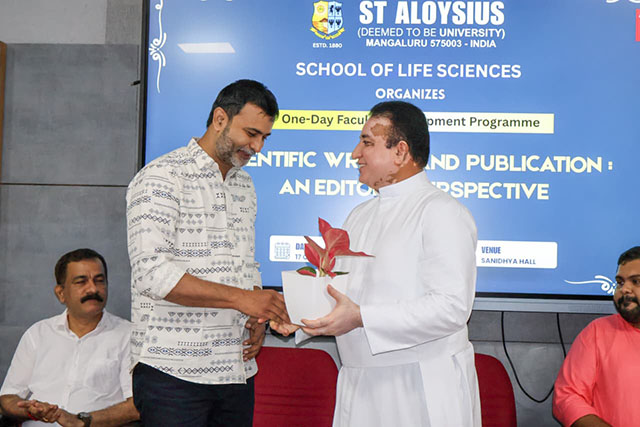
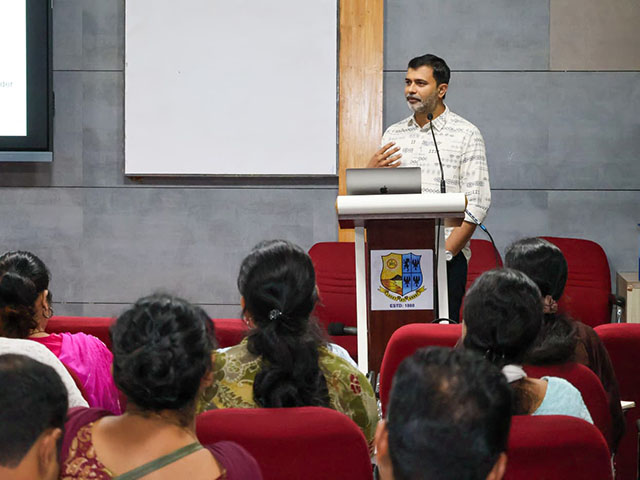
Dr. Raghavan shared these insights during an enlightening session titled “Beyond the Bench: The Unwritten Rules of Getting Published in High-Impact Journals,” organized by the College of Fisheries.
The event was presided over by Dr. A. K. Pal, the Director of Education and former Vice-Chancellor of Kerala University of Fisheries and Ocean Studies (KUFOS). The gathering was also graced by the presence of the institution’s Director of Research, Dr. S. K. Singh, and Dean Dr. V. R. Suresh.
Drawing from his extensive experience as an advisor to countless authors and a reviewer for top-tier journals, Dr. Rajeev Raghavan outlined three critical, yet often overlooked, strategies that can elevate a manuscript from “good” to “must-publish.”
- Time Travel is Not an Option: Why Your Reference List Must Look Forward, Not Backward
A common and fatal assumption is that a journal will be interested in a topic today because it published a similar paper a decade ago. “The academic landscape is not static,” Dr. Raghavan noted. “An editor’s primary goal is to increase the journal’s impact factor, which means they are exclusively looking for papers that will be widely read and cited now and in the near future.”
He advised researchers to become “detectives” before writing, analyzing a journal’s last two years of publications to tailor their work to fit the journal’s current conversation, not its historical archive.
- The Reviewer is Your Judge, Not Your Co-Author
Addressing a common misunderstanding, Dr. Raghavan clarified the role of peer reviewers. “Reviewers and editors are there to assess the validity, significance, and clarity of your substantially complete work. They are not there to perform basic editing or build your argument for you,” he stated.
He emphasized that submitting a half-finished manuscript is a guarantee of rejection. The strategy is to submit only the most polished work, having enlisted colleagues for proofreading and ensured a compelling narrative flow. “The review process is for strategic refinement, not for fundamental writing,” he added.
- From Local Interest to Global Impact: Overcoming the ‘Narrow Scope’ Rejection
This was highlighted as a major hurdle for researchers working on specific case studies. Dr. Raghavan framed the editor’s perspective: “A journal editor in Europe may ask, ‘Why should a researcher in Japan or Canada care about this particular plant in a specific valley?’ If your paper cannot answer that, it will be rejected.”
The solution, he explained, is to frame the work to highlight its broader theoretical implications. A localized study should be positioned as a case study in a universal principle or an insight into a global challenge.
The Mindset for Success
Dr. Raghavan concluded that publishing in high-impact journals is as much about strategy as it is about science. It requires researchers to shift their perspective to that of an editor curating content for a global audience.
The session, which provided a crucial roadmap for academics, was hailed as a significant contribution to research methodology, empowering scientists to offer their work not just as a paper, but as a valuable contribution to the global scientific dialogue.


One thought on “Dr. Rajeev Raghavan | Beyond the Bench: Dr. Rajeev Raghavan Decodes the Unwritten Rules of Publishing in High-Impact Journals | Global TV”