
How Uttar Pradesh Can Become India’s Leader in Organ Donation & Transplantation | A Strategic, Systems-Driven Roadmap | Rotarian Lal Goel
NV Paulose, Chairman, Global TV +91 98441 82044
Uttar Pradesh (UP)—India’s most populous state with nearly 240 million people—holds unparalleled potential to transform India’s organ donation and transplantation landscape. At a time when over 5 lakh Indians await life-saving organ transplants, UP’s deceased organ donation rate remains below 0.1 donors per million population (PMP), among the lowest in the country.
As of 2024–25, India’s transplant ecosystem continues to rely overwhelmingly on living donors (approximately 17,000 living donor transplants versus ~1,100 deceased donor transplants annually), raising ethical, gender, and access concerns. In contrast, Indian states such as Tamil Nadu (≈3.7 PMP) and Telangana (≈4.9 PMP) demonstrate that organ donation outcomes are driven by governance, systems, and leadership—not by culture or religion.
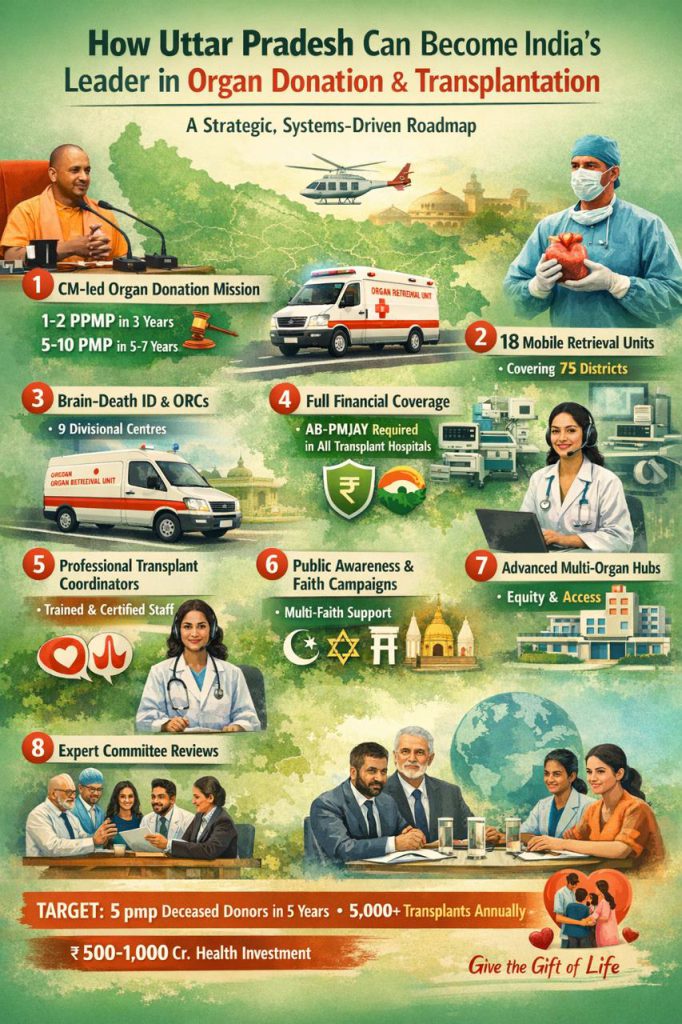
This roadmap—aligned with 2025 NOTTO best practices and Indian public-health realities—lays out a phased, executable pathway for Uttar Pradesh:
• 1–2 PMP within 3 years
• 5–10 PMP within 5–7 years
with a strong focus on equity, transparency, affordability, and public trust.
- Elevate Deceased Organ Donation into a Public Health Mission
Organ donation must be treated as a core public-health responsibility, not an optional awareness activity.
Action Steps
• Launch a Chief Minister–led Uttar Pradesh Organ Donation Mission with clearly defined annual targets.
• Establish Key Performance Indicators (KPIs) such as:
• Brain-death declarations per 1,000 ICU deaths
• Consent conversion rates
• Organs retrieved and transplants performed (district-wise)
• Publish monthly public dashboards integrated with NOTTO/SOTTO platforms.
• Link district health reviews, incentives, and performance appraisals to organ donation outcomes.
• Institute state recognition and awards aligned with Indian Organ Donation Day.
Why it matters
States that institutionalised organ donation as a government mission today accounts for over 70% of India’s deceased organ donations.
- Build a Statewide Brain-Death Identification & Retrieval Network
An estimated 70–80% of potential deceased donors are missed due to delayed brain-death identification and lack of retrieval infrastructure.
Action Steps
• Enforce mandatory brain-death declaration protocols across:
• All government medical colleges
• District hospitals
• Major private ICUs
• Conduct six-monthly audits aligned with NOTTO guidelines.
• Establish permanent Organ Retrieval Centres (ORCs) at all 18 divisional headquarters, ensuring <200 km coverage.
• Fund 24×7 trained retrieval teams, including neurosurgeons, anaesthetists, perfusionists, and coordinators.
• Standardise green corridors, air-ambulance tie-ups, and tele-ICU certification support for underserved districts.
2A. Deploy Mobile Organ Retrieval Vehicles (Interim Capacity Bridging)
Until each district has a permanent Organ Retrieval Centre, Uttar Pradesh must deploy mobile retrieval capacity to prevent organ loss due to distance and time constraints.
Action Steps
• The UP Government shall deploy Mobile Organ Retrieval Vehicles (MORVs) across all 18 Administrative Divisions
(Total: 18 Mobile Units) to cover all 75 districts.
• These mobile units shall function as temporary retrieval centres, equipped with:
• Sterile surgical retrieval infrastructure
• Organ preservation and cold storage facilities
• Rapid transport and communication systems
• Each MORV shall be formally attached to a licensed transplant hospital authorised to carry out organ retrieval and/or transplantation.
• MORVs shall operate 24×7, coordinated through SOTTO, until every district has at least one functional ORC.
Rationale
Mobile retrieval units are essential for large states like UP and ensure rural and semi-urban equity during infrastructure scale-up.
- Professionalise Transplant Coordination – Building the Backbone
Transplant coordinators are the single most important determinant of consent, yet remain under-resourced.
Action Steps
• Appoint full-time, salaried transplant coordinators in all licensed hospitals
(Benchmark: 1 coordinator per 50 ICU beds).
• Establish a State Organ Donation Training Academy, aligned with NOTTO certification.
• Provide legal protection and operational authority to coordinators to initiate donation protocols without delay.
• Mandate refresher training every two years.
Evidence
Professionally trained coordinators consistently double consent rates—from ~30% to 60% or more.
- Transform Public Mindset: From Myths to Moral Leadership
Reluctance to donate is driven more by misinformation and family uncertainty than religion. Surveys suggest ~28% of people in UP are unwilling, despite high latent support.
Action Steps
• Secure multi-faith endorsements through joint declarations by Hindu, Muslim, Sikh, Christian, Jain, and other leaders.
• Institutionalise Annual Donor Family Honour Ceremonies at district and state levels.
• Integrate organ donation education into:
• School curricula
• NSS/NCC
• Panchayats and SHGs
• Deploy targeted Behaviour Change Communication (BCC) campaigns in low-consent districts.
• Promote women-led and youth-led advocacy, recognising higher willingness among women for posthumous donation.
- Scale Transplant Capacity with Equity at the Core
Currently, less than 10% of UP’s transplant demand is met, with services concentrated in a few urban centres.
Action Steps
• Upgrade 6–8 government medical colleges into multi-organ transplant hubs (kidney, liver, heart, lung).
• Prioritise Eastern and North-Eastern UP to reduce regional imbalance.
• Develop PPP models with strict cost caps and quality audits.
• Ring-fence ICUs, OTs, diagnostics, and immunosuppressants under Ayushman Bharat (AB-PMJAY).
5A. Mandatory Acceptance of Government Financial Schemes
To ensure fairness and public trust:
Action Steps
• All licensed transplant hospitals in Uttar Pradesh must mandatorily accept AB-PMJAY in full for organ transplantation.
• Hospitals must also accept any new financial schemes introduced by:
• Government of India
• Government of Uttar Pradesh
• Non-compliance shall attract:
• Financial penalties
• Audit action
• Suspension or non-renewal of transplant licences
Principle
Organs from deceased donors are a public resource and must never be restricted by the ability to pay.
- Ensure Ethics, Transparency, and Trust
Action Steps
• Mandate digital organ allocation and traceability through NOTTO/SOTTO.
• Conduct bi-annual independent audits of all transplant centres.
• Explore ethically designed consent optimisation models, with strong legal safeguards and family-centric approaches.
- Leverage Technology, Data, and Rapid Response
Action Steps
• Implement ICU-to-SOTTO real-time alerts through secure mobile platforms.
• Use AI-enabled logistics to reduce transport times by 30%.
• Deploy tele-ICU services for district hospitals.
• Create a statewide digital donor pledge registry.
- Empower Citizens and Civil Society
Action Steps
• Promote family discussions and donor pledges through apps and community platforms.
• Engage Rotary, youth organisations, survivor networks, and NGOs for outreach and social audits.
• Establish district-level citizen monitoring committees.
- Constitute a High-Level Expert Committee
Action Steps
• Establish an Expert Committee under the leadership of the Chief Minister or Health Minister.
• Members to include:
• Transplant surgeons
• ICU specialists
• Public-health experts
• Legal and ethics experts
• Civil society representatives
• The committee shall:
• Study best practices within India and internationally
• Recommend annual policy, legal, and operational reforms
• Submit time-bound reports to the State Government
Leadership Benchmarks for Uttar Pradesh
With committed execution:
• 5 PMP deceased donors within 5 years, scaling beyond 10 PMP
• 5,000+ additional transplants annually
• A nationally replicable model, as Tamil Nadu once demonstrated
Estimated investment: ₹500–1,000 crore over 5 years
Return: One of the highest public-health ROIs in India
Conclusion: From Potential to Proven Leadership
Uttar Pradesh can redefine India’s organ donation future by treating it as a moral, medical, and administrative imperative. Through bold political leadership, system-ready hospitals, informed communities, and empowered citizens, every ICU tragedy can become a life-saving legacy.
Start with pilots in 2–3 districts. Scale statewide by 2028. Let Uttar Pradesh lead India.


