
KERALA’S 10-MONTH-OLD BABY ALIN’S ACCIDENTAL DEATH: |
A WARNING TO SOCIETY AND A CALL FOR A SAFER FUTURE
By Rotarian Lal Goel | Founder & Charter President | Rotary Club of Organ Donation International | Chairman: Organ Donation India Foundation & GYAN
The Tragedy That Shook a Nation
The recent accidental death of 10-month-old Baby Alin from Kerala has sent a wave of grief and introspection across India. While the nation has united in profound praise for the parents’ selfless decision to donate their infant’s organs — a noble and life-giving act — this tragedy demands that we also pause and ask a harder question: Could this death have been prevented?
The answer, according to the law of the land and the evidence of road safety science, is an unambiguous yes. Baby Alin did not have to die. And therein lies the urgent warning this tragedy holds for every family in India.

The Law That Was Ignored
Section 194B(2) of the Motor Vehicles Act mandates the use of child restraint systems — commonly known as car seats — for young children travelling in motor vehicles. This is not a suggestion. It is a legal obligation, enacted specifically to prevent fatalities like the one that claimed Baby Alin’s life.
Globally, road traffic injuries are a leading cause of death among children under five. Properly installed child car seats reduce the risk of death in a crash by up to 71% for infants. This is not merely statistics — it is the science of survival. When a vehicle is involved in a collision, an unsecured infant becomes a projectile. No parent’s arms, however strong, can hold a child safely against the physics of a crash.
Baby Alin’s parents, like countless Indian parents, may not have been aware of this law. Or perhaps, like many others, they may have considered it unnecessary for a short trip. This is the cultural blind spot that India must urgently address.
Organ Donation: Noble Act, Difficult Context
As someone deeply involved in organ donation advocacy, I believe organ donation is a noble, life-saving act. But organ donation should never become a consolation prize for preventable negligence. A life saved through donation is sacred — but a life lost due to avoidable carelessness is a societal failure.
The decision of Baby Alin’s parents to donate her organs is, without question, an extraordinary act of compassion. Lives have been saved as a direct result. The nation’s gratitude is appropriate and sincere.
However, praising this act without equally acknowledging the preventable circumstances of the death risks sending a dangerous signal to society. It must be said clearly — not to punish grieving parents already devastated by loss — but as a societal learning: the tragedy began with non-compliance with a law designed to protect children. A society that mourns avoidable child deaths while turning a blind eye to the cause does a disservice to every child yet to be born.
The Larger Issue: Prevention Before Donation
India continues to struggle with compliance with road safety regulations. According to global road safety data, India accounts for one of the highest numbers of road fatalities in the world. Yet child car seat usage in India remains extremely low, enforcement of child restraint laws is weak, public awareness about infant road safety is minimal, and many parents wrongly believe holding a baby in arms is safe.
In contrast, countries like the United Kingdom, Australia, and the United States enforce strict child restraint regulations with heavy penalties and strong public education campaigns. Compliance is high because enforcement is real.
India cannot afford symbolic laws. We need cultural change backed by enforcement.
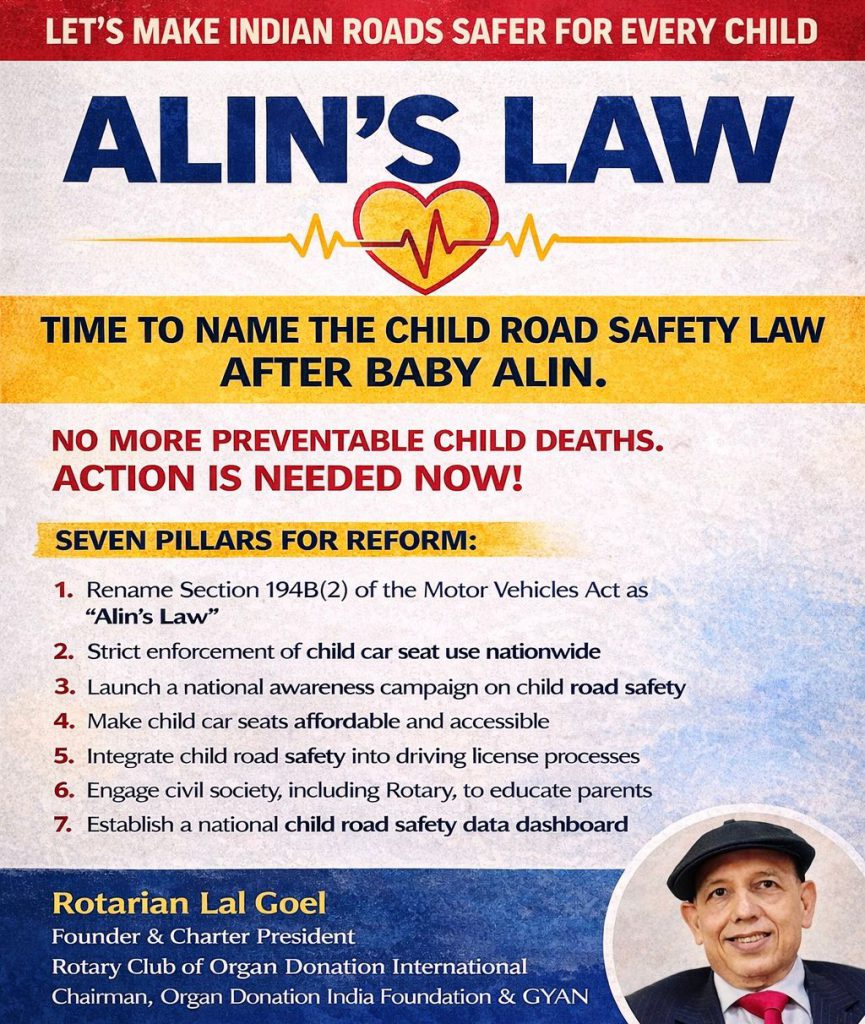
A Roadmap for the Future: Seven Pillars of Child Road Safety
If Baby Alin’s death is to carry meaning beyond grief, it must catalyse systemic change. The following roadmap outlines concrete, actionable steps for government, civil society, and every Indian family.
- Rename Section 194B(2) as “Alin’s Law” — and Enforce It
In the United Kingdom, the landmark organ donation legislation is known as Max and Keira’s Law, named after Keira Ball, a nine-year-old whose organs saved the life of Max Johnson, among others. The law carries their names because their story made it real, gave it a human face, and ensured that the public would remember not merely a legal provision but a child. That is the power of naming a law after those whose lives gave it meaning.
India should do the same. Section 194B(2) of the Motor Vehicles Act — the child restraint law that, had it been followed, might have saved Baby Alin — must be formally designated Alin’s Law. This is not a symbolic gesture alone. It is the most meaningful homage a nation can pay to a child who cannot speak for herself. Every time a traffic officer checks for a car seat, every time a parent reads a road safety notice, every time a hospital hands new parents a safety leaflet, the name Alin should be present. She should be remembered not only as a donor, but as the child whose death became the turning point that made Indian roads safer for every infant who follows her.
The Motor Vehicles Act’s child seat mandate under Alin’s Law must move from paper to practice. Traffic police across India must be trained, equipped, and directed to check for child restraint systems as part of routine enforcement. Fines must be meaningful, consistent, and applied without exception. A law that is not enforced is no law at all — and a law that bears a child’s name carries a moral weight that demands it be taken seriously. - A National Awareness Campaign
The Ministry of Road Transport and Highways, in partnership with state governments, should launch a sustained, multilingual public awareness campaign on child road safety. Hospitals, maternity wards, and paediatricians should be enlisted as frontline educators — informing new parents about car seat requirements before they leave the hospital with their newborn for the very first time. This campaign should carry Baby Alin’s name and story at its heart. - Affordable Access to Child Car Seats
One significant barrier to compliance is the cost of quality child car seats, which can be prohibitive for low- and middle-income families. The government should consider subsidising car seats for economically weaker sections, reducing GST on child safety equipment, and encouraging domestic manufacturing to bring prices down. Safety must not be a privilege of the affluent. - Integration into Driving Licence and Vehicle Registration Processes
Child safety information should be embedded into the process of obtaining a driving licence and registering a vehicle. Every new driver must be tested on child passenger safety laws. Vehicle registration renewal communications should include child safety reminders. These are low-cost, high-impact interventions. - Civil Society and Rotary Engagement
Organisations like Rotary International, with its deep roots in communities across India, have a vital role to play. Rotary clubs can organise free child seat installation clinics, community education drives, and distribute informational materials in local languages. Civil society can bridge the gap between government mandates and ground-level behaviour change. - Media Responsibility
The media, which rightly celebrated the family’s generosity in organ donation, must also fulfil its responsibility to inform. Every report on child road fatalities should mention Alin’s Law and the life-saving statistics that back it up. Journalism that informs is journalism that protects. - A Data-Driven National Child Road Safety Dashboard
India should establish a publicly accessible, state-wise dashboard tracking child road traffic fatalities and injuries, car seat compliance rates, and enforcement statistics. What is measured is managed. Transparency drives accountability, and accountability drives change.
Conclusion: Let Alin’s Life Be a Turning Point
Baby Alin lived for only ten months. In her brief time on earth, she gave life to others through the gifts her parents chose to offer. But civil society owes her something too — the commitment that no other child will needlessly die in a car because parents did not know, or did not comply with, the law.
In Britain, Max and Keira’s Law changed how the nation thinks about organ donation. In India, Alin’s Law must change how a nation protects its children on the road. That is a legacy worthy of her name.
Let us honour Baby Alin not only with tears and praise for her parents’ generosity, but with action. Let every parent who reads this story buckle their child in. Let every government official enforce Alin’s Law. Let every hospital educate new parents in her name. Let every Rotarian spread the word.
A society is measured not by how it mourns its lost children, but by how fiercely it protects the living ones. Baby Alin’s death is a warning. Let us heed it.
— Rotarian Lal Goel


This ia a most pertinent letter that I hve read till now.
The content must be headed by every parent n most importantly by the govt to enforce the recommended law
Kudos to Rtn Lal Goel