
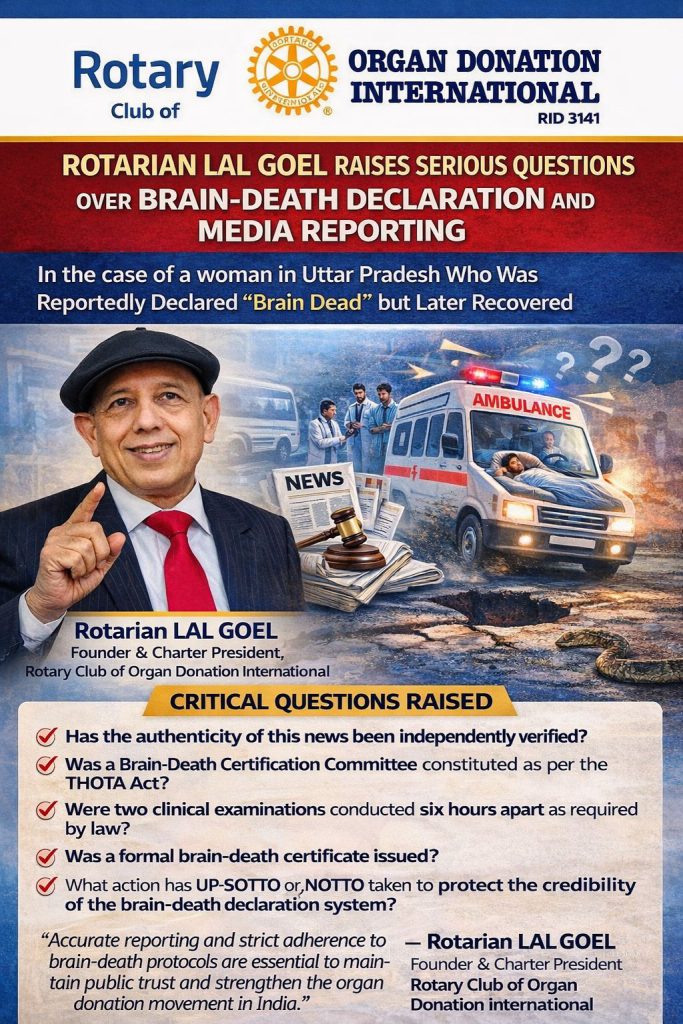
ROTARIAN LAL GOEL RAISES SERIOUS QUESTIONS OVER BRAIN-DEATH DECLARATION AND MEDIA REPORTING
In the Case of a Woman in Uttar Pradesh who was reportedly declared “Brain Dead” but Later Recovered
Background
A recent news story widely circulated across various media platforms has generated significant public discussion. According to the reports, Vinita Shukla, a head copyist at the Pilibhit District Court in Uttar Pradesh, was allegedly declared “brain dead” at a private hospital in Bareilly. While being transported home for the last rites, the ambulance reportedly hit a pothole near Hafizganj, after which she showed signs of movement.
As per the reports, her family noticed the movement following the sudden jolt and immediately rushed her to a hospital in Pilibhit where treatment was initiated. The treating neurosurgeon, Dr Rakesh Singh, reportedly suspected the possibility of a snake bite and administered anti-venom injections along with other treatment. Within about 24 hours, her condition reportedly began to improve, and after nearly 13 days of treatment, she recovered and returned home.
While the family describes the incident as nothing short of a miracle, Rotarian Lal Goel, Founder and Charter President of the Rotary Club of Organ Donation International and a long-time advocate of organ donation awareness, has raised serious concerns regarding the use of the term “brain dead” in media reports and the potential consequences such reporting may have on the organ donation movement in India.
Critical Questions Raised
Rotarian Lal Goel has urged authorities and the media to clarify several important issues before such reports create widespread misunderstanding among the public:
1. Has the authenticity of this news been independently verified? While the name of the treating neurosurgeon Dr Rakesh Singh has been mentioned, the identity of the Bareilly hospital where the patient was allegedly declared brain dead must be clearly confirmed.
2. Was a Brain-Death Certification Committee constituted as required under the Transplantation of Human Organs and Tissues Act (THOTA)?
3. Did the committee conduct the mandatory two clinical examinations with a minimum gap of six hours, as required under the prescribed guidelines?
4. Was a formal brain-death certificate issued after completing these examinations?
5. If the mandatory procedure was not followed, who declared the patient brain dead and under what legal authority?
6. If no official brain-death declaration was made, why did several media organisations repeatedly use the term “brain dead”?
7. Did the media organisations verify the medical facts before publishing the story?
8. What action has been taken by UP-SOTTO (State Organ and Tissue Transplant Organisation) or NOTTO (National Organ and Tissue Transplant Organisation) to investigate the matter and prevent confusion among the public?
Legal Procedure for Declaring Brain Death in India
Under the Transplantation of Human Organs and Tissues Act (THOTA), 1994 (amended in 2011), brain death can only be declared through a strictly defined medical and legal procedure.
A Brain-Death Certification Committee must be constituted comprising:
• The Medical Administrator or Medical Superintendent of the hospital
• The Treating Physician
• A Neurologist or Neurosurgeon (or an approved specialist where such experts are unavailable)
• An Independent Registered Medical Practitioner
The committee must conduct two separate clinical examinations with a minimum interval of six hours to confirm irreversible brain-stem death.
These examinations must establish:
• Absence of brain-stem reflexes
• Absence of spontaneous breathing, confirmed through the apnoea test
• Other neurological assessments confirming irreversible loss of brain function
Only after completing these steps and properly documenting the findings in the prescribed legal format can a person be officially and legally declared brain dead, which in both medical and legal terms is considered death.
Impact on Organ Donation Awareness
Rotarian Lal Goel emphasised that unverified reporting of such incidents can seriously undermine public confidence in the brain-death declaration system, which forms the foundation of deceased organ donation in India.
India already faces a severe shortage of organs for transplantation, with thousands of patients dying every year while waiting for life-saving transplants. One of the most significant challenges in promoting organ donation is public misunderstanding and lack of trust in the brain-death determination process.
“If reports suggest that a person declared brain dead later came back to life, it creates fear and confusion among families and discourages them from consenting to organ donation,”
— Rotarian Lal Goel
Call for Immediate Clarification
Rotarian Lal Goel has urged the concerned authorities, medical institutions, and regulatory bodies to clarify the facts of this case at the earliest.
Accurate reporting by the media and strict adherence to the legal protocol for brain-death declaration are essential to maintaining public trust in the system — a trust that is crucial for strengthening the organ donation movement in India and saving thousands of lives every year.


One thought on “BRAIN-DEATH DECLARATION AND MEDIA REPORTING | Global TV”