
Coffee Festival spotlights roasters, leaves pickers on posters
Written by: Joswin Pereira | School of Communication and Media Studies | St Joseph’s University, Bengaluru
Bengaluru: At the India International Coffee Festival 2026 (IICF) in Bengaluru, roasters, brands and baristas took centre stage in a ‘farm-to-cup’ celebration, while the labourers who pick and process the coffee showed limited presence through posters and video loops.
The festival, which was organised at Chamara Vajra from January 12 to 14, also saw steady footfall across the three days. The event focused on roasters, brands, baristas and industry stakeholders, with discussions centred on cultivation practices, market trends and sustainability, even as the people engaged in harvesting and processing remained at their respective estates. While plantation labour was referenced in discussions on cultivation and the farm-to-cup process, workers themselves did not take part in the panels or presentations held at the event.
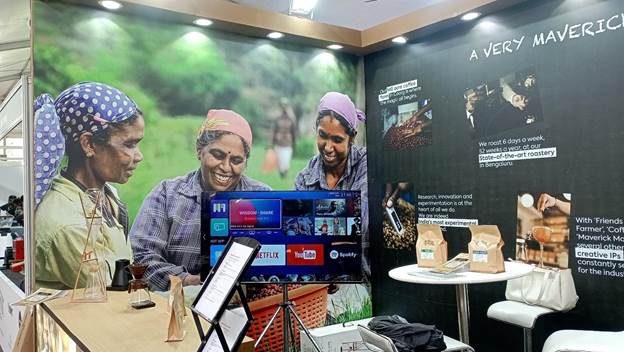
SOURCE- JOSWIN PEREIRA
CAPTION: Stall at the IICF 2026 displays large visuals of plantation workers against a backdrop promoting roasting and innovation at a Bengaluru roastery.
A recent India Today article reported that workers in India’s coffee plantations face conditions that affect their health and financial stability. They are exposed daily to pesticides without adequate protective gear and face long-term risks from chemical residues, along with chronic respiratory problems and skin ailments. During the harvest, they work under scorching sun or relentless rain. Inadequate daily wages push many into debt cycles, with women and migrant labourers particularly affected by long hours, seasonal job insecurity, and limited access to healthcare, housing and social protections.
Karthik Aiyer, a commercial coffee grower from Tamil Nadu, described labourers as the “spine” of plantations and called for spotlighting them at industry festivals. “Good coffee sales stem from good practices, and good practices create good labourers,” he said, adding that when estate owners profit, “naturally it goes to the labourers.”
Thoms Noronha, a grower from Hirebile, spoke about changes in the coffee market, where growers can now cultivate without restrictions. “This has led to workers being hired only during peak seasons,” he said, adding that this inconsistency has resulted in low commitment among labourers who face chronic job insecurity. He noted that due to unemployment, many workers take short-term jobs, moving between estates or migrating to cities. According to him, this affects productivity and makes it difficult for growers to retain skilled workers amid rising global demand.

SOURCE- JOSWIN PEREIRA
CAPTION-A promotional stand at the festival features an image of coffee processing workers.
Healthcare is another concern, said Dr N.K. Pradeep, who runs training programmes for growers and labourers. He attributed low awareness and motivation among workers partly to easy access to cheap alcohol. “Workers are one of the major links in the coffee chain; without them, there will be no plantation,” he said. Pradeep said he advocates for worker-inclusive platforms and trains participants in “scientific knowledge and technology, from soil to cup.”
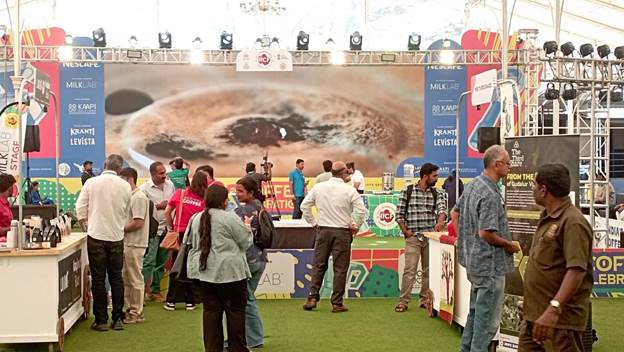
SOURCE- JOSWIN PEREIRA
CAPTION- Visitors gather near the main stage at the India International Coffee Festival 2026 in Bengaluru.
One of the organisers, Srishti Tarakanath, said the event showcases images and videos of coffee pickers and processing workers. “We have all of them, we show how they work and toil on the ground, and their hard work is the fruit we celebrate at this festival today,” she said. She added that the workers continue to remain at plantations and were not present at the Bengaluru venue.
Even as the festival focused on production practices, exports and sustainability including discussions on scientific transformation, residue-free coffee and increasing production, conversations around labour participation were largely reflected through remarks from growers, trainers and organisers.


