
Drawing Eternal Lessons from the Ramayana for a Living Humanitarian Cause | Rotarian Lal Goel
Lord Ram, revered across India and the world as Maryada Purushottam — the ideal upholder of righteousness — is far more than a religious icon. He is the moral soul of a civilisation. His life, as chronicled in the Valmiki Ramayana and lovingly retold by Sant Tulsidas in the Ramcharitmanas, enshrines values that speak directly to the deepest needs of our time: sacrifice, compassion, selfless service, and the sanctity of every human life.
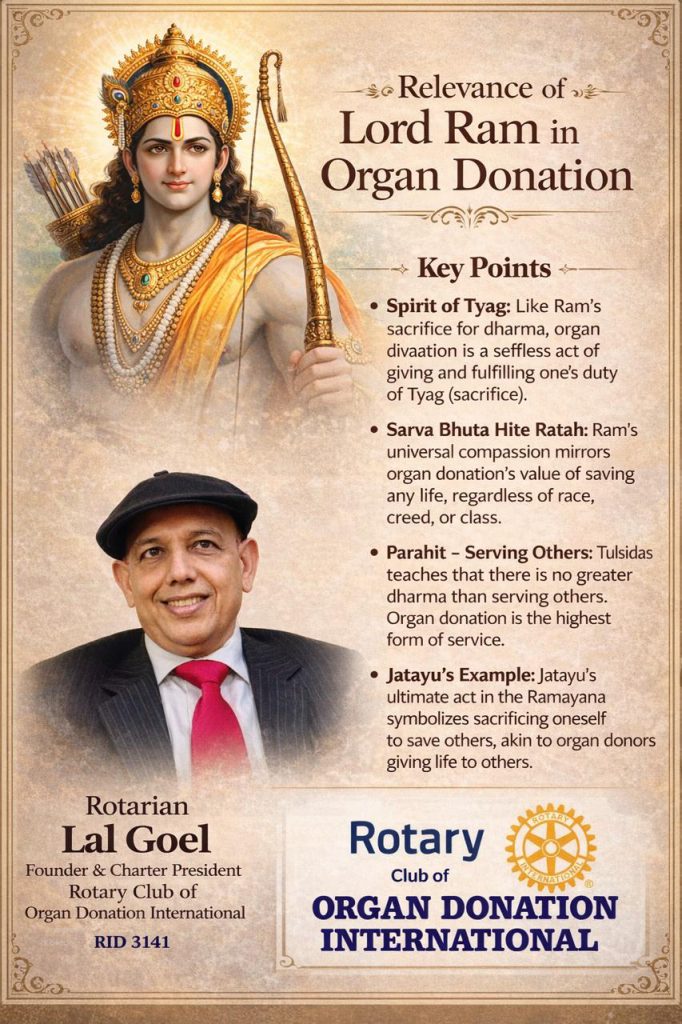
Among the most pressing humanitarian challenges India faces today is the severe shortage of organ donors. Thousands of citizens die each year — not from incurable illness, but simply because a compatible organ did not arrive in time. In a nation whose soul is shaped by the ideals of Ram, it is both fitting and urgent to ask: what does his life teach us about the duty to give, to serve, and to sustain life?
The answer, on reflection, is both clear and profound. Every essential virtue that underlies organ donation — tyag (sacrifice), seva (selfless service), parahit (living for others), and ahimsa (reverence for life) — is lived and demonstrated by Lord Ram. His story is not merely an ancient scripture; it is a living call to compassionate action.
Tyag — The Spirit of Sacrifice
The very first great act of the Ramayana is one of sacrifice. When the young prince Ram is asked to relinquish his throne and accept exile into the forest for fourteen years — to uphold his father’s word — he does so without hesitation, without bitterness, and without seeking recognition. His response, recorded in the Valmiki Ramayana (Ayodhya Kand), is among the most moving utterances in all of Sanskrit literature:
“Pitur vachanam satyam kartum icchami”
(I desire to fulfil my father’s word as truth.)
This single line carries within it the entire philosophy of tyag. Ram did not weigh the cost to himself. He gave up a kingdom — the greatest worldly possession — because someone he loved desired it, and because it was right.
This spirit is precisely what organ donation calls upon us to embody. Most organs are pledged in advance, when a person decides that after their death, their organs may give life to another. It is a decision made not in a moment of grief but in a moment of clarity — a conscious act of tyag, of releasing attachment to one’s own body for the benefit of a stranger. Just as Lord Ram honoured the wishes of his father, we too are called to honour the wishes of our near & dear person who pledged to donate organs — the wish to gift life.
Organ donation, viewed through this lens, is not a medical transaction. It is an act of sacred sacrifice in the finest tradition of Lord Ram himself.
Universal Compassion — Sarva Bhuta Hite Ratah
Lord Ram’s compassion knew no borders. He embraced Shabari, a tribal woman of humble station, with the warmth of a son. He honoured Nishadraj, the boatman, as a friend. He wept for Jatayu, an animal, as he would for a father. His world-view was captured in one enduring ideal:
“Sarva bhuta hite ratah”
(One who is engaged in the welfare of all living beings.)
Ram made no distinction between whose life was worth saving. He served and protected all, regardless of caste, kind, or circumstance.
Organ donation carries forward exactly this principle. A transplanted kidney does not know the religion of its recipient. A donated cornea does not distinguish between rich and poor. The gift of an organ is, in the most literal sense, universal compassion made physical. It crosses every boundary that ordinarily divides human beings and asks only one question: Is there a life that can be saved?
To pledge one’s organs is to embody the spirit of Sarva Bhuta Hite Ratah — to declare that one’s final act will be in service of all beings, without exception.
Parahit — The Highest Dharma
Sant Tulsidas, in his beloved Ramcharitmanas, distils the moral teaching of the Ramayana into two immortal lines that every generation of Indians has grown up hearing:
“Parahit saris dharma nahi bhai, Par peeda sam nahi adhamai.”
(There is no dharma equal to serving others; there is no sin equal to causing them suffering.)
These lines do not merely encourage generosity. They make service to others the highest possible expression of a virtuous life. Conversely, they identify indifference to the suffering of others as a form of wrongdoing.
Consider the reality of organ shortage in India today. Nearly two lakh patients await a kidney transplant. Thousands more wait for a liver, a heart, or corneas. In most cases, their suffering could be relieved — not by any great act of wealth or power, but simply by a decision made by ordinary citizens to register as organ donors and to inform their families of that wish.
Parahit, in this context, requires no grand gesture. It asks only for a pledge and a conversation. Yet its impact — the life saved, the family spared from grief, the years restored — is immeasurable. Tulsidas’s teaching leaves little room for hesitation: to donate is dharma; to withhold when one can give is its opposite.
Jatayu — The Symbolism of the Final Gift
Among the most luminous and emotionally resonant episodes of the Ramayana is the sacrifice of Jatayu in the Aranya Kand. The aged eagle-king, upon witnessing Ravana abducting Sita, does not hesitate. He launches himself into battle against a demon far more powerful than himself, fighting until his wings are severed and he falls, mortally wounded, to the earth below.
When Lord Ram discovers the dying Jatayu, he holds him with a tenderness that moves readers across centuries. With his last breath, Jatayu tells Ram the direction Sita was taken — his final act a gift to the one he loved. Ram weeps for him, and performs his last rites as a devoted son would for a father.
In Jatayu, we see the complete philosophy of organ donation: the willingness to give everything, including one’s own body, for the welfare of another. The pledge of organ donation is, in a sense, each person’s opportunity to be Jatayu — to ensure that even in death, one’s final act is one of love and service, giving life and hope to those left behind.
Ram Rajya — A Society That Cares for Every Life
The vision of Ram Rajya — the ideal society that Lord Ram governed — was one in which no subject suffered needlessly, where justice was universal, and where the happiness of the people was the highest duty of all. It was a society defined not by its monuments, but by its compassion. This ideal is captured in a principle that Lord Ram himself embodied:
“Praja sukhe sukham rajnaha”
(The happiness of the ruler lies in the happiness of the people.)
In today’s India, the responsibility for Ram Rajya does not rest with rulers alone. It rests with citizens. A society where thousands die each year awaiting organs that were never pledged is a society that has not yet fulfilled its duty of collective care.
Building a culture of organ donation is, in this sense, nation-building in the spirit of Lord Ram. Every pledge made, every family conversation held, every myth dispelled about donation brings India one step closer to the compassionate society that Ram Rajya represents. This is not merely a medical goal — it is a civilisational one.
Honouring the Wishes of Our Loved Ones
The Ramayana teaches us something else that is quietly powerful: the importance of honouring the wishes of those we love.
Lord Ram’s exile was not his own desire — it was his father’s. Yet he fulfilled it with complete devotion, because he understood that true love sometimes means putting another’s wishes above our own preferences.
This principle is deeply relevant to organ donation in India. Many people register as donors but never inform their families. When they die, families — consumed by grief and unfamiliar with the deceased’s wishes — decline to permit donation. The organs are lost, and lives that could have been saved are not.
The teaching of Ram calls upon us to do both: to pledge our organs, and to speak about that pledge to our families. And it calls upon families, equally, to honour the wishes of a loved one who desired to give — just as Ram honoured his father’s word as sacred.
In organ donation, honouring a loved one’s wish to donate is one of the most profound acts of devotion a family can perform.
Conclusion
The life of Lord Ram is India’s most enduring moral inheritance. Its teachings on sacrifice, compassion, duty, and the welfare of all living beings are not relics of an ancient age — they are answers to the questions our age most urgently asks.
Organ donation is not simply a medical act. In the light of the Ramayana, it is a sacred act of dharma. It is tyag — the willing release of what is most personal for the benefit of another. It is parahit — the fulfilment of the highest religious duty. It is the spirit of Jatayu — giving life, even in the final moment. And it is the foundation of Ram Rajya — a society where no life is lost for lack of a gift that was within our power to give.
India has the spiritual vocabulary, the cultural values, and the moral tradition to lead the world in the culture of organ donation. The life of Lord Ram shows us the way. It remains only for us to follow it.
Let us not only worship Lord Ram — let us walk his path.
Pledge your organs. Give the gift of life.


