
Rotarian Lal Goel | Founder & Charter President | Rotary Club of Organ Donation International |
Chairman | Organ Donation India Foundation & GYAN
NV Paulose, Chairman, Global TV +91 98441 82044
India continues to face a profound and preventable organ shortage crisis, despite notable progress in recent years. In 2024, the country achieved a record 18,900+ organ transplants, ranking third globally after the United States and China. Yet this achievement masks a grim truth: demand vastly exceeds supply.
Annually, nearly 2.5 lakh patients require kidneys, 80,000 need livers, 50,000 need hearts, and 1 lakh need corneas. Waiting lists remain fragmented and opaque, with kidney registries alone numbering over 1.75 lakh. Thousands die each year while waiting—not due to lack of medical capability, but due to systemic failures.
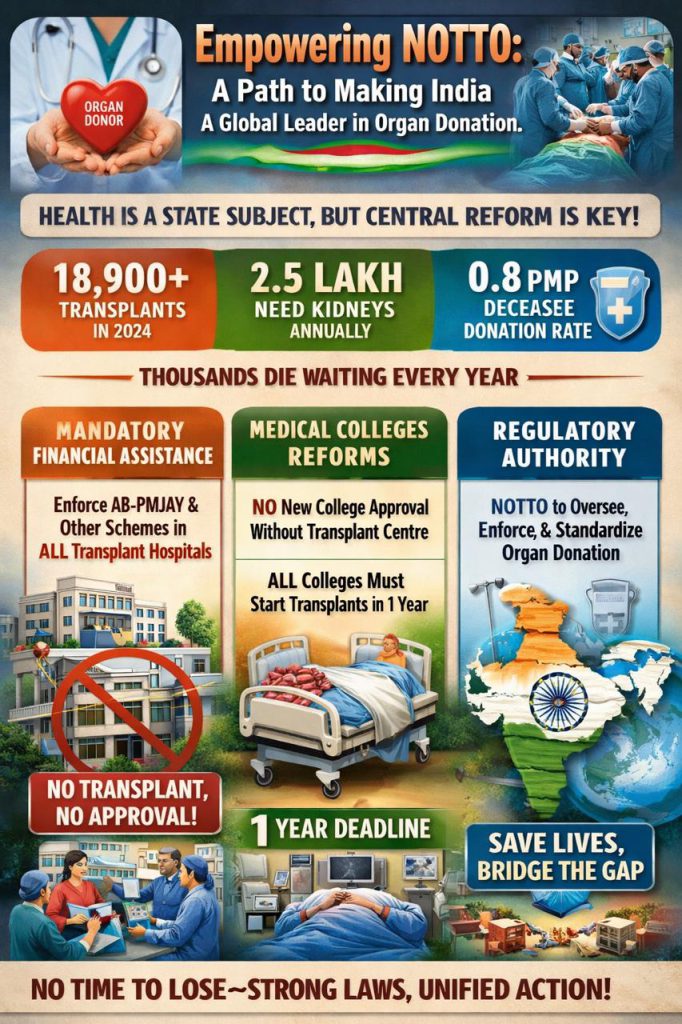
India’s deceased organ donation rate stands at just ~0.8–0.81 per million population (pmp). While an improvement, it remains far below global benchmarks such as Spain (~52.6 pmp) and the United States (~48 pmp).
At the centre of India’s transplant framework is the National Organ and Tissue Transplant Organisation (NOTTO), established under THOTA in 2014. NOTTO has improved coordination, registries, and awareness, including 3.3 lakh+ Aadhaar-linked pledges. However, it lacks statutory authority, enforcement powers, and financial autonomy—severely limiting its impact.
Health Is a State Subject — But the Centre Must Drive Reform
While health is constitutionally a State subject, organ donation and transplantation demand strong central leadership. Only the Central Government can ensure uniformity, accountability, and enforceability across states.
Therefore, Parliament must amend THOTA to empower NOTTO with statutory authority, enabling it to:
• Issue binding national regulations
• Mandate compliance across states and institutions
• Enforce penalties for violations
• Ensure equity and transparency in allocation
Without such central legal reform, disparities between states will persist, and lives will continue to be lost due to administrative paralysis.
Why NOTTO Must Be Strengthened as a National Regulator
- Regulatory Authority with Enforcement Powers
Like the Securities and Exchange Board of India (SEBI) and the Election Commission of India (ECI), NOTTO must regulate:
• Hospitals and transplant centres
• Surgeons and transplant teams
• Organ retrieval and allocation networks
This includes licensing, inspections, accreditation, suspension, and de-recognition for non-compliance.
- Mandatory Implementation of Financial Assistance Schemes
NOTTO must be legally empowered to ensure compulsory implementation of all government financial assistance schemes, including Ayushman Bharat – PMJAY, across all transplant hospitals—public and private.
No transplant centre should be allowed to:
• Refuse AB-PMJAY patients
• Cherry-pick only paying recipients
• Create financial barriers for the poor
Organ transplantation is a public health service, not a luxury commodity.
Medical Colleges: The Missing Backbone of Deceased Donation
No Approval Without Transplant Capability
• No new medical college—government or private—should receive approval from regulatory authorities unless it is established as an organ transplant centre with:
• Brain death certification capability
• ICU donor management protocols
• Organ retrieval infrastructure
Teaching hospitals must be leaders in donations, not passive observers.
One-Year Deadline for Existing Medical Colleges
• All existing medical colleges, both government and private, must be mandated to initiate organ transplant programs within one year, beginning at least with:
• Kidney & Liver transplantation
• Brain death identification and donor referral
Failure to comply should invite:
• Withdrawal of recognition
• Reduction of postgraduate seats
• Financial penalties
India cannot afford medical colleges that train doctors but fail to save lives through organ donation.
Expanded Powers and Functions of NOTTO
• Legal & Quasi-Judicial Authority: Investigate complaints, adjudicate allocation disputes, impose fines, and recommend prosecution.
• Direct Oversight: National registry of centres and surgeons; mandatory audits for poor donor conversion or utilisation rates.
• Public Awareness Mandate: Sustained, well-funded national campaigns—on the scale of voter awareness drives.
• Real-Time Transparency: Legally mandated live data on waiting lists, transplants, donor conversion, and organ utilisation.
• Interstate Authority: Power to override bureaucratic delays in organ sharing, prioritising medical urgency.
• Research & Innovation: Funding for organ preservation, immunology, logistics, and emerging technologies.
A Realistic National Target
With decisive reform:
• 5 pmp within 5 years is achievable
• 10–15 pmp within a decade is realistic
This would mean tens of thousands of additional lives saved annually, reduced black-market risks, and global leadership in ethical transplantation.
The Cost of Inaction
Concerns about regulatory overreach can be addressed through parliamentary oversight, transparent reporting, and independent audits. The real danger lies in inertia.
Every year of delay means:
• Preventable deaths
• Families destroyed
• Public trust eroded
Empowering NOTTO is not administrative reform—it is a moral, medical, and constitutional responsibility.
India has doctors.
India has hospitals.
India has science.
What we lack is decisive governance.
The question is no longer whether India can lead the world in organ donation—
It is whether we choose to.


