
Is India’s Organ Donation Policy Shift Good Enough?
India has reached a historic milestone in organ transplantation. In 2024, the country performed approximately 18,900 organ transplants—the highest ever recorded. Yet beneath this achievement lies a stark reality: India continues to face one of the world’s most severe organ shortages.

An estimated five lakh (500,000) patients require organ transplants annually, but only a fraction receive them. More concerning is the foundation of the system itself—India’s deceased organ donation rate remains below 1 per million population (pmp).
In contrast:
• Spain records approximately 52.6 deceased donors per million population (2024)—the highest in the world.
• The United States records approximately 48 deceased donors per million population (latest reported data).
For a nation of over 1.4 billion people, this gap is not merely statistical—it is systemic.
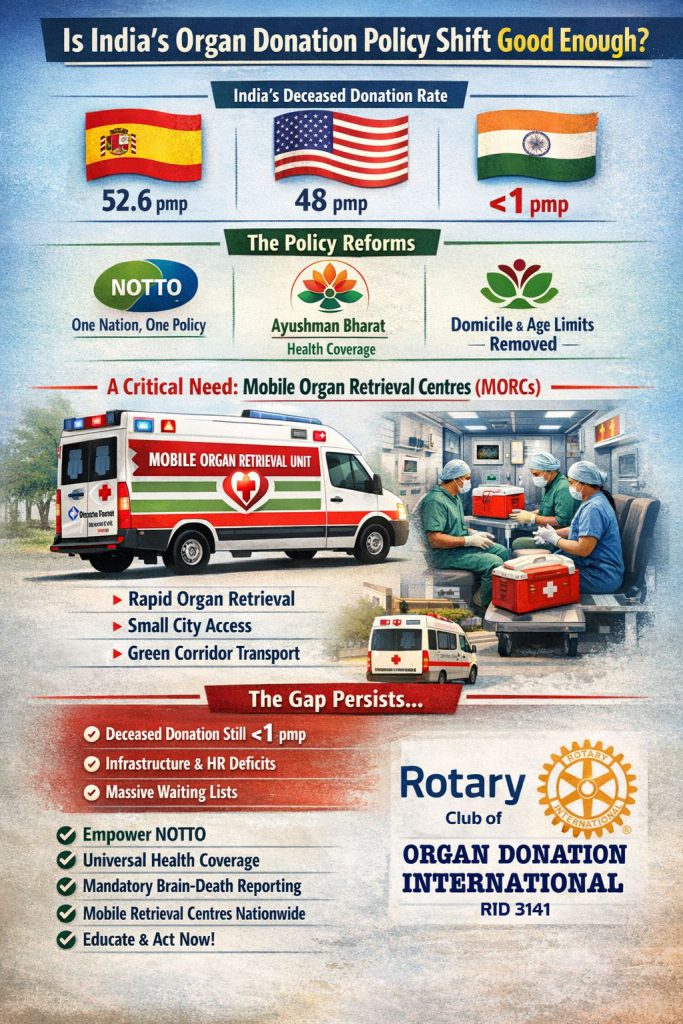
The Recent Policy Shift
Since 2023, the Government of India has initiated significant reforms under a “One Nation, One Policy” approach, anchored by the National Organ and Tissue Transplant Organisation (NOTTO).
1️⃣ Removing Access Barriers (2023)
• The upper age limit of 65 years for waitlist registration was removed.
• The domicile requirement was abolished, allowing patients to register in any state.
• Registration on the national waitlist was made free.
These were long-overdue measures that reduce interstate disparities.
2️⃣ Equity-Based Allocation (2025 Advisory)
NOTTO issued a 10-point advisory providing:
• Additional priority to women recipients.
• Preference to immediate relatives of deceased donors.
This addresses long-standing gender imbalance and incentivises family consent.
3️⃣ Digital and Financial Enablers
• Aadhaar-linked online pledge registration has crossed 3.3 lakh pledges.
• Financial assistance under Ayushman Bharat supports eligible transplant patients.
• Efforts are underway to strengthen real-time registries and organ transport protocols.
These reforms build upon the Transplantation of Human Organs Act and the NOTTO–ROTTO–SOTTO framework established in 2014.
Progress: What Is Working
• Transplants have risen from fewer than 5,000 in 2013 to nearly 19,000 in 2024.
• Deceased donors crossed 1,100 in 2024.
• States like Telangana, Tamil Nadu, Karnataka, and Gujarat demonstrate that structured programmes improve outcomes.
These gains are meaningful—but not transformative.
The Persistent Structural Gaps
1️⃣ Deceased Donation Remains Critically Low
India remains overwhelmingly dependent on living donors.
While Spain stands at 52.6 pmp and the United States at 48 pmp, India remains below 1 pmp due to:
• Inconsistent state implementation
• Legal ambiguity around brainstem death
• Fear of medico-legal consequences
• Absence of national Donation after Circulatory Death (DCD) protocols
• Limited expanded-criteria donor use
Without mandatory reporting and legal clarity, deceased donation cannot scale.
2️⃣ Infrastructure and Human Resource Deficits
Many registered transplant centres remain inactive. Public hospitals lag behind private institutions. Chronic shortages include:
• Trained transplant coordinators
• ICU beds for donor maintenance
• Retrieval and transport logistics
• Real-time digital allocation systems
Announcements alone cannot fix underfunded systems.
3️⃣ Mobile Organ Retrieval Centres: A Critical Missing Link
One transformative reform India urgently needs is the establishment of Mobile Organ Retrieval Centres (MORCs).
Why Mobile Retrieval Centres Matter
India’s geography is vast. Many potential donors are located in tier-2 and tier-3 cities where:
• Transplant teams are unavailable
• Brain-death declaration is delayed
• Organs are lost due to logistical constraints
Mobile Organ Retrieval Centres—equipped ambulances with trained surgical retrieval teams and organ preservation equipment—can:
• Travel to non-transplant hospitals
• Perform on-site organ retrieval
• Stabilise and preserve organs
• Coordinate rapid air or road transport
This model reduces organ wastage, decentralises access, and builds confidence among smaller hospitals.
International Inspiration
Spain’s high performance is supported by hospital-based coordinators and rapid retrieval systems. The U.S. model relies on strong Organ Procurement Organisations with structured transport networks.
India must adapt these principles to its scale through:
• Nationally funded Mobile Retrieval Units
• Regional rapid-response teams
• Dedicated organ air corridors
• Real-time GPS-linked tracking systems
Without mobile infrastructure, policy reform will not translate into higher deceased donation rates.
Massive Unmet Need
Kidney transplants number around 13,000–14,000 annually, yet waiting lists run into lakhs. Waiting periods stretch 3–5 years. Thousands die while waiting.
Rural and economically weaker patients face barriers of affordability and awareness. Myths, religious misconceptions, and fear continue to influence family consent.
The International Comparison
Spain’s leadership—52.6 pmp—was built through:
• Mandatory brain-death reporting
• Hospital-based transplant coordinators
• Continuous professional training
• Cultural normalisation of donation
• Presumed consent
The United States, at 48 pmp, benefits from strong Organ Procurement Organisations and structured national reporting.
India’s reforms remain largely procedural rather than systemic.
The Verdict: Progress, But Not Enough
The 2023–2025 reforms deserve recognition. They have:
• Increased transplant numbers
• Reduced bureaucratic barriers
• Promoted equity
• Improved digital registration
However, they do not yet address the structural core of the crisis.
The Road Ahead: From Reform to Transformation
1️⃣ Universal Financial Protection
• The AB-PMJAY scheme must be mandatory for all transplant-performing hospitals.
• Insurance companies must comprehensively cover organ transplantation without increasing premiums.
Financial fear must never prevent a transplant.
2️⃣ Empower NOTTO with Statutory Authority
NOTTO should be granted stronger binding powers for:
• Mandatory reporting
• Audit control
• Enforcement capability
Organ allocation must be insulated from politics and delay.
3️⃣ Mandatory Brain-Death Reporting
• Compulsory declaration in every ICU
• Regulatory action for non-reporting
• Uniform national protocols
4️⃣ Education Reform
• From 5th standard onwards, organs, tissues, brain death, and organ donation must be part of the curriculum.
5️⃣ Responsible Public Discourse
Deliberate misinformation that discourages organ donation should invite accountability under appropriate legal provisions.
6️⃣ Media as a Public Health Partner
Sustained organ donation messaging—not seasonal campaigns—is essential.
7️⃣ Structural Reforms Still Needed
• Harmonised legal definitions of death
• Mandatory brain-death audits
• National DCD protocols
• Public ICU investment
• Transparent allocation systems
• Performance-linked funding
• National rollout of Mobile Organ Retrieval Centres
Conclusion
India has the population base, clinical expertise, and technological capacity to become a global leader in organ donation.
What is missing is decisive systemic execution.
With Spain at 52.6 pmp, the United States at 48 pmp, and India still below 1 pmp, incremental reform is not enough.
We need stronger laws.
We need empowered institutions.
We need compulsory reporting.
We need universal financial protection.
We need a mobile retrieval infrastructure.
We need education from childhood.
We need a media partnership.
And above all, we need citizens to step forward.
Until structural reform matches policy ambition, thousands of preventable deaths will continue.
And that is a gap no nation of 1.4 billion should accept.


