
The Universe
By Dr. Devan
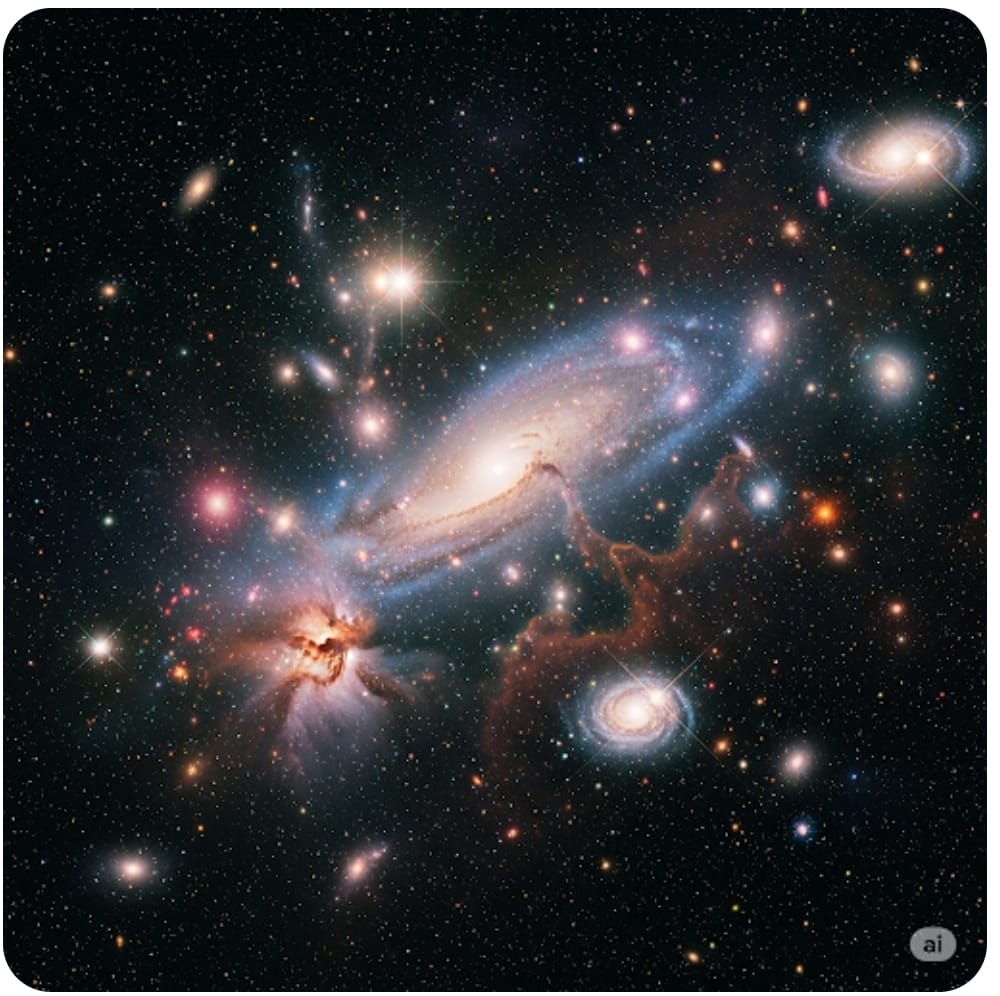
Introduction: The Greatest Mystery
The universe is the grandest and most awe-inspiring mystery known to humanity. It stretches beyond comprehension, in size, time, and complexity. It is everything—space, time, matter, energy, galaxies, stars, planets, black holes, dark matter, and even the thoughts you are having right now. To speak of the universe is to contemplate not only the vastness of creation but our tiny, flickering role within it.
- What Is the Universe?
The universe is the totality of existence. It includes:
All matter: from the tiniest subatomic particles to the largest galaxy clusters.
All energy: kinetic, potential, electromagnetic, gravitational, and more.
All of space and time: known collectively as the spacetime continuum.
All physical laws: which seem finely tuned to allow life and order to emerge.
The universe is not just a collection of objects—it is a grand system, structured and governed by deep natural laws, yet wrapped in immense mystery.
- The Origin: The Big Bang
Scientific consensus suggests the universe began approximately 13.8 billion years ago with a massive event known as the Big Bang. This was not an explosion in space but an expansion of space itself from an infinitely dense point called a singularity.
From that moment onward:
Space began to stretch.
Time began to tick.
Energy and matter began to differentiate.
In the first few minutes, light elements like hydrogen and helium formed. Hundreds of millions of years later, gravity coalesced these elements into stars and galaxies—the first structures of cosmic order.
- The Scale of the Universe
The size of the observable universe is about 93 billion light-years in diameter, but this may be only a fraction of its actual size. Consider:
A single light-year is 9.46 trillion kilometers.
Our galaxy, the Milky Way, contains 100–400 billion stars.
There are likely over 2 trillion galaxies in the observable universe.
And still, this observable portion may be less than 1% of the full universe, especially if it is infinite or wraps around itself in a higher-dimensional shape.
- The Fabric: Space and Time
Einstein revolutionized our understanding of the universe with his theories of relativity:
Special Relativity: Space and time are interconnected; the faster you move, the slower your time flows relative to others.
General Relativity: Massive objects bend space and time around them, creating what we perceive as gravity.
This concept of spacetime shows that the universe is not a stage on which things happen; it is the stage itself, dynamic and influenced by every mass and force within it.
- Cosmic Structures and Phenomena
a. Stars and Galaxies
Stars are nuclear furnaces that fuse hydrogen into helium, releasing energy. Galaxies are massive collections of stars, dust, and dark matter held together by gravity.
b. Black Holes
When massive stars die, they can collapse into black holes—regions where gravity is so intense that not even light can escape. At their core lies a singularity, and around them forms the event horizon, the point of no return.
c. Dark Matter and Dark Energy
Dark Matter: Invisible mass that doesn’t emit light but has gravity. It holds galaxies together.
Dark Energy: A mysterious force driving the accelerated expansion of the universe.
Combined, these two account for 95% of the universe’s content, leaving only 5% as ordinary matter—the stuff we’re made of.
- The Fine-Tuned Universe
The laws and constants of the universe—gravity, electromagnetism, the speed of light—are so finely balanced that a slight variation in any of them would make life impossible.
This has led to philosophical questions:
Is this the only universe?
Are we in a multiverse, where countless universes exist with different laws?
Was the universe designed, or did we emerge by chance in a rare habitable bubble?
These questions bridge science, philosophy, and spirituality.
- Life in the Universe
We live on a Goldilocks planet—not too hot, not too cold, just right for life. Earth may be unique, but the odds suggest otherwise:
There are likely billions of Earth-like planets in our galaxy alone.
Some of them may host intelligent life, microbial life, or civilizations far older than ours.
The Fermi Paradox asks: If intelligent life is likely, why haven’t we found it?
Possible answers range from:
They’re avoiding us,
We’re looking in the wrong way,
Civilizations may destroy themselves before mastering interstellar travel.
- The End of the Universe
How will it all end? Theories include:
Heat Death: Expansion continues, stars burn out, and the universe becomes cold and dark.
Big Crunch: Expansion reverses, the universe collapses back into a singularity.
Big Rip: Expansion accelerates infinitely until galaxies, stars, atoms—and even space—are torn apart.
Each theory reveals that everything we know is temporary, and yet this impermanence deepens the meaning of the present.
- The Human Perspective
As humans, we are made of star dust—literally. The elements in our bodies were forged in ancient stars that exploded billions of years ago.
We are not separate from the universe. We are the universe becoming aware of itself.
This sense of cosmic connectedness has been expressed in:
Science: Through equations and telescopes.
Philosophy: Through existential contemplation.
Religion: Through a sense of divinity and purpose.
Art and poetry: Through beauty and metaphor.
- The Spiritual Dimension
Many spiritual traditions teach that the universe is not just a physical entity but a living consciousness. The Vedas speak of Brahman—the unchanging, infinite reality behind all forms. Taoism speaks of the Tao, the way of the universe.
Modern quantum physics even hints that consciousness may play a role in shaping reality. The observer affects the observed; particles behave differently when watched.
Could it be that mind and matter are two sides of the same coin? That the universe is not a dead machine but an alive mystery?
Conclusion: Awe and Responsibility
In contemplating the universe, one emotion overwhelms all others: awe.
We are tiny, but not insignificant. We are momentary, but meaningful. The universe has created within itself a creature capable of asking questions, imagining galaxies, feeling love, and creating beauty.
With this awareness comes responsibility.
To protect our only known home—Earth.
To live humbly in the face of grandeur.
To continue exploring, questioning, and learning.
To treat others as fellow travelers in this mysterious cosmic journey.
The universe is not just out there in the sky. It is also within us, around us, and perhaps… is us.
Let us be worthy of it.
“You are not a drop in the ocean. You are the entire ocean in a drop.”
— Rumi


