
Guru Gobind Singh Ji’s Teachings and the Organ Donation | Rotarian Lal Goel | Founder & Charter President | Rotary Club of Organ Donation International | Chairman, Organ Donation India Foundation & GYAN
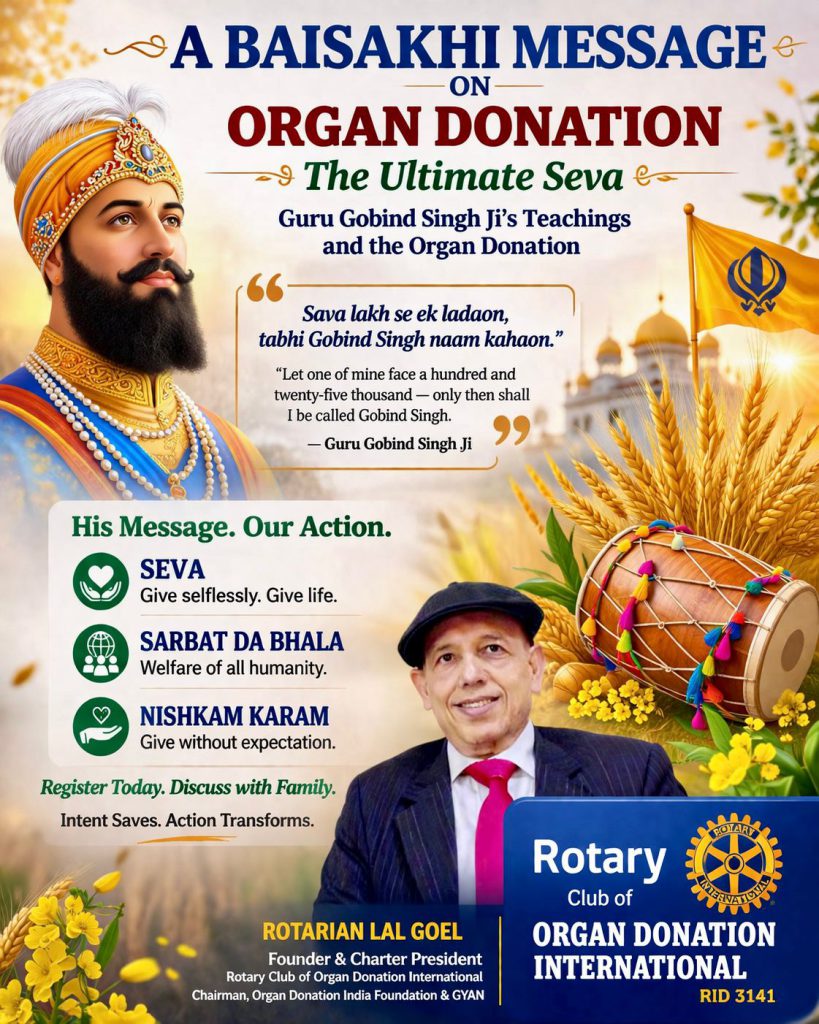
The Ultimate Seva
“Sava lakh se ek ladaon, tabhi Gobind Singh naam kahaon.”
“Let one of mine face a hundred and twenty-five thousand — only then shall I be called Gobind Singh.” – Guru Gobind Singh Ji
A Sacred Reflection on Sacrifice and Service
There are moments in history when one life, freely given, changes the destiny of millions. Guru Gobind Singh Ji—warrior, poet, philosopher, and the tenth Guru of the Sikh faith—lived entirely in such moments. His father, Guru Tegh Bahadur Ji, gave his life for the religious freedom of others. His four sons, the Chaar Sahibzaade, embraced martyrdom rather than compromise their truth.
And the Guru himself showed humanity what it means to live—and give—with total courage and unconditional love.
We may no longer stand on the battlefields of Anandpur Sahib or Chamkaur, but the crisis before us is no less urgent.
In India, over 5 lakh people are waiting for organ transplants, yet only around 4% transplants took place last year. This massive gap continues to grow—silently costing thousands of lives annually.
Despite a culture rooted in sacrifice and compassion, India continues to lag far behind many nations in deceased organ donation. The gap is not of values—but of awareness, infrastructure, timely consent, and decisive action.
Guru Gobind Singh Ji’s teachings speak directly to this moment.
I. Seva — The Highest Form of Giving
At the heart of the Guru’s philosophy lies Seva—selfless service without expectation.
“Deh Shiva bar mohe ihe, shubh karman te kabhun na tarun.”
“O God, grant me this boon — that I may never shy away from righteous deeds.” — Guru Gobind Singh Ji
The Guru did not define Seva as convenience. He defined it as the courage to place another’s need above one’s own comfort—even above one’s own life.
When a grieving family consents to donate the organs of their loved one, they perform Seva in its most transcendent form. Through pain and loss, they choose to give life to others.
The langar does not stop in sorrow. True Seva does not pause in grief. This is the spirit of the Khalsa.
II. Sarbat da Bhala — Welfare of All Humanity
Every Sikh prayer ends with:
“Sarbat da Bhala” — may all humanity prosper.
Organ donation is its most powerful modern expression.
- A donated heart does not ask for religion.
- A transplanted cornea does not ask caste.
“Manas ki jaat sabhe eke pehchaanbo.”
“Recognise the whole human race as one.” — Guru Gobind Singh Ji — Akal Ustat
When we pledge our organs, we declare: Humanity is one—and life must be shared.
III. Nishkam Karam — Giving Without Expectation
“Jo toh prem khelan ka chao, sir dhar tali gali meri aao.”
“If you wish to play the game of love, come to me with your head on the palm of your hand.” — Guru Gobind Singh Ji
The Guru lived Nishkam Karam—action without desire for reward.
An organ donor:
- Will never meet the recipient
- Will never hear their gratitude
- Will never see the life they saved
And yet, they give.
This is the highest form of giving—pure, silent, and eternal.
IV. –The Body as a Sacred Trust
Guru Gobind Singh Ji taught that the body is a divine trust, meant to be used in service—not preserved in attachment.
When its purpose is complete, what remains is not what we kept—but what we gave.
If, in leaving this world, our body can: - Restore sight
- Restart a heart
- Give breath to another
Then it has fulfilled its highest purpose. It becomes a Langar of Life.
V. The Sacrifice of the Chaar Sahibzaade — A Living Legacy
The martyrdom of the Guru’s four sons teaches us:
“Chaar muye to kya hua, jeevat kayi hazaar.”
“What if four have died? Thousands yet live on.” — Guru Gobind Singh Ji
Loss can give birth to life.
When families choose organ donation, they: - Transform grief into hope
- Turn tragedy into continuity
Even in death, they choose love.
VI. India Needs More Than Awareness — It Needs Action
India does not lack spirituality. India does not lack compassion.
What India lacks is timely decision-making and collective action. - Conversations don’t happen within families
- Myths override medical facts
- Opportunities for donation are lost in critical moments
This is not just a medical gap—it is a societal failure to act.
“Teg bahadur simriai, ghar nau nidh aavai dhaai. Sab thain hoe sahaaee.”
“Meditate on the righteous; abundance flows into your home. Help comes from all directions.” – Guru Gobind Singh Ji
If Guru Gobind Singh Ji were among us today, his call would be clear:
Do not wait. Act. Serve. Give.
VII. A Benti(Prayer) — A Humble but Urgent Appeal
If you have ever been inspired by: - The Guru’s sacrifice
- The courage of the Chaar Sahibzaade
- The spirit of Seva
Then honour that legacy.
➤ Register as an organ donor today
➤ Discuss your decision with your family
➤ Act now — because intent alone does not save lives
You may register through national platforms like NOTTO or connect with your nearest hospital or transplant coordinator.
A Final Reflection
Guru Gobind Singh Ji gave everything—for humanity.
He asks of us something far simpler:
To give what we will no longer need…
To those who need it most.
In giving organs, we do not lose life—we multiply it.
Waheguru Ji Ka Khalsa, Waheguru Ji Ki Fateh.
The Khalsa belongs to God. Victory belongs to God.


