
A Review of Women in the Fisheries Sector by K. Sathyavathi
NV Paulose Chairman Global TV+91 98441 82044
Women in the Fisheries Sector, written by K. Sathyavathi, is an important Kannada book that highlights the lives, struggles, and contributions of women belonging to fishing communities. Published by Kannada University, Hampi, through the Onake Obavva Study Chair, the book focuses on a section of society that has often remained invisible despite its significant contribution to the economy and community life. The author brings together her experience as a journalist, field observations, and official records to present a realistic picture of the social, economic, and cultural conditions of fisherwomen.
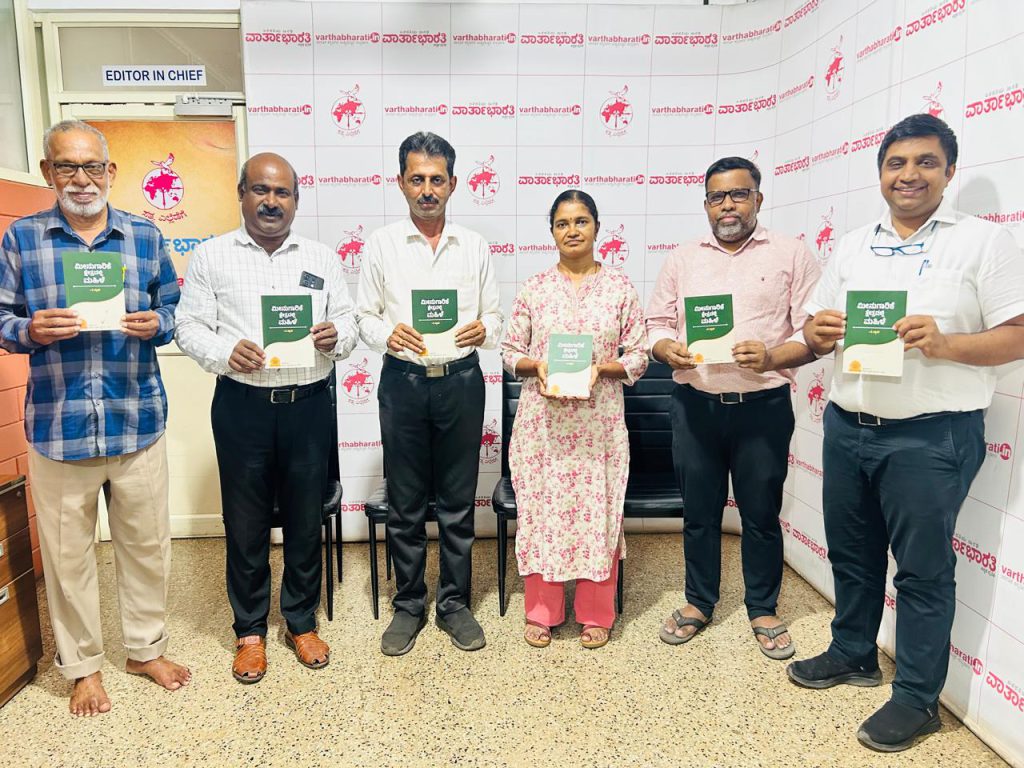
The book begins by emphasizing the importance of women in every sphere of society. Whether in agriculture, industry, education, science, or technology, women have made remarkable contributions. However, despite their hard work and dedication, they continue to face discrimination, neglect, and exploitation. The condition of women from marginalized communities is even more difficult, as they often struggle with poverty, lack of education, and limited opportunities. Fisherwomen are one such group whose lives are filled with hardships but whose contributions remain largely unrecognized.
In the author’s note, K. Sathyavathi shares the story behind the creation of this book. Although writing has been her profession for more than twenty-five years as a journalist, she had never written a full-length book because she believed that book writing demands time, detailed research, and careful reflection. Her journey toward writing this work began when journalist B. M. Basheer and Professor N. Chinnaswamy Sosale encouraged her to prepare a book on the condition of fisherwomen for the Onake Obavva Study Chair. Their encouragement inspired her to transform years of reporting and interaction with fishing communities into a comprehensive study.
One of the greatest strengths of this book is the author’s close connection with fishing communities. Having reported extensively on their lives, she presents not only statistics and government data but also the lived experiences of women who depend on fishing for their survival. The book combines journalistic observation with academic research, making it informative as well as emotionally engaging. Instead of presenting fisherwomen merely as victims, the author portrays them as courageous, hardworking, and determined individuals who continue to support their families under extremely challenging conditions.
The book explains that fishing is not limited to catching fish. Women actively participate in cleaning, sorting, processing, drying, transporting, and selling fish. They also manage household responsibilities while contributing significantly to the family income. Despite performing multiple roles, they receive little recognition, limited financial security, and inadequate access to education and healthcare. Their work often remains unpaid or undervalued, reflecting the broader gender inequalities present in society.
A significant theme discussed in the book is exploitation. The author points out that even though India’s economy continues to grow, the benefits of development have not reached many fisherwomen. They continue to face unstable incomes, poor working conditions, social discrimination, and inadequate government support. Many women spend long hours under difficult weather conditions, carrying heavy loads and traveling to markets, yet they earn only modest incomes. These realities expose the gap between economic development and social justice.
The book also places the lives of fisherwomen within a broader global context. Across oceans, seas, rivers, and lakes around the world, millions of families depend on fishing for their livelihood. Although the specific conditions vary according to geography, culture, and local traditions, women everywhere play an essential role in sustaining fishing economies. By highlighting this wider perspective, the author reminds readers that the struggles of fisherwomen are not isolated but are shared by communities across the world.
An inspiring aspect of the book is its portrayal of the resilience of coastal women. They are described as bold, hardworking, and capable of overcoming numerous obstacles. In coastal Karnataka, fisherwomen are often known for their confidence and determination. However, despite their strength, their social, educational, and economic progress has remained slow. While a few women have achieved success and leadership in their profession, thousands continue to live with poverty, debt, and insecurity. This contrast demonstrates that individual success alone cannot solve structural inequalities.
The foreword and introductory remarks further strengthen the significance of the book. They stress that knowledge should emerge from the experiences of ordinary people and marginalized communities, not only from traditional academic sources. Kannada University, Hampi, has undertaken the important responsibility of documenting such lived realities through its research centers and publications. By publishing this book, the university contributes to preserving social history while encouraging greater awareness of women’s issues.
K. Sathyavathi’s writing style is simple, direct, and compassionate. Her background in journalism allows her to explain complex social issues in a clear and accessible manner. Rather than relying only on emotional appeals, she supports her observations with facts, official reports, and practical examples. This balanced approach makes the book useful for students, researchers, policymakers, social workers, and general readers interested in women’s studies, rural development, and social justice.
Ultimately, Women in the Fisheries Sector is much more than a study of fishing communities. It is a powerful reminder that women who work behind the scenes often sustain families, communities, and local economies without receiving the recognition they deserve. The book calls upon society to acknowledge their contributions, address the inequalities they face, and ensure that development includes even the most marginalized sections of society.
K. Sathyavathi’s Women in the Fisheries Sector is a valuable contribution to Kannada literature and social research. It successfully combines journalism, research, and human sensitivity to document the lives of fisherwomen with honesty and respect. By giving voice to women whose stories are rarely heard, the book encourages readers to reflect on issues of gender equality, dignity of labour, and social inclusion. It stands as an important resource for understanding both the hardships and the resilience of women in the fisheries sector and serves as a meaningful call for greater justice, recognition, and empowerment


