
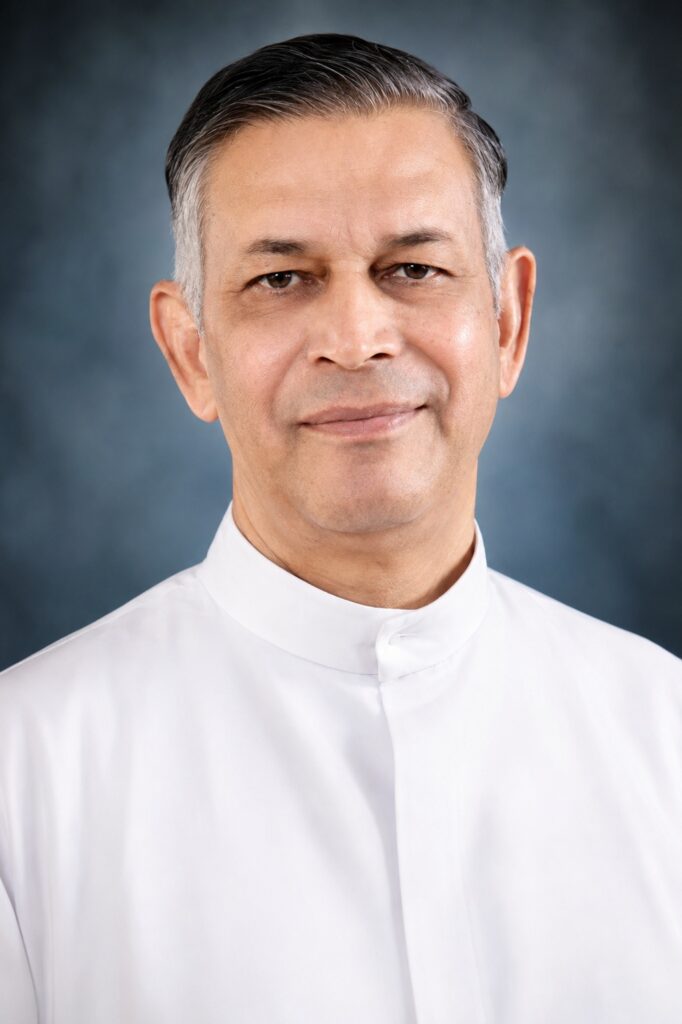
Building Our House on the Rock: The Enduring Principles of Rev. Fr. Victor Machado
NV Paulose, Chairman, Global TV +91 98441 82044
Rev. Fr. Victor Machado is no longer with us, but the principles by which he lived and the values he sought to awaken in others remain deeply relevant. His message was ultimately a simple one: a human life cannot be built securely on things that perish. It must be built on values that endure.
We live in a world that measures success increasingly in terms of possessions, wealth, position, influence and outward achievement. Material progress has brought enormous benefits to humanity, but it has also created a dangerous illusion; the illusion that what we possess can give us lasting security, happiness and meaning. Yet everything material is temporary. Wealth can disappear. Property can be lost. Positions can change. Power can pass from one person to another. Even the strongest institutions and greatest empires of history have risen and fallen. What, then, remains?
What remains is the character of a human being: truthfulness, honesty, integrity, trust, compassion, forgiveness and love. These were among the values that Fr. Victor Machado placed at the heart of his life and ministry. They are not the property of one religion, culture or nation. They belong to humanity itself.
The Human Heart Is the True Treasure
The world often teaches us to look outside ourselves for security. We accumulate possessions, seek recognition and compare ourselves with others. We sometimes begin to believe that the more we have, the more important we are. Fr. Victor Machado’s vision challenged that way of thinking.
The real treasure of a person is not what he owns but what he has become. A person may have very little materially and yet possess extraordinary richness of heart. Another may possess great wealth and influence while remaining poor in compassion, honesty, and love. The question, therefore, is not simply, What do I have? It is:
What kind of person am I?
- Do people trust my word?
- Can others depend on me?
- Do I speak the truth when the truth is inconvenient?
- Do I forgive?
- Do I treat people with dignity?
- Do I use whatever I possess for the good of others?
These are the questions that reveal the real wealth of a human being.
Truthfulness: The Foundation of a Life
Truthfulness was not merely a moral ideal; it was a foundation on which relationships and society itself could stand. Without truth, trust disappears. Without trust, relationships become fragile. Without integrity, institutions lose credibility. When truth becomes negotiable, people begin to live according to convenience rather than conscience. Fr. Victor Machado’s principles remind us that truth must not depend upon personal advantage. It is easy to tell the truth when it benefits us. The real test comes when honesty costs us something, when it requires us to admit a mistake, accept responsibility, resist temptation, or stand against what is popular. A truthful person may sometimes lose an opportunity, but he does not lose himself.

Integrity: Doing What Is Right
Integrity is what happens when our beliefs and our actions become one. It is easy to speak about values. It is much harder to live them when nobody is watching. Fr. Victor Machado’s example points toward a life in which values are not merely preached but practiced. Integrity means that the person we appear to be in public is substantially the person we are in private.
- It means keeping promises.
- It means accepting responsibility.
- It means refusing to exploit another person.
- It means treating the weak with the same respect we show the powerful.
- It means choosing what is right even when there is no applause for doing so.
A society does not become moral merely because it has moral teachings. It becomes moral when ordinary people make moral choices in ordinary circumstances.
Wealth Is Not the Enemy | Attachment Is
Jesus spoke strongly about riches, and this teaching can easily be misunderstood. The problem is not simply possessing wealth. The deeper danger is allowing wealth to possess the human heart. Material resources can be used for tremendous good. Wealth can educate children, feed families, support the vulnerable, build hospitals, create employment, and strengthen communities.

But wealth becomes destructive when it becomes the measure of human worth. When possessions become more important than people, something has gone wrong. When success becomes more important than integrity, something has gone wrong. When profit becomes more important than justice, something has gone wrong. When comfort becomes more important than compassion, something has gone wrong. Jesus’ warning about riches therefore remains remarkably relevant. Material things are useful servants but terrible masters.
Love: The Greatest Measure of a Human Life
At the heart of Fr. Victor’s understanding of Christian values was the recognition that love cannot remain an abstract idea. Love must become action.
- It means listening to someone who feels forgotten.
- It means forgiving someone who has hurt us.
- It means helping a person who cannot repay us.
- It means defending someone who is being treated unjustly.
- It means showing patience when anger would be easier.
- It means recognizing the dignity of every human being.
Love does not ask first, What will I gain? It asks, What can I give? That is why genuine love is stronger than money, position, or power. Those things can command obedience, but love can transform a human heart.
Forgiveness: Breaking the Cycle of Hurt
A society without forgiveness becomes trapped in its own wounds. Every human being makes mistakes. Families experience conflicts. Friends disappoint one another. Communities carry old grievances. Nations remember historical injuries. Forgiveness does not mean pretending that wrongdoing never happened. Nor does it mean abandoning justice. Forgiveness means refusing to allow hatred to have the final word.

The Christian message of forgiveness, which Fr. Victor sought to embody, is therefore profoundly human. It gives people the possibility of beginning again. A person who cannot forgive remains imprisoned by the past. A person who learns to forgive opens a door to the future.
Trust: The Invisible Wealth of Society
Modern society depends upon countless acts of trust.
- We trust that a person’s word means something.
- We trust that a doctor will care for a patient.
- We trust that a teacher will educate with responsibility.
- We trust that a friend will stand by us.
- We trust that a leader will act for the common good.
Much of civilization rests upon this invisible foundation. Once trust collapses, suspicion takes its place. People begin protecting themselves rather than cooperating with one another. Fr. Victor Machado’s emphasis on honesty, integrity, and truth therefore had significance far beyond individual morality. These virtues are the foundations of a healthy society.
Building on the Rock
The Gospel image of the house built upon rock provides a fitting summary of this entire philosophy. A house may look magnificent, but its strength is determined by its foundation. The same is true of a human life. A person may build a life on wealth, fame, status, possessions, and influence. For a time, everything may appear secure. But life inevitably brings its storms, failure, loss, disappointment, illness, rejection, conflict and death. At such moments, the question is no longer how impressive the house looks.
The question is: What is it built upon? A life built on possessions can be shaken when possessions disappear. A life built on reputation can collapse when public opinion changes. A life built on power can become empty when power is lost. But a life built on truth, love, integrity, faith, compassion, and service possesses a deeper strength. The storms may hurt it, but they do not necessarily destroy it. That is the meaning of building one’s house on the rock.
A Universal Message
Although Fr. Victor Machado’s inspiration was deeply rooted in the teachings of Jesus Christ, the values he championed speak to every person. Truth does not belong exclusively to Christians. Honesty does not belong exclusively to one religion. Compassion has no nationality. Integrity has no caste. Love has no border. Forgiveness does not require a particular passport. These values belong to the human family.

In a divided world, they can become common ground. People of different religions, cultures, and philosophies may disagree about many things, but they can still recognize the dignity of truthfulness, compassion, justice, integrity, and love. That is why such a message does not become outdated.
The Challenge of Living the Values
The greatest tribute we can pay to a person like Fr. Victor is not to remember his words alone. It is to live what he believed. This is not easy. It is difficult to remain honest when dishonesty appears profitable. It is difficult to remain humble when recognition is available. It is difficult to forgive when we have been deeply hurt. It is difficult to love when hatred is easier. It is difficult to remain faithful to our principles when compromise offers immediate rewards. But perhaps that is precisely why these values matter. If goodness were always easy, it would require very little courage. The real test of character comes when doing what is right demands sacrifice.
What Will We Leave Behind?
Every human being eventually has to confront the temporary nature of life.
- We cannot take our houses with us.
- We cannot take our bank accounts with us.
- We cannot take our titles, positions or possessions with us.
What we leave behind is something different: the lives we have touched, the kindness we have shown, the truth we have defended, the forgiveness we have offered, the people we have helped and the love we have given. That is the legacy that cannot easily be measured in material terms. Perhaps this is the deepest lesson of Fr. Victor Machado’s life: our greatest achievement is not the size of the house we build, but the strength of the foundation upon which we build it.

The world does not ultimately move forward because of money, possessions or power. It moves forward because human beings continue to choose goodness over selfishness, truth over falsehood, love over hatred, forgiveness over revenge and service over self-interest. These values may sometimes appear hidden beneath the noise and competition of modern life. But they are still there, deep within the human heart. Our task is to bring them out. To live them. To pass them on. And, above all, to build our lives upon them. For everything built on what is temporary will eventually pass. But a life built on truth, integrity, compassion, forgiveness and love can become a lasting testimony to what is best in the human person.
That is a house built on the rock.


