
What Can Ten People Create? | A Non-Threatening Movement
NV Paulose, Chairman, Global TV +91 98441 82044
We often imagine that meaningful change requires thousands of people, a large organization, enormous funding, or someone with extraordinary power. It doesn’t. Sometimes, it begins with ten people. Ten people who decide to sit together, listen to one another, share what they know, and ask a simple question: “What could we create together that none of us could create alone?” That question can become the beginning of an organization, a movement, a community, or even a new way of working.
The Organizational World Inside Ten People
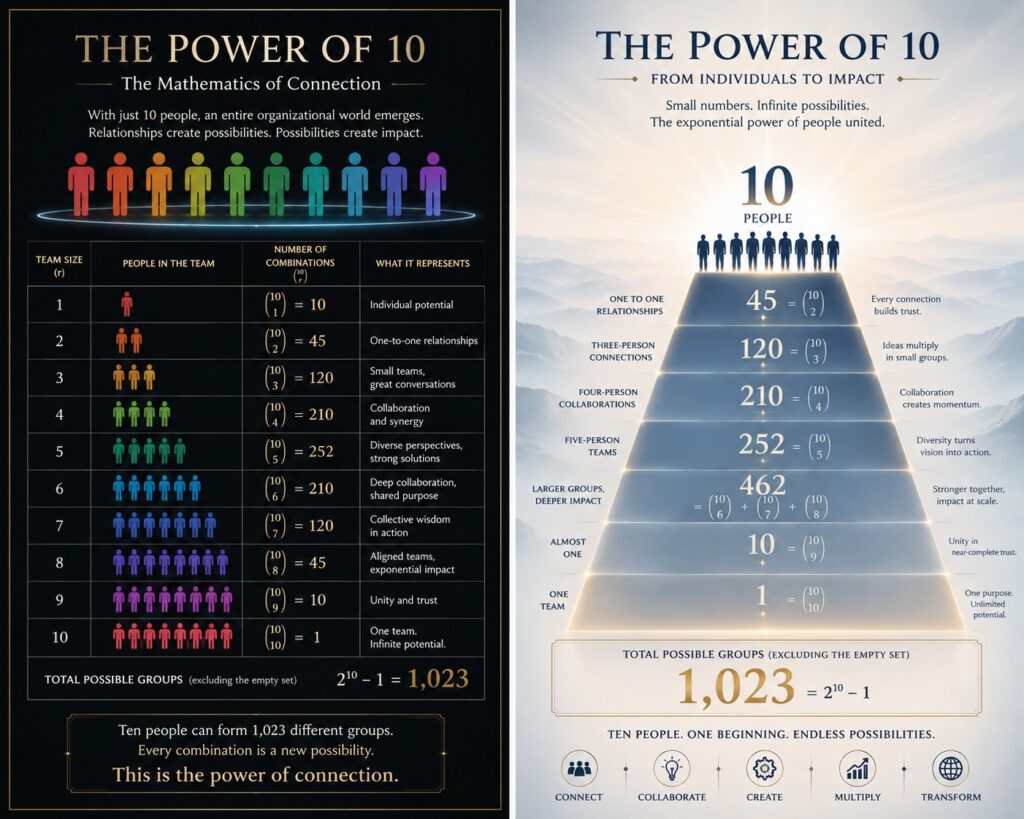
A group of ten people already contains a surprisingly rich organizational world. There are 45 possible one-to-one relationships among them. Each relationship can become a channel for trust, learning, collaboration, mentorship, or exchange. Then there are 120 possible three-person combinations. There are 210 possible four-person groups, 252 five-person groups, and so on. In total, excluding the empty group, ten people can form 1,023 different groups.
The mathematics is interesting, but the human reality is more important. Every combination represents a possibility. A conversation between two people can create an idea. Three people can turn the idea into an experiment. Five people can develop a project. Seven people can create a working system. Ten people can create an organization. The real power is not in the number ten. It is in the relationships between the ten.
From Individuals to an Ecosystem
Imagine ten people with different abilities. One understands technology. Another understands finance. Another knows how to communicate. Someone understands education. Someone knows how to organize people. Another is good at solving practical problems. Someone brings creativity. Someone brings experience. Someone asks difficult questions. And someone simply has the courage to begin.
They don’t have to agree on everything. In fact, they shouldn’t. A healthy organization doesn’t require ten identical minds. It requires enough trust for different minds to work together. When people combine their strengths, the group becomes more capable than the sum of its individual members. This is where an organizational ecosystem begins.
A Non-Threatening Movement
There is another possibility. What if these ten people don’t begin by trying to defeat anyone? What if they don’t define themselves by an enemy? What if the movement is not built around anger, fear, blame, or confrontation? Instead, they decide: We will build something positive. They help one another. They share knowledge. They create opportunities. They solve small problems. They support experiments.
They invite others. They demonstrate that cooperation works. This kind of movement can be powerful precisely because it is non-threatening. It doesn’t need to demand that everyone join. It doesn’t need to force agreement. It doesn’t need to destroy an existing institution. It simply creates something useful and allows people to participate voluntarily. The message becomes: “Come and see what we can build together.”
Ten People Can Become a Laboratory
The first organization doesn’t have to be perfect. Ten people can treat themselves as a laboratory. They can experiment with:
- different leadership models;
- shared decision-making;
- rotating responsibilities;
- collective learning;
- peer mentorship;
- transparent finances;
- collaborative projects;
- conflict resolution;
- technology;
- education;
- community service;
- entrepreneurship.
They can try something. Learn from it. Change it. Try again. In this sense, the group becomes a prototype for a different organizational world. The objective isn’t merely to create a successful organization. It is to discover: What kind of organization helps human beings become more capable, more responsible, and more connected?
The First Ten Can Become the Next Hundred
A positive movement has an important property: it can reproduce itself. The original ten people don’t necessarily need to recruit 990 people. Instead, each person can help create another small circle. Ten become ten circles. Ten circles become a hundred people. Those hundred people can create new circles.
The movement grows through relationships rather than commands. This is fundamentally different from building a hierarchy in which one person tells everyone else what to do. It is closer to a network. Each node can learn. Each node can create. Each node can connect to other nodes. The organization becomes less dependent on a single leader and more dependent on the quality of its relationships.
The Power of Voluntary Participation
The most sustainable movements are not necessarily those that can force participation. They are those that make participation meaningful. People stay because they find: purpose, belonging, learning, contribution, opportunity, or friendship. A person should be able to say: “I am here because I want to be here.” That simple principle changes the character of an organization. It turns participation from obedience into ownership. And ownership creates responsibility.
The Organization as a Positive Force
Imagine if ten people made a commitment: We will not begin with what we oppose. We will begin with what we can contribute. We will not ask, “Who is responsible for the problem?” We will first ask, “What can we do about it?” We will not demand trust. We will earn it. We will not promise to change the world overnight. We will build something small enough to prove. Then we will share what we learn. Such a group can become surprisingly influential. Not because it threatens the existing world. But because it demonstrates an alternative.
The Ripple Effect
One person changes another person. Two people create a relationship. Relationships create teams. Teams create projects. Projects create institutions. Institutions create cultures. And cultures influence generations. That is how ten people can matter. The number ten is small enough that every person matters. Nobody can easily disappear into the crowd. Everyone can contribute. Everyone can be heard. Everyone can be challenged. Everyone can learn. And everyone can take responsibility. That makes ten people an unusually interesting size for experimentation. Large enough to contain diversity. Small enough to maintain human connection.
A Different Definition of Power
Perhaps the deepest lesson is that power does not always have to mean control. There is another kind of power: the power to create. The power to connect people. The power to teach. The power to solve. The power to organize. The power to make something useful. The power to inspire another person to participate voluntarily. A movement built on these forms of power doesn’t need an enemy to justify its existence. Its existence is justified by what it creates.
Ten People, One Beginning
Ten people cannot solve every problem. But they can prove that something different is possible. They can create the first project. The first conversation. The first experiment. The first shared resource. The first working model. The first community. And perhaps, most importantly, the first example that others can copy. Every large organization was once small. Every movement was once a handful of people. Every institution began as an idea that somebody decided to take seriously.
So perhaps the question is not: “What can ten people possibly change?” Perhaps the better question is: “What would ten people be capable of creating if they trusted one another, respected differences, refused unnecessary confrontation, and devoted their energy to building something genuinely useful?” The answer may be much larger than ten. Because ten people can create relationships. Relationships can create teams. Teams can create organizations. Organizations can create movements.


