
Nurturing Nature: One Man, Many Lives, One Living Earth
NV Paulose, Chairman, Global TV +91 98441 82044
There are people who speak about protecting nature, people who campaign for nature, and then there are those who quietly dedicate their lives to creating spaces where nature can heal itself. Manoj Kumar I.B. belongs to the last category. His story is not simply about planting trees. It is about changing the way we look at land, food, biodiversity and our own place within the natural world. In an age when development is often measured by concrete structures, roads and buildings, his work offers a radically different measure of progress: how much life can a piece of land support?

His journey is especially inspiring because it began not with a vast tract of forest, but with a modest piece of land around his home at Edavanakkad in Kerala. Over the years, what could have remained an ordinary residential property was allowed to evolve into a living forest filled with fruit trees, medicinal plants, shade trees, birds, butterflies and countless other forms of life. Reports about his work describe a forest spread across roughly one and a half acres, created through years of patience and a willingness to let nature lead. It is a powerful reminder that restoration does not always begin with governments, institutions or large budgets. Sometimes, it begins with one person refusing to treat nature as something separate from daily life.
The philosophy behind this transformation is equally remarkable. Instead of attempting to control every inch of the land, Manoj has encouraged natural processes to take their course. Leaves become mulch. Seeds find the soil. Birds become seed dispersers. Insects become part of the ecosystem. Plants grow alongside one another rather than existing in isolated rows. What emerges is not merely a garden designed for human enjoyment, but a community of life. This approach challenges the idea that humans must constantly manage, simplify and dominate nature. Sometimes, nurturing nature means knowing when to step back.

His example also demonstrates that biodiversity is not a luxury. A fruit forest is not simply a collection of trees that produce food. It can provide shade, shelter, nesting spaces, pollinator habitat, organic matter and countless relationships between living organisms. Jackfruit, mango, anjili, palm, rambutan and other plants become part of a larger ecological network. When birds arrive, when butterflies return, when soil organisms flourish and when fallen leaves feed the ground, the land begins to function as an ecosystem rather than merely as property. This is the deeper meaning of nurturing nature: creating conditions in which life can multiply.
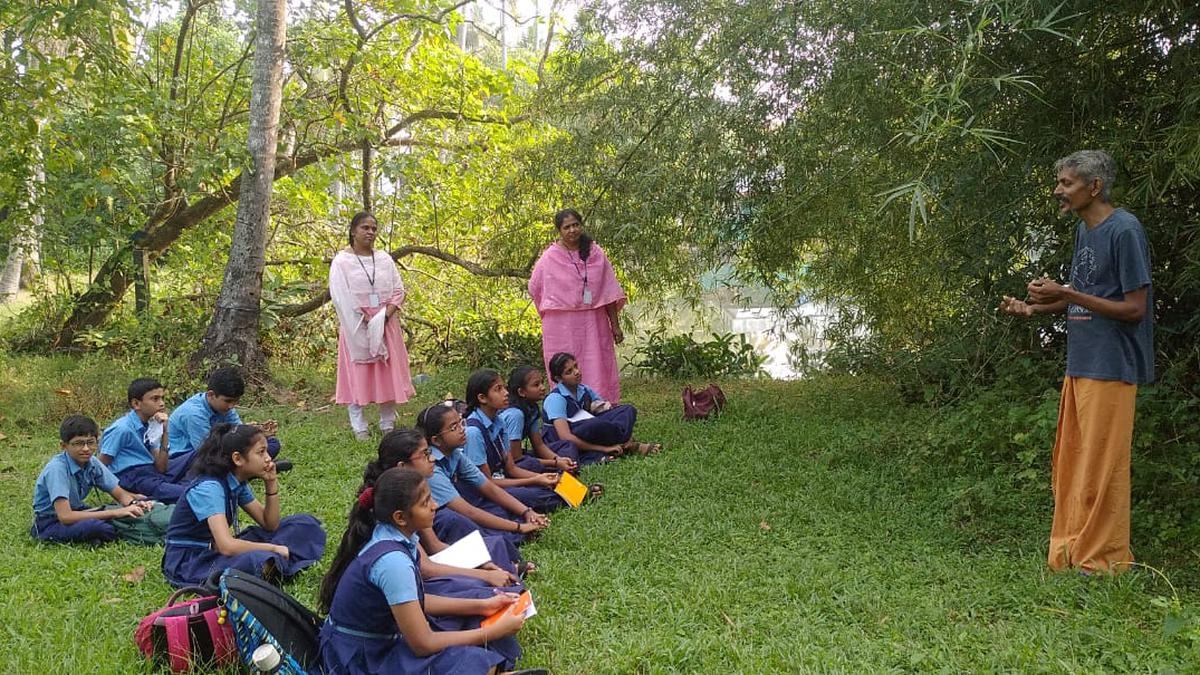
The story becomes even more meaningful when young people enter this living classroom. A visit by students from Kodaikanal International School to the Fruit Forest and the mangrove planting site demonstrates how environmental education becomes far more powerful when it moves beyond textbooks. Students can read about biodiversity, carbon storage, coastal protection and sustainability in a classroom. But standing among trees, touching the soil, travelling through backwaters and planting a mangrove sapling creates a different kind of knowledge. It turns information into experience, and experience into responsibility.
From Fruit Forests to Mangrove Shores
The journey from the Fruit Forest to Kerala’s backwaters near Cherai reveals another dimension of the same philosophy. A fruit forest and a mangrove ecosystem may appear completely different. One grows around a home on land; the other survives at the meeting point of land and water. Yet both demonstrate the extraordinary ability of nature to create relationships between diverse forms of life. The lesson is that ecosystems may be different in appearance, but they are united in purpose: sustaining life.
Mangroves are among the most extraordinary ecosystems on Earth because they thrive in difficult coastal environments where salt, water, tides and changing soil conditions challenge many other plants. Their roots help stabilise shorelines, reduce erosion and create habitats for organisms both above and below the water. They also provide nursery grounds for young fish and other aquatic species. At the same time, mangrove ecosystems can store significant amounts of carbon, making their conservation relevant to the global climate challenge. Protecting a mangrove is therefore not simply about protecting one kind of tree; it is about protecting an entire web of life.
For the students, planting around forty mangrove saplings transformed these ideas into action. A sapling may look insignificant when held in the hand. It does not resemble a forest, a coastline or a climate solution. Yet every forest begins with individual plants, just as every movement begins with individual acts. The students were not merely planting trees that day. They were participating in a process that could continue long after they returned home. That is one of the most important lessons environmental education can offer: the value of an action cannot always be measured by what is visible immediately.
The presence of Manoj made the experience still more meaningful. His years of commitment show that ecological restoration is rarely an instant achievement. It demands patience when results are invisible, courage when others do not understand the purpose, and consistency when there is no immediate reward. His work represents the strength of a one-person effort that gradually becomes a community effort. Once people see what is possible, they begin to participate. Students plant. Teachers encourage. Communities engage. Organisations collaborate. A personal conviction slowly becomes collective action.
This is where the idea of Unity in Diversity takes on a much larger meaning. We often use the phrase to describe human society: different languages, cultures, religions, traditions and identities living together. Nature offers an even more profound version of the same principle. A forest does not demand uniformity. It thrives because different species occupy different roles. Tall trees, shrubs, climbers, herbs, fungi, insects, birds and microorganisms coexist through intricate relationships. Diversity is not an obstacle to unity; diversity is what makes the ecosystem resilient.
The same principle can be applied to human communities. A scientist, farmer, teacher, student, environmentalist, engineer, artist or community volunteer may contribute in completely different ways, yet their efforts can converge around a common purpose. Manoj’s journey shows how one individual’s skills and convictions can connect with the curiosity of students, the commitment of educators and the participation of communities. The mangrove sapling planted by a student and the decades of work invested by a conservationist may appear unequal in scale, but they belong to the same story.
The Larger Forest We Must Grow
Perhaps the greatest lesson from this experience is that sustainability cannot remain an academic concept. It must become a habit of living. Students who plant a mangrove today may think differently tomorrow when they see a wetland being destroyed. A child who understands where fruit comes from may develop a different relationship with food. A young person who sees biodiversity functioning in a backyard may begin to question why every open space must become a construction site. Education becomes transformative when it changes not only what we know, but also what we value.
The Fruit Forest also challenges another modern assumption: that environmental action must always be large, expensive and technologically sophisticated. Sometimes, the most meaningful interventions are surprisingly simple. Mulching soil, allowing fallen leaves to remain, planting native species, protecting wetlands, creating green spaces and reducing unnecessary interference can all contribute to ecological health. These actions may appear small individually, but nature itself teaches us the power of accumulation. One seed becomes one tree; many trees become habitat; habitat supports species; species create an ecosystem.
There is also an important lesson here about the meaning of success. Manoj could have pursued a conventional definition of achievement. Instead, he chose a path in which his greatest accomplishment is measured by the life flourishing around him. The reward is not a monument bearing his name but birds returning to the trees, fruits growing from branches, soil becoming fertile and young people becoming curious about nature. His work quietly asks us to reconsider what we leave behind. Is a person’s legacy the property they build, or the life they enable?
The student reflection captures this transformation beautifully. The visit made the students realise that even a small action, such as planting one sapling, can contribute to a much larger environmental effort. That realisation is crucial. Young people often hear that climate change and biodiversity loss are enormous global problems. When problems are presented only at that scale, they can feel overwhelming. A mangrove sapling provides a different message: you may not be able to solve everything, but you can participate in the solution. Responsibility becomes tangible.
The experience also reminds us that nature protection is ultimately an act of intergenerational solidarity. The tree we plant today may provide shade to someone we will never meet. The mangrove we protect today may shelter fish that support a future fishing community. The seed we save today may become food for a future family. Environmental action therefore asks us to care about people who are not yet part of the conversation. Sustainability is the ability to think beyond our own lifetime.
There is a beautiful symmetry between the Fruit Forest and the mangrove shore. One begins with the patient nurturing of diverse plants on land; the other protects the fragile boundary between land and water. One provides a living classroom among fruit trees; the other demonstrates nature’s defence against coastal vulnerability. Together they tell the same story: when we protect ecological diversity, nature gives back in ways far greater than what we invest.
Ultimately, the most powerful message of Manoj’s work is not simply “plant more trees.” It is “change your relationship with nature.” See the vacant patch of land as a possible habitat. See a fallen leaf as nourishment rather than waste. See a mangrove as a coastal guardian rather than an inconvenient plant. See students not merely as learners but as future custodians. See diversity not as fragmentation but as strength. And see every individual action as a possible beginning.
In a world searching for large solutions to environmental crises, Manoj Kumar’s life offers a quietly radical proposition: start by nurturing what is immediately around you. Let a garden become a forest. Let a sapling become a shelter. Let a student become a steward. Let one person’s conviction inspire another person’s action. When these efforts come together, the result is more than conservation. It becomes a culture of care.
That is the larger spectrum of Unity in Diversity. Humanity and nature are not two separate worlds. Forests, wetlands, rivers, coastlines, animals, plants and people are threads in one living fabric. We do not merely live beside nature; we live within it. Manoj’s Fruit Forest and the mangrove planting experience remind us that the future will not be protected by words alone. It will be protected by people who are willing to nurture, patiently and persistently, the countless forms of life with which we share this Earth. And sometimes, the beginning of that enormous task is as humble as placing one small sapling into the soil.


