
A Journey Dedicated to Education and Leadership |
NV Paulose, Chairman, Global TV +91 98441 82044
Dr. Neha Japani’s journey in education is a story of commitment, continuous learning and a deep belief in the transformative power of young minds. As the Principal of R.D. National College, she has devoted decades to education and institution building, watching generations of students enter college with aspirations and leave with the confidence to pursue diverse paths. For her, education is much more than completing a syllabus or securing a degree. It is about developing minds, discovering potential and giving young people the opportunity to understand what they are capable of achieving.

Dr. Japani’s own academic and professional journey reflects the importance she places on continuous growth. After completing her academic qualifications and clearing the National Eligibility Test, she began her teaching career at Sydney College, where she taught for two and a half years. She joined R.D. National College in 1996, beginning an association that has continued for decades. Her progression from teaching to academic leadership and eventually to the position of Principal has given her a comprehensive understanding of students, teachers, institutions and the changing nature of higher education.
Her commitment to learning has also been evident in her own academic pursuits. Dr. Japani completed her PhD from the Bajaj Institute of Management, for which she was granted study leave with full pay. Pursuing doctoral studies while being an experienced educator demonstrates her belief that learning does not end when one becomes a teacher. In fact, she believes educators must remain learners themselves if they are to inspire their students. Her academic journey has strengthened her understanding of management and education while reinforcing the importance of curiosity, inquiry and intellectual growth.
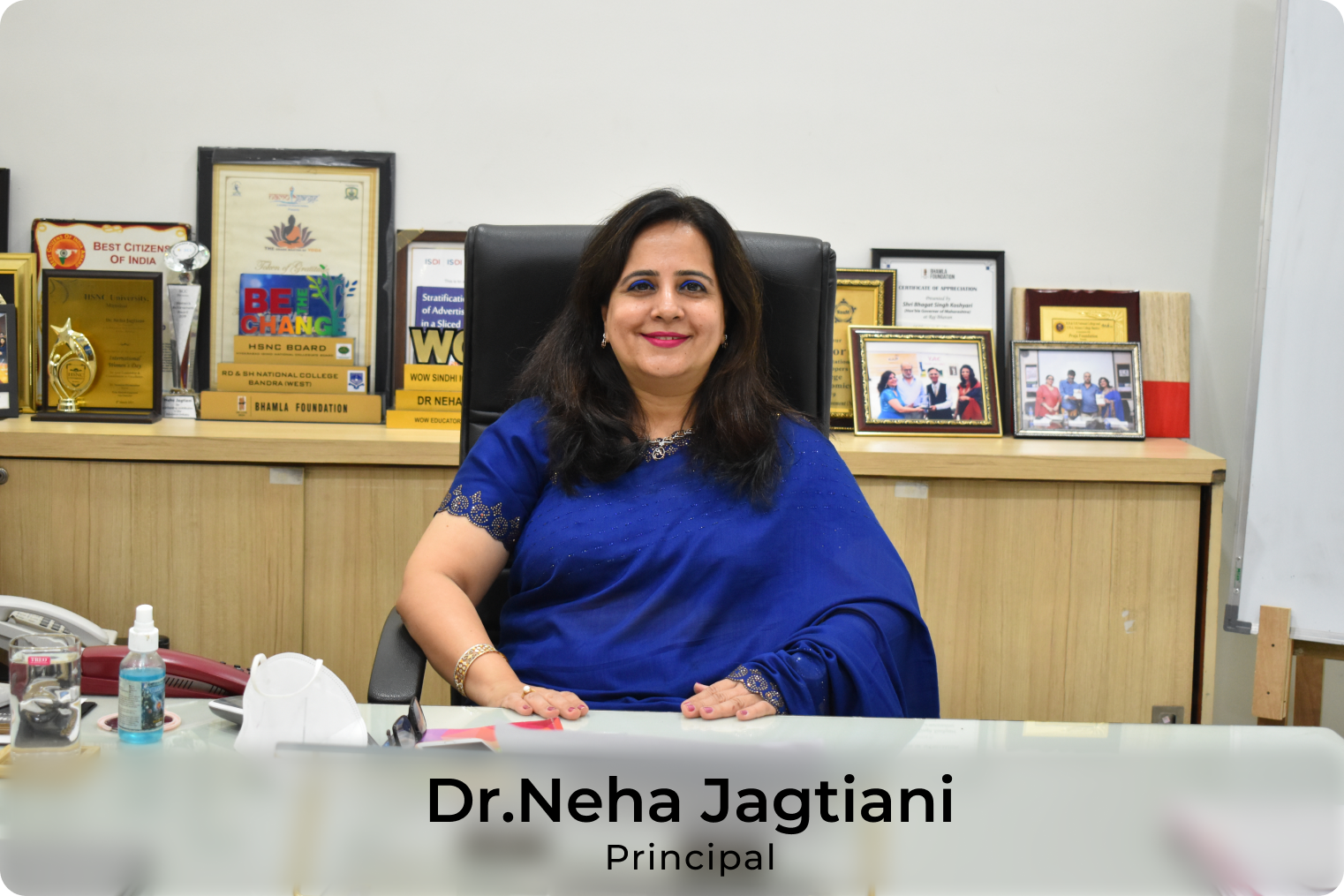
Her contribution to education extends well beyond the boundaries of her college. Dr. Japani has served as the Education Committee Coordinator with the Indian Merchants’ Chamber and has been associated with the Academic Committee of the H.S.N.C. Board. She has also been part of two delegations with the Governor to the United Kingdom and Australia. More recently, she was associated with the National Education Policy as a coordinator with the Government of Maharashtra. These experiences have enabled her to engage with education at institutional, professional, international and policy levels.
Doing Is Learning
At the heart of Dr. Japani’s educational philosophy is a simple but powerful idea: doing is learning. She believes that students understand concepts more deeply when they are given opportunities to experience, experiment, participate and apply what they learn. Education becomes meaningful when knowledge moves beyond the textbook and becomes part of a student’s experience. For her, a classroom should not merely be a place where information is delivered. It should be a space where students are encouraged to think, question, explore and do.
This philosophy also connects closely with the way she describes education as “the best business” because educators are in the business of developing minds. She often explains to her fellow teachers that when a company purchases a computer, it knows exactly what it is getting. The components, capabilities and functions are largely predictable. Over time, the machine may lose its value as technology changes. A human being, however, is completely different. When an institution takes responsibility for educating a student, it is not simply developing a pair of hands. It is nurturing a person whose strengths, abilities, imagination and potential may continue to grow in ways nobody can predict.
That unpredictability is what makes education so exciting for Dr. Japani. A student sitting in a classroom today may become a CEO, entrepreneur, actor, cricketer, researcher or leader tomorrow. Some may discover talents that they themselves were unaware of when they entered college. This is why she believes students must be given opportunities to learn through action. When young people participate in activities, take responsibility, solve problems and face real situations, they develop qualities that cannot always be acquired through conventional classroom instruction.
The principle that doing is learning also reflects the changing requirements of the modern world. Employers and society increasingly need individuals who can apply knowledge, communicate effectively, collaborate with others, solve unfamiliar problems and adapt to changing circumstances. Merely knowing an answer is not always enough. Students must know how to use what they know. Dr. Japani therefore sees education as a process of transforming knowledge into capability and capability into confidence. Every experience can become a lesson when students are encouraged to reflect on what they have done and what they have learned from it.
For Dr. Japani, this is also what makes teaching such a fulfilling profession. The results of education may not always be visible immediately. A teacher may teach a concept today and discover its true impact years later when a former student applies that learning in a career or personal endeavour. Watching students grow, take initiative and eventually succeed in different fields provides educators with a sense of fulfilment that few professions can match. The greatest reward is not simply seeing students pass examinations, but seeing them develop into confident individuals who can create their own futures.
Building a Legacy at R.D. National College
This philosophy acquires an even greater significance at R.D. National College, an institution with a history spanning 73 years. Over more than seven decades, the college has witnessed generations of young people pass through its classrooms and build successful careers in different fields. Every graduating batch adds another chapter to the institution’s story. For Dr. Japani, the college represents not only an academic institution but also a community where students can explore their identities, discover their abilities and develop the confidence to step into the wider world.
Having been associated with the college since 1996, Dr. Japani has witnessed considerable changes in higher education. The students of today live in a world shaped by technology, global opportunities, rapidly changing careers and new forms of communication. Their educational needs are consequently different from those of earlier generations. Yet she believes that the fundamental purpose of education remains constant. Institutions must help students become independent thinkers, responsible citizens and capable professionals who are prepared to learn throughout their lives.
Her leadership is therefore rooted in creating opportunities rather than simply delivering instructions. If doing is learning, students need spaces in which they can participate and take ownership. Activities, projects, discussions, leadership opportunities and real world experiences can help students understand that learning is not confined to examinations. Every challenge can become an opportunity to develop a skill. Every mistake can become a lesson. Every experience can contribute to the making of a more confident and capable individual.
Dr. Japani’s wider involvement in education has further strengthened this perspective. Her work with professional and academic bodies, her international exposure and her association with education policy have allowed her to understand the larger challenges and opportunities facing higher education. She recognises that institutions must respect their traditions while remaining open to innovation. A college with a long legacy cannot simply preserve the past. It must also prepare its students for the future and create an environment in which new ideas can emerge.
Dr. Neha Japani believes in the limitless potential of human beings. Her journey from teacher to principal, her academic achievements, her leadership responsibilities, and her contribution to education policy all point towards one central conviction: education is about developing people. Her philosophy that doing is learning adds another important dimension to this vision. Students learn when they participate, experiment, create, lead and experience. They learn when they are trusted with responsibility and encouraged to discover their own strengths. And when educators provide them with those opportunities, they do far more than teach lessons. They help shape lives.
For Dr. Japani, the true measure of an educational institution is ultimately found in what its students become. A college may have classrooms, laboratories, libraries and examination halls, but its greatest legacy lives in the people who emerge from it. Some may become entrepreneurs, some professionals, some artists, some athletes and some leaders. The possibilities are limitless because the human mind is limitless. This is why she continues to see education as one of the most fulfilling professions. To develop a mind is to influence a future, and to give a young person the opportunity to learn by doing is to give that person the confidence to build that future. Never miss a day in the campus; this is her advice to you students.


