
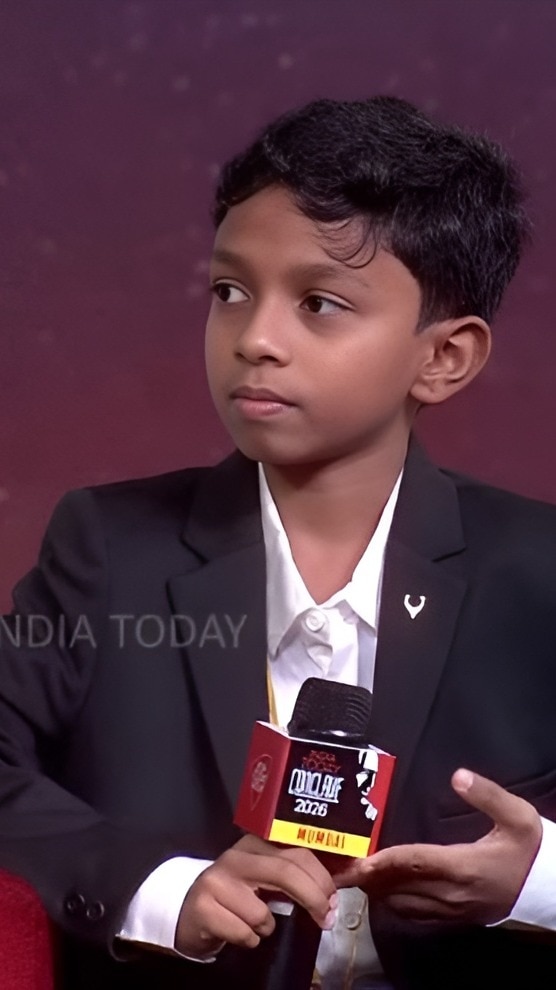
At 12, Rishi Shiv Prasanna is is asking questions about intelligence, education, artificial intelligence and the kind of future humanity should build.
NV Paulose, Chairman, Global TV +91 98441 82044
What were you doing when you were eight years old? Perhaps learning multiplication tables, playing with friends or discovering the world through everyday experiences. Rishi Shiv Prasanna, however, was already exploring computer programming, developing mobile applications and writing books. His remarkable accomplishments at a young age have drawn attention across India, making him an inspiring example of childhood curiosity translated into creative work.

At the India Today Conclave Mumbai 2026, the 12-year-old author and technology enthusiast offered a glimpse into a mind interested not only in scientific puzzles and programming, but also in philosophy, education, human behaviour and the future of artificial intelligence. His observations revealed a young learner who is thinking beyond conventional measures of academic success.
From curiosity to creation
Rishi’s journey began with an interest in understanding how things work. For him, learning was not confined to textbooks or classroom lessons. Science, mathematics and technology offered opportunities to ask questions, explore possibilities and develop new ideas.
His interest in computers eventually led him to Android application development. He became a Google-certified Android developer at a remarkably young age and worked on applications including IQ Test App for Kids, Countries of the World and COVID Help for Bangaloreans. These projects demonstrate an important aspect of his journey: the desire to put knowledge into practice. Programming became more than a technical skill; it became a means of creating tools, sharing information and addressing practical needs.
In 2023, Rishi received the Pradhan Mantri Rashtriya Bal Puraskar for his achievements in innovation. The national recognition brought greater attention to his work and highlighted the possibilities that can emerge when young people are encouraged to pursue their interests. Yet his story is not simply about acquiring technical skills early. It is also about the willingness to experiment, learn independently and transform an idea into something tangible.
A young author with an imaginative approach to learning
Rishi’s interests extend well beyond coding. He is also the author of eight books, combining educational themes with imagination and storytelling. His book Learn Vitamins with Harry Potter grew out of a school writing competition when he was in Class 1. Inspired by the Harry Potter universe, he developed an approach that brought information about vitamins into a familiar and imaginative setting. The idea reflects a valuable educational principle: knowledge becomes more engaging when learners can connect it with subjects they already enjoy.
His writing also includes the Titanium Time Travelers series, which explores time travel and historical periods. Through such projects, Rishi brings together storytelling, curiosity and a desire to communicate ideas to other young readers. Writing requires a different kind of discipline from programming. While coding involves logic, structure and problem-solving, storytelling demands imagination, clarity and an understanding of how readers engage with ideas. His interest in both fields illustrates how technical and creative pursuits can complement each other.
“There’s not only one type of intelligence”
One of the most significant messages from Rishi’s appearance at the India Today Conclave was his observation that there is not just one type of intelligence. The statement challenges a common tendency to measure children’s abilities primarily through examination results, mathematical performance or conventional academic achievement. Children possess different strengths. Some demonstrate exceptional abilities in mathematics or science. Others excel in music, art, writing, sport, communication, empathy or understanding people. Still others may possess a practical instinct for solving problems that cannot easily be captured through a classroom test.
Recognising these differences does not mean abandoning academic standards. Rather, it means understanding that a child’s potential cannot always be represented by a single score or a narrow definition of success. Rishi’s own journey brings this idea into focus. His interests span programming, literature, scientific thinking and public speaking. These activities draw on different combinations of skills, and each offers opportunities for growth.
His reported IQ of 180 and membership in Mensa International have attracted considerable public interest. Mensa admits members who perform within the top two per cent of the population on an approved intelligence test. However, IQ scores measure only certain aspects of cognitive ability and should not be treated as a complete assessment of a person’s creativity, character or future potential. The more important question is what people do with their abilities: whether they continue learning, use their knowledge responsibly and remain open to ideas beyond their immediate interests.
Artificial intelligence: a tool, not an enemy
Artificial intelligence was another important subject discussed at the conclave. As AI tools become increasingly common in education, healthcare, communication and industry, questions about their benefits and risks have become central to public debate. Rishi offered a light-hearted but memorable suggestion about how people should interact with AI: “Be nice to AI. Say, say thank you whenever AI gives you something.”
The remark may sound playful, but it opens the door to a larger conversation about how humans approach emerging technologies. Although AI systems do not require politeness in the same way people do, respectful habits can reflect the way individuals choose to communicate and behave. More substantially, Rishi suggested that artificial intelligence should be viewed as an assistive tool rather than a force destined to conquer humanity. He pointed to its potential to support personalised education and healthcare, while acknowledging that automation could disrupt certain jobs and occupations.
AI-powered educational tools, for instance, may help students explore difficult concepts at their own pace, receive additional explanations and practise skills according to their needs. In healthcare, AI may assist professionals with analysing information, identifying patterns and supporting certain clinical tasks. These possibilities come with responsibilities. AI systems can produce inaccurate information, reproduce biases and raise concerns about privacy. Their effectiveness depends on the quality of the technology, the way it is implemented and the judgement of the people using it.
The future, therefore, is unlikely to be determined by technology alone. Human decisions about how AI is designed, governed and applied will play a major role in determining whether its benefits are widely shared. Rishi’s perspective encourages a balanced approach: neither fear technology blindly nor assume that every new development will automatically improve society.
Education beyond marks and examinations
The question of intelligence naturally leads to another important issue: the way children are educated. Modern schooling often places considerable emphasis on examinations, grades, competition and measurable outcomes. These can serve useful purposes, but they do not always capture a student’s imagination, practical abilities or capacity for original thought. A child who struggles with one subject may have exceptional talent in another. A student who performs well in examinations may still need opportunities to develop communication, collaboration and emotional understanding. Equally, creative talent benefits from discipline, practice and a strong foundation of knowledge.
Rishi’s emphasis on diverse forms of intelligence offers a reason to reconsider how schools identify and nurture potential. Education should provide children with opportunities to experiment, ask questions, read widely, build projects and express themselves through different mediums. Teachers and parents can play an important role by recognising individual interests without imposing unrealistic expectations.
This does not require every child to become a prodigy or achieve extraordinary accomplishments at an early age. It requires an environment in which children are encouraged to discover what interests them and develop those interests with patience. Perhaps the real challenge for education is not to produce more children who follow the same path, but to help more children discover paths that suit their abilities and aspirations.
Can technology help create a cleaner planet?
Among Rishi’s future ambitions is the development of technology that could address pollution, including a proposed device intended to help convert harmful vehicle exhaust emissions into cleaner air. The idea reflects an interest in applying scientific thinking to an urgent environmental problem. Air pollution affects public health, ecosystems and quality of life, particularly in densely populated urban areas.
Turning such an idea into a working invention would require substantial scientific research. Vehicle exhaust contains different pollutants, and effective treatment depends on their chemical properties, the operating conditions of the engine and the performance of the proposed technology. Existing emission-control systems already address some of these pollutants. Any new approach would need to demonstrate that it is effective, safe, affordable and practical at scale.
Nevertheless, early-stage ideas can provide a starting point for meaningful investigation. The process of developing an invention involves asking questions, studying existing solutions, testing assumptions and learning from failure. Rishi’s environmental ambition illustrates how curiosity can be directed towards challenges that affect society as a whole. It also reminds us that innovation is not simply about creating something new; it is about determining whether that creation can make a genuine difference.
A scientific mind with philosophical questions
Perhaps the most intriguing dimension of Rishi’s appearance at the conclave was his willingness to ask questions that science and technology alone cannot easily resolve. He raised the possibility of whether human flaws such as greed and ego could ever be removed.
The question reaches beyond programming, scientific puzzles or intelligence testing. It touches on human nature, ethics and the relationship between technological progress and personal responsibility. Scientific discoveries can improve healthcare, expand access to information and create new ways of addressing environmental problems. Yet technology cannot automatically eliminate selfishness, prejudice or the desire for power.
Indeed, the same tools that support education and scientific research can also be used irresponsibly. The outcome depends partly on the values, institutions and decisions that guide their use. Rishi’s question therefore points to a fundamental issue facing modern society: progress must involve more than increasing our technical capabilities. It must also involve thinking carefully about how those capabilities are used and whom they serve. The challenge is not merely to build smarter machines, but to ensure that human beings use them thoughtfully.
Childhood, talent and the freedom to grow
Rishi’s achievements are remarkable for someone who is 12. Yet there is an important distinction between celebrating a gifted child and expecting every child to reproduce the same accomplishments. Children develop at different rates, and their interests may change as they grow. Early success can create opportunities, but young people also need room to make mistakes, explore unfamiliar subjects, build friendships and enjoy ordinary childhood experiences. The goal should not be to turn every talented child into a constant performer. It should be to support their development while allowing them to remain curious, balanced and open to new experiences.
Rishi’s story is best understood as an example of what can happen when curiosity is encouraged and opportunities are available. It is not a universal formula for success. Parents, teachers and institutions can learn from his journey by making space for reading, experimentation, creativity and independent thinking. They can help children pursue ambitious projects while reminding them that learning is a continuing process rather than a race to accumulate achievements.
The road ahead
At 12, Rishi Shiv Prasanna has already explored several fields, including technology, writing, science and public speaking. He has expressed an interest in a future career in science and an ambition to develop technology that addresses real-world challenges. His next chapter will offer opportunities to deepen his knowledge, test his ideas and discover new questions worth pursuing. As with any young learner, the possibilities ahead will depend not only on his abilities but also on continued learning, mentorship, experience and perseverance.
His story offers a broader message for a world increasingly shaped by artificial intelligence and rapid technological change. Knowledge is valuable, but curiosity gives knowledge direction. Intelligence can open doors, but creativity and persistence help people explore what lies beyond them. Above all, his words about the many forms of intelligence deserve attention. A society that recognises only one definition of talent risks overlooking the contributions of countless individuals whose abilities do not fit conventional expectations.
Rishi Shiv Prasanna’s journey is therefore about more than a young developer, an author or a reported IQ score. It is about the possibilities that emerge when a young mind is allowed to ask questions, explore ideas and imagine solutions. The real promise of intelligence lies not simply in knowing more than others, but in remaining curious, thinking responsibly and using what we learn to make the world a better place.


