
Creating safe spaces for storytelling, self-discovery, collaboration, and meaningful social change
Jessica Fernandes, @UnstoppablewithJ
Everyone wants to be heard. Listening with empathy and appreciation is valuable. Meaningful listening can strengthen relationships, build confidence, uncover hidden strengths, and create a sense of belonging. With this vision, the Listeners Club aims to create safe and welcoming spaces where people can share their stories, listen to one another without interruption, and discover new possibilities for personal and collective growth. Together Everyone Achieves More (TEAM)
During a recent conversation with Mr. Paul, Chairman, Global TV, the vision and practical approach behind the Listeners Club initiative became clearer. The initiative is not merely about improving listening skills; it is about bringing people together, nurturing human potential, and building communities that are rooted in trust, appreciation, and collaboration.
1. The Vision Behind the Listeners Club
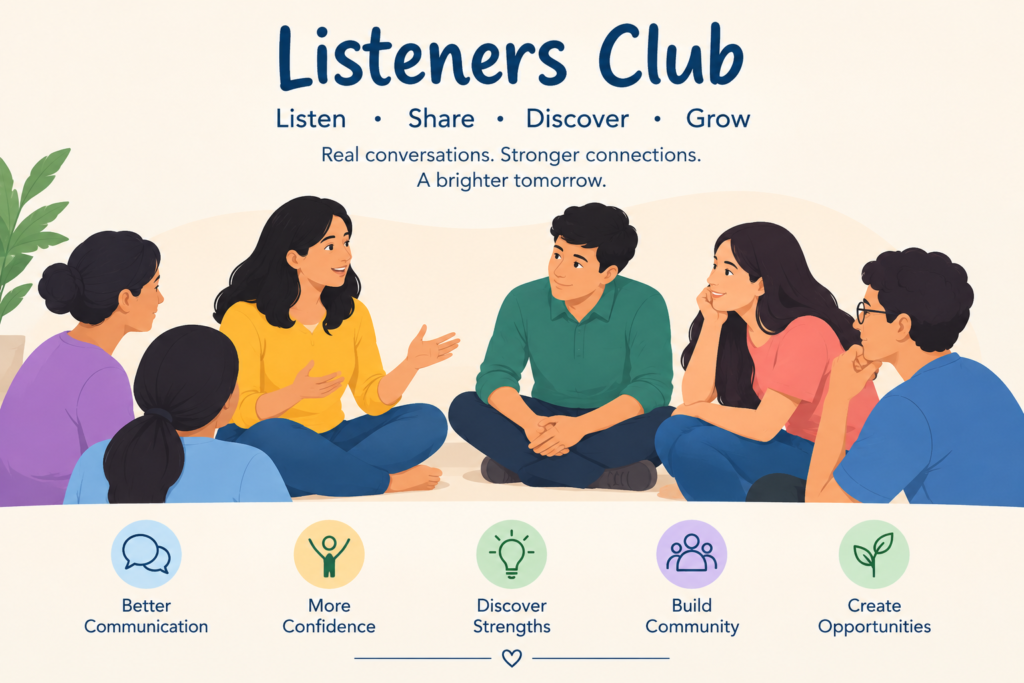
The central idea of the Listeners Club is simple yet powerful: every individual deserves the opportunity to speak, and every individual can learn to listen with genuine attention. The initiative encourages people to step away from everyday distractions and engage in meaningful conversations. Participants are given an opportunity to express their experiences, reflect on their journeys, and feel heard without being interrupted or judged.
The objective is to create a safe space where people can connect as human beings, appreciate one another’s strengths, and explore how their experiences can contribute to their personal development and the well-being of society. The initiative can be introduced across different settings, including colleges, schools, community groups, women’s organisations, professional networks, and informal gatherings.
2. How Does a Listeners Club Meeting Work?
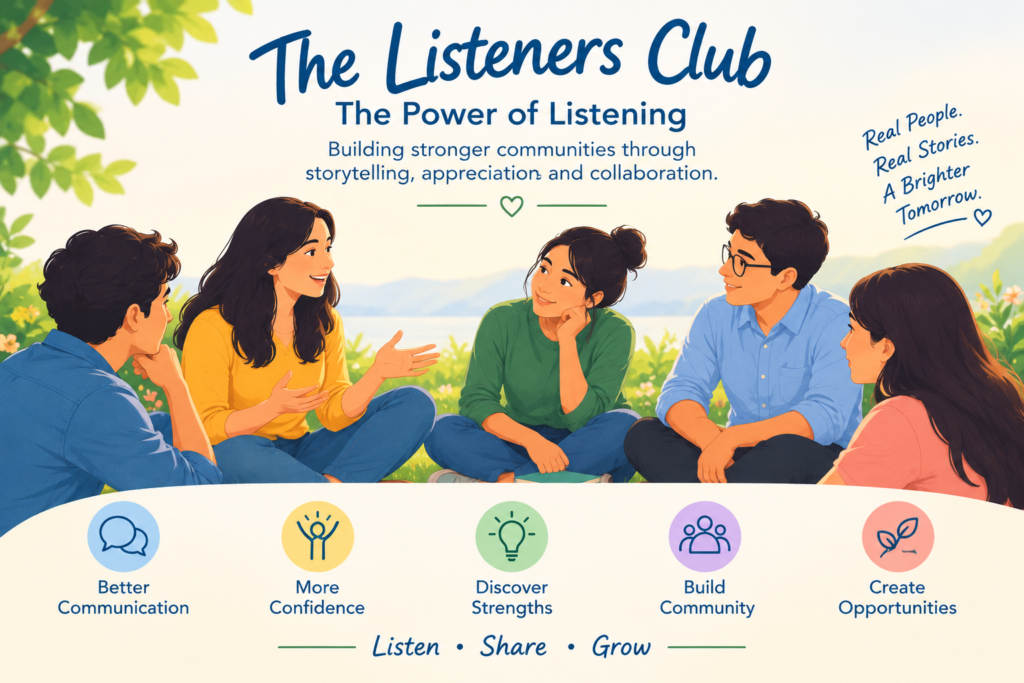
A Listeners Club meeting can begin with a small group of at least five participants. The suggested group size is generally five to ten people, allowing everyone to participate meaningfully. The core activity takes place in pairs. One person shares a story or personal experience while the other listens attentively, without interrupting. The participants then exchange roles so that everyone has the opportunity to speak and listen. When the group has an odd number of participants, one person may take on an observer role, depending on the meeting format.
A typical one-hour session can include three activities:
- Storytelling and appreciative listening: Participants share their experiences in pairs, allowing each person to speak and be heard with undivided attention.
- Strength identification: After listening to a person’s story, the appreciative listener identifies the speaker’s strengths. These may include courage, perseverance, creativity, compassion, leadership, problem-solving, or the ability to overcome challenges. The group can then reflect on these strengths in a supportive manner.
- Future planning: Participants explore how they can use their identified strengths in meaningful ways. They may develop ideas for community projects, student engagement, motivational sessions, educational activities, or other collaborative initiatives.
The format can be adapted to suit the needs of different groups. The emphasis is not on following a rigid structure but on creating a meaningful experience that encourages reflection, connection, and action.
3. From Listening to Discovering Strengths
One of the most important aspects of the Listeners Club is its focus on appreciative listening. When people tell their stories, they often reveal strengths that they may not have consciously recognised in themselves. A story about overcoming a difficult situation, for example, may reveal resilience. An experience of helping someone may demonstrate empathy and responsibility. A personal challenge may reveal determination and adaptability. An appreciative listener helps bring these qualities to the speaker’s attention.
This process can encourage self-awareness and confidence. It can also help participants recognise the strengths of others instead of focusing only on their limitations. As the group meets repeatedly, participants may begin to identify shared interests, complementary skills, and opportunities to work together. In this way, listening becomes a foundation for building relationships and discovering human potential.
4. Taking the Initiative to Schools and Colleges
Schools and colleges are important spaces in which the Listeners Club can make a meaningful contribution. Students often need opportunities to express themselves, develop communication skills, build confidence, and learn to understand different perspectives. Storytelling and attentive listening can provide a practical way to encourage these abilities.
Through carefully facilitated sessions, students can practise expressing their thoughts, listening respectfully to their peers, and recognising the strengths of others. The initiative could eventually support activities related to communication, concentration, teamwork, leadership, career exploration, and student mentoring.
One possible extension is team mentoring, in which a small group of students receives guidance and encouragement to develop their strengths and explore constructive ways of contributing to their communities. These activities should complement existing educational programmes and be conducted in a manner appropriate to students’ ages, needs, and privacy.
5. Building Listening Circles Across Communities
An important principle of the initiative is that people do not need to wait for a large organisation, formal venue, or elaborate event to begin. A listening circle can start with five people who are willing to meet and participate. It may take place in a home, a suitable community space, a garden, a park, or a café where the environment allows comfortable conversation.
The immediate priority is to bring together interested people and create a consistent practice of listening. As more people become involved, additional circles can emerge in different neighbourhoods and communities. Each participant can become a local point of connection, inviting others and helping them experience the value of appreciative listening.
This approach allows the initiative to grow organically. Rather than concentrating all activities in one location, it encourages people to build relationships and establish listening circles within their own networks. Where a school, college, organisation, or other institution is involved, the necessary arrangements should be made in advance.
6. Creating Opportunities for Collaboration
The Listeners Club is also envisioned as a platform for bringing people with different skills, experiences, and interests together. A participant may be passionate about education, another may have experience in healthcare, and someone else may possess expertise in communication, entrepreneurship, or community development. Through repeated meetings, these individuals can discover opportunities to collaborate.
For example, a group might decide to conduct storytelling sessions for students, organise workshops for women, support community awareness programmes, or create opportunities for people to share their professional experiences. The key idea is that collaboration can emerge naturally when people have the opportunity to understand one another.
Instead of beginning with a complicated organisational structure, the initiative begins with human connection. As trust develops, participants can identify common goals and determine what they would like to accomplish together.
7. A Three-Circle Approach: Connection, Mutual Support, and Business
The conversation also introduced a three-circle approach to participation and growth.
- The inner circle: Connection without commercial pressure
The first circle focuses on building relationships, practising listening, and supporting one another. The basic Listeners Club activity is intended to be free, with no participation fee. The emphasis is on trust, human connection, and team formation.
- The second circle: Referral and mutual support
As relationships deepen, participants may refer people to one another, share useful opportunities, and provide mutual assistance. The focus remains on helping one another rather than directly commercialising the relationships.
- The third circle: Business and revenue generation
Once the community has developed meaningful connections, participants may explore professional and commercial opportunities. One proposed example is Breakfast with Global TV, a platform where successful individuals share their stories and experiences. Such events could create opportunities for participants to develop skills in hosting, interviewing, recording, communication, and event coordination.
The conversation discussed a possible participation fee of ₹5,000 for such an event. An illustrative revenue-sharing model would allocate ₹1,000 towards the breakfast and ₹1,000 towards recording and editing, leaving ₹3,000 to be shared among the agreed participants and organisers.
These figures represent a proposed model rather than a confirmed or universal pricing structure. Any event should clearly communicate its fees, expenses, and revenue-sharing arrangements in advance. The broader principle is that the free listening initiative and any future paid activities should remain clearly distinguished. The community can begin with service and connection while exploring sustainable ways to support its work over time.
8. The Role of Global TV in Supporting the Initiative
Global TV was presented in the conversation as a potential support platform for the growing network. Possible forms of support include sharing articles, publicising socially beneficial activities, connecting participants with others, and providing opportunities to showcase initiatives that contribute positively to society. Participants who demonstrate commitment and initiative may also have opportunities to develop their abilities as hosts, interviewers, speakers, and facilitators.
These possibilities can help the Listeners Club expand its reach while enabling individuals to develop practical communication and leadership skills. The emphasis is on using available networks and resources to support people who are genuinely working towards positive social change.
9. Starting Small, Learning, and Growing
One of the strongest messages from the discussion was the importance of action over excessive planning. There is no need to wait until every detail has been finalised. Interested individuals can begin by identifying a few participants, choosing a convenient location, and conducting their first listening session.
The early meetings can help organisers understand what works well, what participants need, and how the format can be improved. Feedback from participants can guide subsequent sessions. Over time, the initiative can develop clearer procedures, stronger partnerships, and more structured programmes for schools, colleges, and community organisations.
A person who wants to initiate a listening circle can take a few practical steps:
- Speak to people who may be interested in the idea.
- Explain the purpose of the Listeners Club and how the activity works.
- Identify a suitable location and gather a small group.
- Conduct a session focused on storytelling and appreciative listening.
- Reflect on the experience and invite participants to suggest future activities.
- Build connections with interested people and establish additional circles when there is sufficient interest.
The approach is straightforward: start with the people available, learn from the experience, and allow the initiative to grow through genuine participation.
Listening as a Foundation for a More Connected Society
The Listeners Club offers a simple but meaningful reminder that positive change often begins with the way people relate to one another. When individuals feel heard, they have an opportunity to reflect, express themselves, and recognise their own strengths. When people learn to appreciate the strengths of others, they can begin to build relationships based on trust and mutual respect. And when those relationships develop into collaboration, they can lead to practical initiatives that benefit communities.
The vision is not simply to create a series of listening sessions. It is to cultivate a culture in which listening, storytelling, appreciation, and shared responsibility become everyday practices. By starting small, engaging with schools and communities, and encouraging people to take initiative, the Listeners Club can become a network of individuals who learn from one another and work together towards meaningful goals. The greatest value of listening is to help people to discover themselves.


