
India needs leaders who do not merely appeal for organ donation but personally lead by example.
Author: Rtn Lal Goel
Founder & Charter President
Rotary Club of Organ Donation International
Chairman
Organ Donation India Foundation & GYAN
India is a country of 1.4 billion people, rich in cultural diversity, spiritual traditions and humanitarian values. Yet, when it comes to deceased organ donation, we remain far behind many countries.
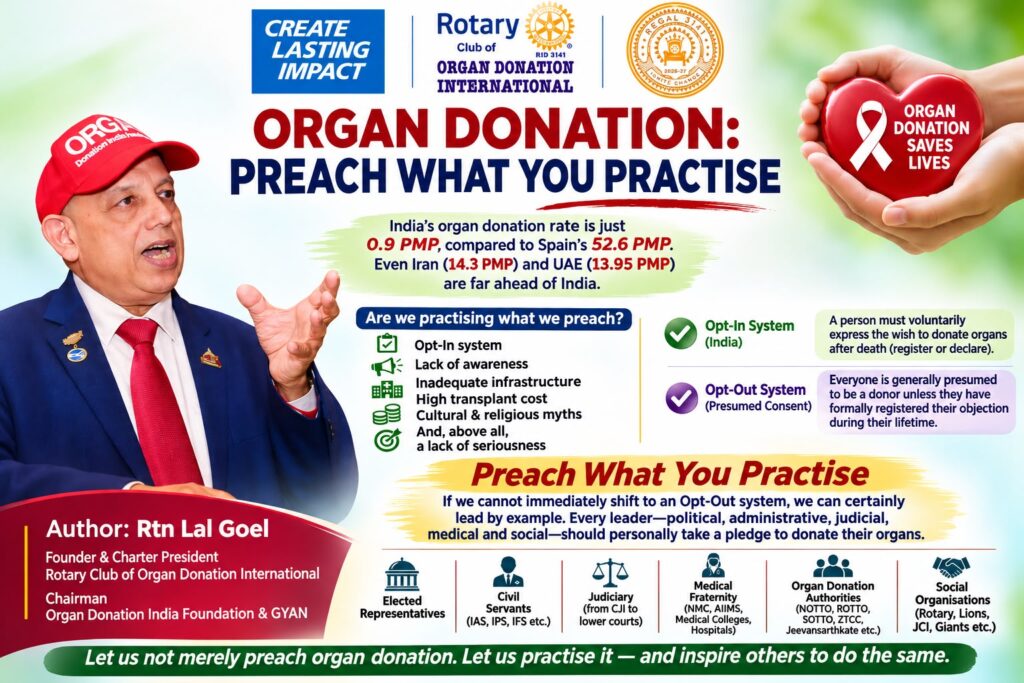
India’s deceased organ donation rate is approximately 0.9 per million population (PMP), compared with Spain’s 52.6 PMP. Even countries like Iran, at approximately 14.3 PMP, and the UAE, at approximately 13.95 PMP, are considerably ahead of us.
The Transplantation of Human Organs Act (THOA), introduced in India in 1994, was an important legislative milestone. However, nearly 32 years later, we have not achieved the progress that was expected.
Why?
There are several reasons: our Opt-In system, inadequate public awareness, insufficient organ retrieval and transplant infrastructure, high transplant costs, and persistent cultural and religious misconceptions. These are all significant challenges. But, based on my experience of more than a decade in the organ donation movement, I believe there is another fundamental problem: As a society, we are simply not serious enough about organ donation.
We organise awareness programmes, deliver speeches, distribute pledge forms and appeal to people to become organ donors. But how many of us who advocate organ donation have personally taken the pledge?
It is time to ask ourselves a difficult question: Are we practising what we preach?
Preach What You Practise
Our Honourable Prime Minister, Shri Narendra Modi, has repeatedly appealed to citizens to consider organ donation through his popular radio programme Mann Ki Baat. These appeals have undoubtedly helped bring the subject into public discussion and inspired sections of society.
However, organ donation cannot become a mass movement through the efforts of one individual or one political leader. What about our other elected representatives, political leaders, ministers, public servants, administrators, judges, medical professionals and social organisations?
Leadership is not merely about delivering messages. It is about setting examples.
When a Member of Parliament appeals to citizens to donate their organs, the impact would be far greater if that Member has personally taken the pledge. When a doctor advocates organ donation, the message becomes more convincing when the doctor has also registered as a donor. Similarly, when the head of an organisation campaigns for organ donation, the organisation’s leadership should demonstrate its commitment.
People are more likely to follow those who practise what they preach.
Opt-In versus Opt-Out: Understanding the Difference
One of the important differences between India and several countries with higher deceased organ donation rates is their approach to organ donor consent.
- Opt-In System
India follows an Opt-In system. Under this system, an individual must voluntarily express the wish to donate organs after death, usually by registering as an organ donor or making a formal declaration.
However, even when a person has pledged to donate, the family is approached and its consent is sought at the time of death. In practice, family understanding and cooperation remain extremely important.
- Opt-Out System
Under an Opt-Out system, every adult is generally presumed to have agreed to donate organs after death unless they have formally registered their objection during their lifetime.
Several European countries, including Spain, France and the UK, follow variations of this approach. The precise legal provisions and the role of families differ from country to country.
Spain, which has consistently been a global leader in organ donation, combines its legal framework with an exceptionally strong hospital-based coordination system, trained transplant professionals, effective organ retrieval networks and public trust.
India’s enormous religious, cultural, linguistic and social diversity makes any proposed change in the consent framework a complex political and social issue. There may be genuine concerns about introducing an Opt-Out system in our country.
But if political and social considerations prevent us from changing the law at present, does that mean we should simply accept the status quo?
Certainly not!
My Proposal: Let India’s Leadership Lead by Example
If we cannot immediately change the law, we can certainly change the attitude towards organ donation.
I propose that every elected representative, senior public servant, judicial officer, medical leader and head of an organisation associated with organ donation should be encouraged to take a personal pledge to donate their organs after death.
This initiative should cover:
- Political Leadership
- President of India
- Prime Minister of India
- Union Ministers and Members of Parliament
- Governors and Chief Ministers
- Members of Legislative Assemblies and Legislative Councils
- Elected representatives of municipal corporations, municipalities and Panchayati Raj institutions
- Administrative Leadership
- Senior civil servants, including IAS, IPS and IFS officers
- Secretaries and senior government officials
- District Collectors and other district-level administrators
- Judiciary
- Chief Justice of India and Supreme Court judges
- Chief Justices and judges of High Courts
- Judicial officers serving in district and subordinate courts
- Medical Leadership
- National Medical Commission (NMC)
- AIIMS and other premier medical institutions
- Deans and principals of medical colleges
- Directors and medical superintendents of government and private hospitals
- Doctors, nurses and other healthcare professionals
- Organ Donation Authorities and Institutions
- National Organ and Tissue Transplant Organisation (NOTTO)
- Regional Organ and Tissue Transplant Organisations (ROTTOs)
- State Organ and Tissue Transplant Organisations (SOTTOs)
- Zonal Transplant Coordination Centres (ZTCCs)
- Jeevasarthakathe and other state-level organ donation networks
- All institutions involved in organ retrieval, allocation and transplantation
- Social and Voluntary Organisations
Organ donation awareness cannot remain confined to medical institutions. It must become a people’s movement.
Organisations such as Rotary, Lions, JCI, Giants and other NGOs working in social service should take the initiative. At the very least, their national, district and club-level leaders, including District Governors, Presidents and other office-bearers, should personally pledge to donate their organs.
This should be a voluntary, informed and publicly encouraged commitment, supported by proper donor registration and family communication.
Imagine the impact if the President, Prime Minister, Chief Ministers, Members of Parliament, senior bureaucrats, judges, leading doctors and social organisation leaders collectively came forward to take this pledge!
It would send a powerful message across the country.
From Individual Pledges to a National Movement
I am not suggesting that taking a pledge alone will solve India’s organ donation crisis. We also urgently need:
- More organ retrieval centres and transplant facilities across the country.
- Better coordination between hospitals, NOTTO, ROTTOs and SOTTOs.
- Greater public awareness, particularly in schools and colleges.
- Affordable and accessible transplantation for economically weaker sections.
- Training of doctors, nurses, police personnel and hospital coordinators.
- Transparent organ allocation and stronger public confidence.
- Greater involvement of religious leaders, celebrities, media and civil society.
The government must take a much more proactive approach. Organ donation should become a national public health priority rather than an occasional awareness campaign.
However, the first step towards creating public confidence must come from those who occupy positions of influence.
Let Us Practise Before We Preach
India has the potential to become a global leader in organ donation. We have the population, medical talent, healthcare institutions, technology and social organisations. What we urgently need is stronger leadership, collective commitment and a sense of responsibility.
For years, we have been telling people that organ donation is the greatest gift of life. It is time that those of us who deliver this message demonstrate our own commitment.
Let every leader, every doctor, every public servant and every social worker ask themselves one simple question:
Have I personally taken the pledge to donate my organs?
If the answer is yes, you have every moral right to encourage others to follow.
If the answer is no, perhaps it is time to lead by example.
Let us not merely preach organ donation. Let us practise it.
PREACH WHAT YOU PRACTISE — AND PRACTISE WHAT YOU PREACH.
That is how we can build public trust, inspire millions and make India a true Vishwa Guru in the field of organ donation.


