
When Professionalism Becomes Your Core, Transformation Follows | Global TV
NV Paulose, Chairman, Global TV +91 98441 82044
Transformation in institutions is often discussed as if it begins with strategy, policy, or financial restructuring. In reality, it begins much deeper. It begins when professionalism is no longer an external expectation but an internal standard. Change begins to unfold naturally when it becomes part of a leader’s thinking, behaviour, and discipline.
Mangalore Catholic Cooperative Bank. A century old institution rooted in community service has, in recent years, redefined its direction and performance. At the center of the shift is Sahakari Ratna Anil Lobo, whose leadership has quietly but firmly reshaped the bank’s identity.
MCC Bank was established in 1912 with a purpose of serving people who needed accessible and reliable financial support. Over the decades, it built credibility and trust across Dakshina Kannada and surrounding regions. However, like many long-standing cooperative institutions, it reached a stage where stability began to outweigh progress. Growth slowed, expansion paused, and modernization lagged behind the pace of the wider banking sector. When Anil Lobo assumed leadership, he did not enter as an outsider with theoretical ideas. He came with years of experience as a director within the same institution.
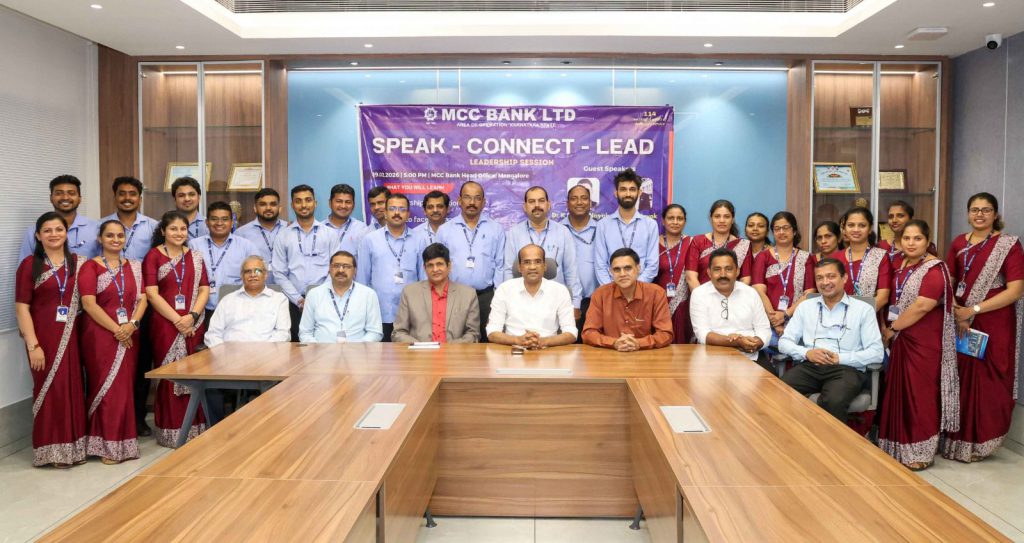
He understood its systems, its strengths, and its limitations. More importantly, he understood that real change would not come from isolated decisions but from a consistent shift in standards. His approach was simple in principle but demanding in practice. Professionalism had to become the foundation of every function within the bank.
One of the earliest signs of this shift was visible in expansion. For over two decades, the bank had seen little movement in terms of branch growth. Under his leadership, that changed with intent and clarity. New branches were opened in key locations, increasing the total network significantly within a short period. This expansion was not carried out for visibility alone. It reflected renewed institutional confidence. It allowed the bank to reach new communities, strengthen its regional presence, and demonstrate that it was ready to grow again.
Expansion, in this context, became a signal that the bank had moved out of inertia and into action. Financial performance began to reflect and the bank recorded its highest ever net profit, crossing ten crore rupees. Total business exceeded fifteen hundred crore rupees. These figures were not the result of aggressive risk taking. They were built on structured improvements in lending, monitoring, and recovery.

What stands out in this phase is the balance that was maintained. Growth did not come at the cost of stability. The bank continued to hold strong financial indicators, which included
- A capital adequacy ratio above regulatory expectation
- A controlled and low level of nonperforming assets (NPA)
- Consistent profitability supported by disciplined operations
These are not small achievements in the cooperative banking space. They reflect a system that is not only growing but doing so with responsibility and control. At the same time, modernization was treated as essential, not optional. Banking had already entered a digital phase, and any delay in adaptation would have widened the gap between customer expectations and service delivery. Recognizing this, Anil Lobo ensured that technology was integrated across operations.
Core banking systems were implemented across all branches. Customers were given access to digital transaction facilities, including online transfers and internet banking. ATM services were expanded, and further digital services were prepared for rollout. These changes improved efficiency internally and enhanced trust externally.
However, systems alone do not define an institution. The real measure lies in how it connects with people. In this area, the leadership approach remained direct and grounded. Customer interactions were not left to routine processes. Meetings were organized across branches, giving customers an opportunity to voice concerns and share feedback.

This created a different kind of relationship between the bank and its customers. It reduced distance. It replaced assumption with understanding. Most importantly, it signalled that the institution was willing to listen and respond. A similar focus was placed on the internal team. Employees were not expected to adapt without support.
A structured training environment was introduced to improve skills and align staff with evolving expectations. Regular reviews ensured that performance was monitored and guided. Employee welfare was also given importance. Health and accident insurance coverage provided a sense of security. These measures contributed to a work environment where employees felt supported, which in turn influenced the quality of service delivered. Even as the bank focused on growth and efficiency, it did not move away from its social responsibility.
Financial assistance programs continued to support families in need, covering areas such as education, healthcare, and essential life expenses. This balance between financial discipline and social commitment preserved the original spirit of the institution.
Recognition followed these efforts in a natural way. In the board elections, the leadership panel was elected without opposition, reflecting strong confidence among members. The conferment of the Sahakara Ratna Award by the Government of Karnataka further acknowledged the impact of this leadership.
Yet, beyond awards and numbers, the real transformation lies in a shift that is less visible but more powerful. MCC Bank moved from functioning as a traditional institution maintaining stability to operating as a focused organization pursuing growth with clarity and discipline.
Looking ahead, the direction remains steady. Plans for further expansion are already in place. Digital services will continue to improve. Support for small businesses and entrepreneurs will expand. The objective is not only to increase scale but to strengthen relevance in a changing financial environment.
The leadership journey of Anil Lobo offers a clear lesson. Institutions do not transform because of occasional effort. They transform when standards change at the core. When professionalism becomes part of everyday thinking, it influences decisions, shapes systems, and builds trust over time. This is not a dramatic process. It is steady, consistent, and often quiet. At MCC Bank, professionalism is a culture. And once it became a culture, transformation is something inevitable.


