SENIOR CITIZENS CAN TRANSFORM FAMILY CONVERSATIONS ON ORGAN DONATION: ROTARIAN LAL GOEL
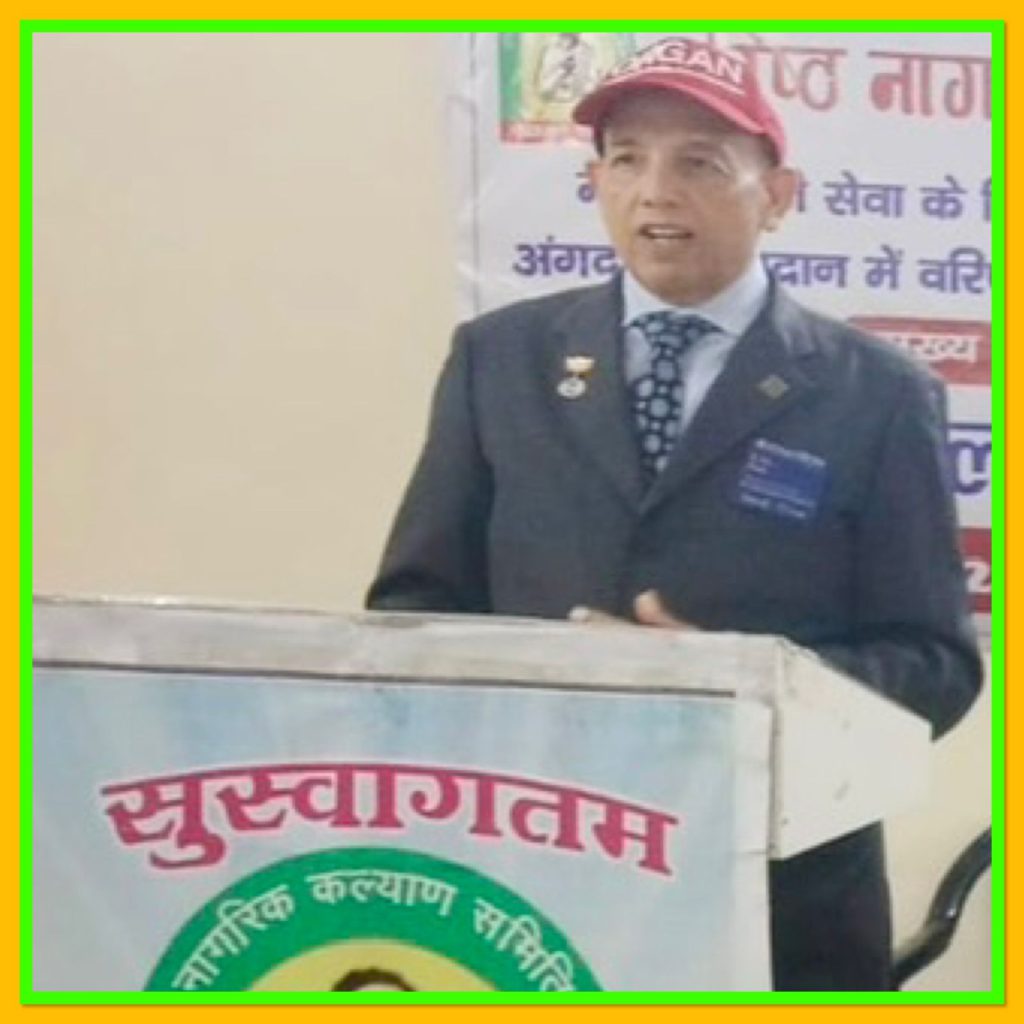
Mathura, 25 April 2026 — Delivering a powerful and heartfelt message, Rotarian Lal Goel, Founder & Charter President of the Rotary Club of Organ Donation International and Chairman of the Organ Donation India Foundation & GYAN, urged senior citizens to become catalysts of change within their families by championing the cause of organ donation.
Addressing a gathering at the Senior Citizen Welfare Society Mathura as Chief Guest and Keynote Speaker, he emphasised that the influence of elders within Indian families is profound — and when they speak, generations listen.
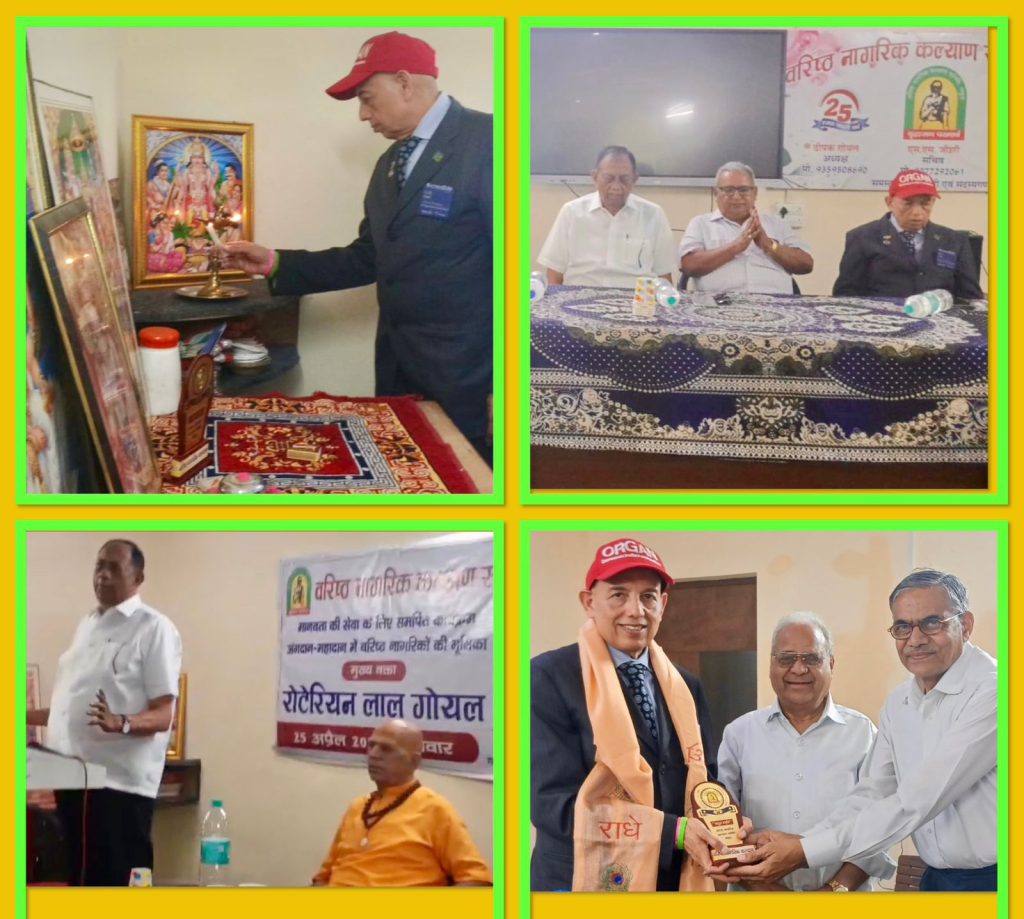
The programme commenced with the traditional lighting of the lamp and the recitation of the Gayatri Mantra, setting a reflective and purposeful tone. Er S. S. Johri, Secretary of the Society, warmly welcomed the gathering and introduced the keynote speaker.
In his address, Rotarian Lal Goel clearly distinguished between organ donation, body donation, and tissue donation — dispelling common myths and encouraging informed decision-making. He urged senior citizens not to underestimate their moral authority, but to actively initiate conversations within their families — during daily interactions, walks, and moments of togetherness.
With particular emphasis, he highlighted the unique emotional bond between grandparents and grandchildren, noting that this connection can become a powerful force in shaping family decisions.
Grounding his message in real stories of courage and compassion, he acknowledged individuals who had led by example. Shri S. K. Kansal was appreciated for donating his wife’s organs in Pune, while Rotarian Shreyansh Prasad Jain was commended for his timely efforts in facilitating the eye donation of Late Shri Suresh Chand Jain in Ghaziabad. “When elders lead with conviction,” he said, “families follow with trust.”
Rotarian PHF Deepak Goel, President of the Society and Foundation Chair of the Rotary Club of Organ Donation International, expressed gratitude for the inspiring session. He highlighted the urgent need to strengthen awareness and infrastructure in Mathura, noting that even body and tissue donations often face challenges due to systemic gaps. He expressed confidence that such initiatives would spark meaningful change within families and the wider community.
The interactive session that followed saw enthusiastic participation, with attendees raising thoughtful questions that were addressed in detail.
Shri Gopal Sharan, Shri Raman Lal Gupta, Shri Suresh Chand Gaur, Sushri Usha Bhargava, Sushri Uma Sharma, and Dr Madhubala Garg, were present amongst others.
The programme concluded with a felicitation ceremony, where Rotarian Dr D. P. Goyal, Er Radhey Shyam Bansal, and Shri Suresh Sharma honoured Rotarian Lal Goel for his unwavering commitment to the cause.
In his closing remarks, Rotarian Lal Goel expressed sincere appreciation to the Society for organising the awareness programme at short notice — reaffirming that the spirit to save lives must always rise above circumstances, even the intense summer heat.
Nitte Vinaya Hegde | A Leader of Contrasts and an Architect of Education | Champion of Social Empowerment | Global TV
NV Paulose, Chairman, Global TV +91 98441 82044
Nitte (Deemed to be University) is set to host the prestigious Nitte Vinaya Hegde Oration 2026 on 28 April 2026 at the KS Hegde Auditorium, Deralakatte, Mangaluru. This distinguished annual event continues to serve as a platform for national dialogue, bringing together eminent leaders to share insights on issues of national and global importance.
This year’s oration will be delivered by Nirmala Sitharaman, Hon’ble Union Minister of Finance and Corporate Affairs, Government of India, on the theme “Viksit Bharat – Vision for 2047.” The session will be presided over by N Santosh Hegde, former Judge of the Supreme Court of India and former Lokayukta of Karnataka. The event will also be graced by distinguished Guests of Honour including U T Khader and Brijesh Chowta. The oration reflects the enduring vision and legacy of Nitte Vinaya Hegde, in whose honour the series is instituted.
Celebrating the Vision of Sri Nitte Vinaya Hegde
Sri Nitte Vinaya Hegde, Chancellor of Nitte (Deemed to be University) and President of the Nitte Education Trust, is widely regarded as a visionary educationist and philanthropist. His leadership has transformed Nitte into a hub of excellence in education, healthcare, and community development.
With a strong belief that education should be both empowering and value-driven, he has nurtured institutions that combine academic rigor with social responsibility. Under his guidance, Nitte has expanded its reach across diverse disciplines while remaining committed to inclusive growth and service to society.
A Platform for Ideas and Nation-Building
The Nitte Vinaya Hegde Oration series embodies his commitment to intellectual engagement and nation-building. By inviting influential voices like Smt. Nirmala Sitharaman, the platform fosters meaningful discussions on India’s future, encouraging students and citizens alike to think critically about their role in shaping the nation.
Continuing a Legacy of Excellence
As Nitte hosts this year’s oration, it not only brings thought leadership to the forefront but also celebrates the ideals of service, leadership, and vision that Sri Vinaya Hegde represents. His enduring contributions continue to inspire generations to pursue excellence while remaining rooted in values.
Nitte Vinaya Hegde: From Industry to Education, A Journey of Vision and Values | A Life of Excellence, Collaboration, Compassion and Vision | Global TV
NV Paulose, Chairman, Global TV +91 98441 82044
Leadership is never a matter of one quality or one approach. The greatest leaders are often those who embody paradoxes and hold together traits that appear to contradict each other. Nitte Vinaya Hegde, Chancellor of Nitte Deemed to be University and President of the Nitte Education Trust, is one such leader. His life story and his accomplishments are rooted in contrasts that complement each other. He is aggressive, progressive, and regressive all at the same time.
When it comes to his pursuit of excellence, he is super aggressive. He believes in aiming high and refuses to compromise on quality. Institutions that bear his imprint are known for setting standards that are constantly elevated. Mediocrity has no space in his world.
Yet, when it comes to teamwork and collective wisdom, he is profoundly progressive. He values the insights of others, encourages collaborative decision making, and understands that leadership is never a one man show. He respects colleagues and associates, empowering them to think freely and to contribute to common goals.
At the same time, when it comes to taking decisions that may cause harm to individuals, even those far below his stature, he is regressive. He hesitates to take harsh action that might affect someone’s dignity or livelihood. Compassion guides his choices, and what might appear as conservatism to some is in fact his deeply personal philosophy of fairness.
This unusual combination; aggression in the pursuit of excellence, progressiveness in collaboration, and repressiveness in judgment against individuals, is what makes him truly unique. To understand Nitte Vinaya Hegde, one has to look at his life journey, his achievements in industry and education, and his philosophy that balances ambition with humanity.
Early Life and Heritage Nitte Vinaya Hegde was born into a family of distinction in coastal Karnataka. His father, Justice K. S. Hegde, was one of the most respected jurists and public leaders of modern India. Justice Hegde had served as a Judge of the Supreme Court of India, later became the Speaker of the Lok Sabha, and went on to establish the Nitte Education Trust with a vision to use education as a force for social transformation.
From such a family, young Vinaya Hegde inherited not only a legacy of service but also a vision for the future. Yet, he never remained in the shadow of his father’s reputation. He was determined to make his own mark, not by wielding inherited influence but by demonstrating capability and creating opportunities for others.
His early years were shaped by the values of humility, hard work, and responsibility. Justice Hegde, though a towering public figure, ensured that his children grew up grounded in culture and social consciousness. These values later became central to the philosophy of Vinaya Hegde, influencing how he approached both business and education.
The Industrial Journey Before stepping fully into education, Nitte Vinaya Hegde built a strong foundation in industry. His first professional assignment was as a marketing manager at Canara Workshop in Mangalore, a company involved in manufacturing automobile leaf springs.
In 1976, along with colleagues, he co founded Lamina Suspension Products Limited, which later grew into one of India’s largest independent manufacturers of automobile leaf springs. Under his leadership, the company became part of the Lamina Group of Industries, employing more than two thousand people and achieving turnovers of more than two hundred crore rupees. The group exported more than one hundred crore worth of products to countries such as Germany, the United States, the United Kingdom, Korea, Finland, and Belgium.
This phase of his life revealed his aggressive pursuit of excellence. He set high benchmarks for performance and insisted on uncompromising quality standards. The Lamina Group became a trusted name in international markets. The discipline, global outlook, and management skills that he cultivated in industry would later become invaluable when he expanded into education.
Transition to Education The turning point came in 1979 when he assumed leadership of the Nitte Education Trust, founded by his father. What began as a small initiative with limited resources grew, under his stewardship, into one of the largest educational networks in Karnataka.
His vision was simple yet profound: education should be holistic, inclusive, and transformative. It should provide not just degrees but also skills, confidence, and character. He believed that education should not only create professionals but also socially responsible citizens.
From modest beginnings, the Trust grew into a network of schools, colleges, and professional institutions. Today it offers programs in engineering, medicine, dental sciences, pharmacy, nursing, management, architecture, hotel management, journalism, and many other fields. More than twenty thousand students study in its institutions each year, guided by over one thousand faculty members.
Establishing Nitte University The crowning glory of his educational journey came in 2008, when the Ministry of Human Resource Development conferred university status on the group of institutions under the Trust. Nitte Deemed to be University was thus born, with Vinaya Hegde as its Chancellor.
Within just four years, the university achieved an A grade accreditation from the National Assessment and Accreditation Council. This was a remarkable achievement for a young university and a testimony to the standards of excellence he insisted upon.
Under his guidance, Nitte University expanded its academic programs, established research centers, and entered into collaborations with international universities. It became known not only for professional education but also for research, innovation, and community service.
Vision 2030: Project Vriddhi A leader is known not only for what he has built but also for the dreams he envisions. In this spirit, Nitte Vinaya Hegde launched Project Vriddhi, a strategic roadmap to transform Nitte University into a globally recognized institution by 2030.
The plan aims to expand student enrollment to more than thirty thousand, develop world class research facilities, strengthen innovation and start up ecosystems, and create sustainable campuses with state of the art infrastructure. It emphasizes international partnerships to ensure that students are globally competitive while remaining rooted in Indian values.
Project Vriddhi reflects his progressive side. It shows his belief that Indian universities must not remain insular but must reach out to the world, preparing students to be citizens of a globalized society.
Education Beyond Campuses For Vinaya Hegde, education is not confined to elite campuses or privileged students. He believes in extending its benefits to rural and marginalized communities.
Through the Nitte Foundation, the Trust has undertaken village adoption programs, rural health initiatives, vocational training centers, and rehabilitation programs for displaced children. The Foundation runs rural hospitals that bring healthcare to underserved communities. It also supports schools and programs for the underprivileged, ensuring that education is not a privilege of the few but a right for many.
This aspect of his work reflects his compassion and his regressive approach when it comes to harming individuals. He is reluctant to let anyone fall behind. He believes that leadership is about lifting people up rather than pushing them down.
Honours and Recognition The contributions of Nitte Vinaya Hegde have been widely recognized. He has received an Honorary Doctorate from Mangalore University for his outstanding contributions to education and industry.
His earlier recognitions include the Udyogapathra Award, the Kanara Chamber of Commerce and Industry Award, the Outstanding Manager Award for Dakshina Kannada and Udupi districts, and the Best Public Relations Person Award.
But more than awards, it is the living legacy of thousands of alumni, spread across the world, who serve as the true recognition of his impact. Doctors, engineers, entrepreneurs, researchers, and professionals who studied in Nitte institutions carry forward his vision and values in their careers and lives.
The Man Behind the Leader To understand Nitte Vinaya Hegde is to understand the balance of contrasts that define him. He is aggressive when he sets goals for himself and his institutions. He is progressive when he collaborates with colleagues and builds teams. He is regressive when it comes to hurting individuals or making decisions that may adversely affect people.
This rare blend is not a contradiction but a harmony. It is what has allowed him to build institutions of excellence without losing sight of compassion. It is what has made him a tough industrialist and a gentle educationalist. It is what has given him both respect and affection.
Legacy and the Road Ahead
If his father Justice K. S. Hegde laid the foundation of the Nitte Education Trust, it is Vinaya Hegde who built the grand edifice. Under his guidance, Nitte has grown from a regional initiative into a nationally and internationally respected brand in education.
His legacy is not just in the physical campuses or the rankings of the university. It is in the culture of excellence, collaboration, and compassion that defines Nitte institutions. It is in the lives of students who were given opportunities they might never have dreamed of. It is in the communities uplifted by healthcare, education, and vocational programs.
As he continues to guide the university and the Trust, his vision remains clear. Education must prepare young people not just for jobs but for life. It must make them competent professionals and also responsible citizens. It must open doors to global opportunities and also cultivate a sense of service to society.
Nitte Vinaya Hegde is not an easy leader to define. He is many things at once. He is an industrialist who built successful companies. He is an educationalist who shaped a university of repute. He is a philanthropist who extended education and healthcare to rural communities. And above all, he is a leader of contrasts—aggressive in his pursuit of excellence, progressive in his embrace of collaboration, and regressive in his reluctance to harm others.
In a world that often seeks simple definitions, his life is a reminder that greatness often lies in complexity. It is the paradoxes that make him unique, and it is the harmony of those paradoxes that make him enduring.
Nitte Vinaya Hegde is not just a leader of his time. He is a leader of contrasts, and in those contrasts lies his enduring strength and his lasting legacy.
The Power of the Media Combine: How Three Media Establishments Can Collaborate Globally with Global TV
NV Paulose, Chairman, Global TV +91 98441 82044
In an increasingly interconnected world, the media landscape is no longer limited by geography, size, or legacy influence. Today, even small and mid sized media establishments have the opportunity to expand their reach and deepen their impact through collaboration. One of the most effective ways to achieve this is through the concept of a Media Combine, where three independent media organizations come together to operate as a unified force. When this combine collaborates with Global TV, the possibilities for growth, learning, and global recognition expand dramatically.
A Media Combine is built on a simple but powerful idea. Any three media establishments can join together with a shared purpose and a commitment to collaboration. These organizations can be local television stations, digital news platforms, independent journalists, podcast networks, or niche content creators. What matters most is not their size, but their willingness to align their goals and work together.
Each organization brings its own strengths to the table. One may excel in investigative reporting, another in visual storytelling, and the third in audience engagement through digital platforms. Individually, they operate within certain limits. Together, they become stronger, more dynamic, and more capable of producing meaningful content that resonates with a broader audience.
The real transformation begins when this Media Combine partners with Global TV. This collaboration opens the door to a vast and powerful ecosystem that includes hundreds of exceptional institutions and thousands of brilliant mentors from around the world. It is not just a partnership. It is an entry into a global network designed to elevate media organizations and empower them to perform at a higher level.
One of the most valuable benefits of collaborating with Global TV is access to mentorship. The media industry is evolving rapidly, with constant changes in technology, audience expectations, and content formats. Many organizations struggle to keep up with these changes. Through Global TV, members of a Media Combine can connect with experienced mentors who provide guidance based on real world experience. These mentors help refine strategies, improve content quality, and navigate challenges with greater confidence.
In addition to mentorship, the access to hundreds of institutions creates new opportunities for collaboration and growth. These institutions may include universities, research centers, global media organizations, and cultural platforms. By connecting with them, Media Combine members can participate in joint projects, gain access to valuable knowledge resources, and contribute to important global conversations.
Another major advantage is the expansion of audience reach. When three media establishments unite and collaborate with Global TV, their content gains access to a global distribution network. This means stories created in one region can reach audiences across continents. It allows local voices to be heard on a global stage and encourages a deeper understanding of diverse perspectives.
This broader reach also enhances credibility. Being associated with Global TV signals quality, professionalism, and trust. For emerging media organizations, this can significantly strengthen their reputation. It builds confidence among audiences, attracts partnerships, and creates new opportunities for revenue and sustainability.
Collaboration within the Media Combine itself also drives innovation. When different teams come together, they share ideas, experiment with new formats, and approach storytelling from multiple angles. This leads to more engaging and impactful content. It also improves efficiency, as resources and expertise are shared rather than duplicated.
Equally important is the shift in mindset that comes with forming a Media Combine. Instead of competing for attention, organizations begin to focus on contribution and impact. They prioritize serving their audience, creating meaningful content, and supporting one another. This approach fosters a culture of trust, creativity, and continuous improvement.
This mindset aligns closely with the vision of Global TV. The platform is not just about distributing content. It is about building a global community that values knowledge, integrity, and collaboration. By becoming part of this ecosystem, Media Combine members contribute to a larger mission of strengthening journalism, empowering communities, and creating a better future.
Another strength of this model is its inclusivity. Media establishments from any part of the world can participate. Whether they are based in large cities or smaller regions, they have equal access to the opportunities provided by Global TV. This ensures that a wide range of voices and perspectives are represented, enriching the global media landscape.
Of course, forming a successful Media Combine requires commitment and discipline. Clear communication, mutual respect, and a shared vision are essential. Each organization must be willing to adapt and support the others. Challenges may arise, but with a strong foundation and a collaborative spirit, these challenges can be overcome.
The rewards of this approach are significant. Media organizations gain access to knowledge, expand their reach, enhance their credibility, and create more meaningful content. They also become part of a global network that supports their growth and development.
In conclusion, the Media Combine represents a powerful and practical model for the future of media. It shows that collaboration is not just an option, but a strategy for success. By bringing together three media establishments and connecting them with Global TV, it is possible to unlock opportunities that would otherwise remain out of reach.
It only takes three organizations to begin this journey. With the right mindset and the support of Global TV, they can grow beyond their limitations, connect with exceptional institutions, learn from brilliant mentors, and reach audiences around the world.
Together, they can build something far greater than individual success. They can create a collective force that advances storytelling, strengthens journalism, and contributes to a better tomorrow.
Strengthening the Start-up Ecosystem: Rohan Corporation seals Joint Venture with Rainmakers Workspace
NV Paulose, Chairman, Global TV +91 98441 82044
Mangaluru: In a significant development for the city’s commercial landscape, a joint venture agreement has been signed by Rohan Corporation and Rainmakers Workspace India Pvt. Ltd. to launch a modern workspace on the 4th floor of Rohan Square.
On the occasion, Managing Director Dr. Rohan Monteiro and Director Mr. Dion Monteiro were present and signed the agreement with Rainmakers Workspace India Pvt. Ltd. Managing Director Mr. Paneesh Rao and Mr. Shreekar. The collaboration marks a new chapter for Mangaluru’s growing business and start-up ecosystem.
Speaking on the occasion, Dr. Rohan Monteiro said, “We aim to introduce modern and innovative workspace solutions in Mangaluru. This joint venture with Rainmakers Workspace will provide a strong platform for start-ups and young entrepreneurs.”
Mr. Paneesh Rao, Managing Director of Rainmakers Workspace India Pvt. Ltd. stated, “Mangaluru is emerging as a fast-growing business hub. The launch of our working space here will offer a creative and collaborative environment for the new generation of entrepreneurs.”
The initiative is expected to further boost the startup ecosystem in Mangaluru and contribute to increased business activity and opportunities in the region.
From Nail Biting to Brilliant Speaking Using NLP Techniques | Global TV
NV Paulose, Chairman, Global TV +91 98441 82044
Do you struggle with nail biting, anxiety, or low confidence in public speaking? You are not alone. Many people deal with nervous habits that come from deeper subconscious patterns. The good news is that these behaviours can change.
With the help of Neuro Linguistic Programming, you can break free from limiting habits and grow into a confident and effective speaker. You will learn how NLP techniques can help you stop nail biting, reduce anxiety, and build strong public speaking confidence.
What is Neuro Linguistic Programming
Neuro Linguistic Programming, often called NLP, is a method that explores how your thoughts, language, and behavior are connected. It focuses on helping you change internal patterns so you can achieve better results in life.
NLP is commonly used for:
Changing habits such as nail biting
Building confidence
Managing stress and anxiety
Improving communication skills
Personal growth and development
Why Nail Biting Happens
Nail biting is more than just a habit. It is often linked to:
Stress and anxiety
Nervous energy
Boredom
Subconscious coping patterns
Instead of trying to simply stop the behaviour, NLP helps you understand what triggers it and how to change the response.
How NLP Helps You Stop Nail Biting
Identifying Triggers
The first step is awareness. NLP helps you recognize the situations or emotions that lead to nail biting.
Interrupting the Pattern
Once you notice the pattern, you can interrupt it before the behavior begins. This gives you control instead of reacting automatically.
Reprogramming the Mind
Using visualization and reframing, NLP helps you replace the habit with healthier responses.
Creating Positive Associations
You can train your mind to feel calm and in control during situations that once caused stress.
Building Confidence with NLP
After breaking unwanted habits, the next step is building confidence.
NLP offers simple but powerful tools:
Visualization of successful outcomes
Positive self talk
Emotional control in stressful situations
Changing negative thoughts into empowering ones
These techniques help you move from self doubt to confidence.
Improving Public Speaking Skills
Many people fear speaking in front of others. NLP helps you manage that fear and build strong communication skills.
With practice, you can:
Stay calm while speaking
Organize your thoughts clearly
Connect with your audience
Speak with confidence and clarity
When your mindset changes, your communication naturally improves.
The Connection Between Habits and Confidence
Breaking nail biting is not just about stopping a habit. It is about gaining control over your thoughts and emotions.
As you build self awareness and confidence, you begin to:
Feel more in control
Trust yourself more
Express your ideas clearly
This creates a strong foundation for personal and professional growth.
Benefits of NLP for Personal Growth
Regular use of NLP techniques can help you:
Let go of unwanted habits
Increase confidence and self belief
Reduce stress and anxiety
Improve communication skills
Grow in both personal and professional life
Learning in a Group Setting
Working in a group can speed up your progress.
Group sessions provide:
Practice in real situations
Support from others
Shared learning experiences
Faster improvement in confidence
You learn from theory, and from doing. Moving from nail biting to confident speaking is not about forcing change. It is about understanding and reshiring how your mind works.
With NLP, you can break limiting patterns, build confidence, and become a strong communicator. Real change begins from within. When your thinking changes, your actions follow.
Repeat and Remember
Primary:
NLP techniques
Stop nail biting
Public speaking confidence
Neuro Linguistic Programming
Secondary:
Overcome anxiety
Build self confidence
Break bad habits
Improve communication skills
Personal development
Call to Action
If you are ready to take control of your habits and build real confidence, start exploring NLP techniques today. Your transformation begins with a single step.
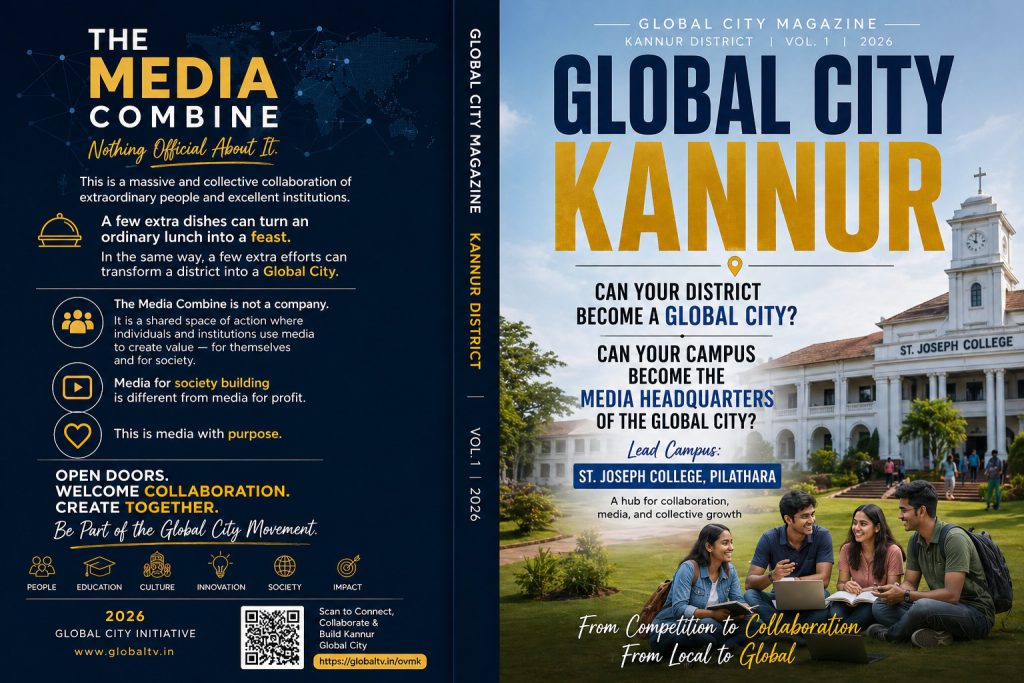
Welcome to Global City Kannur | Not a government scheme. Not a private company. Not a waiting room.
NV Paulose, Chairman, Global TV +91 98441 82044
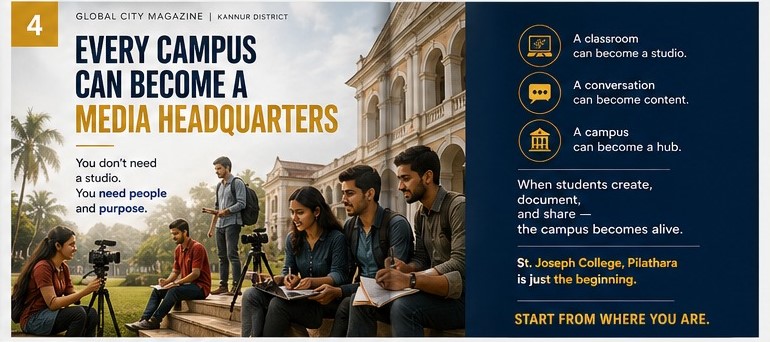
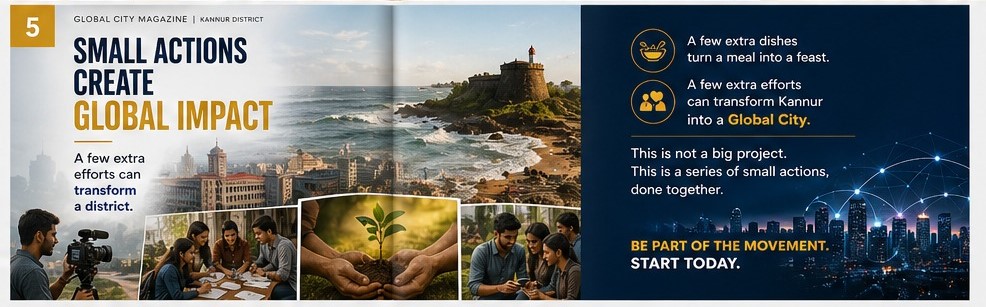
Global City Kannur is not a government scheme, a private company, or a waiting room. It is a movement. A massive, collective collaboration where ordinary people and extraordinary institutions turn small actions into global impact. We believe a few extra efforts can transform a district. A classroom becomes a studio. A conversation becomes content. A campus becomes a media headquarters. This is media with purpose, not for profit, but for people. From competition to collaboration. From local to global. From many institutions to one vision.
Open your doors. Welcome collaboration. Create together. Kannur is not just a district anymore. It is a global city in the making. Every campus can lead. Every voice matters. Every small action ripples outward. The Media Combine is your shared space to act, connect, and grow. No permission needed. No budget required. Just purpose and people. Scan the code, join the movement, and build the future. Kannur is ready. The world is watching. Start today.
Ten Principles of the Global City Movement
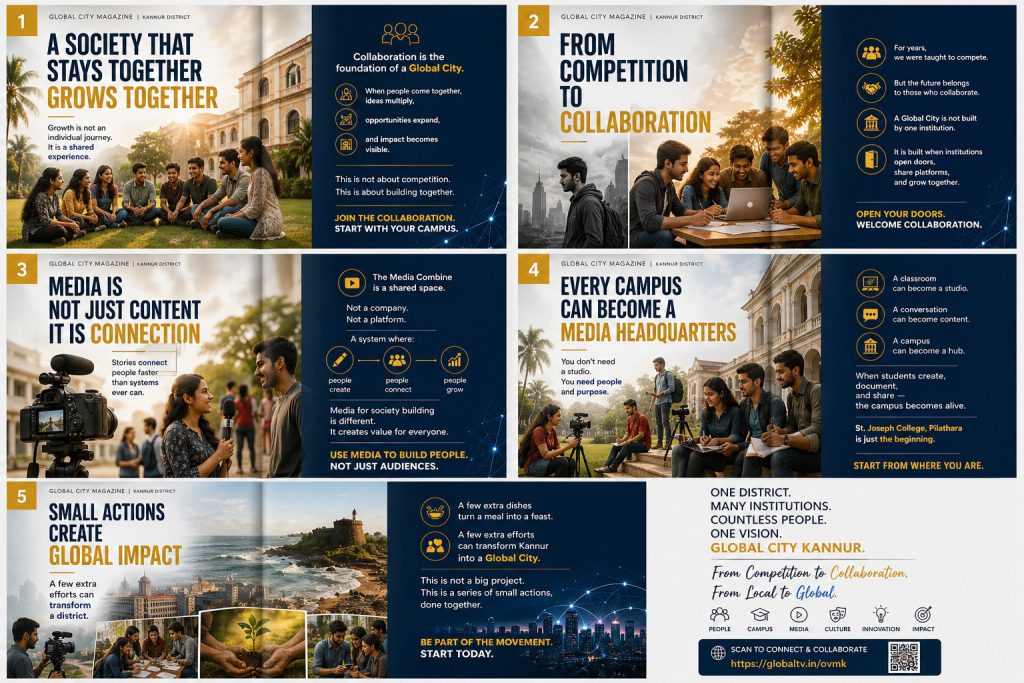
A Society That Stays Together Grows Together
Growth is not solitary. It is collective. When a society shares knowledge, resources, and encouragement, every member rises faster. Isolation slows progress, but connection accelerates it. This idea challenges the myth of the self made individual, reminding us that communities, districts, and campuses thrive when they collaborate. In Kannur, this means shifting from isolated success to shared prosperity. Whether through media, education, or local action, staying together ensures no one is left behind. True growth is measured not by individual achievement, but by how many are lifted in the process. Together, we become resilient, creative, and unstoppable.
Collaboration Is the Combination. Start with Your Campus.
Collaboration multiplies what individuals cannot achieve alone. It is not a merger or a company. It is a shared space where people create, connect, and grow together. The Media Combine model starts small, right on your own campus. When students, teachers, and local creators combine skills, equipment, and ideas, a studio emerges from a classroom. No need for big budgets, just purpose and people. Starting with your campus builds trust and momentum. From there, districts connect. Collaboration turns competition into synergy, transforming scattered efforts into a powerful, unified voice for change.
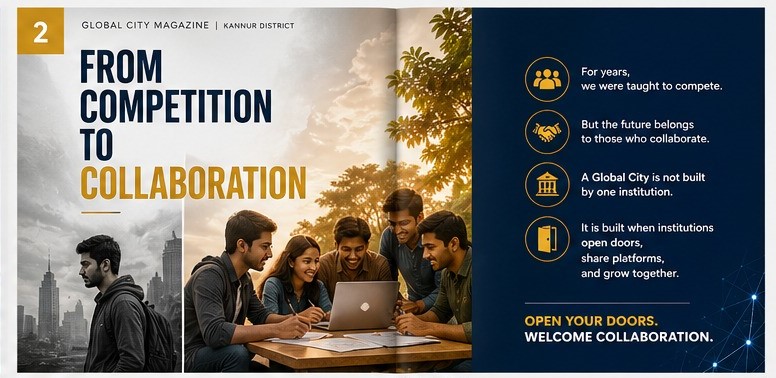
Media Is Not Just Content. It Is Connection.
Content without connection is noise. Media’s real power lies in linking people, ideas, and emotions. Stories build bridges faster than policies or infrastructure. When a student shares a campus event, or a citizen documents a local issue, they create threads of understanding. In Kannur District, media becomes a tool for unity, not just broadcasting, but listening and responding. Connection turns passive audiences into active communities. Unlike impersonal systems, stories spark empathy, trust, and collaboration. That is why Global City Magazine focuses on connection over clicks. Media that builds relationships builds lasting change.
Use Media to Build People, Not Just Audiences
Traditional media treats people as targets for ads or views. But people first media invests in growth, skills, and dignity. When you build people, you create contributors, not consumers. A student who learns to film, write, or edit gains confidence and employability. A story that highlights local heroes inspires action. This approach turns a meal into a feast. Small extra efforts yield abundance. In Kannur, building people means every campus becomes a leadership lab. Audiences are passive. People are powerful. Choose to educate, empower, and elevate through every piece of content you create.
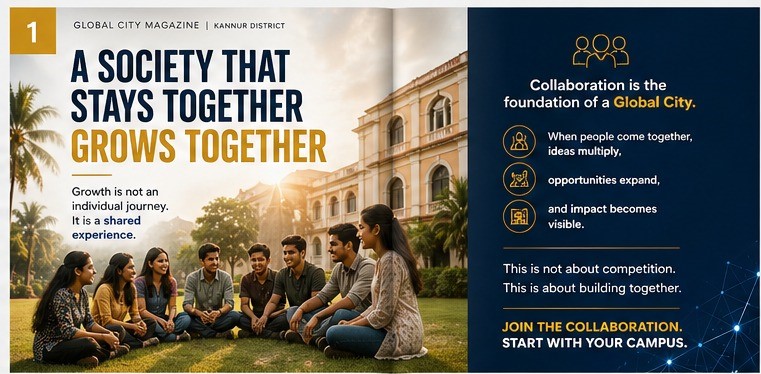
From Competition to Collaboration
Competition divides. Collaboration multiplies. In many districts, institutions compete for prestige, funding, or attention. But Global City Kannur proposes a shift, to share resources, cocreate content, and celebrate collective wins. When colleges stop rivalries and start combines, everyone benefits. A studio at one campus can serve many. A story from one student can inspire thousands. This shift is not naive. It is strategic. Collaboration reduces duplication, builds trust, and accelerates impact. From local to global, Kannur can lead by example. Moving from competition to collaboration turns scarcity into abundance and rivals into partners.
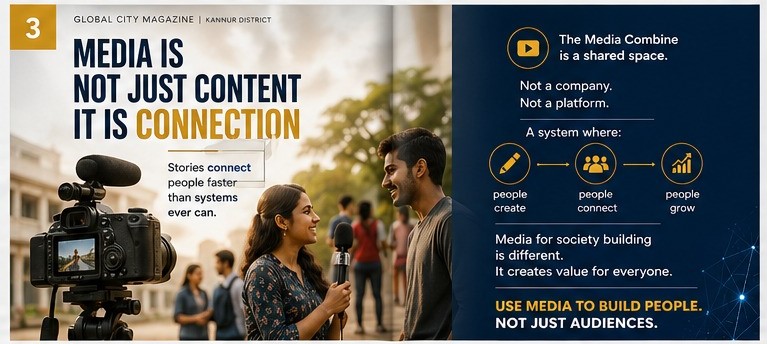
Every Campus Can Become a Media Headquarters
You do not need a professional studio to be a media hub. You need people with purpose and the will to share stories. A smartphone, a classroom, and a few motivated students are enough to start. When a campus becomes a media headquarters, learning becomes visible, local issues gain attention, and students gain real world skills. Recording events, interviewing alumni, or documenting community work turns ordinary moments into powerful content. In Kannur, every college, big or small, can produce, publish, and connect. Media headquarters are not built with money. They are built with intention and collaboration.
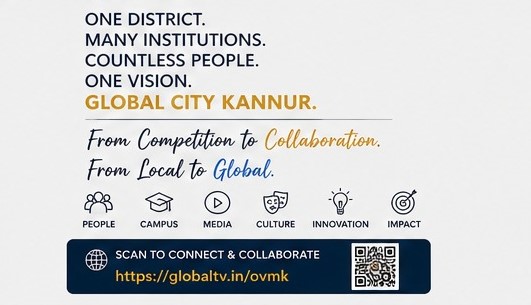
One District. Many Institutions. Countless People. One Vision: Global City Kannur
This is the unifying heartbeat of the movement. Kannur has many colleges, cultures, and voices. But one vision, becoming a Global City, aligns them. Diversity becomes strength when everyone moves in the same direction. Not uniformity, but shared purpose. Students from different campuses can coproduce, co-learn, and grow together. From local festivals to global digital content, Kannur’s identity becomes collaborative. This vision turns a district into a brand known for unity, creativity, and impact. One vision does not erase differences. It channels them toward a future where everyone belongs and contributes.
Open Your Doors. Welcome Collaboration.
A closed campus limits potential. An open campus becomes a living studio. When you invite neighbours, local creators, and other institutions in, ordinary spaces transform. A classroom becomes a broadcast set. A conversation becomes a podcast. A cultural event becomes a documentary. Welcoming collaboration means sharing wifi, microphones, and time. It means saying “yes” to joint projects. In Kannur, St. Joseph College, Pilathara has started this. Now every campus can follow. Opening doors builds trust, breaks silos, and turns isolation into innovation. Collaboration begins with one small invitation extended to another.
Small Actions Create Global Impact
You do not need a massive campaign to change the world. A few extra efforts, filming a local hero, writing a profile of a small business, recording a classroom discussion, ripple outward. Shared online, these small actions reach global audiences. They inspire other districts, attract opportunities, and build reputation. In Kannur, consistency beats scale. A single college’s weekly news update can become a district wide movement. Small actions are sustainable, low risk, and scalable. Over time, they create a library of stories that prove the district’s spirit. Global impact is just local action multiplied by many people over time.
Be Part of the Movement. Start Today.
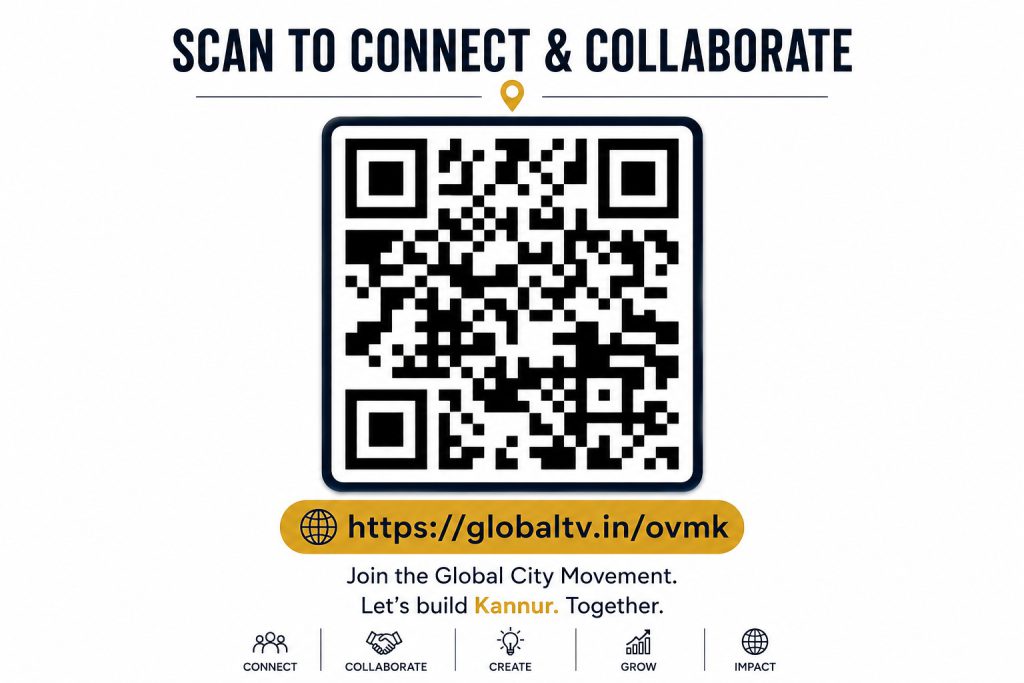
Waiting for perfect resources or permission means never starting. The movement is already alive. Scan the QR code, visit https://globaltv.in/ovmk, and connect. Starting today means filming a three-minute interview, sharing a story, a campus event, or inviting another college to collaborate. No red tape. No budget required. Every participant builds momentum. The Global City Kannur vision grows one story, one connection, one small action at a time. Do not wait for a leader. Become one. Scan, join, create, and share. The district is ready. The world is watching. Your campus, your voice, your moment is now.
Financial Crimes as Economic Models in Chronic Capital Systems | Global TV
NV Paulose, Chairman, Global TV +91 98441 82044
Money does not grow on its own. It does not multiply in isolation, nor does it create value without human effort, production, or exchange. Yet many economic systems operate under a persistent illusion that money can expand endlessly without a real foundation. This illusion becomes especially dangerous in what can be called chronic capital systems, where financial crimes are not rare disruptions but recurring patterns that shape the flow of wealth.
To understand this, it is useful to revisit a story from pre independence India, narrated by Sardar Patel. The story is not merely historical. It reveals a structure that continues to exist in different forms even today.
In a rural village under British rule, a series of thefts began to occur. Property was stolen, and the community was left in distress. Instead of protecting the villagers, the British police took a very different approach. They accused the entire village of being responsible for the crimes. As punishment, the administration imposed a collective fine on all residents. This was not a small penalty.
For a rural population already struggling, it was a heavy financial burden. The logic presented by the authorities was simple. If crime occurred within the village, then the village must bear responsibility. But this reasoning hid a deeper truth.
The villagers knew they were innocent. They also suspected something was wrong with the way the police were handling the situation. Instead of accepting the punishment quietly, they resisted. They refused to pay the fine and demanded a proper investigation. They stood together and maintained their position despite pressure from the authorities. As the resistance continued, cracks began to appear in the official narrative. A deeper inquiry revealed that the criminals were not acting separately.
They were operating with the knowledge and support of the very police who were supposed to prevent crime. The thefts had been enabled, if not directly organized, by those in power. The collective fine was not justice. It was a mechanism to extract wealth from innocent people.
Eventually, the truth came out. The collusion between the police and the criminals was exposed. The villagers were vindicated. But the episode left behind an important lesson. Crime, in this case, was not separate from the system. It was part of how the system functioned.
This historical pattern is not as distant as it may seem. The structure remains visible in modern financial systems, especially in the context of cybercrimes. Consider a common situation today. A person finds that money has been fraudulently transferred from their bank account to another account. This is a clear case of theft. In theory, the response should be immediate. The receiving account should be frozen. The money trail should be tracked instantly. Digital systems make this entirely possible. Transactions are recorded, timestamps are precise, and the path of money can be followed in real time.
But what actually happens?
The bank often refuses to take immediate responsibility. Instead of acting swiftly to freeze the funds, it directs the victim to file a written complaint with the police. The burden shifts from the institution that holds the money to the individual who has lost it.
When the victim approaches the police, another delay begins. The police may ask for time, sometimes two or three weeks, to initiate action. By the time any serious step is taken, the money has already been moved across multiple accounts, withdrawn, or converted into other forms. The trail becomes harder to follow, not because it is impossible, but because the response was deliberately slow.
Even then, it is not accurate to say the money cannot be recovered. In many cases, it still can be traced. The digital footprint exists. The system has the capacity. What is missing is the will to act. Banks, Police and Mobile Service Providers are all at fault in their basic duties.
This situation closely mirrors the earlier story. Instead of immediate protection, the system places procedural barriers. Instead of focusing on the crime, it shifts responsibility onto the victim.
A more physical example makes this even clearer. Imagine a theft where gold is stolen and sold to a jewellery shop. If the police catch the thief, they have the authority to take him to the shop and recover the stolen goods. This can be done quickly and effectively.
But whether it actually happens depends on power dynamics. If the complainant is influential, determined, or able to apply pressure, the police act decisively. The thief is taken to the shop, the gold is identified, and it is recovered. If the thief has influence, connections, or offers a bribe, the situation changes. The recovery may be delayed or avoided altogether. The system bends depending on who holds power.
This is not a failure of capability. It is a reflection of how systems are structured. The same principle applies in cybercrimes. The systems are capable of tracing transactions. Banks can flag suspicious movements. Accounts can be frozen within minutes. But action is uneven. It depends on who pushes, who insists, and who benefits from delay.
In this sense, financial crime becomes an economic model. It is not just an illegal act. It is a method through which wealth is redistributed. Money moves from those with less power to those with more influence, often through mechanisms that appear procedural and legitimate on the surface. The illusion that money grows on its own plays a role here. When large amounts of money circulate rapidly through digital systems, it creates the impression of continuous growth. But if that movement is driven by fraud, manipulation, or delayed enforcement, then it is not growth. It is extraction.
The pre independence example and modern cybercrimes share a common structure. In both cases, authority is present but selectively applied. In both cases, the system has the tools to act but chooses when to use them. And in both cases, the burden falls on ordinary people to prove their innocence or recover what was taken from them.
The painful truth is that the scenario is not fundamentally different today. The forms have changed, but the logic remains. Knowing this is important. It shifts the way we understand financial systems. Instead of assuming that all failures are accidental, we begin to see patterns. We start asking who benefits from delay, who gains from confusion, and why systems that can act quickly often choose not to.
Change requires accountability and alignment of incentives. Systems must be designed so that immediate action is the default, not the exception. Responsibility must lie with institutions that have the power to act, not with individuals who suffer the loss.
Until then, financial crimes will continue to operate not just as isolated incidents, but as embedded features of chronic capital systems. And the illusion that money grows on its own will continue to hide the reality that somewhere, someone is always paying the price.
A Celebration of Talent and Confidence at Sandesha Summer Camp 2026
By Fr Sudeep Paul msfs, Director
Mangaluru, April 23, 2026
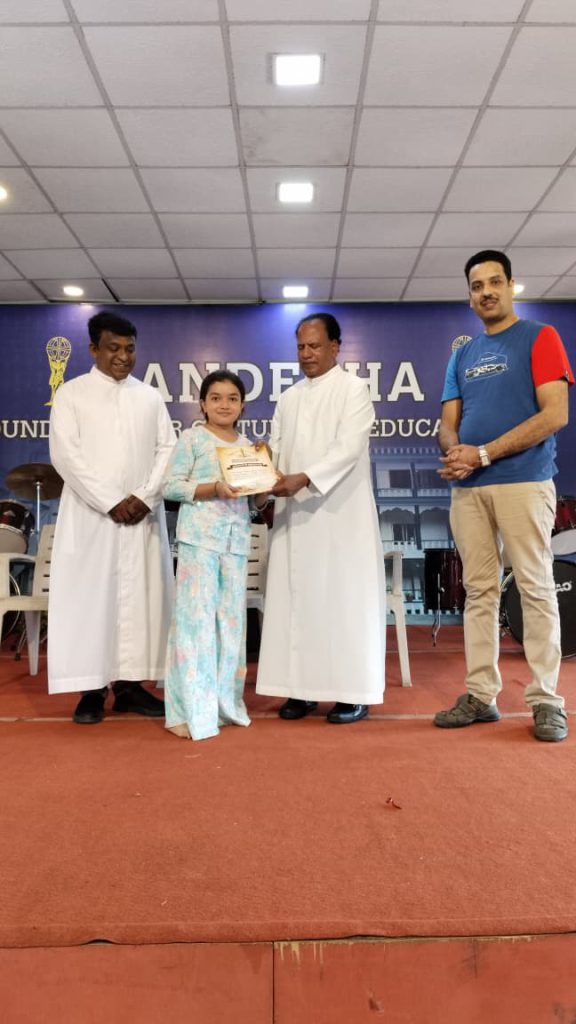
The Grand Finale of the Sandesha Summer Camp 2026 was celebrated with great enthusiasm and colour at the Sandesha Auditorium, bringing together young talents, parents, trainers, and guests in a joyful celebration of creativity, music, and learning.
Organised by the Sandesha Foundation for Culture and Education, the summer camp witnessed the participation of 142 students from different parts of Karnataka, including Bellary, Raichur, Chikmagalur, Shimoga, Karwar, Honnavar, Mangaluru, and Bengaluru. The grand finale marked the culmination of days of intensive training in music, arts, and creative expression.
The programme began with a prayer song followed by the lighting of the lamp, symbolising the spirit of knowledge and creativity. In his welcome address, Fr. Sudeep Paul MSFS, Director of Sandesha Foundation, warmly greeted the gathering and highlighted the vision of Sandesha as a charitable institution committed to nurturing young talents irrespective of their economic background. He noted that the camp was designed not only to teach musical skills but also to foster confidence, creativity, and teamwork among children.
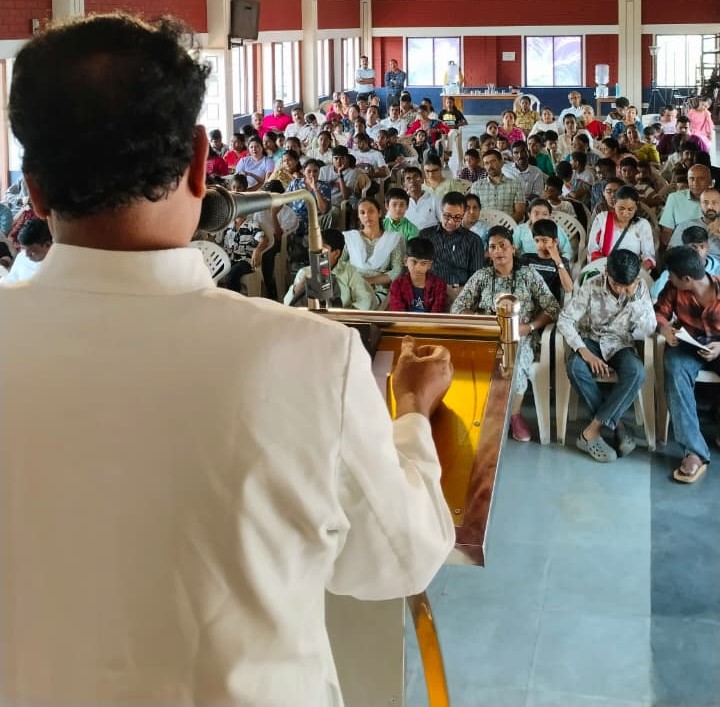
The highlight of the event was the address by the Chief Guest, Rev. Fr. Erudayaraja MSFS, an experienced educator and pastor who has served as Principal of SFS Schools at Hebbagodi, Chintamani, and Malur and has also held administrative responsibilities in several institutions. Addressing the students, he expressed his joy at being part of the celebration and congratulated all the participants for their dedication and hard work.
Fr. Erudayaraja noted that the presence of students from various regions of the state showed how Sandesha has become a meeting place where young talents gather to learn, grow, and celebrate their gifts. He emphasised that the performances presented during the finale were not merely stage programmes but the fruits of discipline, practice, and teamwork developed during the camp.
Appreciating the trainers and teachers, he said that teaching music and art is not simply about imparting skills but about nurturing confidence, creativity, and joy in young hearts. He also praised the Sandesha Foundation for its inclusive mission, pointing out that the institution provides opportunities for children from both rural and urban backgrounds, irrespective of their financial status, to discover and develop their talents.
Reflecting on the challenges of modern times, Fr. Erudayaraja observed that many young people today spend much of their time on digital devices. Programmes like the Sandesha Summer Camp, he said, remind young people that true joy comes from learning, creating, singing, and performing together. Music, he added, has a unique power to bring people together and elevate the human spirit.
Encouraging the students, he reminded them that talent is a gift from God, but it becomes meaningful only when nurtured with discipline and humility. He urged them to continue practising, learning, and sharing their talents with others even after the camp.
The cultural segment of the programme featured a variety of performances by the campers, including Hindustani and Western vocal music, guitar and keyboard performances, drumming, public speaking, dance presentations, creative arts displays, and calligraphy exhibitions. The audience warmly applauded the confidence and skill displayed by the young performers.
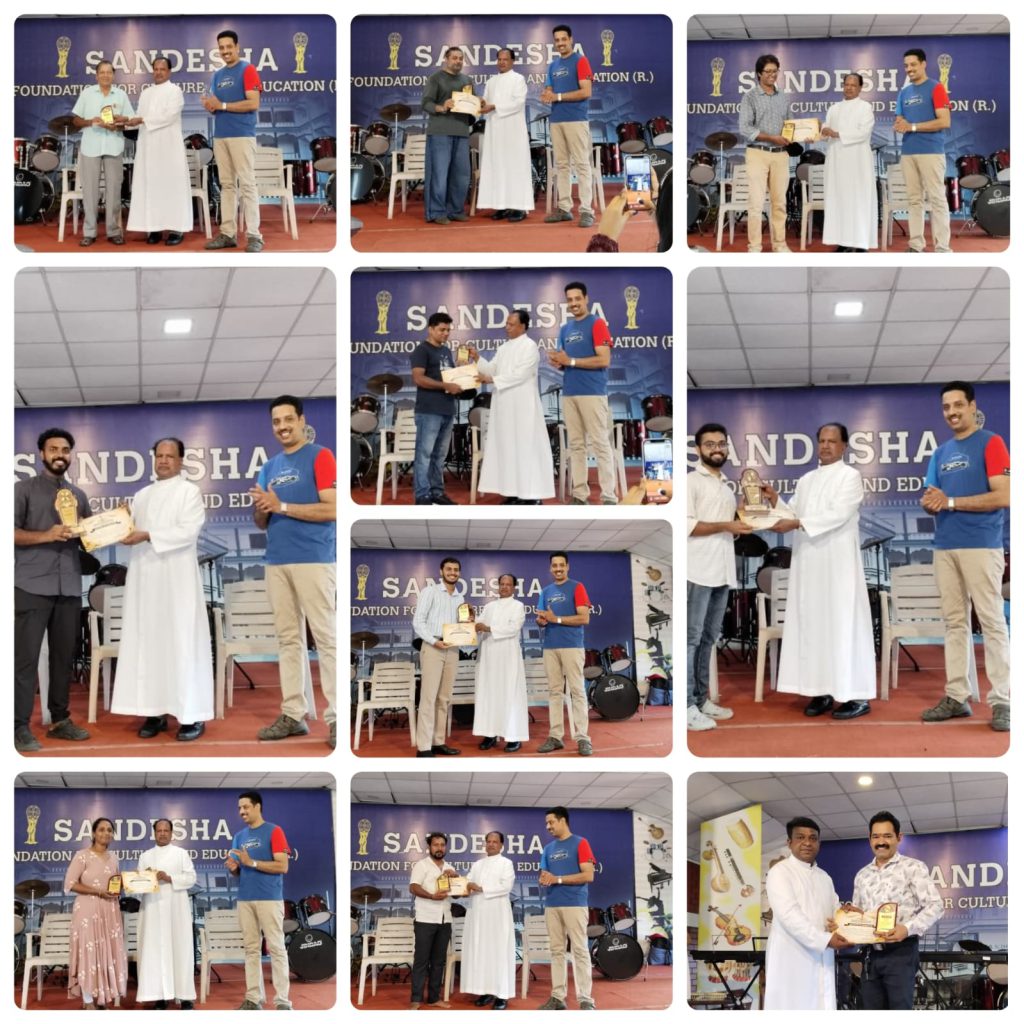
The event also included the distribution of certificates and mementos to the participants and the felicitation of the tutors who guided the students throughout the camp.
The programme concluded with the Sandesha Anthem and a vote of thanks, leaving the audience inspired by the remarkable talent and enthusiasm of the young participants.
The Sandesha Summer Camp continues to stand as a significant initiative that nurtures creativity, builds confidence, and promotes cultural and artistic values among young people, shaping not only talented performers but responsible and confident individuals for the future.
Nitte Institute of Communication to Host Two-Day International Media Conclave on Global Conflict and Responsibility
NV Paulose, Chairman, Global TV +91 98441 82044
MANGALURU: The Nitte Institute of Communication (NICO), a constituent college of Nitte (Deemed to be University), is proud to announce its upcoming two-day international event, Media Conclave 2026. The conclave will take place on April 28 and 29, 2026, at the University Auditorium, Paneer Campus, Mangaluru.
Under the theme “From Propaganda to Peace: Rethinking Media Responsibility in Global Conflicts,” the event aims to bring together industry leaders, academics, and students to discuss the evolving role of journalism in an era of global instability.
Distinguished Speakers and Guests:
The conclave will be inaugurated by Dhanya Rajendran, Co-founder and Editor-in-Chief of The News Minute, who serves as the Chief Guest. Joining her as the Guest of Honour is Prof. Dr. M. S. Moodithaya, Vice-Chancellor of Nitte (Deemed to be University).
The keynote address will be delivered by Dr. Nikhil Moro, Associate Professor and former Director of the A. Q. Miller School of Media and Communication at Kansas State University, U.S.A..
Event Highlights:
The two-day schedule is packed with intellectual and creative sessions:
Day 1 (April 28): Features the Inauguration, Keynote Address, two Panel Discussions, a Poster Presentation, and a Cultural Programme starting from 5:30 PM.
Day 2 (April 29): Includes a third Panel Discussion, an intensive Workshop, and an Award Ceremony.
Workshop for Journalists:
An interactive workshop on Understanding Misinformation, Deepfakes and Fake News in Conflict Reporting for the working journalists of Dakshina Kannada district is also a highlight of the event on April 29.
The workshop will be facilitated by AI for Digital Readiness and Advancement (ADiRA) of Data Leads Academy. S Kumar, an independent Journalist will lead the workshop.
Valedictory Ceremony:
The event will conclude on the afternoon of April 29 at 3 PM with a Valedictory Ceremony. Dr. Suma Ballal, Deputy Registrar of Nitte (Deemed to be University), will attend as Chief Guest. She will be joined by Stanley Carvalho, an independent journalist and former Reuters correspondent, serving as the Guest of Honour.
Media Excellence Award:
A Media Excellence Award for the lifetime achievement in the field of journalism will be conferred to Chidambara Baikampady, Senior Journailst from Mangaluru on the occasion.
About Nitte Institute of Communication
The Nitte Institute of Communication provides a platform for media education and critical discourse. Headed by Dr. Moulya Baladi, the institute continues to foster international dialogues on contemporary communication challenges.
Ananya Negi’s Viral Parliament Speech On Ambedkar: Himachal’s Young Leader’s Big Message
NV Paulose, Chairman, Global TV +91 98441 82044
Ananya Negi’s recent speech in Parliament on B. R. Ambedkar has quickly gone viral, drawing widespread attention across India. Her address stood out for its clarity, confidence, and strong connection to Ambedkar’s vision of equality, justice, and constitutional values.
In her speech, Negi stressed that Ambedkar’s ideas are not limited to history or symbolism. Instead, they remain highly relevant in present day India. She pointed out that challenges such as social inequality, unequal access to education, and lack of representation still persist. By highlighting these issues, she reminded Parliament that honoring Ambedkar requires meaningful action, not just respectful words.
A major reason the speech connected with people was her honest and direct tone. Negi spoke about the gap between constitutional ideals and everyday reality. She urged lawmakers to take responsibility and work toward a more inclusive society that truly reflects the spirit of the Constitution.
The speech also gained strong support among young people, many of whom shared it widely on social media. Her ability to explain Ambedkar’s ideas in a simple and relatable way made the message more powerful and accessible. It encouraged citizens, especially the youth, to think more deeply about their role in democracy.
The popularity of the speech shows a growing desire among people to reconnect with the core values of the nation. Ananya Negi’s words served as both a tribute to Ambedkar and a call for reflection. Her message asked an important question about whether India is fully living up to the ideals set out in its Constitution.
We the People
“We the People” is not just the opening phrase of the Indian Constitution, it is a powerful declaration of collective identity and responsibility. When B. R. Ambedkar and the makers of the Constitution chose these words, they placed the true authority of the nation in the hands of its citizens.
This idea tells a simple but profound story. India is not ruled by a king, a party, or a select few. It belongs to its people. Every citizen, regardless of background, language, caste, or belief, is an equal part of this democratic foundation. “We the People” reflects unity in diversity, reminding us that the strength of the nation lies in its shared voice.
However, this phrase is not only about rights, it is also about duty. It calls on citizens to stay aware, to question injustice, and to participate actively in shaping the country’s future. Democracy is not something that runs on its own. It depends on people who are willing to stand up for fairness, equality, and truth.