
WHEN A ROTARY MEETING BECOMES A LIFE-SAVING SESSION | By Rotarian Lal Goel, Founder & Charter President, Rotary Club of Organ Donation International, Chairman, Organ Donation India Foundation & GYAN
The Rotary Club of Organ Donation International recently hosted an interactive online talk titled “FATTY LIVER: PREVENTION TODAY, TRANSPLANT TOMORROW IF IGNORED” — and what followed was a masterclass in preventive healthcare awareness.
A testament to the dedication of Rotary members — even on the evening of the IPL Final, the majority of club members chose to join this session, reflecting their unwavering commitment to the cause of health awareness and service above self.
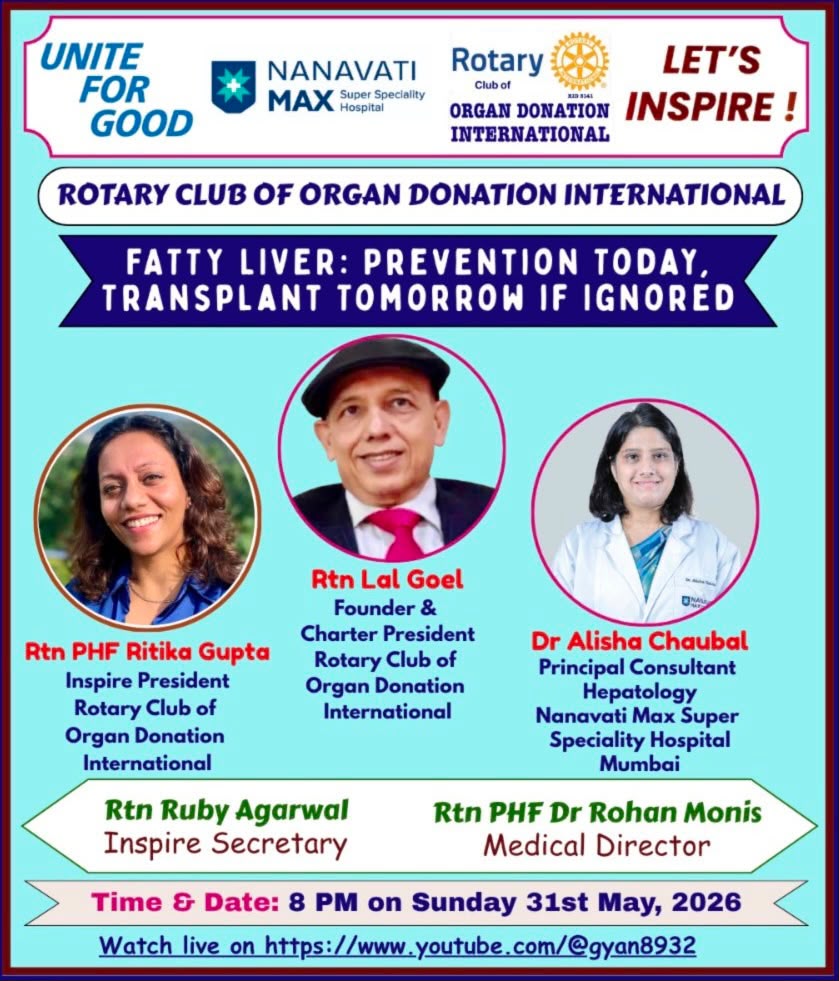
The speaker, Dr Alisha Chaubal, Principal Consultant Hepatologist, Nanavati Max Super Speciality Hospital, Mumbai, delivered an eye-opening presentation highlighting one of India’s fastest-growing yet least understood health challenges — Fatty Liver Disease.
Through an informative PowerPoint presentation and an engaging question-and-answer session, Dr Chaubal explained how a seemingly harmless accumulation of fat in the liver can gradually progress to inflammation, fibrosis, cirrhosis, liver failure, and ultimately the need for a liver transplant — if corrective action is not taken in time.
The session was particularly relevant for India, where changing lifestyles, increasing obesity, diabetes, and sedentary habits have created a silent epidemic affecting millions of adults and even children.
The Meeting Proceedings:
What is Fatty Liver Disease?
Fatty Liver Disease occurs when excess fat accumulates in liver cells. Normally, the liver contains very little fat. However, when more than 5% of the liver’s weight consists of fat, it is classified as a fatty liver.
In India, the condition is increasingly linked to:
•   Obesity and abdominal fat
•   Type 2 diabetes
•   High cholesterol and triglycerides
•   Lack of physical activity
•   Excessive consumption of sugar and processed foods
•   Frequent intake of fried foods and refined carbohydrates
•   Genetic predisposition among South Asians
The most alarming aspect of fatty liver disease is that it often produces no symptoms in its early stages. Many patients discover the condition accidentally during routine health check-ups or abdominal sonography.
Why Should Indians Take Fatty Liver Seriously?
India is witnessing an unprecedented rise in metabolic disorders, and experts estimate that a significant proportion of urban Indians may already have some degree of fatty liver disease.
The progression can be dangerous and swift:
Fatty Liver → Inflammation (NASH/MASH) → Fibrosis → Cirrhosis → Liver Failure → Liver Transplant
Once cirrhosis develops, the damage is largely irreversible. Complications such as liver cancer, internal bleeding, fluid accumulation in the abdomen, and liver failure can follow.
The good news: fatty liver in its early stages is often fully reversible through lifestyle modifications.
Understanding the FIB-4 Test
One of the most important tools discussed during the session was the FIB-4 (Fibrosis-4) Score — a simple, non-invasive method used to estimate the risk of liver fibrosis.
The score is calculated using:
•   Age
•   AST (SGOT)
•   ALT (SGPT)
•   Platelet Count
Formula: FIB-4 = (Age × AST) ÷ (Platelet Count × √ALT)
Free online calculators are widely available, and physicians use this score to determine whether a patient requires further evaluation.
FIB-4 Calculator
https://share.google/6RbD01jH0YlcKHgaH
Interpretation of FIB-4
For adults below 65 years:
•   Below 1.3 — Low risk
•   1.3 to 2.67 — Intermediate risk
•   Above 2.67 — High risk; specialist evaluation recommended
For adults above 65 years:
•   Below 2.0 — Low risk
•   2.0 to 2.67 — Intermediate risk
•   Above 2.67 — High risk
The FIB-4 score does not replace medical consultation but serves as an effective first-line screening tool, helping identify patients who may need further tests such as FibroScan or specialist assessment.
Prevention is Better than Transplant
The strongest message from the session was unambiguous: liver transplantation should never be viewed as the first solution. Prevention is the best treatment.
Research has shown that even a modest reduction in body weight can significantly improve liver health.
Lifestyle Changes That Can Reverse Fatty Liver
1.  Lose excess body weight gradually
2.  Walk at least 8,000–10,000 steps daily
3.  Exercise for 150–300 minutes per week
4.  Reduce sugar consumption
5.  Eliminate sugary beverages and packaged fruit juices
6.  Avoid frequent consumption of fried foods
7.  Sleep 7–8 hours daily
8.  Control diabetes, blood pressure, and cholesterol
9.  Avoid smoking and excessive alcohol
10. Undergo regular health check-ups
Even a 7–10% reduction in body weight can substantially improve liver health and reduce inflammation.
Recommended Indian Diet for Fatty Liver
For those looking to improve liver health through diet, the emphasis should be on whole, minimally processed foods. A good daily pattern includes options such as oats porridge with flaxseeds, vegetable poha, or sprout salad for breakfast; multigrain or whole wheat roti with dal, vegetables, and salad for lunch; green tea, buttermilk, or roasted nuts and chana for evening snacks; and vegetable soup with millet khichdi or dal and mixed vegetables for dinner. Non-vegetarians can incorporate egg whites, grilled fish, or skinless chicken in place of heavier proteins. Equally important is what to avoid — sugary soft drinks, packaged juices, white bread, maida products, deep-fried snacks, processed foods, excess sweets, and alcohol should all be eliminated or significantly reduced.
Rotary’s Role — And Why Organ Donation Matters Here
This session demonstrated how Rotary meetings can become powerful platforms for preventive healthcare education. By bringing medical experts directly to the community, Rotary empowers people to act before conditions become life-threatening.
And there is a deeper connection worth reflecting upon: when prevention fails and a liver reaches end-stage failure, a transplant becomes the only hope — and that transplant depends entirely on the generosity of an organ donor, living or deceased. This is precisely why the work of the Rotary Club of Organ Donation International carries such profound significance. Every awareness campaign, every pledge, every conversation about organ donation is a bridge between despair and survival.
A liver transplant can save lives — but preventing the need for one is even better. Through awareness, early detection, healthy lifestyle choices, and regular medical evaluation, countless Indians can avoid the devastating consequences of advanced liver disease.
The message from this meeting was clear:
“Your liver may be silent today — but it should not be ignored. Prevention today can save you from a transplant tomorrow.”


