
A lady from the Brahmin community, getting married to a man from the lower caste, converting to Christianity, and continuing her work for the improvement of living condition of widows, and destitutes.
Dr Uday Kumar Irvathur
Ananth Shastry Dongrey, who hails from Heranje in Mala Village in Karkala of the present Udupi District, had the privilege of accompanying his guru Ramachandra Shastry, to the palace of Baji Rao-II, to teach Sanskrit to the Queen. His visit to the palace made him think of teaching Sanskrit to women in his family. However, his wife Yamuna Bai, did not show much interest to learn Sanskrit.
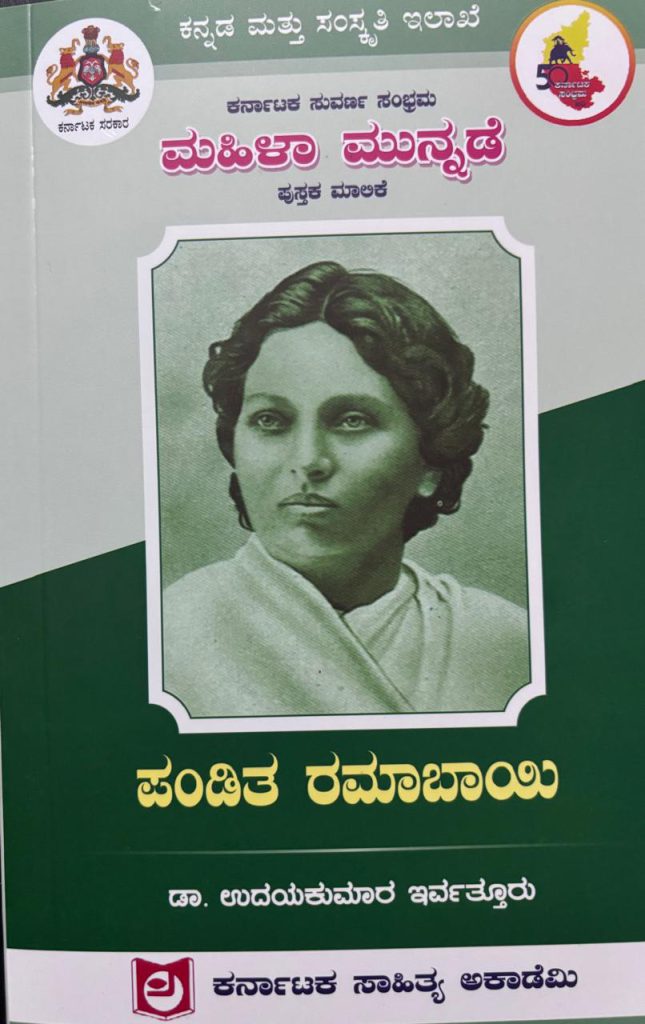
In a strange situation he lost his first wife and his daughter Rama Bai, from the second wife turns her father’s dream of not only learning Sanskrit but being a scholar in the chosen field, into reality. The life was not easy for Rama Bai and her father. The conservative community did not spare Sanskrit scholar like, Anantha Shastry Dongre too, who was severely criticised for teaching Sanskrit to his daughter, much against the then societal norms. Though Anantha Shastry could prove what he did was right as per the sacred books, he did not succeed winning the heart of his community.
Anantha Shastry along with the family set on a pilgrimage to Kashi. Due to illness and hunger Shastry and his wife died on the way. Young Rama Bai and her brother Srinivas continued their journey and they arrive in Kolkutta. In Kolkatta, Rama Bai made a presentation of her scholarship in Sanskrit to the Scholars of the city. They were highly impressed by the command that she had over the subject, especially the Sanskrit literature and she was decorated with the title of “Panditha” in recognition of her scholarship. From Kolkatta, they proceeded to Dakha, which was then part of India. In Daksha, she married Bipin Bihari Bose, a young lawyer from the backward community, though there was a que of grooms from the elite class to marry a scholar of high calibre. Unfortunately, Rama Bai lost her husband, after a very brief period of the marriage. By then daughter Manorama was born.
Rama Bai, then moves to Poona, and starts her work for improving the life of young widows, and girls. Though the community wanted her to join hands with reforms already started, Rama Bai had her own plans for the empowerment of women. She wrote a book on the condition of women in India, which was not well appreciated by many in the community. Later, she goes to England to continue her studies. In England, she decided to convert to Christianity. From England she goes to USA, where she moots the idea of formation of “Rama Bai Association” with the support of philanthropists of USA. Rama Bai Association aimed at working for the cause of education, employment, social service and other allied activities that enhances the self-esteem of women in India.
Rama Bai did great service towards improving the condition of women. She made representation seeking appointment of women physicians to medically check women in the hospitals, appointment Women Officers, to whom female employees could repot.
Panditha Rama Bai, a lady from the Brahmin community, getting married to a man from the lower caste, converting to Christianity, and continuing her work for the improvement of living condition of widows, and destitutes. She was person with a vision and extra-ordinary will power, who was much ahead of her time in her thinking. Her life story, would certainly be an inspiration to all of us.


