
From STD Booths to Storytelling Dynamic Hubs: A Systemic Vision for Global Village Television
NV Paulose, Chairman, Global TV +91 98441 82044
India witnessed one of the greatest communication revolutions through the establishment of STD (Subscriber Trunk Dialing) booths. Before mobile phones became common, millions of people gained access to communication because a simple booth connected individuals with the rest of the country and the world. The success of the STD booth was technological, social, economic, and entrepreneurial.
Every booth became a local communication centre, enabling ordinary citizens to participate in the communication economy. It created employment, encouraged entrepreneurship, and made communication accessible to people from every section of society.
Today, communication has reached another turning point.
Television has achieved extraordinary reach, yet its role has remained largely confined to broadcasting information, entertainment, and news. Unlike telecommunications, which transformed person to person communication, television has not yet realised its larger potential as a platform for community communication, collective intelligence, large scale social participation, and global collaboration.
It has succeeded in creating one-sided audiences, but it has not fully evolved into a system that enables communities to become active creators, contributors, and partners in communication.
The next stage in the evolution of television is not simply better broadcasting. It is participatory communication. It is about enabling communities to tell their own stories, document their knowledge, share their innovations, preserve their cultural heritage, and engage directly with people across the world. It is about sharing spaces.
When communities become storytellers and appreciative Inquiry (AI) Practitioners rather than passive viewers, television becomes a catalyst for development rather than merely a medium of entertainment. True miracles happen when people are connected. Can we present ourselves as a community and a shared entity of mutual collaboration?
Collaborative storytelling opens opportunities that extend far beyond one-sided communication. It becomes the foundation for participatory development projects, community entrepreneurship, local innovation, educational exchange, cultural preservation, tourism, and economic cooperation. We can initiate Asset Light Establishments (ALE) in large numbers when we are connected as a community. Stories reveal strengths, resources, skills, traditions, aspirations, and opportunities that often remain invisible in conventional development models.
Once our strengths are visible, we can organise them around shared goals and attract partners, guests, investors, researchers, educational institutions, and businesses interested in mutual collaboration. Villages possesses valuable resources that are often underutilised; including people, knowledge, traditions, skills, enterprises, natural assets, cultural practices, educational institutions, and social networks.
Storytelling makes these resources visible. Once documented and shared through a community communication platform, they become part of a living resource pool that can be accessed, strengthened, and connected with similar resources elsewhere. Communities begin learning from one another instead of working in isolation. They share ideas, avoid duplication of effort, reduce costs through cooperation, and create solutions that benefit everyone involved.
This creates significant cost advantages. Shared knowledge reduces the cost of experimentation. Shared infrastructure reduces the cost of communication. Shared experiences reduce the cost of learning. Shared participation reduces the cost of development. Communities become partners in creating value rather than isolated beneficiaries of external programmes.
History shows that major economic revolutions occur when systems become interconnected. One of the finest examples is containerisation in global shipping. Before the introduction of standard shipping containers, transporting goods across countries was slow, expensive, and inefficient. Containerisation created a common system that connected ships, ports, railways, and road transport into one integrated global logistics network. The result was a dramatic reduction in transportation costs, greater efficiency, increased trade, and unprecedented global economic growth.
Global communication now stands at a similar moment. Local stories remain scattered like goods before containerisation. Every village possesses knowledge, culture, innovations, and experiences, yet these remain disconnected from one another and from the rest of the world.
Storytelling Dynamic Hubs can become the standard communication infrastructure that connects these scattered resources into a global knowledge network. As containerisation transformed the movement of goods, Storytelling Dynamic Hubs can transform the movement of ideas, experiences, cultural knowledge, and community innovations.
The cost of discovering knowledge decreases. The speed of learning increases. Collaboration becomes easier. Communities become visible to one another, and new opportunities emerge naturally through connection.
Global TV practices an innovative communication architecture called Storytelling Dynamic Hubs, or STD Hubs.
The transition from Booth to Hub represents a profound shift in the philosophy of communication. A booth serves individual communication. A hub enables community communication. A booth connects one person with another. A hub connects families, villages, educational institutions, businesses, visitors, researchers, governments, and global communities through shared stories and shared purpose. The hub is not simply a media centre. It is a centre for knowledge creation, relationship building, community development, and economic participation.
At the heart of every Storytelling Dynamic Hub lies the philosophy of Appreciative Inquiry. Instead of beginning with problems, Appreciative Inquiry begins by discovering strengths, achievements, capabilities, aspirations, and possibilities. Every person, every family, every organisation, and every village possesses unique assets. Storytelling becomes the process through which these assets are identified, appreciated, documented, shared, and transformed into opportunities for collective action.
As stories accumulate, they create collective intelligence. Individual experiences become community knowledge. Community knowledge becomes shared wisdom. Shared wisdom becomes innovation. Innovation generates new enterprises, strengthens local economies, attracts responsible tourism, improves education, encourages investment, and enhances the quality of life.
Communication therefore evolves beyond the transmission of information. It becomes a living system for continuous learning, collaboration, innovation, and value creation.
The movement from Booth to Hub represents far more than a technological change. It represents a transformation in the way humanity communicates, collaborates, learns, and develops. It marks the evolution from individual access to collective participation, from broadcasting to dialogue, from isolated communities to connected global villages, and from passive audiences to active partners in creating a more prosperous, sustainable, and interconnected world.
The STD Booth transformed access to communication in India.
The Storytelling Dynamic Hub has the potential to transform communication into a global ecosystem for knowledge, culture, cooperation, and shared prosperity.
1. The Forgotten Dimension of Television
Television is one of humanity’s most influential inventions. It has informed, educated, entertained, and connected billions of people across geographical and cultural boundaries. Yet, despite its enormous reach, television has remained largely a one way communication medium. A relatively small number of institutions create content, while millions of people watch it. The audience participates emotionally but rarely contributes actively to the communication process.
This broadcasting model has achieved remarkable success in disseminating information, but it has not fully realised the deeper purpose of mass communication. Communication is not merely the transmission of information from one source to many receivers. It is also the creation of understanding, relationships, shared learning, and collective action. A truly mature communication system enables every individual and every community to become both a learner and a contributor.
Every village, every neighbourhood, every institution, and every family possesses valuable experiences that deserve to be shared. Farmers develop innovative cultivation methods. Teachers create effective educational practices. Artisans preserve traditional skills. Women lead successful community initiatives. Young people introduce new technologies. Elders carry historical memories and cultural wisdom. Unfortunately, most of this knowledge remains invisible because existing media systems are not designed to capture and circulate it.
Global Village Television seeks to recover this forgotten dimension of television. Instead of functioning only as a broadcasting platform, television becomes a community communication platform where people actively document, exchange, and celebrate their knowledge. Communities are no longer passive audiences waiting for recognition from national or international media. They become producers of meaningful content that reflects their own identity, achievements, aspirations, and innovations.
When television evolves from broadcasting programmes to facilitating community participation, it begins to strengthen democracy, preserve culture, promote learning, encourage entrepreneurship, and build stronger social relationships. The television screen becomes not merely a window through which people observe the world, but a mirror through which communities discover themselves and a bridge through which they connect with the rest of humanity.
This is the forgotten dimension of television. Its greatest potential lies not in producing more programmes but in enabling more people to participate in creating knowledge, sharing stories, and shaping the future of their communities.
2. From Broadcasting to Storytelling
Information informs. Stories inspire transformation.
Facts communicate what happened. Stories explain why it happened, how people experienced it, and what others can learn from it. Human beings have always understood the world through stories. Long before the invention of writing, libraries, newspapers, radio, or television, knowledge was preserved and transmitted through storytelling. Stories carried history, culture, values, ethics, practical wisdom, and collective memory from one generation to another.
Modern communication has become increasingly dominated by facts, statistics, headlines, and short lived information. While these are essential, they often fail to create emotional connection or lasting understanding. Storytelling fills this gap by connecting information with human experience. It transforms data into meaning and observation into learning.
Global Village Television places storytelling at the centre of community communication. Every village possesses thousands of untold stories waiting to be discovered. There are stories of farmers adapting to climate challenges, teachers transforming schools, entrepreneurs creating employment, artists preserving cultural traditions, doctors improving community health, women’s groups strengthening local economies, and young innovators solving practical problems. These stories are not merely interesting. They are valuable social resources that can inspire similar initiatives in other communities.
Storytelling also creates trust. People naturally relate to real experiences shared by people like themselves. When one village shares its successful practices, another village gains confidence to adapt and improve them. Knowledge spreads more effectively because it is embedded in lived experience rather than abstract instruction.
In this sense, storytelling becomes much more than entertainment. It becomes a method of education, community development, leadership, conflict resolution, cultural preservation, tourism promotion, and economic growth. Every story contributes to a growing body of community knowledge that benefits future generations.
Global Village Television therefore views storytelling not simply as a communication technique but as the operating system of community development. Stories connect people. Connected people create ideas. Shared ideas generate collaboration. Collaboration produces innovation, prosperity, and social progress.
3. What is a Storytelling Dynamic Hub?
A Storytelling Dynamic Hub represents the next stage in the evolution of communication infrastructure. Just as the STD Booth democratised access to telephone communication, the Storytelling Dynamic Hub democratises participation in mass communication.
A booth provides access to communication. A hub creates an ecosystem for communication.
Within a hub, stories are collected, documented, produced, translated, archived, and shared. Local knowledge becomes globally accessible while global knowledge becomes locally relevant. The hub functions simultaneously as a media centre, a learning centre, an innovation centre, a cultural archive, a tourism information centre, and a community collaboration platform.
Every Storytelling Dynamic Hub connects multiple stakeholders. Families contribute their experiences. Schools document educational innovations. Farmers share agricultural practices. Entrepreneurs present business ideas. Artists preserve cultural heritage. Researchers discover local knowledge. Visitors experience authentic community life. Hotels, educational institutions, businesses, governments, and development organisations become partners within the same communication ecosystem.
Unlike conventional television studios that primarily produce programmes, Storytelling Dynamic Hubs produce relationships. Every conversation generates new knowledge. Every interview creates learning. Every visitor contributes fresh perspectives. Every collaboration opens new opportunities for education, employment, entrepreneurship, cultural exchange, and investment.
The Hub also functions as a living knowledge repository. Instead of allowing valuable experiences to disappear with each generation, it systematically preserves community memory through digital storytelling. Oral histories, local innovations, traditional medicine, indigenous agriculture, family enterprises, festivals, crafts, environmental practices, and community achievements become permanent assets that continue to educate and inspire future generations.
The Hub is equally an economic institution. Storytelling attracts visitors. Visitors generate demand for hospitality, local food, handicrafts, transportation, education, cultural experiences, and professional services. Local enterprises gain visibility. Young people discover meaningful careers in media production, tourism, digital communication, research, and community entrepreneurship. Knowledge itself becomes an economic resource capable of creating sustainable livelihoods.
Most importantly, every Storytelling Dynamic Hub becomes part of a global network. Villages do not function as isolated communities but as members of a worldwide learning system. A successful innovation in one village can inspire hundreds of others. A cultural tradition preserved in one country can enrich communities elsewhere. A local solution can become a global solution.
The Storytelling Dynamic Hub therefore represents far more than a communication centre. It is a centre for collective intelligence, appreciative inquiry, collaborative learning, community enterprise, cultural preservation, and sustainable development. It transforms communication from the simple exchange of information into the continuous creation of knowledge, relationships, opportunity, and shared prosperity
4. The Global Village Television Station
The Global Village Television Station is the operational heart of the Storytelling Dynamic Hub. It is not conceived as a conventional television studio with expensive equipment, large production teams, or one way broadcasting schedules. Instead, it is a community communication centre where local people become creators, curators, and custodians of knowledge.
Every village has stories worth telling. Every town has innovations worth sharing. Every community has experiences that can benefit others. The Global Village Television Station provides the infrastructure through which these stories are identified, documented, produced, archived, translated, and shared with regional, national, and global audiences.
Programming is generated by the community itself. Farmers document successful agricultural practices. Teachers share educational innovations. Doctors discuss preventive healthcare. Women’s groups present livelihood initiatives. Young entrepreneurs introduce new business ideas. Artists preserve music, dance, crafts, and oral traditions. Senior citizens record local history and community memories. Children contribute creative ideas that reflect the aspirations of the next generation.
Unlike conventional broadcasting, where content flows from a central authority to passive viewers, the Global Village Television Station enables multidirectional communication. Villages learn from neighbouring villages. Regions learn from one another. Countries exchange ideas directly through authentic local experiences. Every participant is simultaneously a learner and a contributor.
Digital technologies, artificial intelligence, multilingual translation, cloud archives, and online communication platforms make it possible for even small communities to produce content of international relevance. Local stories become global learning resources. At the same time, global knowledge becomes accessible in local languages and cultural contexts.
The Global Village Television Station therefore functions as a knowledge exchange, a cultural archive, an educational platform, a tourism gateway, and a catalyst for community development. It transforms media from an industry that distributes programmes into an institution that cultivates participation, learning, and collaboration.
5. Appreciative Inquiry as the Communication Philosophy
Every communication system reflects the questions it asks. If the primary question is “What is wrong?” attention naturally concentrates on problems, deficiencies, and failures. While identifying problems is important, sustainable development requires an equally systematic exploration of strengths, achievements, capabilities, and opportunities.
Global Village Television adopts Appreciative Inquiry as its guiding communication philosophy.
Appreciative Inquiry begins with the belief that every individual, every family, every organisation, and every community possesses valuable strengths. Development becomes more effective when these strengths are recognised, appreciated, connected, and expanded.
Instead of asking why a village is underdeveloped, the conversation begins by asking what the village already does exceptionally well. Instead of focusing only on unemployment, attention is also given to successful entrepreneurs. Instead of concentrating only on educational challenges, the search includes outstanding teachers and innovative schools. Instead of highlighting social conflicts alone, communication also celebrates cooperation, resilience, creativity, and leadership.
Storytelling becomes the practical method through which Appreciative Inquiry is implemented. Every interview, every documentary, every community discussion, and every local programme seeks to identify positive experiences that others can learn from. These stories do not ignore problems. Rather, they demonstrate how communities have successfully addressed challenges through creativity, cooperation, and determination.
As positive stories circulate, confidence grows. People begin recognising the assets within their own communities. They discover that solutions often already exist nearby. Successful practices spread naturally because they are communicated through authentic human experiences rather than abstract theories.
Appreciative Inquiry also creates social trust. When communities celebrate one another’s achievements, relationships become stronger. Collaboration becomes easier. Innovation accelerates because people are encouraged to build upon existing successes instead of remaining discouraged by limitations.
In this way, communication becomes a force for possibility rather than pessimism. It creates hope grounded in evidence, confidence supported by experience, and development driven by collective strengths.
6. Introducing the Joint Family Kiosk
One of India’s greatest social innovations has been the Joint Family, where several generations share resources, responsibilities, knowledge, and emotional support. Hospitality within this tradition extends beyond providing accommodation. Visitors are welcomed as members of the family and invited to participate in everyday life.
The Joint Family Kiosk applies this timeless cultural principle to the emerging global communication economy.
Located within every Storytelling Dynamic Hub, the Joint Family Kiosk becomes the community’s welcome centre for visitors from across India and around the world. It serves as the first point of contact where guests are introduced not only to places but also to people, stories, traditions, values, and opportunities for meaningful engagement.
Rather than functioning as a conventional tourist information desk, the Joint Family Kiosk connects visitors with authentic community experiences. Guests may choose to spend time with farming families, participate in traditional cooking, learn local crafts, attend cultural performances, visit schools, interact with entrepreneurs, or join community development activities. Every visit becomes an exchange of knowledge and friendship rather than a commercial transaction.
The kiosk also serves local residents. Families interested in hosting visitors receive orientation, training, and support. Young volunteers develop skills in communication, translation, digital media, and cultural interpretation. Women’s groups organise culinary experiences. Local artisans demonstrate traditional skills. Educational institutions host student exchanges. Entrepreneurs showcase locally produced goods and services.
The Joint Family Kiosk therefore becomes a bridge between local communities and global citizens. It creates relationships that continue long after the visit has ended, transforming hospitality into an enduring network of learning, cooperation, and mutual respect.
7. Storytelling Based Community Tourism
Tourism has traditionally been organised around monuments, landscapes, and historical sites. While these attractions remain important, increasing numbers of travellers seek authentic experiences that allow them to understand how people actually live, work, learn, celebrate, and solve problems within their communities.
Storytelling based community tourism responds to this emerging aspiration.
Instead of merely showing places, communities share the stories behind those places. A farm becomes a story about sustainable agriculture. A village pond becomes a story about water conservation. A local festival becomes a story about cultural identity. A family enterprise becomes a story about entrepreneurship across generations. Every location becomes meaningful because it is interpreted through human experience.
Visitors become active participants rather than passive observers. They prepare traditional meals with local families, join agricultural activities, learn indigenous crafts, attend storytelling evenings, interact with teachers and students, participate in community celebrations, and contribute their own knowledge and experiences. Tourism evolves into a process of mutual learning.
This model also creates substantial economic benefits. Income is distributed across many sectors of the local economy. Farmers, artisans, transport providers, guides, storytellers, performers, restaurants, home kitchens, hotels, educational institutions, and community organisations all become participants in the tourism ecosystem. The value created by each visitor circulates throughout the community rather than remaining concentrated within a few businesses.
Storytelling based tourism also encourages responsible travel. Visitors develop genuine respect for local culture because they understand its history and significance. Communities preserve their traditions because they recognise their educational and economic value. Young people develop pride in their heritage and discover opportunities for meaningful employment within their own villages.
The result is a model in which tourism strengthens culture instead of replacing it, creates livelihoods without exhausting natural resources, and builds enduring relationships between communities across the world.
Within the Global Village Television ecosystem, every visitor becomes a learner, every host becomes a teacher, and every shared experience becomes another story that enriches the growing network of collective human knowledge.
8. Hotel Partnerships as Community Development Partners
Hotels have traditionally been viewed as providers of accommodation. Their primary function has been to offer visitors comfortable places to stay while they explore nearby attractions. Within the Global Village Television ecosystem, however, hotels become much more than lodging facilities. They become active partners in community development, storytelling, and cultural exchange.
Every visitor arriving at a hotel is searching for experiences, not merely accommodation. The hotel therefore becomes the first gateway through which guests are introduced to the stories of the surrounding communities. Instead of offering only sightseeing information, hotels can connect visitors with Storytelling Dynamic Hubs, Joint Family Kiosks, village television programmes, educational institutions, local entrepreneurs, artisans, farmers, and community organisations.
This partnership creates value for everyone involved. Hotels enhance the quality of the visitor experience by offering authentic cultural engagement that cannot be replicated elsewhere. Communities receive increased visibility, new markets, and opportunities for sustainable livelihoods. Visitors gain meaningful interactions rather than superficial tourism. Local governments benefit from longer visitor stays and increased economic activity.
Hotels also become venues for storytelling events. Evening conversations with local innovators, exhibitions by artisans, cultural performances, documentary screenings, village entrepreneurship forums, and educational dialogues can all become part of the hospitality experience. The hotel transforms into a meeting place where local communities and global visitors exchange ideas, experiences, and aspirations.
Rather than competing with villages, hotels become partners that extend the reach of community storytelling. Together they create an integrated hospitality ecosystem in which tourism supports education, entrepreneurship, culture, and local development.
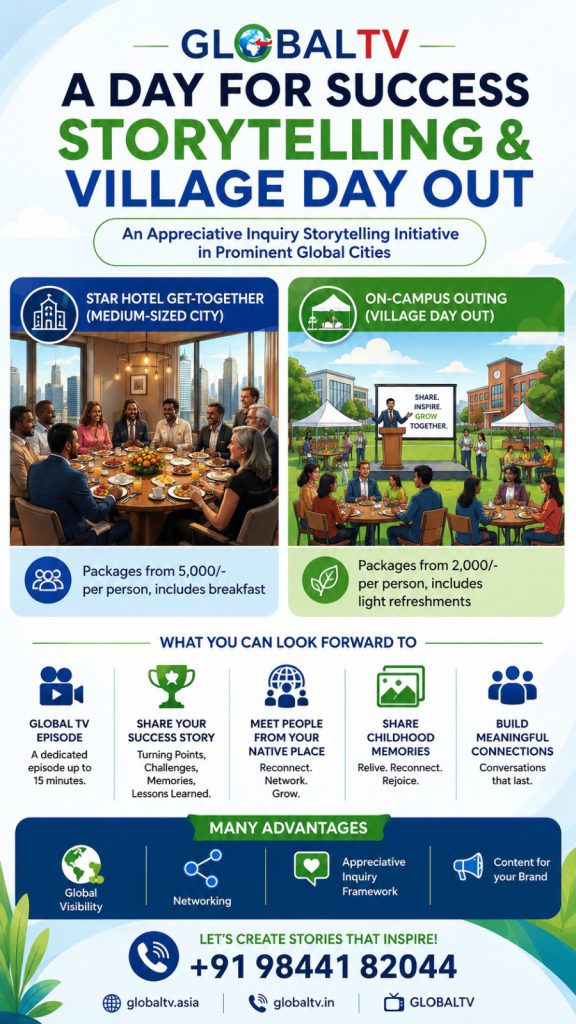
9. Storytelling Breakfast, Lunch, and Dinner Experiences
Food is one of humanity’s oldest forms of storytelling. Every meal reflects the geography, climate, agriculture, history, traditions, beliefs, and creativity of a community. Recipes are living documents that preserve generations of accumulated knowledge.
Global Village Television proposes transforming meals into structured learning experiences through storytelling.
A Storytelling Breakfast introduces visitors to the rhythm of community life. Guests learn about local agriculture, seasonal foods, nutritional traditions, family routines, and the relationship between food and health. Farmers explain how crops are cultivated. Elders share stories connected with traditional breakfast practices. Nutrition experts discuss the scientific value of indigenous foods.
A Storytelling Lunch explores the productive life of the community. Visitors interact with entrepreneurs, craftspeople, teachers, women’s groups, cooperatives, and local industries while sharing regional cuisine. Discussions focus on livelihoods, innovation, education, environmental sustainability, and community cooperation. Meals become opportunities for dialogue rather than simply consumption.
A Storytelling Dinner celebrates relationships and culture. Music, folklore, theatre, oral history, poetry, local achievements, family traditions, and community aspirations are shared in an atmosphere of friendship and reflection. Visitors experience not only the food but also the values and identities that give meaning to community life.
Each meal becomes an educational event that combines hospitality, culture, dialogue, and learning. Instead of purchasing food alone, visitors participate in experiences that deepen understanding and build lasting relationships.
Separate breakfast, lunch, and dinner programmes also create flexible participation models. Visitors may choose individual experiences or combine them into comprehensive cultural packages, generating multiple revenue opportunities for communities while encouraging longer stays.
10. Revenue Models for Storytelling Dynamic Hubs
A sustainable communication system must generate sustainable economic value. Storytelling Dynamic Hubs are designed not as charitable institutions but as community enterprises capable of creating multiple streams of income while strengthening social and cultural capital.
The first source of revenue arises from storytelling experiences themselves. Visitors participate in guided conversations, village walks, heritage programmes, educational workshops, cultural performances, and community interaction sessions. Each experience contributes directly to local livelihoods while preserving community knowledge.
Hospitality partnerships generate additional income through collaborative tourism packages. Hotels, restaurants, transport providers, and local guides work together with Storytelling Dynamic Hubs to create integrated visitor experiences. Revenue is shared across multiple participants, ensuring that economic benefits circulate throughout the local community.
Educational institutions represent another major opportunity. Schools, universities, management institutes, research organisations, and international study programmes increasingly seek experiential learning environments. Villages become living classrooms where students learn directly from practitioners, entrepreneurs, farmers, artists, health workers, and community leaders.
Digital platforms create global participation beyond physical travel. Storytelling programmes can be accessed through online memberships, subscriptions, virtual learning sessions, multilingual archives, documentary channels, and specialised knowledge networks. Communities gain worldwide visibility while generating recurring income from digital audiences.
Local entrepreneurship expands naturally within this ecosystem. Artisans market traditional products. Farmers introduce value added agricultural products. Women’s groups offer culinary experiences. Young media professionals provide documentation, editing, translation, and digital communication services. Community enterprises emerge around the growing demand created by storytelling tourism.
Corporate partnerships also become possible. Businesses seeking meaningful community engagement, responsible tourism initiatives, employee learning programmes, and social responsibility projects can collaborate with Storytelling Dynamic Hubs. Rather than offering one time donations, such partnerships support long term community capacity building.
The diversity of these revenue streams ensures that Storytelling Dynamic Hubs remain economically resilient while fulfilling their educational and social missions.
11. Empowering Youth Through the Storytelling Economy
Young people represent the greatest resource of every community. Yet many villages experience the migration of talented youth because meaningful employment opportunities appear limited. The Storytelling Dynamic Hub introduces an entirely new knowledge economy in which young people become creators, innovators, communicators, entrepreneurs, and global connectors.
The digital economy increasingly values creativity, communication, design, media production, research, cultural interpretation, education, hospitality, and community leadership. These are precisely the capabilities that Storytelling Dynamic Hubs cultivate.
Young people can serve as interviewers, documentary producers, editors, photographers, translators, digital archivists, artificial intelligence facilitators, tourism coordinators, social media managers, cultural interpreters, event organisers, researchers, and entrepreneurship mentors. Every story collected and every visitor welcomed creates opportunities for learning and professional growth.
The model also encourages young people to rediscover the knowledge available within their own communities. Instead of viewing villages as places to leave behind, they begin recognising them as centres of innovation, culture, enterprise, and global opportunity. Elders become teachers. Local practitioners become mentors. Community history becomes a source of inspiration for future entrepreneurship.
Importantly, this is not merely employment generation. It is leadership development. Young people learn communication, collaboration, systems thinking, project management, intercultural dialogue, digital technologies, and Appreciative Inquiry. These capabilities prepare them to become leaders within both local communities and global networks.
As Storytelling Dynamic Hubs expand across regions and countries, youth become ambassadors of their communities. They connect villages with universities, businesses, governments, tourists, researchers, and international organisations. They help transform local knowledge into global knowledge and global opportunities into local prosperity.
The Storytelling Economy therefore offers a new development paradigm. Instead of exporting talented young people in search of opportunity, communities create opportunities that encourage them to remain connected with their roots while participating confidently in the global knowledge society.
In this emerging economy, stories become assets, communication becomes enterprise, culture becomes innovation, and young people become the architects of a connected and prosperous Global Village.
12. Preserving Community Knowledge as Living Heritage
Every community possesses an immense wealth of knowledge accumulated over generations. Much of this knowledge exists not in books or digital archives but in the memories and experiences of ordinary people. Elders remember the history of the village, traditional farming methods, local medicinal practices, water conservation techniques, cultural festivals, family enterprises, and social customs that have sustained communities for centuries. Unless these stories are documented, they disappear with every passing generation.
The Storytelling Dynamic Hub transforms community knowledge into a living heritage archive. Every interview, conversation, documentary, and community event contributes to an expanding repository of human experience. Knowledge that once remained confined to a few individuals becomes available to future generations, researchers, educators, entrepreneurs, and communities around the world.
Unlike conventional archives that simply preserve information, Storytelling Dynamic Hubs encourage continuous interaction with knowledge. Young people reinterpret traditional practices through modern technologies. Researchers validate indigenous innovations through scientific methods. Entrepreneurs transform traditional skills into sustainable enterprises. Teachers integrate local knowledge into education. Thus, preservation becomes an active process of renewal rather than passive storage.
Community knowledge is one of humanity’s most valuable yet least recognised resources. By preserving it systematically, every village becomes a knowledge institution whose contributions extend far beyond its geographical boundaries.
13. Building the Global Village Network
An individual Storytelling Dynamic Hub creates value for one community. A network of Storytelling Dynamic Hubs creates value for the world.
The vision of Global Village Television extends beyond establishing isolated community media centres. Every hub becomes part of an interconnected global network where villages, towns, educational institutions, businesses, researchers, governments, and civil society organisations continuously exchange knowledge, experiences, innovations, and opportunities.
A successful agricultural practice developed in one country may benefit farmers on another continent. A community health initiative can inspire improvements elsewhere. A traditional craft can find new markets internationally. Educational innovations, environmental solutions, cooperative business models, and cultural programmes can all travel across the network through storytelling.
This network transforms local experiences into global public knowledge. Instead of depending entirely upon centralised institutions for innovation, communities begin learning directly from one another. Development becomes horizontal as well as vertical. Every community contributes. Every community learns.
Technology enables this network to function continuously through multilingual communication, artificial intelligence assisted translation, digital archives, virtual conferences, collaborative research, and shared educational platforms. Geography no longer limits participation. Every village becomes both a classroom and a teacher within the Global Village.
14. The Power of Hubs
History demonstrates that transformative progress rarely occurs through isolated individuals alone. It emerges through networks that connect people, ideas, institutions, and resources. The Hub represents this principle in its simplest and most practical form.
- A booth provides access.
- A hub creates relationships.
- A booth enables communication.
- A hub enables collaboration.
- A booth serves one individual at a time.
- A hub serves entire communities.
- A booth facilitates transactions.
- A hub creates ecosystems.
The Storytelling Dynamic Hub combines communication, education, culture, entrepreneurship, tourism, hospitality, research, and community development within a single integrated framework. Instead of operating as separate activities managed by separate institutions, they become mutually reinforcing components of one living system.
As more participants join the hub, its value increases for everyone. Every additional story enriches collective knowledge. Every visitor creates new opportunities. Every partnership expands available resources. Every successful project inspires another community. The Hub therefore grows stronger through participation, making collaboration itself the source of increasing value.
This systemic approach distinguishes the Hub from traditional communication models. Its purpose is not simply to distribute information but to cultivate relationships that continuously generate knowledge, innovation, trust, and prosperity.
15. Technology as the Enabler, Humanity as the Purpose
Technology has transformed the speed and scale of communication. Smartphones, digital cameras, cloud computing, artificial intelligence, multilingual translation, virtual meetings, and global internet connectivity have made it possible for even the smallest communities to communicate with the world.
Yet technology alone does not create meaningful communication. Human relationships, shared experiences, trust, and purpose remain at the centre of every successful community.
Within the Storytelling Dynamic Hub, technology functions as an enabler rather than the objective. Artificial intelligence assists translation, transcription, documentation, and knowledge discovery. Digital platforms expand the reach of local stories. Cloud archives preserve community memory. Interactive media encourage participation across geographical boundaries.
However, the true value of technology lies in strengthening human connections. The objective is not more content but more understanding. Not more viewers but more participants. Not more information but more wisdom.
Technology serves humanity best when it helps people learn from one another, appreciate diversity, solve shared challenges, and create opportunities for future generations.
16. Creating a New Communication Economy
Communication has traditionally been viewed as a service that supports economic activity. Global Village Television proposes a broader perspective in which communication itself becomes an engine of economic development.
- Stories generate visibility.
- Visibility attracts visitors.
- Visitors create demand.
- Demand supports entrepreneurship.
- Entrepreneurship generates employment.
- Employment strengthens communities.
This cycle creates a Communication Economy where knowledge, culture, hospitality, education, tourism, creativity, and innovation become interconnected sources of value.
Unlike extractive economic models that depend upon finite natural resources, the Communication Economy grows through participation. The more communities contribute their stories, the more valuable the entire network becomes. Every participant benefits from the increasing richness of shared knowledge.
The Storytelling Dynamic Hub therefore creates multiple forms of capital simultaneously. It strengthens social capital through trust and cooperation. It preserves cultural capital through storytelling. It develops intellectual capital through shared learning. It generates economic capital through entrepreneurship and tourism. It builds human capital by developing communication, leadership, and digital skills.
Prosperity is no longer measured only by financial wealth. It is measured by the strength of relationships, the quality of knowledge, the resilience of communities, and the opportunities available to future generations.
17. From Local Villages to a Global Movement
The vision of Global Village Television extends far beyond individual projects or national boundaries. Every country possesses villages, neighbourhoods, towns, and communities with unique knowledge and cultural heritage. Every society has stories capable of enriching humanity.
The Storytelling Dynamic Hub provides a common framework through which these communities can collaborate while preserving their distinct identities. Diversity becomes a strength rather than a barrier. Communities learn not by becoming identical but by appreciating one another’s uniqueness.
The movement therefore encourages cooperation across cultures, religions, languages, professions, and generations. Farmers exchange ideas with farmers. Teachers collaborate with teachers. Artists inspire artists. Entrepreneurs mentor entrepreneurs. Young people build friendships across continents. Elders preserve wisdom for future generations.
Gradually, the Global Village becomes more than a metaphor. It becomes a practical communication network built upon mutual respect, shared learning, appreciative inquiry, and collaborative development.
The objective is not global uniformity. The objective is global understanding through local participation.
18. From Booth to Hub, From Communication to Civilization
Every great transformation begins with a simple but powerful idea.
The STD Booth transformed India’s communication landscape because it democratised access. Millions of ordinary citizens gained the ability to connect with one another regardless of distance. That simple innovation became one of the foundations of India’s telecommunications revolution.
Today, humanity stands before a similar opportunity.
The Storytelling Dynamic Hub represents the next stage in the evolution of communication. It democratises participation rather than merely access. It enables every community to become a creator of knowledge, every citizen to become a storyteller, and every village to become a contributor to global progress.
Global Village Television is therefore not merely a television initiative. It is a systemic framework for community development, education, tourism, entrepreneurship, hospitality, cultural preservation, research, and international cooperation. It integrates these dimensions into a single ecosystem where communication creates value far beyond the exchange of information.
The transition from Booth to Hub symbolises the evolution of society itself. We move from isolated conversations to collective intelligence. From broadcasting to dialogue. From passive audiences to active participation. From fragmented efforts to integrated ecosystems. From local experiences to global learning.
If the twentieth century demonstrated that communication could connect people, the twenty-first century can demonstrate that storytelling can connect communities.
The future belongs to societies that learn together, create together, and prosper together.
The Storytelling Dynamic Hub offers a pathway towards that future.
- It is not simply a new model of television.
- It is a new model of communication.
- It is a new model of development.
- It is a new model of the Global Village.
And perhaps, it is the beginning of the next great communication revolution.


