
The Lion Share Concept That Has Ruined the Bottom-Line Economy of Nations | The Greed of Taking More Than Needed | Global TV
NV Paulose, Chairman, Global TV +91 98441 82044
The “lion’s share” concept represents a system where a small group takes the biggest portion of wealth, resources, and opportunities while the majority struggle with limited access. Across many nations, this mindset has slowly weakened the foundation of healthy economies. Wealth becomes concentrated in a few hands, while farmers, workers, small businesses, and ordinary citizens carry the burden of sustaining society. When only a few benefit from economic growth, a nation may appear rich on paper, but its people remain financially insecure. A country cannot become truly prosperous when its economic structure rewards hoarding instead of contribution.
The problem with the lion’s share mentality is that it destroys balance. Nature itself never supports imbalance for long. Forests survive because every tree receives sunlight, water, and space to grow. Rivers flow because water moves continuously instead of remaining trapped in one place. Economies too must circulate wealth and opportunities among people. When resources stop flowing and accumulate at the top, the system weakens from within. Social frustration rises, unemployment spreads, and trust in institutions begins to decline.
Lessons from Trees
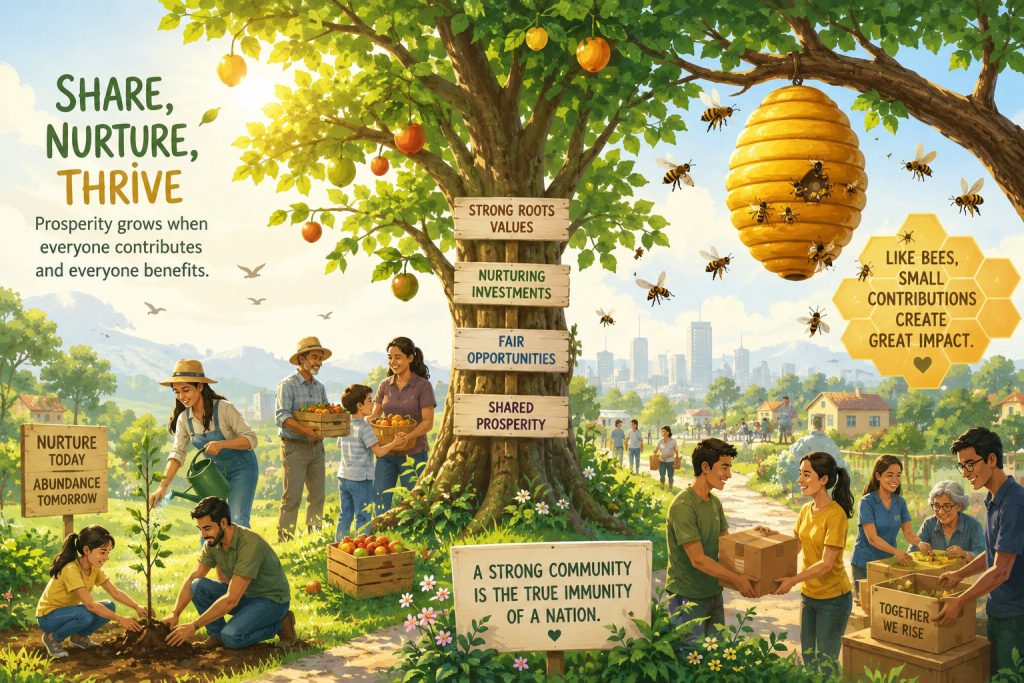
Trees teach humanity one of the greatest economic principles: nurturing creates abundance. When a farmer waters a tree, protects it from damage, and gives it time to grow, the tree eventually gives back fruits, shade, oxygen, and seeds in return. One tree can feed hundreds of people over many years. The tree never consumes all its fruits for itself. Instead, it contributes continuously to the ecosystem around it.
Modern economies often forget this simple lesson. Governments and corporations sometimes focus only on extracting profit instead of nurturing people. Workers are treated as tools rather than contributors. Farmers are underpaid while middlemen take larger profits. Small businesses are neglected while giant monopolies dominate markets. Such systems may produce short-term gains, but they weaken long-term national stability.
An economy should function like a healthy orchard. Investments in education, healthcare, agriculture, and small enterprises are like watering trees. The return may not come instantly, but over time these investments create strong communities and sustainable growth. Nations that support their citizens create productive populations capable of innovation, creativity, and resilience.
The Wisdom of Honey Bees
Honey bees offer another powerful lesson about collective prosperity. A beehive survives because thousands of bees contribute small efforts toward a common purpose. No single bee controls all the honey. Every bee performs its role with discipline and cooperation. Some gather nectar, some protect the hive, and some care for the young. Their combined efforts create a thriving ecosystem that benefits not only the hive but also flowers, crops, and entire food chains through pollination.
Human economies flourish under similar principles. When millions of people contribute fairly and receive fair rewards, societies become strong and stable. Small contributions from large populations can create extraordinary economic power. Taxes used honestly for public welfare, community-based entrepreneurship, cooperative farming, and local industries all reflect the spirit of the beehive.
The danger begins when a few individuals or corporations attempt to control the entire honey reserve. Once greed enters the hive, cooperation weakens. The same happens in nations where economic policies favor only the wealthy elite. Ordinary citizens lose motivation because their efforts no longer translate into meaningful progress. Economic inequality then becomes not only a financial issue but also a moral and social crisis.
The Damage Caused by Economic Concentration
Many countries today suffer because wealth is excessively concentrated. Large corporations influence political systems, manipulate markets, and suppress smaller competitors. Rural communities decline while urban wealth expands unevenly. Young people struggle to find opportunities despite working hard. In many cases, economic growth figures increase while the quality of life for average citizens remains stagnant.
This imbalance damages the bottom-line economy of nations. Consumer spending weakens when ordinary people lack purchasing power. Small businesses close because they cannot compete against giant companies. Public frustration grows as citizens witness luxury for a few and hardship for many. Eventually, social divisions deepen, leading to instability and distrust.
Economic concentration also harms innovation. In healthy systems, many people participate in production, creativity, and entrepreneurship. But when opportunities are monopolized, talent remains unused. A poor child with brilliant ideas may never receive education or support simply because resources are unequally distributed. Nations then lose enormous human potential.
Immunity of the Community
Just as the human body survives through a strong immune system, a nation survives through the immunity of its community. A healthy community protects itself from economic collapse, social division, and exploitation by standing together during times of difficulty. When people support local businesses, help struggling families, share knowledge, and work collectively for common welfare, they create social immunity that strengthens the entire nation.
The COVID-19 pandemic became one of the greatest modern examples of the immunity of the community. During lockdowns and economic uncertainty, governments alone could not carry the entire burden of survival. It was communities, ordinary citizens, healthcare workers, volunteers, farmers, delivery workers, and small local networks that kept societies functioning. In many places, neighbors shared food with struggling families, youth groups delivered medicines to elderly people, and community organizations arranged oxygen supplies and free meals. These acts proved that collective responsibility is far more powerful than isolated wealth.
At the same time, the pandemic also exposed the weakness of the lion’s share mentality. While millions lost jobs and livelihoods, a small section of corporations and wealthy individuals accumulated enormous profits. The gap between the rich and the poor widened dramatically. This imbalance revealed how fragile economies become when resources remain concentrated in a few hands. Nations that showed stronger community cooperation and public trust managed the crisis more effectively than those driven mainly by competition and individual gain.
COVID-19 reminded humanity of an important truth: survival depends not only on economic power, but on social solidarity. Just like bees protecting their hive together, communities that shared responsibilities became more resilient during the crisis. The pandemic taught the world that the true immunity of a nation lies in compassion, cooperation, and the willingness of people to stand together in difficult times.
Building Economies That Give Back
The future belongs to economies that learn from trees and honey bees. Sustainable prosperity comes not from taking the lion’s share, but from creating systems where everyone contributes and benefits. Governments must encourage policies that strengthen small businesses, support farmers, improve education, and protect workers. Wealth creation should not depend on exploitation but on cooperation and innovation.
Businesses too must adopt responsible models. Companies that invest in employee welfare, environmental sustainability, and community development often achieve greater long-term success. Consumers today increasingly value ethical businesses that contribute positively to society. Profit is important, but profit without responsibility eventually damages both society and the market itself.
Communities also play a crucial role. Local cooperation, shared knowledge, and collective responsibility can strengthen economies from the grassroots level. Cooperative farming, self-help groups, and community enterprises demonstrate how small contributions from many people can produce powerful outcomes. These systems mirror the intelligence of the beehive and the generosity of trees.
A nation becomes strong when economic opportunity reaches every household. Prosperity should not be limited to a privileged minority. When people feel included in growth, they work harder, innovate more, and contribute positively to society. Shared prosperity creates stability, trust, and long-term development.
The lion’s share mentality may create temporary wealth for a few, but it weakens the foundation of nations. Nature offers a wiser model. Trees teach us to nurture before expecting returns. Honey bees teach us that collective effort creates abundance for all. If societies adopt these lessons, economies can become more balanced, sustainable, and humane.
The true strength of a nation is not measured by the wealth of its richest citizens, but by the well-being of its ordinary people. Economies flourish when resources circulate, opportunities expand, and contributions are valued fairly. The future of sustainable development depends on replacing greed with cooperation, extraction with nurturing, and monopoly with participation. Only then can nations build economies that are not only profitable, but also just, resilient, and deeply connected to the wisdom of nature.


