
Reflections of Msgr. Anto Cheranthuruthy at the Global Symposium on Keralam’s Blue Economy in Cherthala.
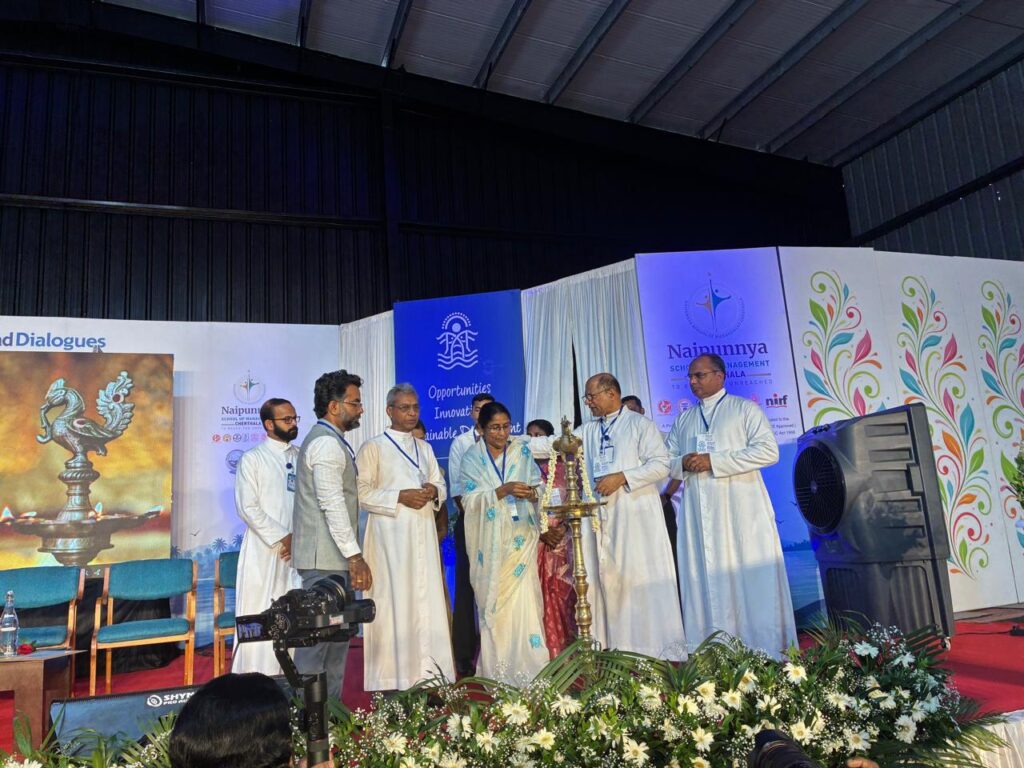
The blue economy is often spoken about in terms of oceans, fisheries, aquaculture, tourism, ports and new economic opportunities. But before planning a blue economy, there is a more fundamental task: we need to know our resources and understand how they are interconnected. This was a key idea emerging from the reflections of Msgr. Anto Cheranthuruthy at the Global Symposium on Keralam’s Blue Economy in Cherthala. The event, organised as part of the Vembanad Dialogues, brings together different perspectives on Kerala’s marine, coastal and backwater resources.
When we speak about resources, however, we should not think only of water, fish, wetlands, coastlines and biodiversity. People themselves are an important resource. The fishermen who have generations of knowledge about the waters, the farmers who understand the rhythms of the backwaters, the people involved in coir and traditional occupations, tourism workers, boat operators, entrepreneurs, scientists, researchers and young people with new ideas are all part of Kerala’s blue economy.
A resource cannot be understood in isolation from the people who depend on it. Vembanad, for example, is not simply a vast body of water. It is connected with fishing communities, farmers, tourism, transport, food, culture and the everyday lives of thousands of people. The health of the water affects fish. The availability of fish affects fishermen and their families. The condition of the environment affects tourism. Tourism creates employment and income for communities. Agriculture, waterways and wetlands are similarly connected. A change in one part of this system can create consequences elsewhere.
This is why the idea of interrelatedness becomes so important. When we understand reality, we begin to see that things do not exist independently. The economy is connected with the environment. The environment is connected with communities. Communities are connected with their livelihoods, traditions and knowledge. Human well-being is therefore closely linked with the health of the natural systems around us.
This understanding can change the way we approach the blue economy. Instead of asking only what economic value can be extracted from the sea or backwaters, we can ask a broader question: How can we create prosperity while strengthening the natural and human systems that make that prosperity possible?
Knowing our resources therefore means more than preparing an inventory of rivers, lakes, fisheries or marine wealth. It means understanding their ecological, economic, social and cultural value. A wetland, for instance, has value beyond the land or water it contains. A fishing community possesses knowledge accumulated over generations. Traditional occupations carry skills and cultural memory. A healthy ecosystem supports livelihoods that may not always be visible in conventional economic calculations.
People should consequently be placed at the centre of blue-economy planning. Development that ignores the people living beside the water cannot be truly sustainable. The knowledge of local communities can complement scientific research and modern technology. Their experience can help identify changes in ecosystems, understand seasonal patterns and recognise problems that may not be immediately visible from outside.
At the same time, the blue economy can create new opportunities for younger generations. Technology, scientific research, sustainable tourism, aquaculture, marine services, renewable energy and new forms of entrepreneurship can create livelihoods while opening new possibilities for communities. The challenge is to ensure that innovation does not disconnect people from the resources and places that sustain them, but instead creates opportunities for them to participate in and benefit from a changing economy.
Kerala has a particularly rich foundation for this approach because its blue resources are deeply connected. The Arabian Sea, rivers, backwaters, wetlands, agriculture, fisheries, tourism, traditional industries and coastal communities form parts of one larger system. Treating each sector separately can hide these relationships. Seeing the whole system can reveal opportunities as well as risks.
The Vembanad region illustrates this clearly. Its economic importance cannot be separated from its ecological health or from the communities that have built their lives around it. If water quality declines, aquatic life can suffer. If aquatic life suffers, fishing livelihoods can be affected. Changes in the environment can influence tourism and agriculture, which in turn affect employment and local economies. The wellbeing of the ecosystem and the wellbeing of the people are therefore closely connected.
The blue economy should consequently not be understood simply as another economic sector. It can become a way of thinking about development—one that recognises relationships between nature, people and the economy. It asks us to understand what we possess before deciding how to use it, to recognise the people who hold knowledge about those resources, and to consider the consequences of every intervention across the wider system.
The message is ultimately simple: know your resources, know your people, and understand their relationships. The future of the blue economy will depend not only on how much value we can generate from our waters, but on whether we understand the living system that makes that value possible.
The real strength of Kerala’s blue economy may therefore lie not in any single resource, but in the interconnectedness of its resources and its people. Once we learn to see the whole, economic development can become more sustainable, inclusive and rooted in the realities of the communities and ecosystems that define Kerala.


