
ROTARY CLUB OF ORGAN DONATION INTERNATIONAL ORGANISES SPEAKER MEETING ON “ONE DISEASE, MULTIPLE ORGANS: DIABETES AND THE HUMAN BODY”
Mumbai, 15 November 2026: On the occasion of World Diabetes Day, the Rotary Club of Organ Donation International organised an enlightening and informative speaker meeting on the theme “ONE DISEASE, MULTIPLE ORGANS: DIABETES AND THE HUMAN BODY.”
The distinguished guest speaker was a renowned Diabetes and Bariatric Surgeon Rtn Dr Ramen Goel, FRCS, MS, President of the Diabetes Surgery Foundation and Director of the Centre of Excellence in Diabetes & Bariatrics at Wockhardt Hospitals and P. D. Hinduja Hospital, Mumbai.
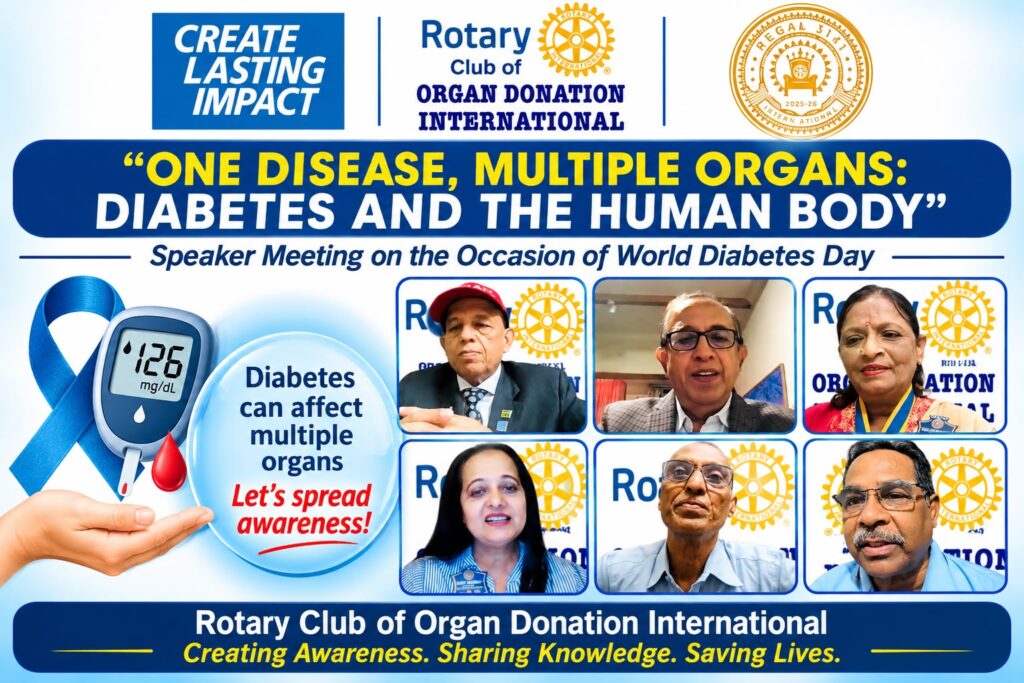
Dr Ramen Goel delivered an insightful presentation explaining how diabetes, often perceived merely as a disorder of elevated blood sugar, is actually a complex metabolic disease that can affect almost every major organ in the human body.
He highlighted the enormous burden of diabetes in India, referring to estimates of approximately 22 crore people living with the disease, with nearly 43% remaining undiagnosed. He stressed that diabetes management must go beyond controlling blood sugar, as many patients also suffer from multiple associated health conditions. He also drew attention to the growing global health burden of diabetes and kidney disease and the urgent need to improve awareness, early diagnosis and access to affordable treatment.
INSULIN RESISTANCE: THE BEGINNING OF THE PROBLEM
Explaining the development of Type 2 diabetes, Dr Ramen Goel emphasised that insulin resistance often begins several years before diabetes is actually diagnosed. Excess body fat, inadequate muscle mass, physical inactivity and genetic predisposition are among the contributing factors.
He stressed that early intervention through regular physical activity, appropriate nutrition and timely medical treatment can help prevent or delay diabetes. He also explained how insulin resistance, glucose toxicity, high blood pressure, abnormal lipid levels and inflammation collectively damage various organs.
HOW DIABETES AFFECTS MULTIPLE ORGANS
One of the most important aspects of the presentation was the impact of diabetes on different organs:
Kidneys: Progressive damage can lead to diabetic kidney disease and eventually kidney failure.
Liver: Diabetes and insulin resistance can contribute to fatty liver disease, inflammation and fibrosis.
Heart and Brain: Diabetes increases the risk of cardiovascular disease, stroke and cognitive decline.
Eyes: Damage to the retina can cause diabetic retinopathy and even blindness.
Nerves: Diabetic neuropathy can reduce sensation, particularly in the feet, increasing the risk of ulcers, infections and amputations.
Dr Ramen Goel cautioned that organ damage can develop even when blood sugar readings appear reasonably controlled. Therefore, diabetes requires comprehensive and continuous monitoring rather than focusing exclusively on glucose levels.
EARLY DETECTION, SCREENING AND LIFESTYLE MODIFICATIONS
Emphasising prevention and early detection, Dr Ramen Goel recommended regular monitoring of HbA1c, blood pressure, cholesterol, kidney function and urine parameters, along with periodic eye examinations and daily foot checks.
He also explained the importance of understanding the Glycaemic Index (GI) of foods and making informed dietary choices. Foods with a high GI can cause rapid increases in blood glucose and should be consumed cautiously, with appropriate attention to portion sizes and individual dietary requirements.
EXERCISE: A POWERFUL TOOL AGAINST DIABETES
Dr Ramen Goel highlighted physical activity as one of the most important pillars of diabetes management. Since muscles play a major role in glucose utilisation, regular exercise and maintaining adequate muscle mass are essential for improving insulin sensitivity and controlling blood sugar.
He discussed various medical and surgical treatment options, explaining that treatment should be individualised according to the patient’s condition, associated complications and degree of insulin resistance.
DIABETES, ORGAN TRANSPLANTATION AND ROTARY’S ROLE
Of particular relevance to the Rotary Club of Organ Donation International was Dr Goel’s discussion of the relationship between diabetes and organ transplantation.
He explained the challenges posed by diabetes in transplant recipients and discussed the role of simultaneous pancreas and kidney transplantation in selected patients with Type 2 diabetes and advanced kidney disease. Only Pancreatic transplants are done in type 1 diabetes.
He also suggested that Rotary Clubs could make a meaningful contribution by organising diabetes and obesity awareness campaigns, health screening programmes, promoting healthy eating habits and physical activity, and educating communities about organ donation.
AN INTERACTIVE AND INFORMATIVE SESSION
The presentation was followed by an engaging question-and-answer session in which Dr Ramen Goel addressed several questions from Rotarians on hereditary diabetes, obesity, insulin resistance, Type 1 diabetes, post-transplant diabetes and emerging treatment possibilities.
The discussion reinforced an important message: controlling blood sugar is essential, but protecting every organ requires a comprehensive approach to diabetes management.
The online meeting witnessed enthusiastic participation from a large number of members joining from across the globe.
MEETING PROCEEDINGS
Rtn Prof Dr Barathi S. Subramaniam, Senior Professor of Physiology at Kanachur Institute of Medical Sciences, Mangaluru, a living kidney donor and Honorary Member of the Rotary Club of Organ Donation International, introduced the distinguished speaker.
The vote of thanks was proposed by Non-Medical Director Rtn Prof Dr Sudhir Sharan, Bengaluru.
The meeting was conducted by Regal Secretary Rtn Ruby Agarwal, presided over by Regal President Rtn Hemalatha Bhandari and moderated by Founder & Charter President Rtn Lal Goel.
The programme was another meaningful initiative by the Rotary Club of Organ Donation International to promote health awareness, disease prevention and organ donation education.
WATCH THE COMPLETE MEETING ON THE GYAN YOUTUBE CHANNEL:
ROTARY CLUB OF ORGAN DONATION INTERNATIONAL
Creating Awareness. Sharing Knowledge. Saving Lives.


