
Calmness Is Not Weakness; It Is Leadership | The Legacy of a Father, the Discipline of a Son | A Builder of People, Not Merely Institutions
NV Paulose, Chairman, Global TV +91 98441 82044
There are leaders who announce themselves through their voices, and there are leaders whose presence is felt through confidence, discipline and purpose they bring to everything around them. Mr. Abdul Rahiman, Director of Kanachur Institute of Medical Sciences (KIMS), belongs to the latter category. Today, leadership mostly is confused with visibility and artificial stimulations. Abdul Rahiman represents an enduring leadership model built through character.

He is calm in temperament, attentive in conversation courteous in conduct, and firm in responsibility. Over a period of two decades, he has emerged as one of the promising next-generation leaders of Mangaluru’s educational and healthcare landscape.
His journey is particularly meaningful because it is inseparable from the larger Kanachur story. The Kanachur Islamic Education Trust was founded by his father, Dr. Haji U.K. Monu, in 2001 with a mission centred on education, healthcare and opportunities for economically disadvantaged communities. Abdul Rahiman stands top among the key members of the leadership team of that institution. But not just being the son of a successful institution builder. He is in the leadership by his performance and practices as an approved qualification for leadership.
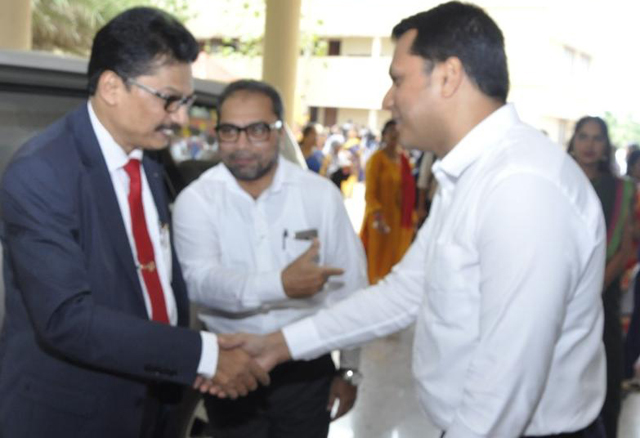
A legacy can open a door; character determines whether one is worthy of walking through it. Abdul Rahiman’s story is therefore not simply the story of a son succeeding his father. It is the story of a son learning from his father’s work ethic, respecting his father’s sacrifices and gradually developing his own identity as a responsible, thoughtful and contemporary leader. He carefully carved his future and played it will although the years. He built confidence in his father that he found true meaning for his hard work and all sacralises.
The Legacy of a Father, the Discipline of a Son
Behind many successful institutions stands a person who was willing to work when there was little recognition, to persist when the outcome was uncertain and to believe in a dream before others could see it. This is Dr. Haji U.K. Monu’s journey in building the Kanachur institutions and it reflects precisely such a spirit. The Kanachur story began with a vision of creating meaningful opportunities through education and healthcare. What started as a trust in 2001 has developed into a broad educational and healthcare ecosystem encompassing medical education, allied health sciences, nursing, physiotherapy, Ayurveda, management and school education. Abdul Rahiman grew up witnessing this transformation. He was also an integral part of the journey.

That experience mattered the most in his career journey. A son who has watched his father work tirelessly to build something from the ground up understands that success is not merely about position or privilege. It is about responsibility. It is about waking up every day with the determination to make yesterday’s achievement the foundation for tomorrow’s improvement.
This is perhaps one of Abdul Rahiman’s most admirable qualities: his respect for his father does not appear to be merely ceremonial. It is reflected in the way he carries forward the values associated with that legacy; hard work, discipline, humility, service and an appetite for continuous progress. The relationship between father and son also represents an important leadership transition.
Dr. Monu is the visionary founder and Chairman; Abdul Rahiman has become one of the important forces translating that vision into the demands of a new era. That transition requires more than loyalty. It requires maturity. And Abdul Rahiman appears to understand that very well. He does not have to imitate his father to honour him.
His responsibility is to preserve the values while finding new ways to express them. He knew what brought you here will not take you further where you aim to reach. That is the mark of a respectful son
Calmness Is Not Weakness; It Is Leadership
In leadership, calmness is often underestimated. The most striking qualities attributed to Abdul Rahiman is his calm and composed nature. A noisy leader can command attention. A calm leader can command trust. Abdul Rahiman’s professional persona reflects the latter. His approach appears measured rather than impulsive, attentive rather than hurried, and practical rather than theatrical.
Those qualities are especially valuable in an institution as complex as medical education and healthcare. Strengthening medical education, pursuing accreditation, enhancing curricula, developing faculty, upgrading infrastructure and strengthening quality assurance; he takes care of everything. These are very ambitious plans, not merely efforts to maintaining an existing institution. They indicate a leader looking ahead. His calmness is therefore better understood as controlled energy. He listens before deciding. He observes before reacting.
He gives people space to contribute. And when a decision has to be made, professionalism replaces emotion. Such a personality is valuable when leading doctors, professors, administrators, nurses, students and support staff; people with different responsibilities, personalities and expectations. Leadership in an institution cannot be built around authority alone. It requires collaboration.
A Builder of People, Not Merely Institutions
The most inspiring aspect of Abdul Rahiman’s leadership is that his vision extends beyond buildings, equipment and numbers. The Kanachur model is fundamentally about people. The Kanachur group emphasis on academic excellence, faculty development, research, practical training, infrastructure and quality assurance. It has also place efforts to strengthen specialized healthcare, improve patient experience and expand health education and preventive outreach. That philosophy aligns naturally with Abdul Rahiman’s qualities as a listener and team builder. He is very good in finding opportunities with every discussion and deliberation as he take them seriously on to a series of talks.
Institutions grow when people grow. A medical college may have modern laboratories, lecture halls and hospitals, but its real strength lies in the people who teach, treat, guide, administer and serve. Abdul Rahiman appears to understand this distinction.
His presence at academic programmes, professional workshops, medical events, community initiatives and institutional ceremonies demonstrates a leadership style that remains connected to the people doing the work. His message to young people is also characteristic of a leader who understands the importance of mindset. Leadership is not only about telling people what to do. It is about shaping the environment in which people think, dream and perform. A team builder creates that environment. He identifies talent. He encourages confidence. He respects expertise. He connects different departments. He creates a shared sense of purpose. In healthcare education, where the ultimate objective is to prepare professionals entrusted with human lives, such leadership can have an impact beyond the institution itself.
The Next Chapter: From Inherited Legacy to Earned Leadership
Every second-generation leader faces a difficult question: How do I honour what was built before me while creating something that belongs to my generation? Abdul Rahiman’s answer appears to be progress.
He is not merely protecting a legacy. He is helping modernise it. His future roadmap speaks of advanced healthcare technologies, stronger clinical services, improved patient experience, faculty development, research, quality standards and digital transformation. That forward-looking approach is essential because healthcare is changing rapidly.
Artificial intelligence, digital records, advanced diagnostics, specialised medicine, telehealth and data-driven decision-making are reshaping the profession. The leaders of tomorrow must therefore possess both human sensitivity and technological awareness. Abdul Rahiman’s leadership philosophy appears to sit at that intersection. He respects tradition without becoming trapped by it.
He values experience without resisting innovation. He understands that discipline does not mean rigidity. And perhaps most importantly, he seems to recognise that professional success without human values is incomplete. His father’s generation built with determination. Abdul Rahiman’s generation must build with determination and adaptation. That is the challenge before him; and also the opportunity.
Kanachur story has already demonstrated what sustained commitment can achieve. Yet the most meaningful measure of Abdul Rahiman’s success will not simply be the number of buildings added, courses introduced or milestones achieved. It will be the number of people whose lives become better because he led well. The student who finds confidence. The doctor who receives encouragement. The teacher whose ideas are heard. The patient who receives better care. The employee who discovers a sense of belonging. The family that finds educational opportunity. These are the quiet victories of leadership. And they are often more enduring than awards.
Mangaluru has many accomplished professionals, entrepreneurs and institution builders. The next generation, however, will require a different kind of leadership; leaders who can combine ambition with humility, technology with humanity, authority with listening and success with responsibility. Abdul Rahiman represents that possibility. He carries the name of a successful father, but he is also steadily creating a reputation of his own. He has inherited a formidable legacy, but inheritance alone cannot explain the respect he commands. It is his conduct; the calm manner, disciplined approach, professional commitment, respectful nature and ability to work with people, that gives meaning to the position he holds. A father’s greatest achievement may not be the institution he builds. It may be the values he succeeds in passing to his children. Dr. Haji U.K. Monu’s legacy finds a great continuation in Abdul Rahiman: a son who respects the hands that built the foundation while preparing himself to strengthen and extend the structure. The future belongs to leaders who understand that success is not a destination but an obligation to do better.


