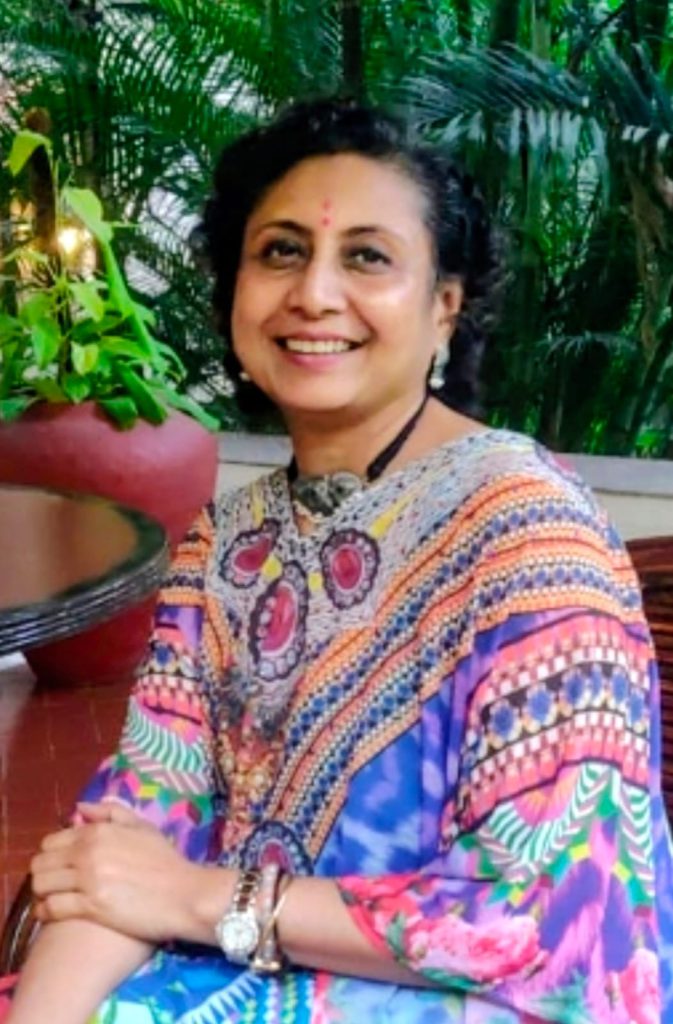
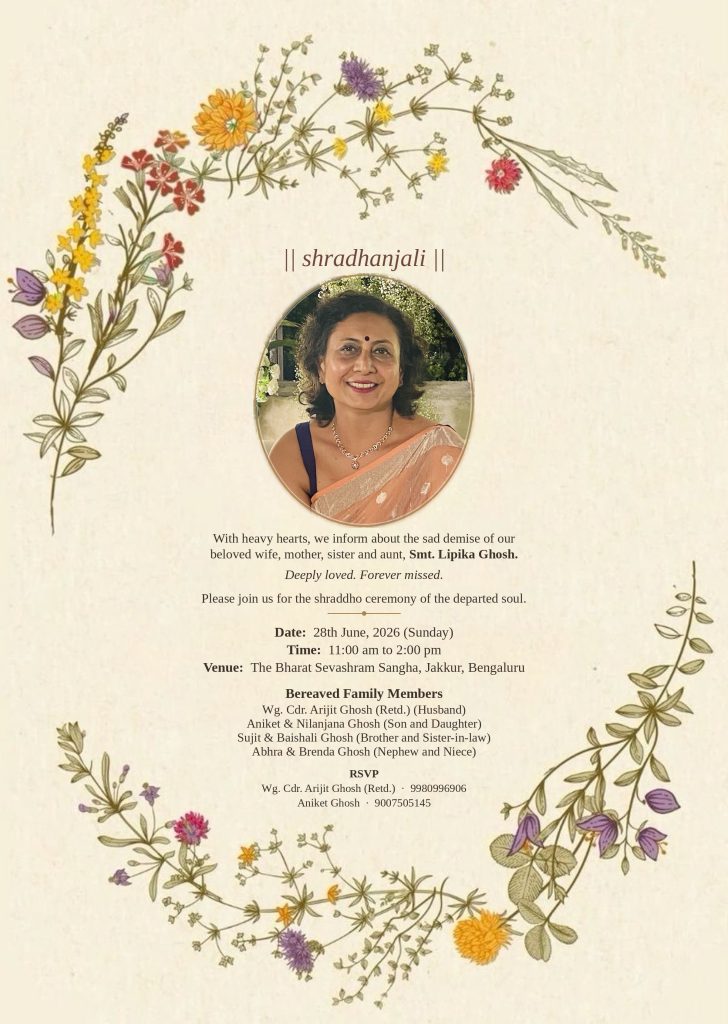
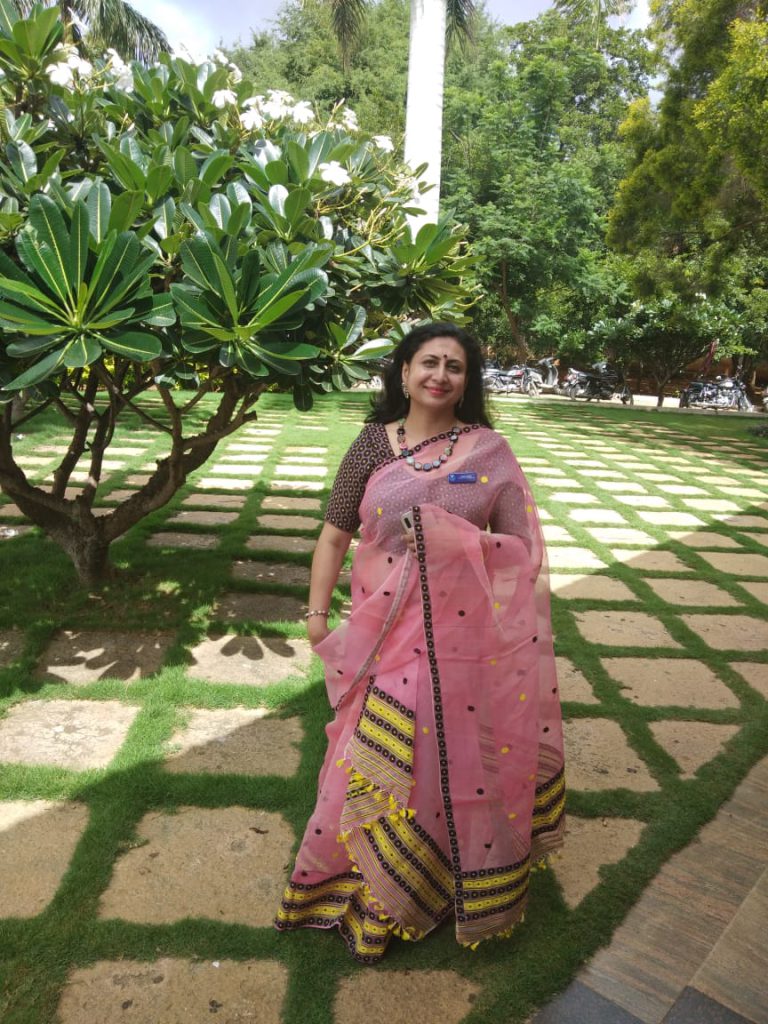
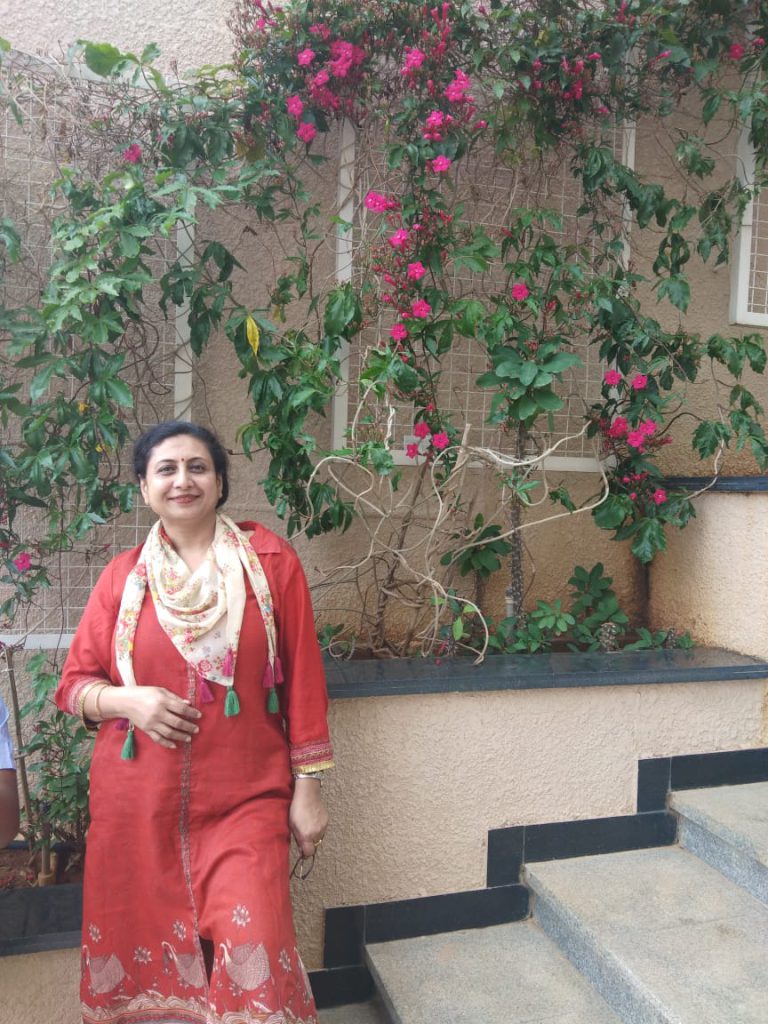
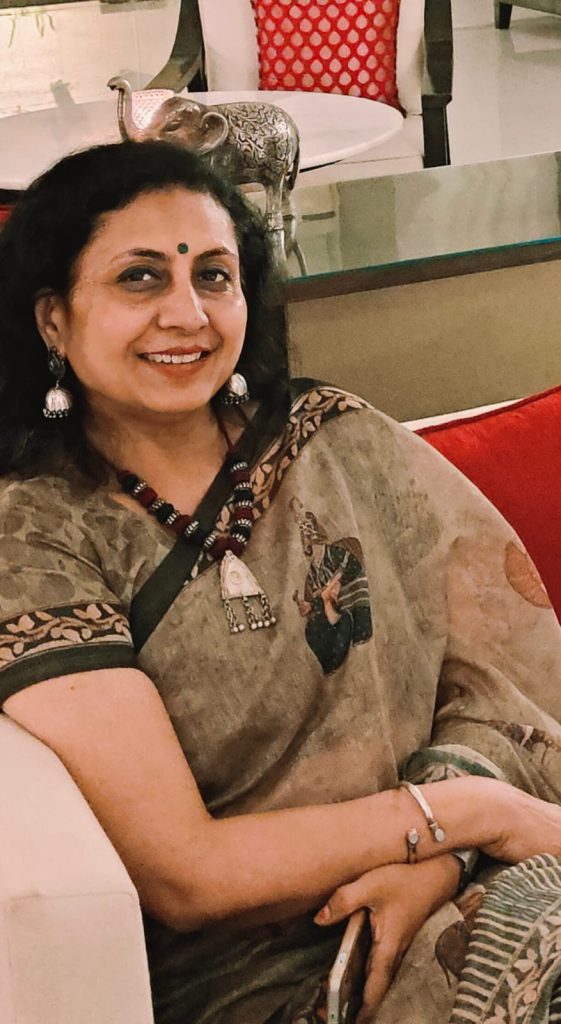
A Tribute to Smt. Lipika Ghosh | Some people leave behind memories. A few leave behind a legacy | Smt. Lipika Ghosh leaves behind both | Global TV
NV Paulose, Chairman, Global TV +91 98441 82044
I have had the privilege of knowing Wing Commander Arijit Ghosh for nearly twenty-five years. I have admired him as a Ranji cricketer, respected him as an officer of the Indian Air Force, and appreciated him as an accomplished Penguin author. Yet, of all the roles he has fulfilled with distinction, the one that defines him most is that of a devoted husband.
When Mrs. Lipika Ghosh’s health began to fail, Wing Commander Arijit Ghosh quietly set aside everything else to stand beside her. His unwavering care, boundless love, and selfless dedication became the strength on which she could lean through her long and difficult journey. Their relationship reflected the true meaning of commitment, sacrifice, and unconditional love.
Lipika Ghosh herself was a woman of exceptional courage. She fought her illness with remarkable dignity and determination until her very last breath. Even as her body grew weaker, her resolve remained unshaken. She continued to attend school and teach almost until the final week of her life. She did not merely teach academic subjects. She taught sporting spirit, grace, compassion, and the strength to face adversity with a smile.
Her students will remember her as a teacher. Those who knew her will remember her as an inspiration.
There are no words that can ease the sorrow of Wing Commander Arijit Ghosh and their two children. The loss they bear is beyond expression. Yet they can take comfort in knowing that Mrs. Lipika Ghosh lived a life of purpose and touched countless hearts through her kindness, courage, and quiet strength.
Some lives continue to illuminate the path of others long after they are retired. Lipika Ghosh’s is one such life.
May her noble soul rest in eternal peace. Forever remembered. Forever missed.
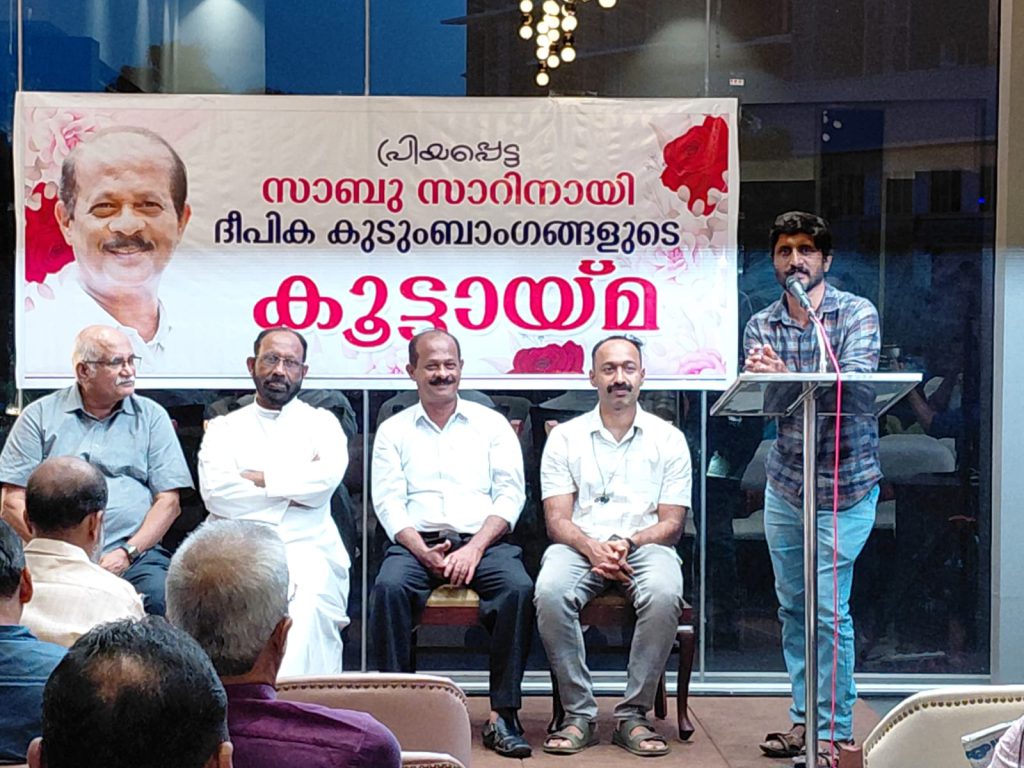
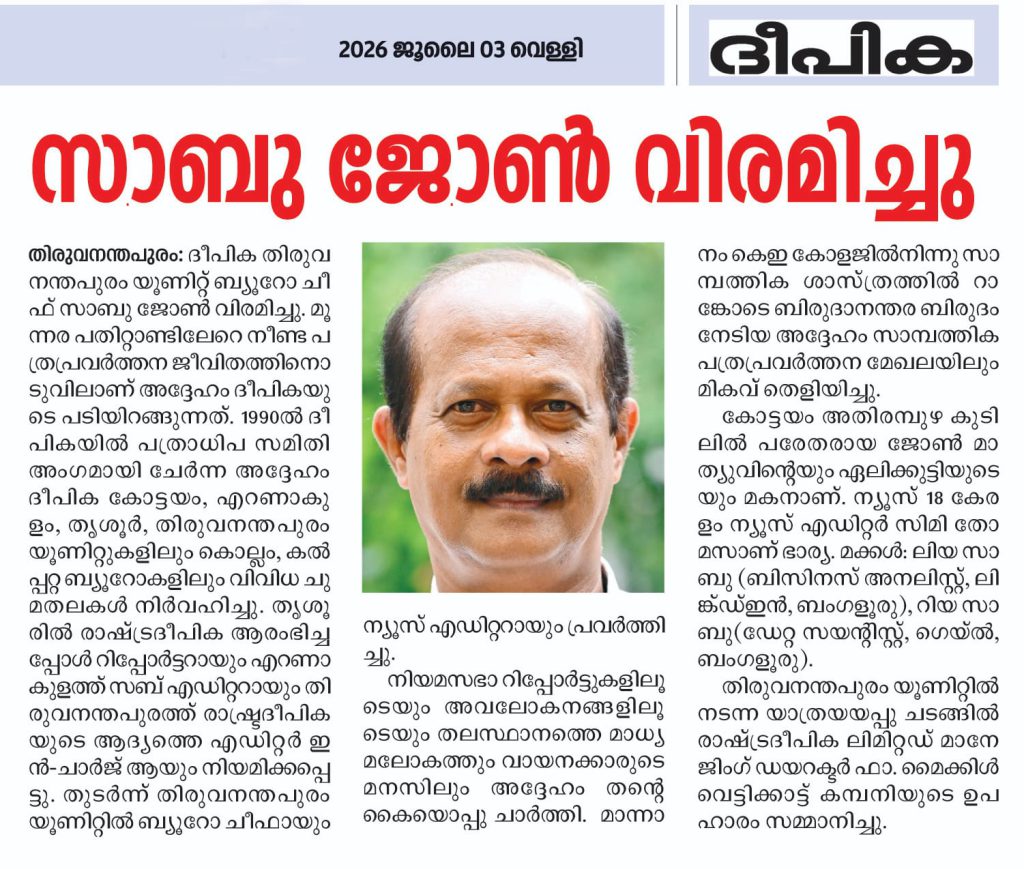
Retirement is often seen as the end of a professional journey. For journalists like Mr. Sabu John, however, it marks the completion of only a phase in life and the beginning of a more devoted stream of Career Mentoring and Connecting with much stronger themes in life. He was not merely reporting news, but serving society with integrity, fairness, and compassion. His new phase in his career with more freedom and a vast spectrum of possibilities will prove him much stronger and more powerful in the Media Space in Keralam and beyond.
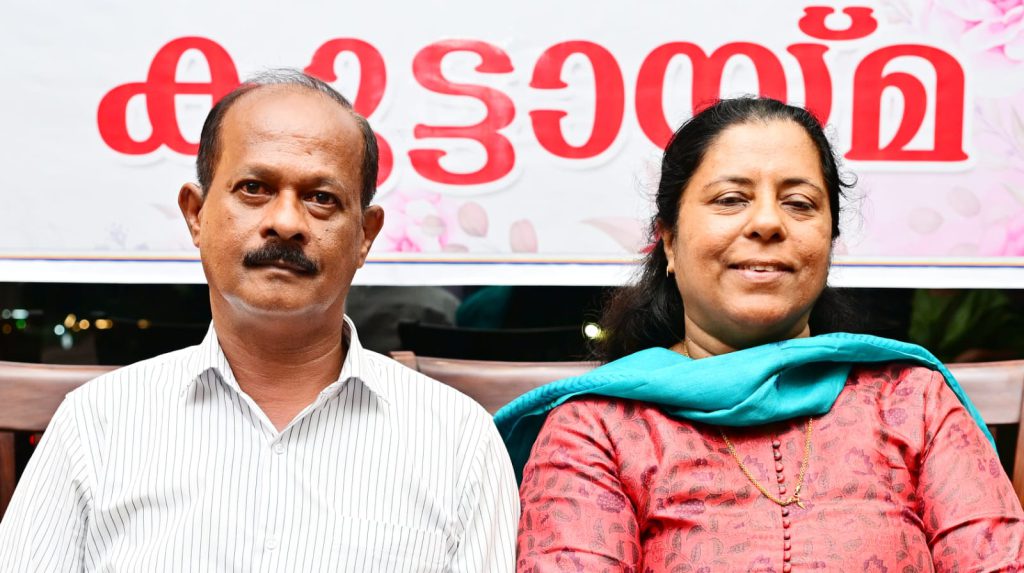
Having retired as Bureau Chief of Deepika in Thiruvananthapuram, Mr. Sabu John leaves behind a legacy built over more than three decades of dedicated journalism. His long association with Deepika and his leadership in the Thiruvananthapuram bureau earned him the respect of colleagues, public officials, and readers alike. I had the privilege of working with Mr. Sabu John during 1993 and 1994 in Thiruvananthapuram. Looking back after more than three decades, what stands out is not merely his professional excellence, but the values that defined him as a person.
He belongs to a rare generation of journalists who believed that human relationships are as important as headlines. He treated everyone with dignity, whether they were senior administrators, political leaders, fellow journalists, or ordinary citizens who approached him with a story. His simplicity made him approachable, and his humility earned him lasting friendships across professional and social boundaries.
As a journalist, Mr. Sabu John was guided by a strong moral compass. He was righteous in his profession, never allowing personal interests or external pressures to compromise his commitment to truth. His reporting was balanced, unbiased, and deeply people oriented. He understood that journalism is not merely about conveying information. It is about giving voice to those who might otherwise remain unheard. In an era when sensationalism increasingly competes with substance, Mr. Sabu John’s career reminds us of the enduring values of responsible journalism. He demonstrated that credibility is earned through consistency, fairness, and ethical conduct rather than through loud opinions or fleeting publicity.
Those who worked with him will remember not only his professional competence but also his calm demeanor, his willingness to help younger colleagues, and his ability to build bridges among people with differing views. His office was often a place where conversations extended beyond news, reflecting his genuine interest in people and their lives.
Every profession needs role models. Journalism, perhaps more than any other profession, depends on individuals whose personal integrity reinforces public trust. Mr. Sabu John has been one such example. His career illustrates that one can remain principled, compassionate, and independent while earning the confidence of both colleagues and the community.
Retirement is not the closing of a meaningful life. It is the opening of a new chapter filled with opportunities that professional commitments often leave little time to pursue. It offers the freedom to spend more time with family, reconnect with old friends, nurture personal interests, and continue contributing to society in new and enriching ways. For someone like Mr. Sabu John, whose greatest strength has always been his relationship with people, retirement is certain to become another meaningful phase of service and friendship.
The experience, wisdom, and values accumulated over decades do not retire with a person. They become an invaluable gift to the community. Young journalists and those who have had the privilege of knowing Mr. Sabu John will continue to draw inspiration from his example of integrity, humility, and dedication. Retirement is therefore not an end. It is a new beginning, one that promises fresh experiences, lasting happiness, and countless opportunities to make a positive difference.
I consider myself fortunate to have known and worked with Mr. Sabu John during the early years of his distinguished career. He is among the very few journalists who have remained steadfast in their values while earning the admiration of friends, colleagues, and the public. I wish him good health, happiness, peace, and many fulfilling years ahead. His professional journey may have reached its formal conclusion, but the values he embodied will continue to inspire everyone who believes that journalism is, above all, a service to society.
Mrs. Jolly Sebastian Karakkunnel | A National Educator, Trainer, and Champion of Human Values
NV Paulose, Chairman, Global TV +91 98441 82044
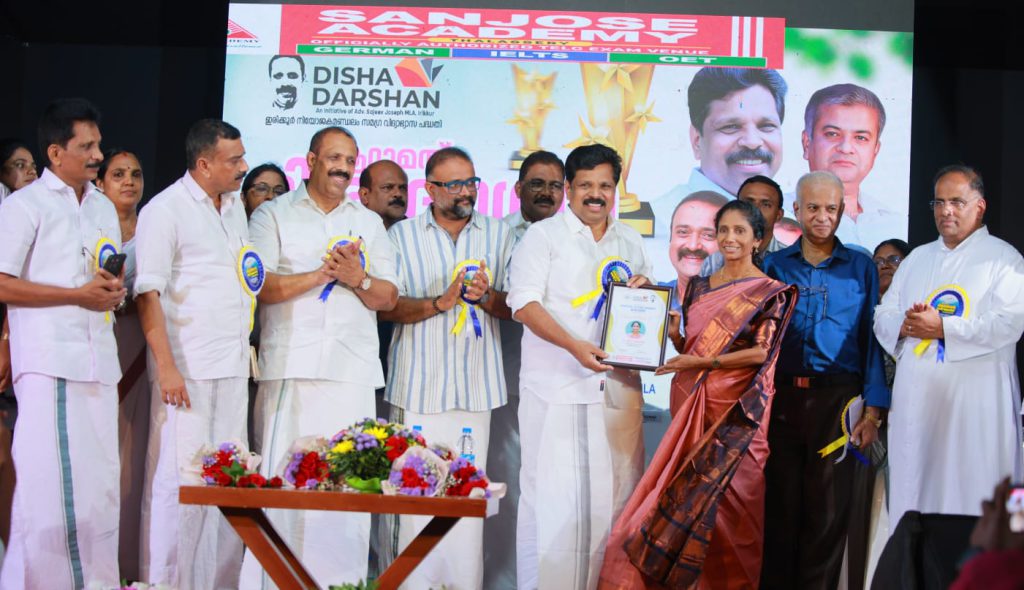
The true measure of an educator is not only the knowledge they impart but the lives they transform. This truth was fittingly recognized when Mrs. Jolly Sebastian Karakkunnel was honoured with the Special Achievement Award, presented by Hon. Revenue Minister Shri A. P. Anilkumar, in recognition of her outstanding service as a National Trainer for Teachers, Youth, Children, Women, and Parents. The prestigious honour celebrates her unwavering commitment to empowering individuals through education, leadership development, safeguarding initiatives, and value-based learning. It stands as a testament to decades of dedicated service that has touched countless lives across India.
For over 26 years, Mrs. Jolly Sebastian has devoted her life to shaping young minds and strengthening communities through education. An accomplished educator, national trainer, author, motivational speaker, and social leader, she has earned widespread respect for her remarkable contributions to teacher education, child protection, leadership formation, and humanitarian service. Her work extends far beyond the classroom, influencing teachers, students, parents, women, youth, and community leaders throughout the country.
Holding postgraduate degrees in M.A., M.Phil., and B.Ed., Mrs. Jolly began her teaching career in 2000 at Pushko Senior Secondary School, Pooparamba, where she continues to serve with exceptional dedication and passion. Throughout her teaching career, she has consistently inspired students to pursue academic excellence while nurturing integrity, compassion, and responsible citizenship.
Her greatest contribution lies in her national leadership in safeguarding and human development. Since 2014, she has served as the National Trainer and Resource Person of SSVP India, conducting training programmes across the country in English, Hindi, and Malayalam. Through these programmes, she has equipped thousands of teachers, children, youth, women, parents, and volunteers with practical knowledge in safeguarding, leadership, child protection, and value-based education. Her engaging training sessions have earned her recognition as one of India’s respected resource persons in these fields.
Mrs. Jolly’s leadership responsibilities have continued to grow over the years. Since 2017, she has been serving as the National Lady Representative of SSVP India, and in 2023, she was appointed the National Safeguarding Coordinator of SSVP India. In addition, she serves as a Member of the Pastoral Council of the Diocese of Thalassery and has held important leadership positions as the Diocesan Women’s Coordinator and Joint Secretary of SSVP.
One of her most remarkable achievements is the authorship of India’s Safeguarding Policy Book. Under the guidance of the SSVP International Council, she drafted the safeguarding policy in English for implementation throughout India. The policy received official approval from the International Council and has since been distributed across all Indian states, establishing a unified framework to ensure the safety, dignity, and well-being of members and beneficiaries.
Mrs. Jolly’s excellence has also been recognized through the Ideal Teacher Award 2026 at the Kannur Sahodaya Teacher Excellence in Education Awards. In addition, she has won awards in state- and district-level essay competitions and has received numerous honours for her outstanding contributions to charitable and humanitarian activities at district, state, and national levels.
Beyond education, Mrs. Jolly is a gifted writer, speaker, and creative artist. She has written songs, dramas, poems, storytelling scripts, dance dramas, and traditional performance pieces that promote moral values and social awareness. Her acclaimed play, “Golden Flowers of Paradise” (Parudeesayile Pon Pookkal), received state-level recognition and was published in the State Bulletin.
Fluent in English, Hindi, and Malayalam, she continues to inspire audiences across India through training programmes, seminars, and motivational talks. Her ability to connect with people from diverse backgrounds has made her an influential educator and mentor.
Mrs. Jolly Sebastian Karakkunnel’s journey is a powerful example of how one person’s dedication can influence an entire generation. From a committed classroom teacher to a nationally respected trainer, policy author, safeguarding advocate, and educational leader, she has consistently worked to build safer, stronger, and more compassionate communities.
Mrs. Jolly Sebastian Karakkunnel has built a distinguished career through her dedication to education, leadership development, safeguarding, and social service. Her contributions as an educator, national trainer, author, and mentor have earned recognition at various levels. She continues to serve with commitment, inspiring individuals and contributing to the growth of value-based education and community development across India.
From Maverick to Movement: Celebrating Ricardo Semler, Semco, and the Rise of Semco Style in India
NV Paulose, Chairman, Global TV +91 98441 82044
Some ideas arrive before the world is ready for them. They challenge deeply held beliefs, question accepted management practices, and inspire people to imagine a better way of working. More than two decades ago, in 2003, I first came across the remarkable story of Ricardo Semler and Semco. It was not merely a business success story; it was a profound lesson on trust, freedom, responsibility, and the untapped potential of human beings.
Twenty-three years later, it is deeply gratifying to witness the emergence of Semco Style Consultants India, an initiative dedicated to bringing the timeless philosophy of Semco to Indian organizations. This is more than the introduction of a management framework—it is the beginning of a movement that has the potential to transform workplaces, leadership, and organizational culture across the country.
Ricardo Semler earned global recognition by transforming a conventional manufacturing company into one of the world’s most admired organizations. At a time when command-and-control management dominated boardrooms, Semler chose an entirely different path. He believed that people perform their best when they are trusted rather than controlled, empowered rather than supervised, and treated as responsible adults rather than mere employees.
The Semco Style Expert Program:
For OD consultants, business consultants, and organisational change-makers who want to bring the Semco practices and Ricardo Semler’s thinking on trust, autonomy, transparency, and ownership into their consulting work.
The program gives consultants a structured way to assess organisational culture, identify the barriers behind stalled growth, and guide clients through a transformation journey that fits their context.
Reach out to know more or sign up. Please also circulate this with anyone who may find it relevant. Cohort starts: 6 August 2026
The principles that emerged from Semco challenged traditional management thinking. Employees participated in decision-making, transparency became a cornerstone of organizational life, unnecessary bureaucracy was dismantled, and leadership evolved from exercising authority to enabling people to succeed. Rather than relying on rigid rules and excessive supervision, Semco demonstrated that trust, accountability, and shared ownership could produce exceptional business performance.
What makes Ricardo Semler truly exceptional is that he proved these ideas were not idealistic dreams but practical business realities. His philosophy showed that profitability and human-centered leadership are not opposing forces. In fact, sustainable growth often flourishes when organizations invest in creating environments where people genuinely want to contribute.
For countless leaders around the world, books such as Maverick and The Seven-Day Weekend became more than business literature. They inspired a generation to rethink what leadership means and to question whether organizations should exist merely to maximize profits or also to enhance human potential.
Today, the challenges facing organizations are remarkably similar to those Semler identified decades ago. Many businesses struggle with slow decision-making, excessive bureaucracy, leadership burnout, disengaged employees, and cultures where innovation is stifled because authority remains concentrated at the top. Growth becomes increasingly dependent on a handful of individuals, leaving organizations vulnerable and limiting their ability to adapt.
This is precisely why the emergence of Semco Style Consultants India is both timely and significant.
Rather than offering another management fad or a collection of fashionable buzzwords, Semco Style Consultants India is helping organizations rethink how people work together. Their philosophy recognizes that true business transformation begins not with technology or processes but with culture. As they aptly observe, if a business moves only when its leaders continuously push it forward, that is not genuine growth—it is dependency. Their aspiration is to help organizations become capable of running and growing beyond the constant presence of their founders or senior executives.
This perspective is especially relevant in India, where entrepreneurial businesses often experience rapid expansion but struggle to scale because decision-making remains centralized. As organizations grow, layers of approvals, policies, and supervision frequently replace trust and agility. Employees wait for instructions rather than taking initiative, and leaders become overwhelmed by responsibilities that should be shared across capable teams.
Semco Style Consultants India offers an alternative path. Their focus on reducing bureaucracy, strengthening trust, building accountability, and nurturing autonomous teams reflects the enduring wisdom of the Semco philosophy while adapting it to contemporary organizational realities. Their message is refreshingly simple: organizations achieve lasting success when people are empowered to think, decide, and contribute with genuine ownership rather than merely complying with instructions.
What is particularly encouraging is the comprehensive nature of their work. Through leadership development, ownership culture programs, agile culture transformation, organizational culture assessments, coaching, and certification initiatives, they are helping leaders translate values into everyday practice. These interventions recognize that culture cannot be changed through slogans displayed on office walls. It changes only when leaders consistently demonstrate trust, openness, accountability, and respect in their daily actions.
The contributions of Jyoti Menezes and Milind Vaidya, the co-founders of Semco Style Consultants India, deserve sincere appreciation. Their combined expertise in leadership development, organizational transformation, manufacturing, supply chain management, talent development, and workplace culture positions them uniquely to guide Indian organizations through meaningful change. More importantly, they appear committed to preserving the spirit of Semco rather than simply replicating its practices. As they rightly state, Semco Style is not a recipe to copy but a perspective from which every organization can develop its own unique way of working. This distinction is critically important. Every organization possesses its own history, people, challenges, and aspirations. The objective is not to imitate Semco mechanically but to embrace its underlying principles of trust, freedom with responsibility, transparency, participation, and continuous learning.
As India aspires to become one of the world’s leading economic powers, conversations about organizational culture become increasingly important. Innovation cannot flourish in environments dominated by fear. Accountability cannot thrive where people lack ownership. Agility cannot emerge from excessive bureaucracy. Sustainable excellence requires organizations where people feel respected, trusted, and inspired to contribute their best ideas.
The philosophy pioneered by Ricardo Semler speaks directly to these realities. It reminds us that businesses exist not only to produce products and profits but also to create environments where human potential can flourish. The success of an organization ultimately depends not on how tightly people are controlled but on how meaningfully they are engaged.
Looking back over the past twenty-three years since I first encountered the story of Semco, it is immensely satisfying to see these ideas finding renewed relevance in India. The emergence of Semco Style Consultants India represents an important milestone in advancing progressive leadership and organizational development. Their work has the potential to influence not only individual companies but also the broader conversation about what effective leadership should look like in the twenty-first century.
Ricardo Semler showed the world that extraordinary organizations are built on extraordinary trust. Semco proved that freedom and accountability can coexist, and that business success is strongest when people are empowered to lead from every level. Now, through the dedicated efforts of Semco Style Consultants India, these transformative ideas are being thoughtfully introduced to Indian businesses.
This is an initiative worthy of recognition and wholehearted appreciation. It carries forward a remarkable legacy while adapting it to the aspirations of a new generation of leaders. May this movement continue to inspire organizations to move beyond bureaucracy, embrace ownership, cultivate trust, and build workplaces where both people and businesses truly thrive
10 Super Mentors Can Create 1000 Career Opportunities Through a Positive Massive Collective Media Collaboration in Kerala
NV Paulose, Chairman, Global TV +91 98441 82044
A New Vision Based on Asset-Light Establishments
Kerala has always been admired for its educated population, entrepreneurial spirit, social awareness, and strong global connections. Yet one of its greatest challenges continues to be the creation of meaningful career opportunities that match the aspirations of its young people. Conventional employment models depend on large investments, expensive infrastructure, and long implementation periods before significant results become visible.
There is another path that is faster, more collaborative, and capable of creating immediate impact.
Imagine bringing together just ten Super Mentors who possess outstanding experience, extensive professional networks, leadership qualities, and a commitment to social transformation. Instead of working independently, these mentors become the foundation of a Positive Massive Collective Media Collaboration. Their combined knowledge, credibility, and influence can inspire thousands of people while creating immediate career opportunities through the concept of Asset Light Establishments.
Rather than investing first in buildings and heavy infrastructure, this model invests in knowledge, relationships, collaboration, digital platforms, media visibility, and community participation. It reflects the philosophy of positive journalism promoted by Global TV, where connecting people creates far greater value than simply connecting physical assets.
The Transformative Role of Super Mentors
Every successful movement begins with visionary individuals who inspire others to act.
A Super Mentor is much more than an expert. Such a person connects ideas with action, institutions with entrepreneurs, students with employers, and aspirations with practical opportunities.
If ten accomplished mentors represent areas such as media, education, technology, agriculture, healthcare, tourism, entrepreneurship, finance, creative industries, and social innovation, they become a powerful knowledge network for Kerala.
Working together, they can identify opportunities, build partnerships, encourage innovation, and guide young people towards productive careers. Their collective influence is far greater than the sum of their individual contributions.
Positive Media as a Creator of Opportunities
Media today is much more than a source of information. It has become a platform for education, inspiration, collaboration, and economic development.
Positive media highlights solutions, celebrates innovation, encourages participation, and builds trust within society. Every inspiring story gives visibility to entrepreneurs, educators, artisans, researchers, startups, social organisations, and community leaders.
When media organisations work together with a shared purpose instead of functioning in isolation, they create an ecosystem where opportunities multiply naturally. Positive journalism becomes a catalyst for entrepreneurship, tourism, education, healthcare, culture, and community development.
This collaborative approach can transform media from an observer of progress into an active creator of progress.
Asset Light Establishments Can Build Careers Quickly
The future belongs to organisations that create value through knowledge, creativity, partnerships, and digital capabilities rather than expensive physical infrastructure.
Asset Light Establishments may include digital media centres, knowledge networks, mentoring platforms, career guidance centres, skill development academies, tourism collaborations, community innovation hubs, content production teams, and professional networking platforms.
These initiatives require relatively modest financial investment while generating significant economic and social value. Instead of waiting for large industries to arrive, communities can create opportunity ecosystems using the talent, experience, and resources that already exist around them.
Knowledge becomes capital.
Relationships become infrastructure.
Trust becomes the strongest investment.
Creating One Thousand Career Opportunities
Creating one thousand career opportunities does not necessarily require one thousand employers. It requires one thousand meaningful roles that contribute value to society.
Opportunities can emerge in digital content creation, video production, community journalism, graphic design, social media management, mentoring, event management, tourism services, startup support, online education, research, translation, public relations, digital marketing, knowledge management, and community engagement.
Many of these careers can be independent, collaborative, flexible, or entrepreneurial. Young people become creators of opportunities instead of waiting for traditional employment.
Every successful initiative generates additional opportunities, creating a cycle of continuous growth.
Kerala Can Become a Global Model
Kerala possesses exceptional strengths, including high literacy, a globally connected diaspora, respected educational institutions, vibrant communities, rich cultural heritage, and widespread digital connectivity.
When these strengths are connected through a Positive Massive Collective Media Collaboration, Kerala can become an international model for knowledge-driven development.
Universities, colleges, alumni associations, business organisations, startups, local governments, media institutions, professionals, and community groups can work together within one collaborative ecosystem. Instead of isolated efforts, every institution becomes a contributor to shared progress.
Collective success grows much faster than individual success when collaboration becomes the guiding principle.
A Movement Towards Shared Prosperity
The next generation of development is not about creating a few successful individuals. It is about creating thousands of meaningful connections that generate opportunities for everyone.
Every mentor becomes a bridge between knowledge and opportunity.
Every media platform becomes a creator of careers.
Every educational institution becomes a centre for innovation.
Every entrepreneur becomes a mentor.
Every citizen becomes a contributor to positive change.
When ten Super Mentors unite with positive media, educational institutions, entrepreneurs, and community leaders, they can begin a movement that transforms the employment landscape of Kerala.
The vision of creating one thousand immediate career opportunities is therefore much more than an employment initiative. It represents a new philosophy of development where collaboration becomes the greatest asset.
Asset Light Establishments demonstrate that sustainable growth depends less on physical infrastructure and far more on human relationships, shared knowledge, collective leadership, and purposeful communication.
Kerala possesses every ingredient needed to lead this transformation. Through collaboration, innovation, and positive media, one thousand opportunities can become ten thousand, then one lakh, and eventually many more.
The future belongs to societies that connect people, nurture talent, and build ecosystems where everyone grows together. Kerala has the potential to become that inspiring model for India and for the world.
AA Meeting Highlights Vital Role of Alcoholics Anonymous in De-addiction and Recovery
NV Paulose, Chairman, Global TV +91 98441 82044
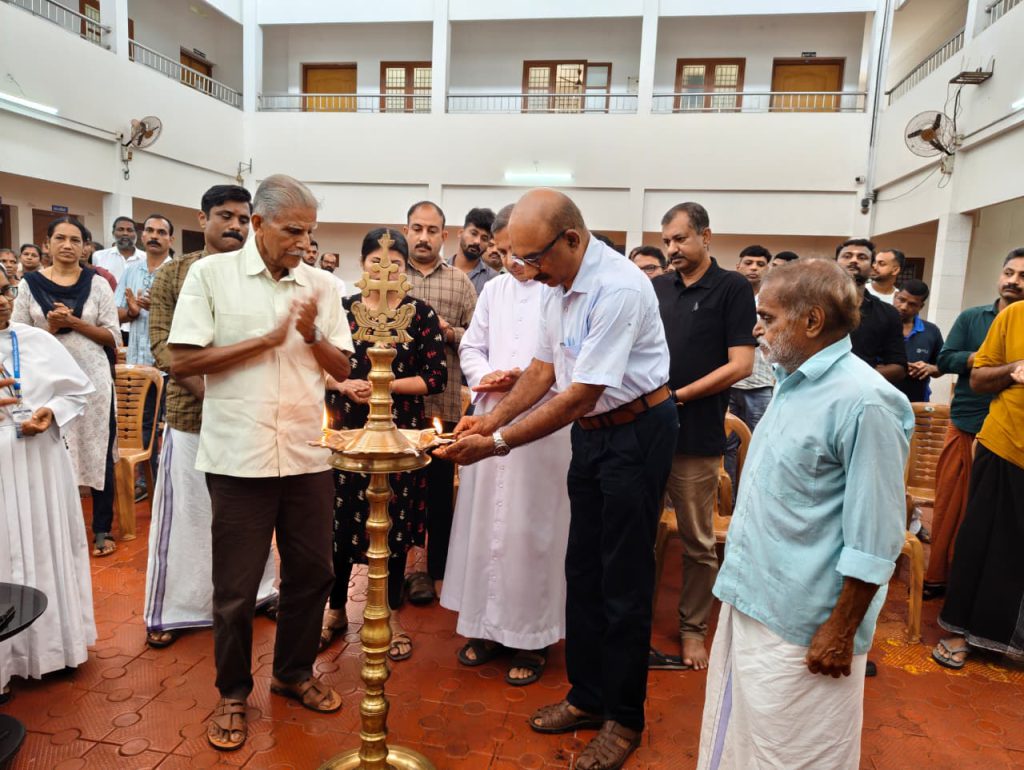
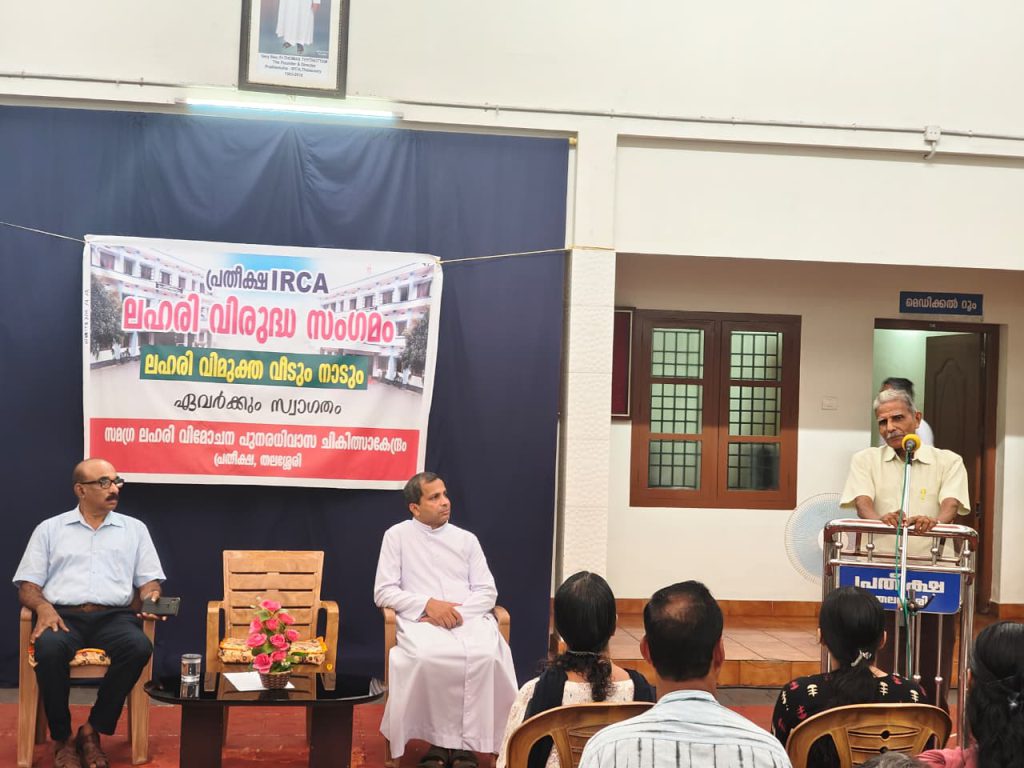
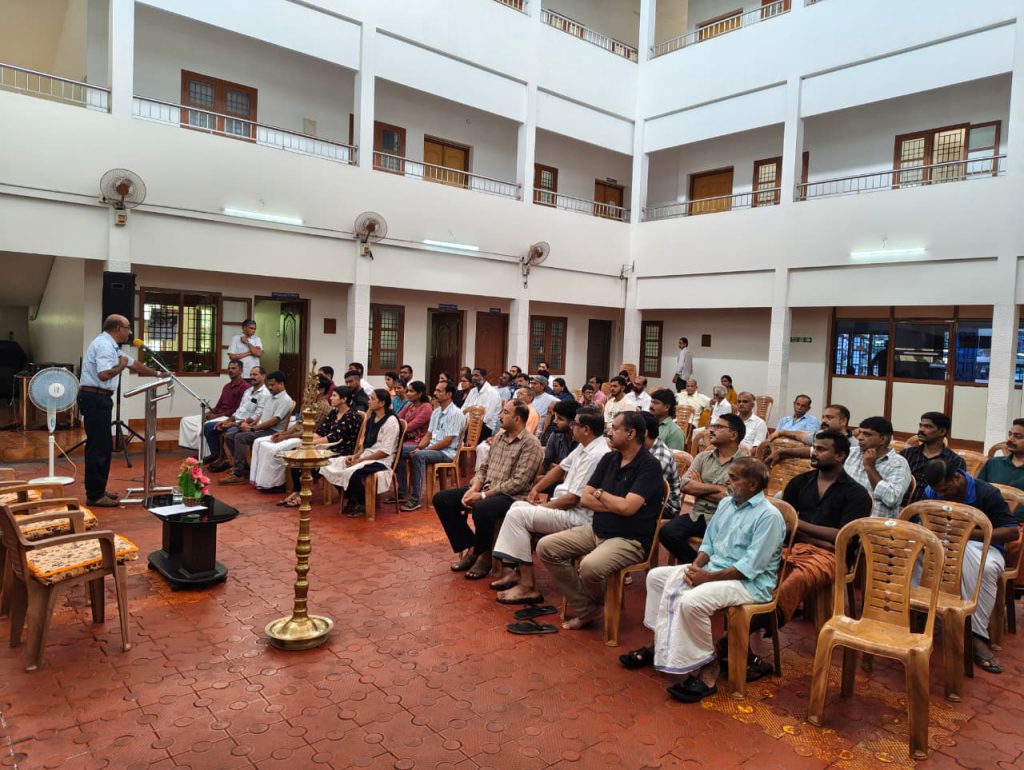
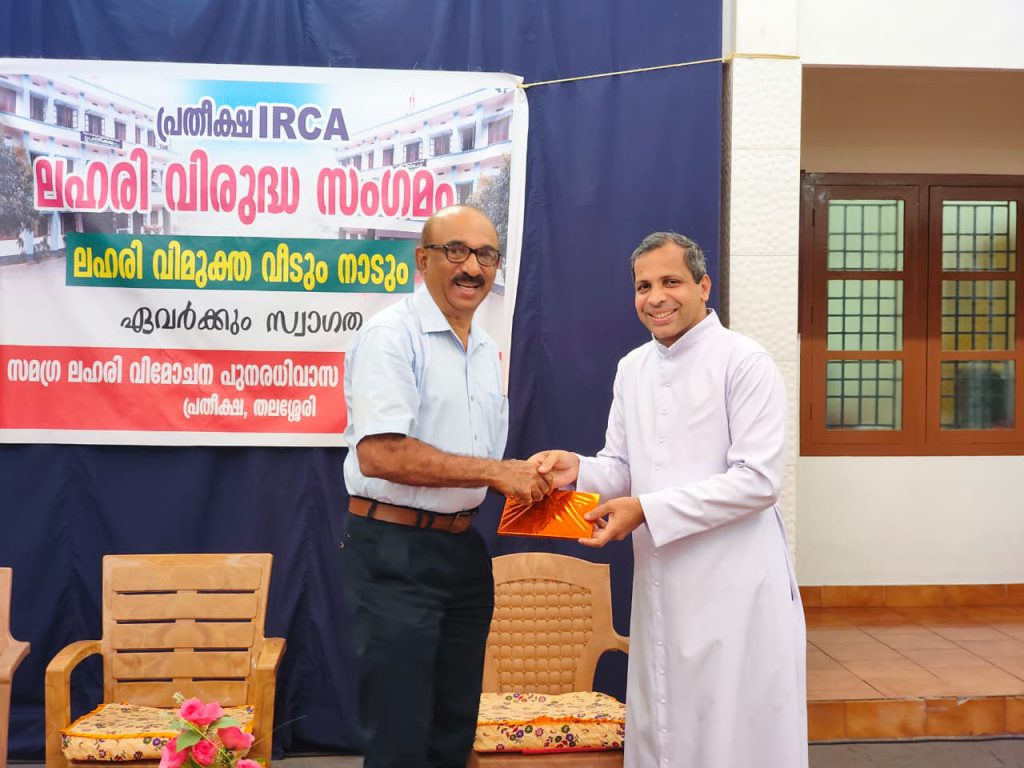
Thalassery, July 5, 2026: Pratheeksha De-Addiction Centre, Thalassery, organized an Alcoholics Anonymous (AA) Meeting on Sunday, bringing together around 100 AA family members to reaffirm the importance of mutual support in the journey of recovery from addiction.
The meeting was presided over by Rev. Fr. Jaison Kolakunnel, Director of Pratheeksha De-Addiction Centre and KCBC Madhya Virudha Samithi. The programme was inaugurated by Shri T. C. Thomas, former Project Officer of Pratheeksha.
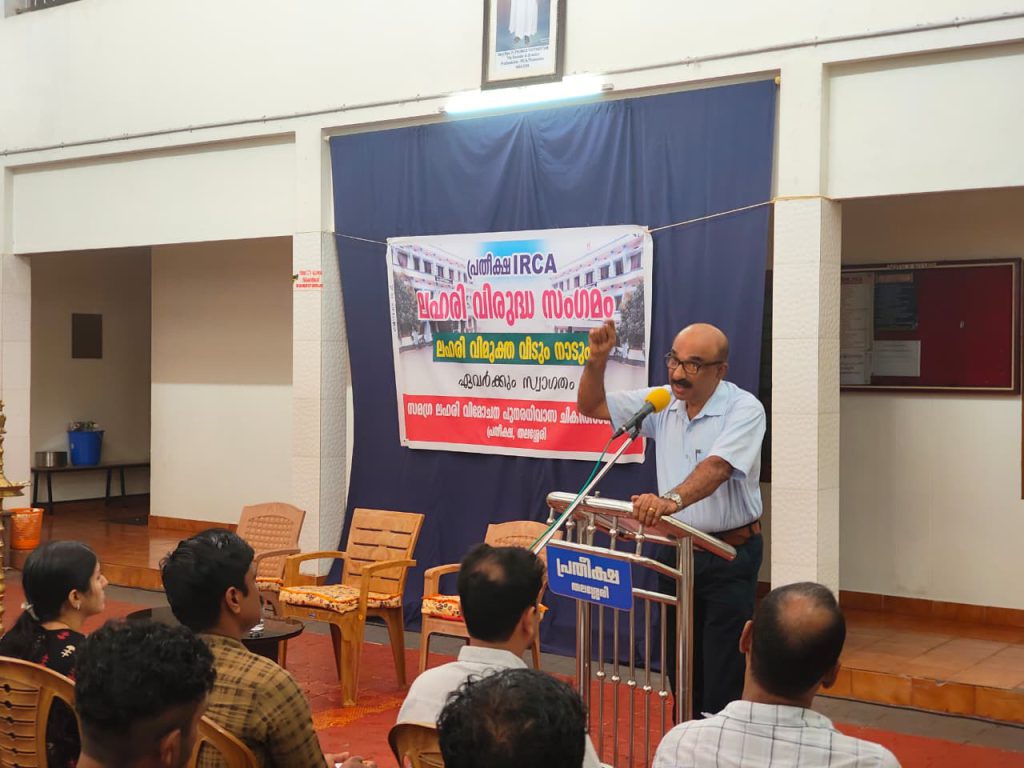
Delivering the keynote address, Dr. Joslet Mathew, former Principal of Nirmalagiri College, spoke on the importance of Alcoholics Anonymous (AA) groups in the de-addiction treatment and recovery process. He emphasized that recovery from addiction is a lifelong journey and highlighted how AA meetings provide a supportive environment where individuals encourage one another to maintain sobriety, rebuild relationships, and lead productive lives. He also stressed that the fellowship, accountability, and shared experiences within AA play a crucial role in preventing relapse and sustaining long-term recovery.
The programme began with registration, followed by a welcome address, prayer, and a tea break. The event concluded with lunch, providing participants an opportunity for fellowship and interaction.
The gathering witnessed the enthusiastic participation of around 100 members of the AA family, reflecting the growing commitment of recovering individuals and their families towards sustained recovery and a life free from addiction.
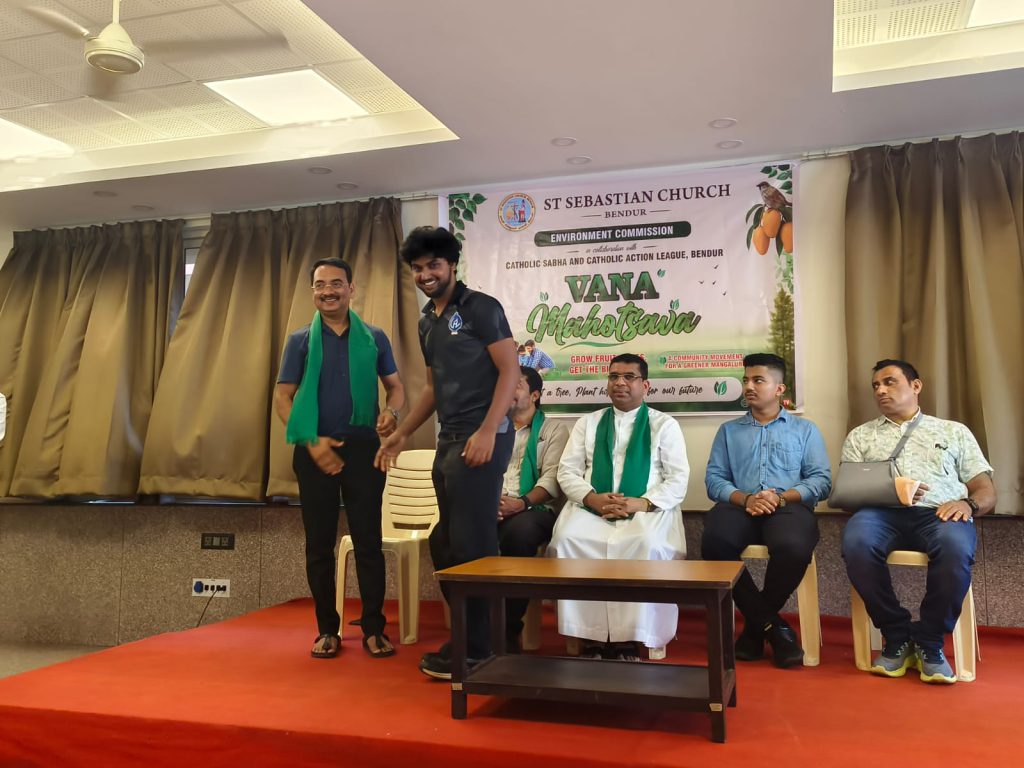
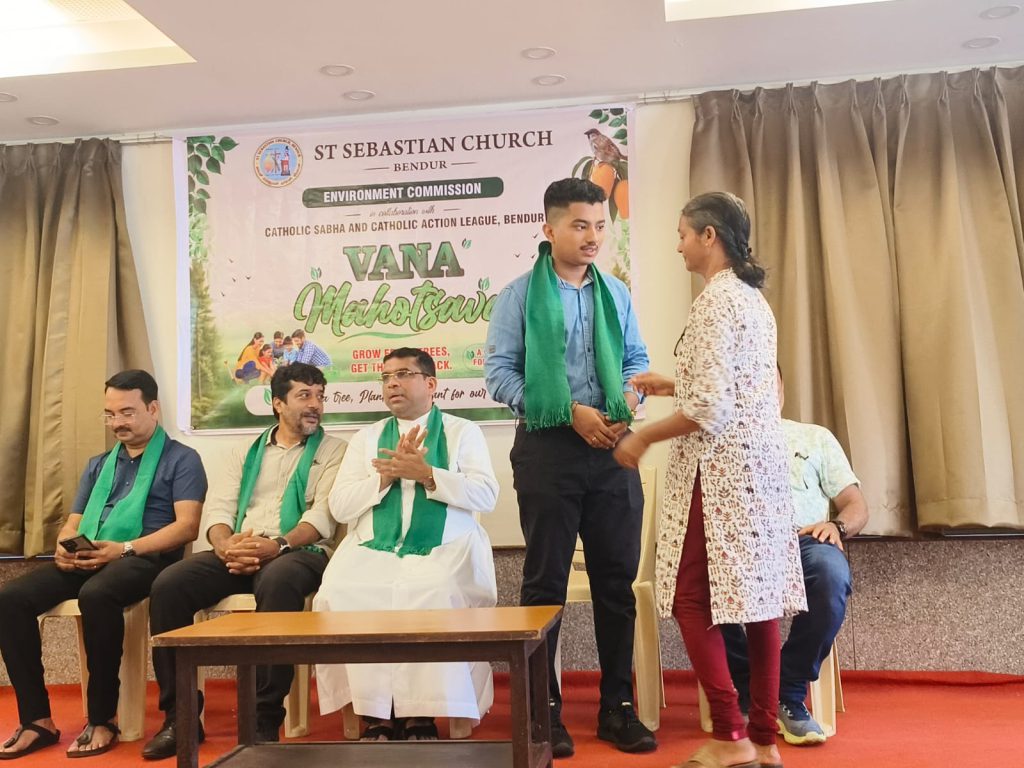
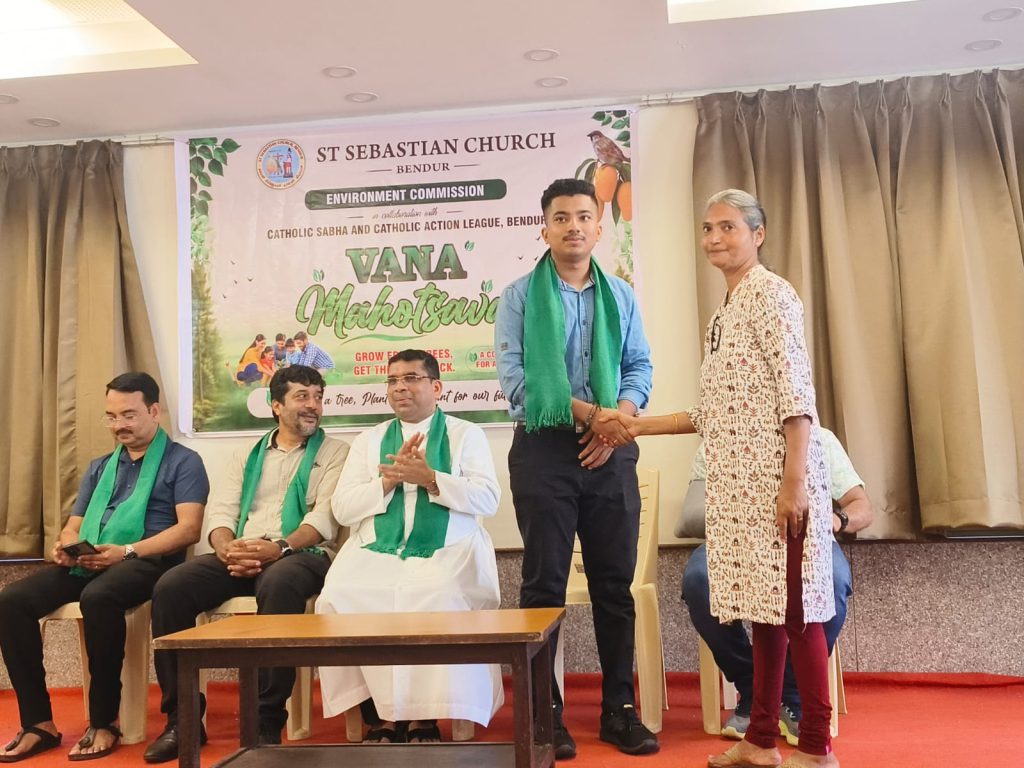
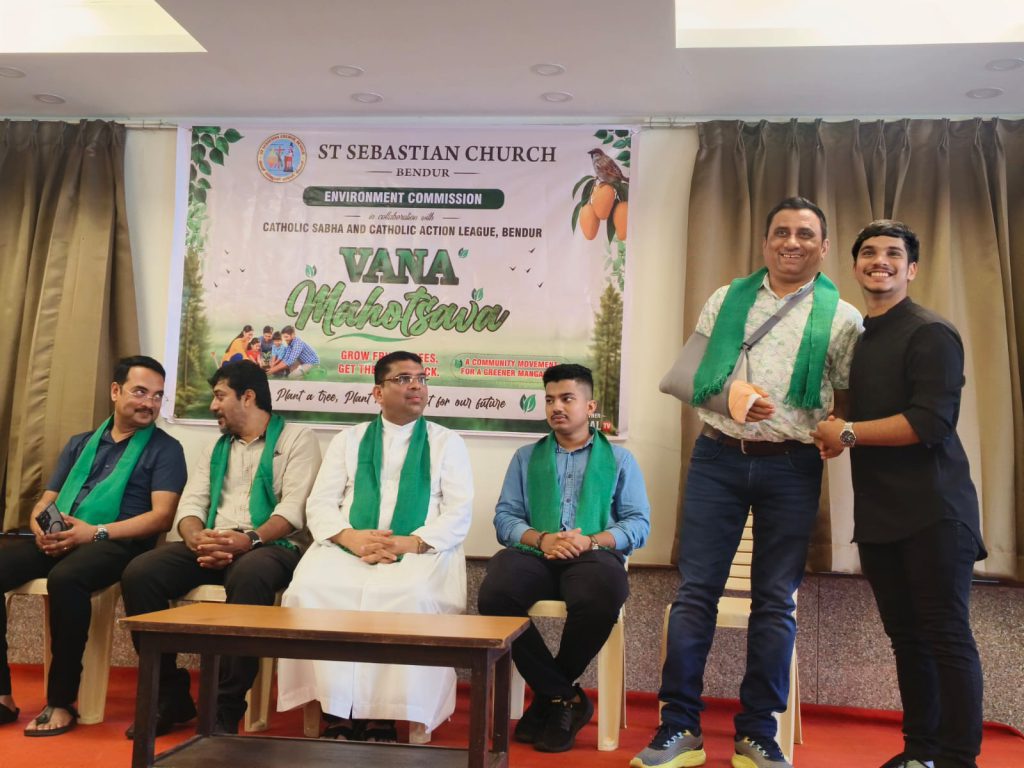
Environment Commission of St. Sebastian Church, Bendur, in collaboration with the Catholic Sabha and Catholic Action League | Global TV
NV Paulose, Chairman, Global TV +91 98441 82044
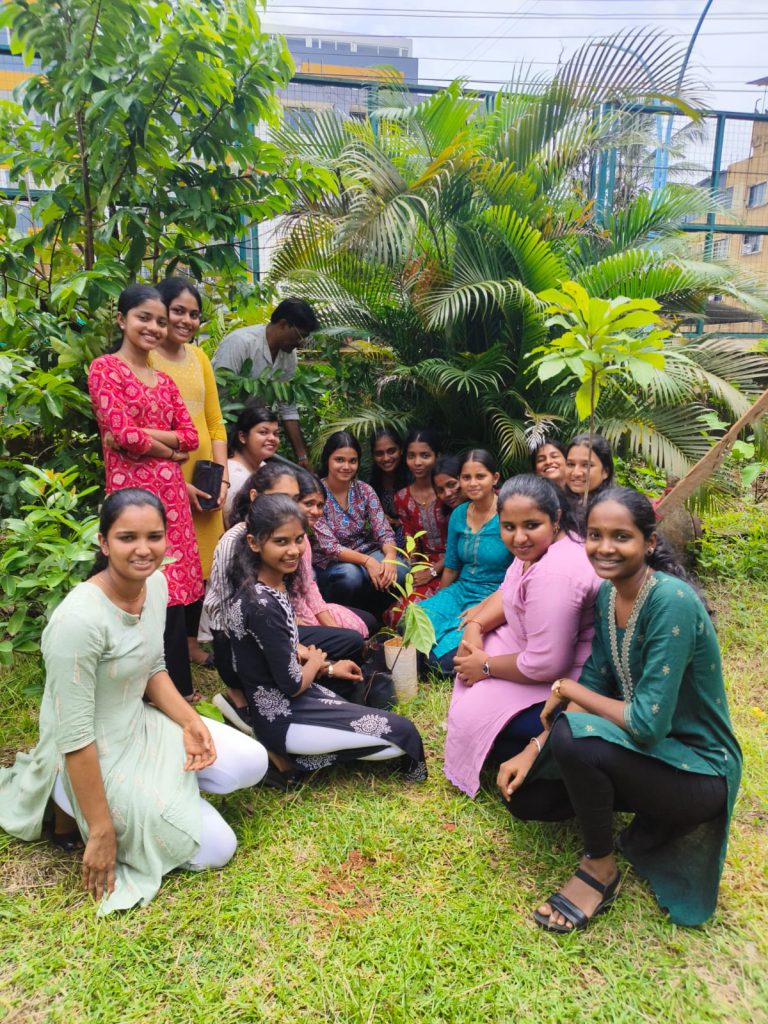
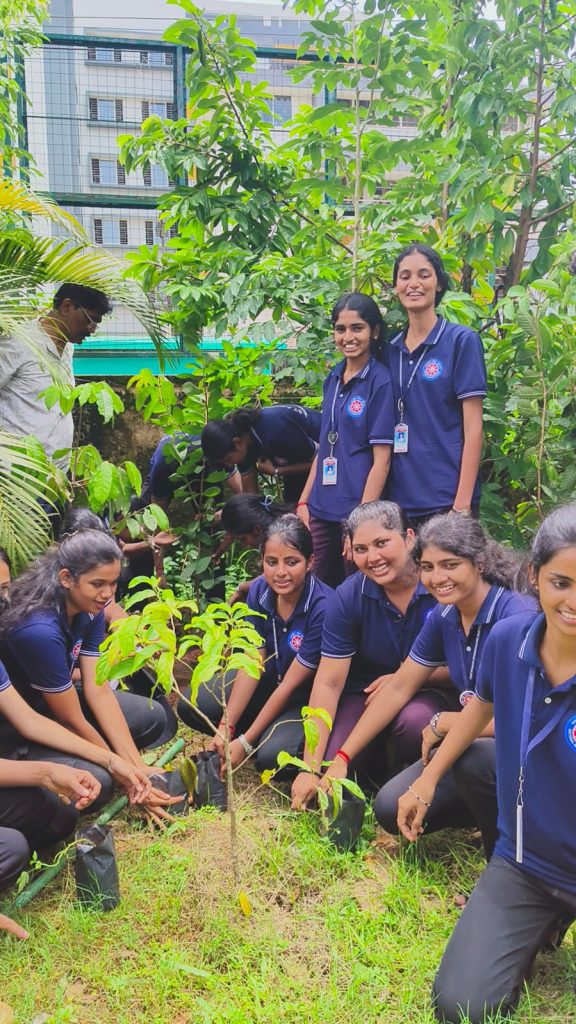
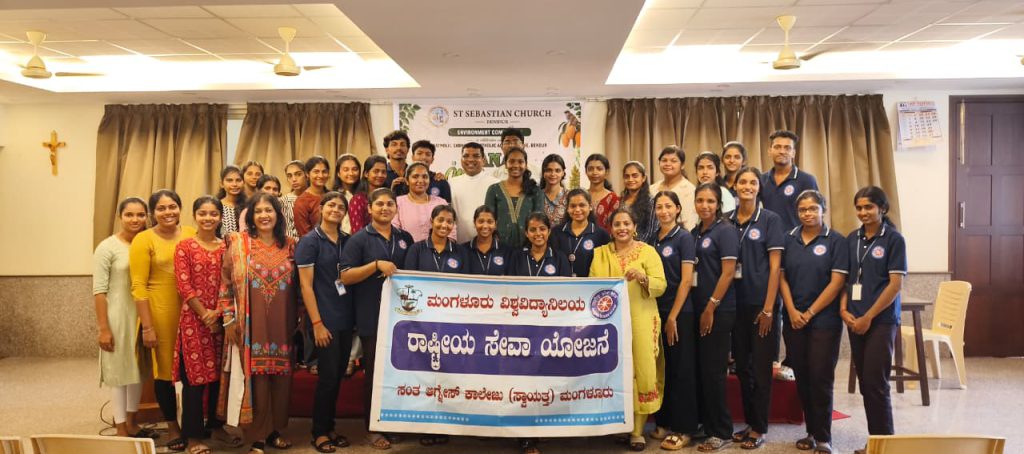
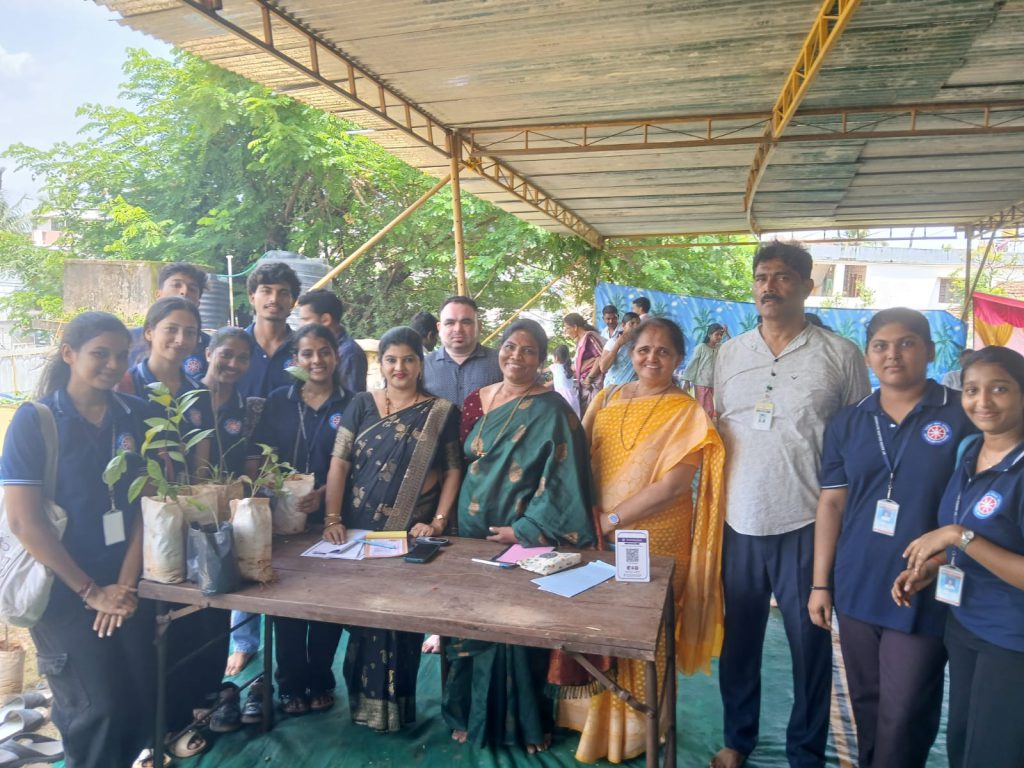
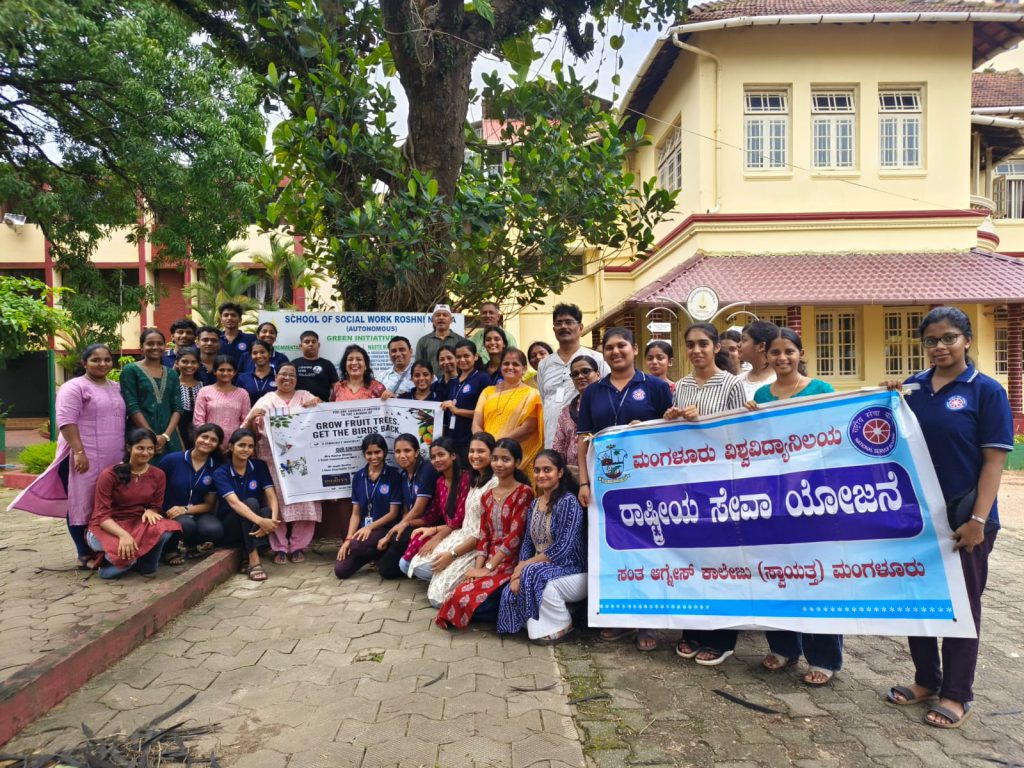
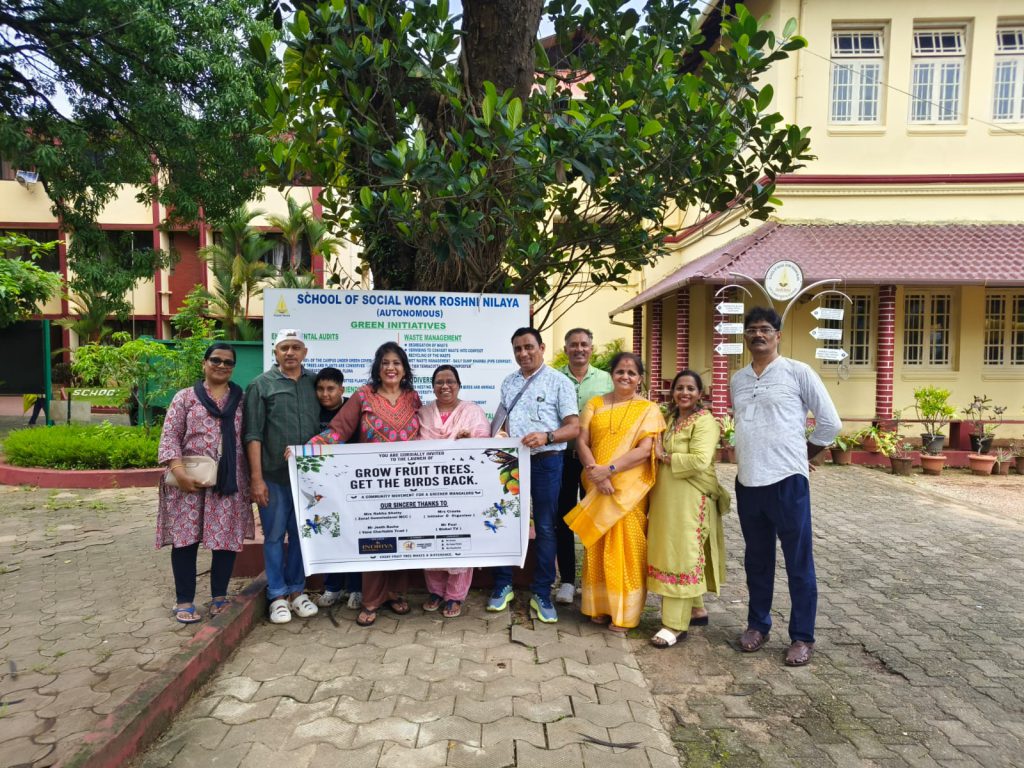
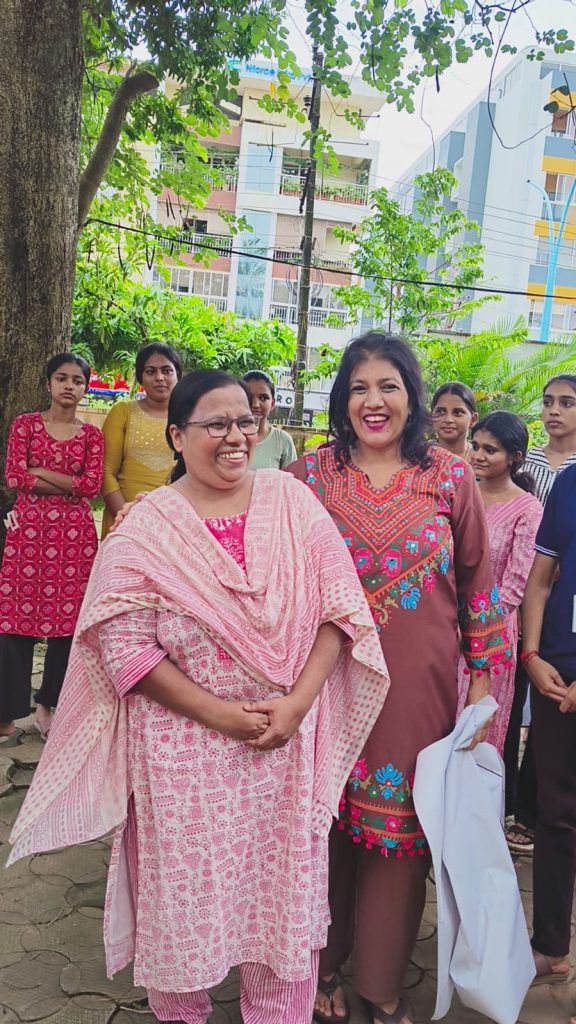
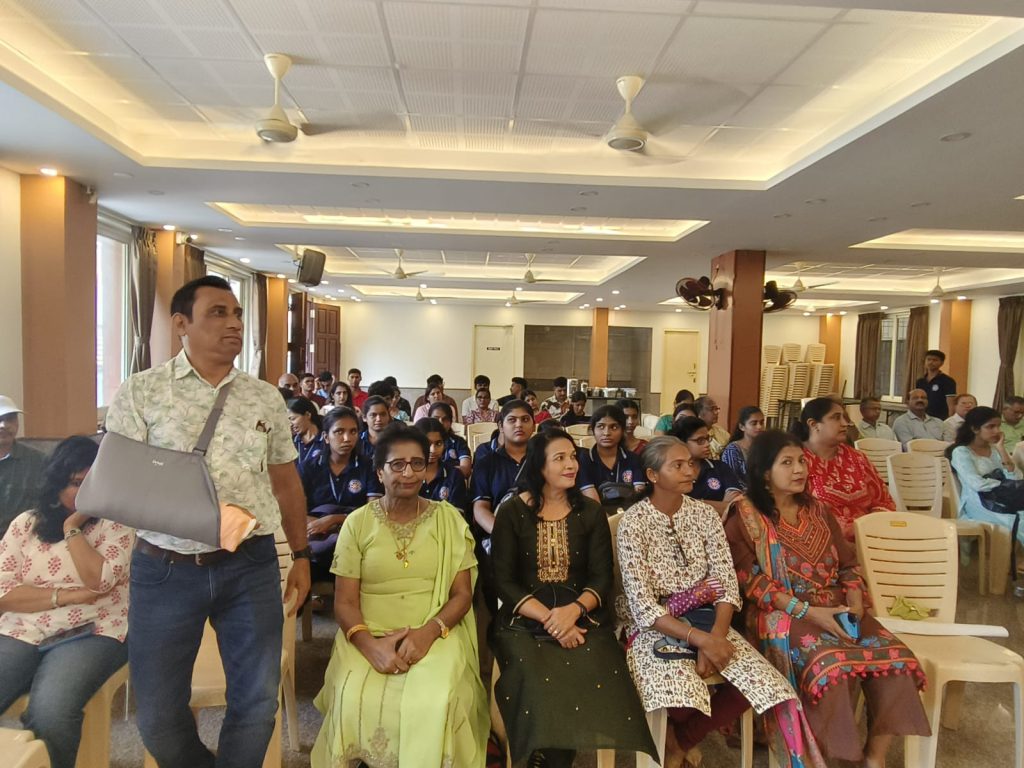
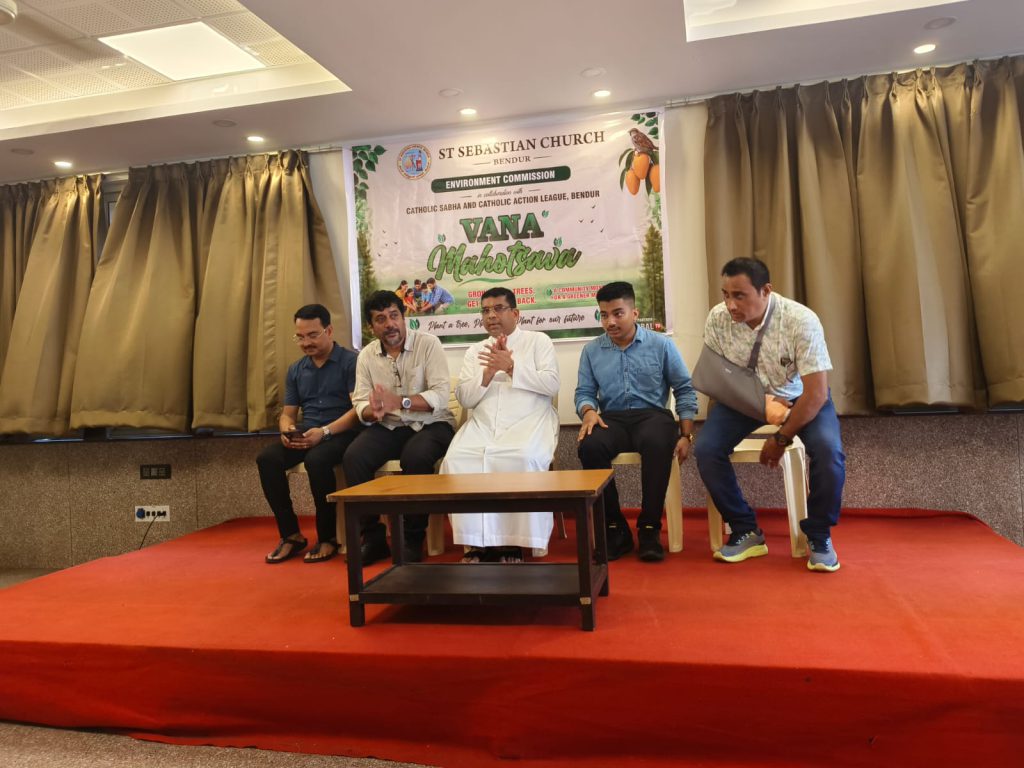
BENDUR, July 5: The Vana Mahotsava programme organised by the Environment Commission of St. Sebastian Church, Bendur, in collaboration with the Catholic Sabha and Catholic Action League, is currently underway with enthusiastic participation from parishioners and local residents. The initiative aims to encourage the planting of fruit-bearing trees to enhance the city’s green cover and create a habitat that attracts birds back to the area. The campaign is being held under the theme, “Grow Fruit Trees, Get the Birds Back,” promoting environmental conservation through community involvement.
Families, children and volunteers are actively taking part in the tree-planting drive, reflecting the campaign’s message, “Plant a Tree, Plant Hope, Plant for Our Future.” Organisers said the programme seeks to inspire long-term environmental responsibility while contributing to a greener and more sustainable Mangaluru. The event continues to witness strong community support, reinforcing the importance of collective action in protecting nature for future generations.
Are you searching for genuine connections and meaningful conversations? A day out for storytelling is an opportunity to step away from routine and spend time with people who can inspire, encourage, and enrich your life. Every person has a unique journey filled with experiences, challenges, achievements, and dreams. When these stories are shared, they create bonds that go beyond introductions and transform simple meetings into lasting friendships.
There Are No Strangers, Only Friends Waiting to Meet
The philosophy of storytelling is simple. Miracles happen when people come together. There are no strangers in the world. All are friends waiting to meet. A conversation over breakfast, lunch, or dinner can open new doors, spark fresh ideas, and create unexpected opportunities. Listening to another person’s story often helps us discover common values, shared experiences, and a deeper appreciation of our collective human journey.
Celebrating Success and Creating Opportunities for Gen Z
Storytelling is also a celebration of success and a platform to create opportunities for Gen Z. By bringing together people from different walks of life, we build bridges between experience and aspiration. The wisdom and experiences of one generation can inspire the next generation to dream bigger and achieve more. A day spent sharing stories is a day spent building friendships, celebrating achievements, and creating opportunities that can positively change lives.
Are you searching for genuine connections and meaningful conversations? A day out for storytelling is an opportunity to step away from routine and spend time with people who can inspire, encourage, and enrich your life. Every person has a unique journey filled with experiences, challenges, achievements, and dreams. When these stories are shared, they create bonds that go beyond introductions and transform simple meetings into lasting friendships.
There Are No Strangers, Only Friends Waiting to Meet
The philosophy of storytelling is simple. Miracles happen when people come together. There are no strangers in the world. All are friends waiting to meet. A conversation over breakfast, lunch, or dinner can open new doors, spark fresh ideas, and create unexpected opportunities. Listening to another person’s story often helps us discover common values, shared experiences, and a deeper appreciation of our collective human journey.
Celebrating Success and Creating Opportunities for Gen Z
Storytelling is also a celebration of success and a platform to create opportunities for Gen Z. By bringing together people from different walks of life, we build bridges between experience and aspiration. The wisdom and experiences of one generation can inspire the next generation to dream bigger and achieve more. A day spent sharing stories is a day spent building friendships, celebrating achievements, and creating opportunities that can positively change lives.
Are you searching for genuine connections and meaningful conversations? A day out for storytelling is an opportunity to step away from routine and spend time with people who can inspire, encourage, and enrich your life. Every person has a unique journey filled with experiences, challenges, achievements, and dreams. When these stories are shared, they create bonds that go beyond introductions and transform simple meetings into lasting friendships.
There Are No Strangers, Only Friends Waiting to Meet
The philosophy of storytelling is simple. Miracles happen when people come together. There are no strangers in the world. All are friends waiting to meet. A conversation over breakfast, lunch, or dinner can open new doors, spark fresh ideas, and create unexpected opportunities. Listening to another person’s story often helps us discover common values, shared experiences, and a deeper appreciation of our collective human journey.
Celebrating Success and Creating Opportunities for Gen Z
Storytelling is also a celebration of success and a platform to create opportunities for Gen Z. By bringing together people from different walks of life, we build bridges between experience and aspiration. The wisdom and experiences of one generation can inspire the next generation to dream bigger and achieve more. A day spent sharing stories is a day spent building friendships, celebrating achievements, and creating opportunities that can positively change lives.