All posts by admin

About admin

Chairman of Global TV | Excellent Writer | Exceptional PR Skills | Author of Six books | MASTER HEALER | +91 98441 82044 |

Storytelling as a Movement for People Engagement and Economic Prosperity | Global TV

In every community, there are thousands of stories waiting to be told.

NV Paulose, Chairman, Global TV +91 98441 82044

Stories of achievement. Stories of struggle. Stories of migration, enterprise, education, service, creativity and resilience. Stories of people who left their hometowns and built successful lives elsewhere, while carrying their language, culture and memories with them. Yet many of these stories remain disconnected from the next generation. This is why storytelling can become much more than communication or entertainment. It can become a powerful movement for people engagement.

A story can make people curious about their past, proud of their identity and interested in their community. It can create conversations between generations and reconnect successful individuals with the places, institutions and people who shaped them. The idea behind the United Konkani Movement is rooted in this possibility. Its first major initiative, 1K Konkani Icons of Excellence, can create a platform to discover, document and celebrate 1,000 stories of Konkani achievement, beginning with Mumbai, Goa and Mangalore. The objective is not simply to distribute awards. It is to create connections.

1. Every Community Has a Story to Tell

Communities are often described through statistics: population, businesses, educational institutions, income levels and migration patterns. But statistics do not tell us what makes a community alive. Stories do. Behind every successful business there is a story. Behind every institution there is a story. Behind every teacher, artist, entrepreneur, professional, social worker and community leader there is a story. These stories reveal how people responded to opportunities and difficulties.

They show how values were passed from one generation to another. They demonstrate how ordinary people created extraordinary outcomes. Storytelling brings these experiences into the public imagination. It allows a young person to see someone from their own community who succeeded in a field they had never considered. It allows an older generation to see that its sacrifices and contributions have not been forgotten. Most importantly, storytelling creates recognition and participation. When people see that their community values contribution, they become more willing to contribute themselves.

2. Language Can Become a Bridge to Our Roots

For communities spread across cities and countries, language can be one of the strongest connecting factors. People may live thousands of kilometres away from their ancestral homes. They may work in different industries, speak several languages and belong to very different professional networks. Yet a shared language can immediately create familiarity.

Konkani is an important example. There are successful Konkani people across India and around the world who have achieved remarkable things in business, education, medicine, technology, arts, public service, entrepreneurship and many other fields. Many of them also carry a desire to reconnect with their roots.

That desire should not be viewed simply as nostalgia. It can become a resource for the future. When successful people reconnect with their community, they can bring knowledge, mentorship, investment, networks and opportunities. They can support institutions, encourage young people and help build new economic and cultural connections. Language can therefore become more than a marker of identity. It can become an infrastructure for connection.

3. 1K Konkani Icons of Excellence: A Beginning of the United Konkani Movement

The 1K Konkani Icons of Excellence initiative can serve as the first major expression of the United Konkani Movement. Beginning with Mumbai, Goa and Mangalore, the initiative can bring together people and institutions around a shared objective: identifying and celebrating Konkani excellence. The three locations have particular significance. Mumbai represents a major centre of Konkani migration, enterprise and professional achievement. Goa represents an important geographical, cultural and historical centre of Konkani identity. Mangalore and the wider coastal Karnataka region represent another deeply significant part of the Konkani story, with generations of contributions across commerce, education, culture, religion and public life.

Together, these places can form the first chapters of a much larger story. The 1,000 Icons should represent diversity rather than a single definition of success. Excellence can be found in a multinational corporation and a small family enterprise. It can be found in a university professor, a doctor, an artist, a farmer, an entrepreneur, a social worker or an individual quietly serving a community. The purpose is to discover the stories that deserve to be remembered. And once discovered, those stories can become bridges to the next generation.

4. From Recognition to Engagement

The real power of storytelling begins after the story is told. A recognised individual can become a mentor. An entrepreneur can become an investor. A professional can create internships. An institution can open its doors to young talent. A successful person can return to their roots and support a local initiative. A young person can discover a career possibility through the story of someone who came before them. This is where storytelling becomes an economic and social engagement mechanism. The objective should be to create a cycle:

Discover → Tell → Recognise → Connect → Participate → Create Opportunity

A storytelling movement should therefore not end with a stage, trophy or publication. It should create relationships. The stories can be recorded digitally, presented through events, shared through media, incorporated into educational initiatives and connected to mentorship and professional networks. Over time, a database of 1,000 stories could become a living community resource. It could answer a powerful question: “Who are our people, what have they achieved, and how can their experience help the next generation?”

5. A Model Other Language Communities Can Build

The idea should not belong exclusively to Konkani society. India is a country of extraordinary linguistic and cultural diversity. Every major language community has its own history of migration, achievement and contribution. Tamil, Kannada, Marathi, Bengali, Telugu, Malayalam, Hindi, Punjabi, Gujarati, Odia, Assamese and many other language communities have successful people spread across India and around the world. Many of these individuals also want to reconnect with their roots.

There is an opportunity to build movements that use storytelling to bring these networks together. Imagine different language communities creating their own Icons of Excellence initiatives. Each could identify its remarkable people, document their stories, connect generations and create platforms for mentorship, collaboration and opportunity. This could develop into something much larger than cultural celebration. It could become a new model of people engagement through identity and achievement.

The strength of such a model lies in inclusion. It does not require people to choose between their regional identity and their national identity. In fact, celebrating India’s many languages and communities can strengthen the country’s larger social fabric. A person can be proudly Konkani, Kannada, Marathi, Malayalee, Tamil, Bengali or Punjabi while being equally committed to the prosperity of India. The common thread is contribution.

Storytelling Can Create a Living Network

The ultimate opportunity is to transform storytelling from an occasional activity into a continuing movement.

  • Every story can lead to another connection.
  • Every connection can lead to an opportunity.
  • Every opportunity can lead to participation.
  • And participation can lead to prosperity.

That is why 1K Konkani Icons of Excellence should be viewed as more than an awards ceremony. It can be the beginning of a structured movement to reconnect people with their language, their heritage and one another. Mumbai, Goa and Mangalore can be the first three chapters. The 1,000 Icons can be the first thousand stories. The United Konkani Movement can become the platform that carries those stories forward. The larger vision is simple:

  • Tell the stories.
  • Reconnect the people.
  • Celebrate the contribution.
  • Create the opportunities.
  • Build the future.

Because when people find their story, they often find their connection. And when people reconnect, a community begins to move.
North India Awareness Tour | organ donation awareness programmes across North India from 20 to 25 August 2026 | Global TV

Rotary Club of Organ Donation International to Organise Multiple Organ Donation Awareness Programmes in North India

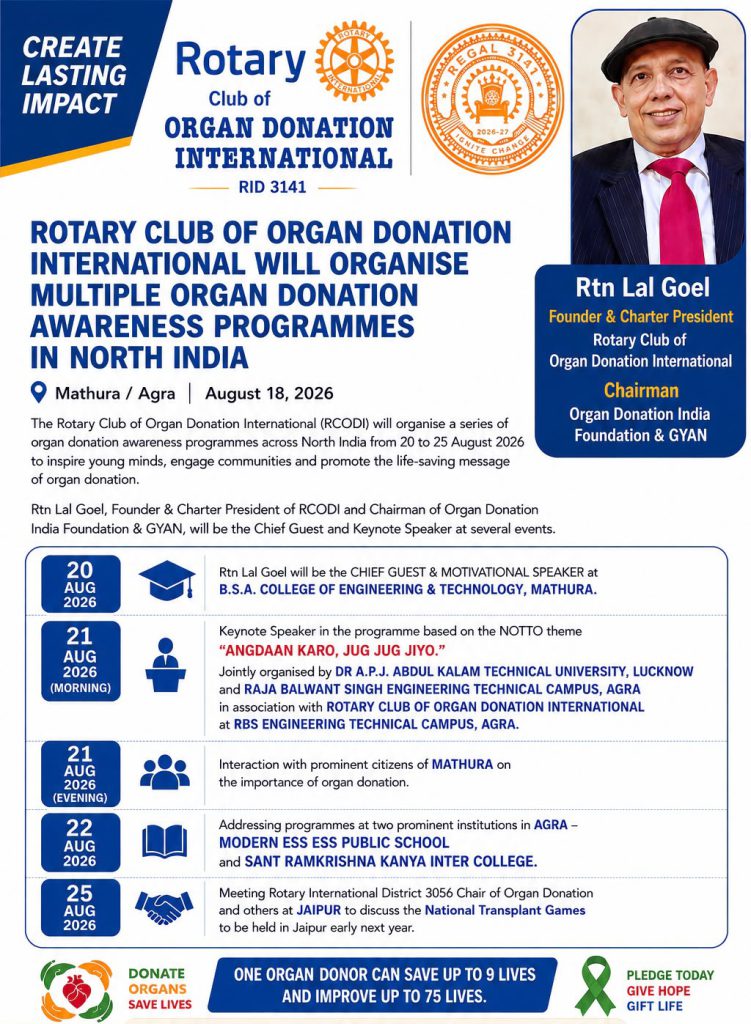
Mathura/Agra/Jaipur, August 18, 2026: The Rotary Club of Organ Donation International RCODI will organise a series of organ donation awareness programmes across North India from 20 to 25 August 2026, aimed at encouraging young people, educational institutions and the wider community to understand the importance of organ donation and make an informed pledge to donate.

Rtn Lal Goel, Founder & Charter President of the Rotary Club of Organ Donation International and Chairman of Organ Donation India Foundation & GYAN, will be the keynote speaker and Chief Guest at several of these programmes.

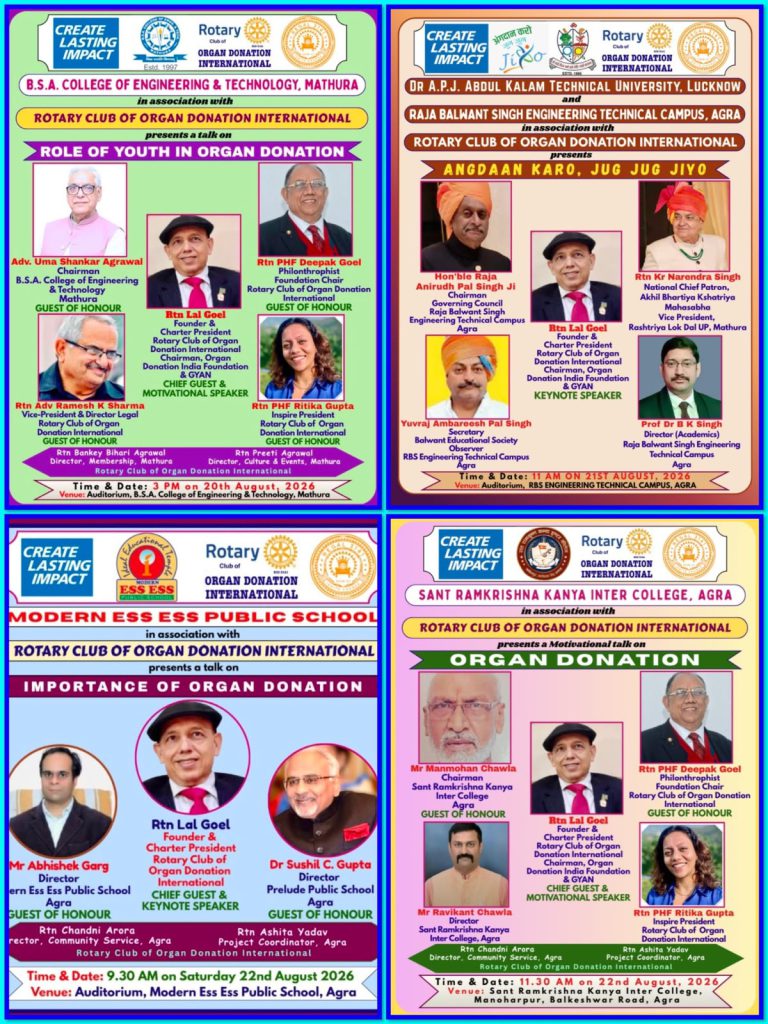
The series will begin on 20 August at the renowned B.S.A. College of Engineering & Technology, Mathura, where Rtn Lal Goel will address students and faculty as Chief Guest and Motivational Speaker, highlighting the urgent need to build a strong culture of organ donation in India.

On the morning of 21 August, he will deliver the keynote address at a major organ donation awareness programme at Raja Balwant Singh Engineering Technical Campus, Agra. The programme, based on the National Organ and Tissue Donation Organisation NOTTO theme “Angdaan Karo, Jug Jug Jiyo”, is being jointly organised by Dr. A.P.J. Abdul Kalam Technical University, Lucknow, and Raja Balwant Singh Engineering Technical Campus, Agra, in association with the Rotary Club of Organ Donation International.

On the evening of 21 August, Rtn Lal Goel, along with fellow Rotarians, will interact with prominent citizens of Mathura to discuss the importance of organ donation and the need for greater community participation in saving lives through deceased organ donation.

On 22 August, he will address awareness programmes at two prominent educational institutions in Agra — Modern ESS ESS Public School and Sant Ramkrishna Kanya Inter College — with a special focus on inspiring students and young people to become ambassadors of organ donation.

The North India programme will conclude with a meeting on 25 August in Jaipur, where Rtn Lal Goel will meet the Rotary International District 3056 Chair for Organ Donation and other stakeholders to discuss preparations and collaboration for the National Transplant Games, proposed to be held in Jaipur early next year.

Speaking about the initiative, Rtn Lal Goel said, “India has made significant progress in transplantation, but the gap between the number of patients waiting for organs and the number of organs available remains enormous. Awareness alone is not enough—we need people to make a conscious decision to become organ donors and discuss that decision with their families.”

The Rotary Club of Organ Donation International, a cause-based Rotary e-Club dedicated to organ donation awareness, has been conducting regular awareness and knowledge-sharing programmes across India and internationally. Through educational programmes, public campaigns and community engagement, the Club aims to create a movement in which every family understands organ donation and every potential donor has the opportunity to save lives.

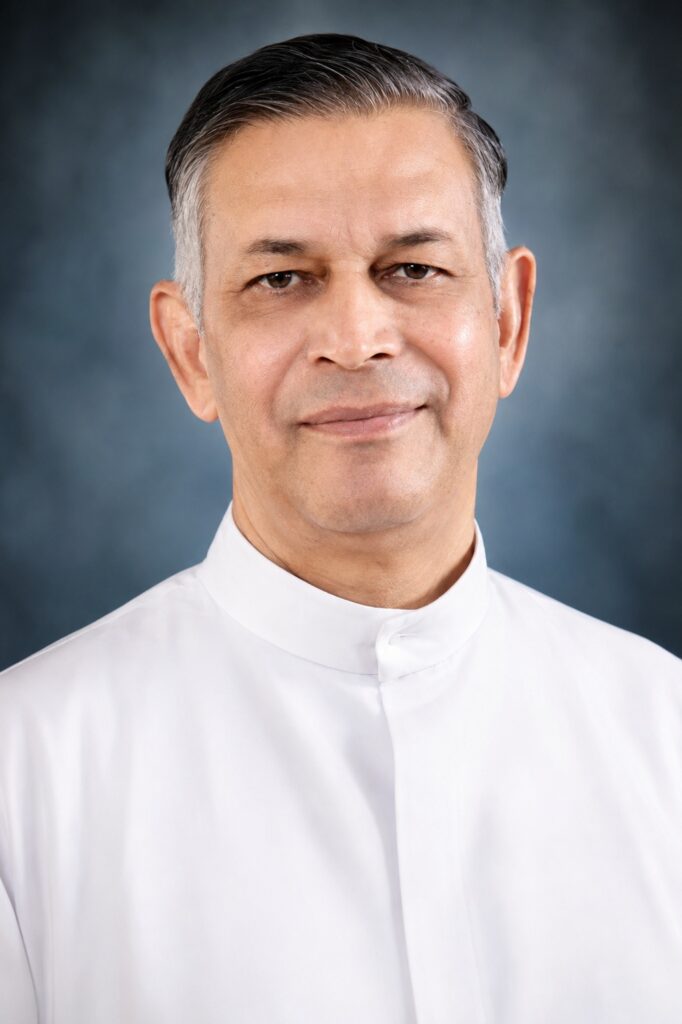
Rev. Fr. Victor Machado | A Life Built on Truth, Love and Integrity | Values in a Materialistic World | Global TV

Building Our House on the Rock: The Enduring Principles of Rev. Fr. Victor Machado

NV Paulose, Chairman, Global TV +91 98441 82044

Rev. Fr. Victor Machado is no longer with us, but the principles by which he lived and the values he sought to awaken in others remain deeply relevant. His message was ultimately a simple one: a human life cannot be built securely on things that perish. It must be built on values that endure.

We live in a world that measures success increasingly in terms of possessions, wealth, position, influence and outward achievement. Material progress has brought enormous benefits to humanity, but it has also created a dangerous illusion; the illusion that what we possess can give us lasting security, happiness and meaning. Yet everything material is temporary. Wealth can disappear. Property can be lost. Positions can change. Power can pass from one person to another. Even the strongest institutions and greatest empires of history have risen and fallen. What, then, remains?

What remains is the character of a human being: truthfulness, honesty, integrity, trust, compassion, forgiveness and love. These were among the values that Fr. Victor Machado placed at the heart of his life and ministry. They are not the property of one religion, culture or nation. They belong to humanity itself.

The Human Heart Is the True Treasure

The world often teaches us to look outside ourselves for security. We accumulate possessions, seek recognition and compare ourselves with others. We sometimes begin to believe that the more we have, the more important we are. Fr. Victor Machado’s vision challenged that way of thinking.

The real treasure of a person is not what he owns but what he has become. A person may have very little materially and yet possess extraordinary richness of heart. Another may possess great wealth and influence while remaining poor in compassion, honesty, and love. The question, therefore, is not simply, What do I have? It is:

What kind of person am I?

  • Do people trust my word?
  • Can others depend on me?
  • Do I speak the truth when the truth is inconvenient?
  • Do I forgive?
  • Do I treat people with dignity?
  • Do I use whatever I possess for the good of others?

These are the questions that reveal the real wealth of a human being.

Truthfulness: The Foundation of a Life

Truthfulness was not merely a moral ideal; it was a foundation on which relationships and society itself could stand. Without truth, trust disappears. Without trust, relationships become fragile. Without integrity, institutions lose credibility. When truth becomes negotiable, people begin to live according to convenience rather than conscience. Fr. Victor Machado’s principles remind us that truth must not depend upon personal advantage. It is easy to tell the truth when it benefits us. The real test comes when honesty costs us something, when it requires us to admit a mistake, accept responsibility, resist temptation, or stand against what is popular. A truthful person may sometimes lose an opportunity, but he does not lose himself.

Integrity: Doing What Is Right

Integrity is what happens when our beliefs and our actions become one. It is easy to speak about values. It is much harder to live them when nobody is watching. Fr. Victor Machado’s example points toward a life in which values are not merely preached but practiced. Integrity means that the person we appear to be in public is substantially the person we are in private.

  • It means keeping promises.
  • It means accepting responsibility.
  • It means refusing to exploit another person.
  • It means treating the weak with the same respect we show the powerful.
  • It means choosing what is right even when there is no applause for doing so.

A society does not become moral merely because it has moral teachings. It becomes moral when ordinary people make moral choices in ordinary circumstances.

Wealth Is Not the Enemy | Attachment Is

Jesus spoke strongly about riches, and this teaching can easily be misunderstood. The problem is not simply possessing wealth. The deeper danger is allowing wealth to possess the human heart. Material resources can be used for tremendous good. Wealth can educate children, feed families, support the vulnerable, build hospitals, create employment, and strengthen communities.

But wealth becomes destructive when it becomes the measure of human worth. When possessions become more important than people, something has gone wrong. When success becomes more important than integrity, something has gone wrong. When profit becomes more important than justice, something has gone wrong. When comfort becomes more important than compassion, something has gone wrong. Jesus’ warning about riches therefore remains remarkably relevant. Material things are useful servants but terrible masters.

Love: The Greatest Measure of a Human Life

At the heart of Fr. Victor’s understanding of Christian values was the recognition that love cannot remain an abstract idea. Love must become action.

  • It means listening to someone who feels forgotten.
  • It means forgiving someone who has hurt us.
  • It means helping a person who cannot repay us.
  • It means defending someone who is being treated unjustly.
  • It means showing patience when anger would be easier.
  • It means recognizing the dignity of every human being.

Love does not ask first, What will I gain? It asks, What can I give? That is why genuine love is stronger than money, position, or power. Those things can command obedience, but love can transform a human heart.

Forgiveness: Breaking the Cycle of Hurt

A society without forgiveness becomes trapped in its own wounds. Every human being makes mistakes. Families experience conflicts. Friends disappoint one another. Communities carry old grievances. Nations remember historical injuries. Forgiveness does not mean pretending that wrongdoing never happened. Nor does it mean abandoning justice. Forgiveness means refusing to allow hatred to have the final word.

The Christian message of forgiveness, which Fr. Victor sought to embody, is therefore profoundly human. It gives people the possibility of beginning again. A person who cannot forgive remains imprisoned by the past. A person who learns to forgive opens a door to the future.

Trust: The Invisible Wealth of Society

Modern society depends upon countless acts of trust.

  • We trust that a person’s word means something.
  • We trust that a doctor will care for a patient.
  • We trust that a teacher will educate with responsibility.
  • We trust that a friend will stand by us.
  • We trust that a leader will act for the common good.

Much of civilization rests upon this invisible foundation. Once trust collapses, suspicion takes its place. People begin protecting themselves rather than cooperating with one another. Fr. Victor Machado’s emphasis on honesty, integrity, and truth therefore had significance far beyond individual morality. These virtues are the foundations of a healthy society.

Building on the Rock

The Gospel image of the house built upon rock provides a fitting summary of this entire philosophy. A house may look magnificent, but its strength is determined by its foundation. The same is true of a human life. A person may build a life on wealth, fame, status, possessions, and influence. For a time, everything may appear secure. But life inevitably brings its storms, failure, loss, disappointment, illness, rejection, conflict and death. At such moments, the question is no longer how impressive the house looks.

The question is: What is it built upon? A life built on possessions can be shaken when possessions disappear. A life built on reputation can collapse when public opinion changes. A life built on power can become empty when power is lost. But a life built on truth, love, integrity, faith, compassion, and service possesses a deeper strength. The storms may hurt it, but they do not necessarily destroy it. That is the meaning of building one’s house on the rock.

A Universal Message

Although Fr. Victor Machado’s inspiration was deeply rooted in the teachings of Jesus Christ, the values he championed speak to every person. Truth does not belong exclusively to Christians. Honesty does not belong exclusively to one religion. Compassion has no nationality. Integrity has no caste. Love has no border. Forgiveness does not require a particular passport. These values belong to the human family.

In a divided world, they can become common ground. People of different religions, cultures, and philosophies may disagree about many things, but they can still recognize the dignity of truthfulness, compassion, justice, integrity, and love. That is why such a message does not become outdated.

The Challenge of Living the Values

The greatest tribute we can pay to a person like Fr. Victor is not to remember his words alone. It is to live what he believed. This is not easy. It is difficult to remain honest when dishonesty appears profitable. It is difficult to remain humble when recognition is available. It is difficult to forgive when we have been deeply hurt. It is difficult to love when hatred is easier. It is difficult to remain faithful to our principles when compromise offers immediate rewards. But perhaps that is precisely why these values matter. If goodness were always easy, it would require very little courage. The real test of character comes when doing what is right demands sacrifice.

What Will We Leave Behind?

Every human being eventually has to confront the temporary nature of life.

  • We cannot take our houses with us.
  • We cannot take our bank accounts with us.
  • We cannot take our titles, positions or possessions with us.

What we leave behind is something different: the lives we have touched, the kindness we have shown, the truth we have defended, the forgiveness we have offered, the people we have helped and the love we have given. That is the legacy that cannot easily be measured in material terms. Perhaps this is the deepest lesson of Fr. Victor Machado’s life: our greatest achievement is not the size of the house we build, but the strength of the foundation upon which we build it.

The world does not ultimately move forward because of money, possessions or power. It moves forward because human beings continue to choose goodness over selfishness, truth over falsehood, love over hatred, forgiveness over revenge and service over self-interest. These values may sometimes appear hidden beneath the noise and competition of modern life. But they are still there, deep within the human heart. Our task is to bring them out. To live them. To pass them on. And, above all, to build our lives upon them. For everything built on what is temporary will eventually pass. But a life built on truth, integrity, compassion, forgiveness and love can become a lasting testimony to what is best in the human person.

That is a house built on the rock.

Prof. Dr. M. S. Gowd | A Life That Made Dentistry a Mission of Service | Global TV

From one man’s vision in 1967 to a three-generation legacy of trust, compassion, and excellence

NV Paulose, Chairman, Global TV +91 98441 82044

There are careers measured in years. There are careers measured in achievements. And then there are lives measured by the number of people whose lives have been touched, restored and made better. The story of Prof. Dr. M. S. Gowd belongs to the third kind.

In 1967, when dentistry in India was still finding its place in the public consciousness, a young dentist began a journey that would eventually become one of Hyderabad’s enduring stories in healthcare. That young professional was Prof. Dr. M. S. Gowd.

What began in 1967 as the vision and enterprise of one dentist gradually evolved into an institution, a profession embraced by a family, and a philosophy of care passed from one generation to another. But the most important part of the story is not the growth of a dental hospital. It is the story of why Dr. Gowd devoted his life to dentistry in the first place.

A pioneer who believed dentistry could change lives

Dr. Gowd’s professional journey began at a time when dentistry did not enjoy the recognition it commands today. He completed his BDS in 1967 and pursued postgraduate training in Prosthodontics, developing expertise in restoring not only dental function but also the appearance and confidence of his patients. His career subsequently extended into government service, academia, professional leadership and private practice. For Dr. Gowd, dentistry was never merely about treating teeth.

It was about restoring something that can be difficult to measure but is immediately recognizable when it returns: confidence. A person who has lost the ability to smile freely does not experience that loss merely as a dental problem. It can affect how they speak. How they meet people. How they photograph themselves. How confidently they enter a room. How they see themselves.

Dr. Gowd understood this dimension of dentistry early, and devoted his professional life to it. That understanding helped shape his pioneering interest in aesthetic and cosmetic dentistry, prosthodontics, implants, and advanced restorative care.

The courage to be ahead of his time

Great pioneers are rarely satisfied with doing what has always been done. They ask a different question: What can be done better? Dr. Gowd repeatedly asked that question. Dr. Gowd’s institutional history credits him and his team with pioneering advanced dental practices in the region, including cosmetic dentistry, laser dentistry and dental implants. Contemporary accounts of his career describe his long-standing commitment to bringing new technologies and treatment approaches to patients in South India. His interest in innovation was not innovation for its own sake. It was patient-centred.

New technology mattered because it could make treatment more precise. New techniques mattered because they could make treatment more comfortable. Cosmetic dentistry mattered because a restored smile could restore confidence. Implant dentistry mattered because a missing tooth could mean much more than an empty space. That is the difference between being a technologist and being a true healthcare pioneer. The technology was never the purpose. The patient was.

Twenty-two years of public service

Before his name became synonymous with private dental excellence, Dr. Gowd devoted 22 years to government service, eventually retiring as Dean of the Army Dental College. Those years are an important part of his story because they reveal the breadth of his understanding of dentistry. He was not simply a clinician. He was an educator. An administrator. A mentor. A public servant. And a professional leader.

His career also earned him distinction within organized dentistry. He is described in professional profiles as the first dentist from Andhra Pradesh to serve as President of the Indian Prosthodontic Society. He was also selected as an official dentist to the Governor and served as a consultant to Governors of Andhra Pradesh for many years. These were honours. But they were also responsibilities. And Dr. Gowd appears to have understood them that way.

The man who wanted people to understand their own health

Perhaps one of the most admirable aspects of Dr. Gowd’s legacy is that he did not believe the dentist’s responsibility ended when the patient left the chair. He believed in education. He wanted people to understand dental health before pain forced them to seek treatment. He wanted families to understand prevention. He wanted ordinary people to know that oral health was not an isolated concern but an important part of overall wellbeing. And he did something remarkable to achieve that.

Dr. Gowd has authored books on oral health and dentistry in multiple languages, including Telugu, Hindi, Urdu, Tamil and English. His first Telugu book, Mee Chirunavunu Saridhidukondi, was published in 1997, beginning a sustained effort to make dental knowledge accessible to people beyond the professional medical community. More recently, Miles of Smiles continued that tradition.

There is something deeply human in that decision. A doctor can help the patient sitting in front of him. A doctor who educates an entire community can help people he may never meet. That was Dr. Gowd’s larger vision.

A dentist who helped elevate the profession itself

Dr. Gowd’s generation faced a different India. Dentistry was not always understood as the sophisticated healthcare discipline it is today. In an account of his career, he reflected on the struggle dentists once faced to gain recognition and expressed satisfaction at the respect the profession eventually achieved.

His response was not to complain about the limitations of his time. He worked to overcome them. Through education. Through clinical excellence. Through professional leadership. Through public awareness. Through innovation. And through an unwavering commitment to his patients. In doing so, he contributed not only to the growth of his own institution but to the changing perception of dentistry itself.

Compassion as a professional discipline

It is easy to speak about compassion. It is much harder to make it part of a professional life lasting more than five decades. The accounts surrounding Dr. Gowd repeatedly return to his personalized approach to patients. A contemporary profile described the warmth with which he spoke about his profession and family, noting the genuine smile with which he discussed his work. Another account characterized his practice as being associated with personalized service. That matters. Because the best healthcare is not coldly technical. It is technically excellent and deeply human.

A patient may forget the model of a machine used during treatment. They may forget the name of a particular procedure. But they remember how they were treated. Whether someone listened. Whether someone explained. Whether someone reassured them. Whether they felt like a patient number, or a human being. Dr. Gowd’s enduring reputation suggests that this human dimension was never secondary to him. It was part of the treatment itself.

His greatest innovation: trust

Machines become outdated. Techniques evolve. Buildings change. Even the definition of “modern dentistry” changes with every generation. But trust remains timeless. The most extraordinary achievement of a dental institution founded in 1967 is therefore not simply that it survived for decades. It is that generations of families continued to place their health in its hands. The hospital today describes itself as a three-generation dental family, with the next generation continuing the work begun by Dr. Gowd. That is more than succession. It is inheritance of values.

The younger generation may work with digital dentistry, advanced imaging, aligners, implants and technologies that Dr. Gowd could only have imagined when he began. But beneath all of that remains the original principle: Take care of the person.

A legacy that belongs to the people

The story of Dr. Gowd also extends beyond the walls of his clinics. The institution records community initiatives, dental camps, and oral-health programmes, including work involving underserved communities and villages. This aspect deserves particular recognition. Because healthcare becomes truly meaningful when excellence is accompanied by accessibility and awareness. Dr. Gowd’s contribution was therefore not limited to those who could walk into his clinic. Through public education, books, awareness efforts and community initiatives, his work reached people who might otherwise never have had access to professional dental knowledge. That is the mark of someone who sees medicine as a social responsibility, not merely a profession.

Three generations, one philosophy

Today, the Dr. Gowds name represents a family of dental professionals. But the family legacy is not simply biological. It is professional. It is ethical. It is philosophical. What has passed from one generation to another is the belief that a dentist should never stop learning. That excellence requires discipline. That innovation must serve humanity. That patients deserve dignity. That knowledge should be shared. And that a smile is not a superficial thing. A smile can be an expression of health. Of confidence. Of belonging. Of freedom. Of joy. The work of restoring it can therefore become an act of profound human service.

1967 is the starting point of a journey.

It was the year Dr. M. S. Gowd began laying the foundations of what would become a remarkable dental legacy. More than half a century later, the significance of that beginning can be understood differently. The real achievement was not simply building an organization. It was building belief. Belief that dentistry could be world-class. Belief that Indian patients deserved the best available care. Belief that technology could be brought closer to ordinary people. Belief that education could prevent suffering. And, above all, belief that every patient deserved to be treated with care and respect.

A life of purpose

When a professional career lasts more than five decades, the list of accomplishments inevitably becomes long. Degrees. Fellowships. Leadership positions. Awards. Innovations. Books. Institutions. Students. Patients. But if all those accomplishments had to be reduced to one sentence, perhaps the simplest would be this: Prof. Dr. M. S. Gowd devoted his life to making people healthier, more confident, and more willing to smile. That is why his legacy deserves to be remembered with more than statistics. It deserves to be remembered with gratitude. Because behind every procedure was a person. Behind every patient was a family. Behind every restored smile was a story. And behind the institution that carries his name stands a man who chose, in 1967, to dedicate his life to a profession that he would spend the next five-plus decades elevating.

The enduring promise

The greatest tribute to a pioneer is not to preserve his past unchanged. It is to carry his purpose forward. That is what makes a generational legacy meaningful. The world of dentistry has changed enormously since 1967. The instruments are different. The technologies are different. The possibilities are different. But one principle remains unchanged: People still want to be treated by someone who cares.

That was Dr. M. S. Gowd’s great strength.

  • He cared about the profession.
  • He cared about innovation.
  • He cared about education.
  • He cared about public awareness.
  • He cared about his patients.

And he cared enough to build something that could continue serving people long after the first clinic opened its doors. That is the true meaning of a legacy. Not merely that a name survives. But that a value system survives with it. And perhaps that is the finest way to honour Prof. Dr. M. S. Gowd: To remember not only the pioneer who advanced dentistry, but the compassionate professional who understood that behind every tooth was a human being, and behind every smile was a life waiting to be lived with greater confidence. From 1967 to the generations that followed, the story of Dr. M. S. Gowd is ultimately a story of service. A story of vision. A story of compassion. And above all, a story of a lifelong passion for giving people a reason to smile.

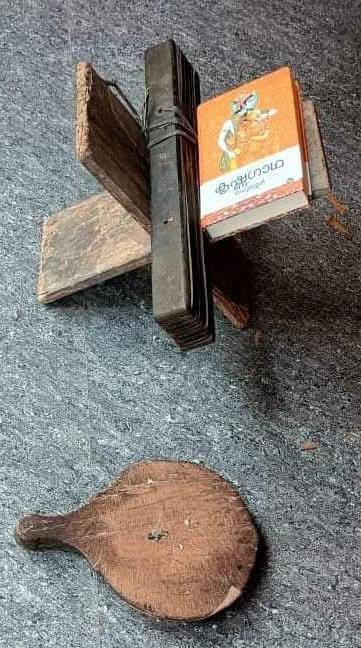
ചിങ്ങം പിറന്നു; ഇനി കൃഷ്ണപ്പാട്ടിൻ്റെ ശീലുകൾ പാടും നാളുകൾ | Global TV


കൃഷ്ണഗാഥ പ്രചാരണവുമായി സംഘവഴക്ക ഗവേഷണ പീഠം രംഗത്ത്


കണ്ണൂർ: ചിങ്ങം ഉത്തര കേരളത്തിൽ ചെറുശ്ശേരിയുടെ കൃഷ്ണഗാഥ പിറന്ന മാസമാണ്.

മലയാളത്തിലെ ആദ്യത്തെ സമ്പൂർണ പച്ച മലയാള മഹാകാവ്യമാണ് കോലത്തിരിയുടെ വിദ്വൽ സദസ്യനായ ചെറുശ്ശേരി നമ്പൂതിരി രചിച്ച കൃഷ്ണഗാഥ. മലയാള സാഹിത്യത്തിൽ പാട്ടു പ്രസ്ഥാനത്തിൽ ഉൾപ്പെട്ട സമ്പൂർണ മഹാകാവ്യം.ഉദയവർമ്മൻ കോലത്തിരി മഹാരാജയുടെ ആജ്ഞപ്രകാരമാണ് കൃഷ്ണഗാഥ നിർമ്മിച്ചതെന്ന് കവി തന്നെ കാവ്യത്തിൽ ആവർത്തിച്ച് വ്യക്തമാക്കിയിട്ടുണ്ട്. ശ്രീകൃഷ്ണ ജന്മമാസമായ ചിങ്ങത്തിൽ കൃഷ്ണഗാഥ തൻ്റെ നാട്ടിൽ എല്ലാവരും പാരായണം ചെയ്യണമെന്ന് തിട്ടൂരമിറക്കി ഉദയവർമ്മൻ കോലത്തിരി മഹാരാജ കവിയെ ആദരിച്ചു.


കൃഷ്ണഗാഥയുടെ രചനാകാലം പതിനഞ്ചാം നൂറ്റാണ്ടാണെന്നാണ് സാഹിത്യ ഗവേഷകർ അംഗീകരിച്ചിട്ടുള്ളത്.

മലയാളത്തിലെ ആദ്യത്തെ പാരായണ കാവ്യം കൂടിയായി കൃഷ്ണഗാഥ ചരിത്രത്തിൽ സ്ഥാനം പിടിച്ചു. പിന്നീടാണ് എഴുത്തച്ഛൻ്റെ അധ്യാത്മ രാമായണം കിളിപ്പാട്ട് കർക്കടക മാസം പാരായണം ചെയ്യുന്ന സമ്പ്രദായം ആരംഭിച്ചത്. ചിങ്ങത്തിൽ ഉദയവർമ്മൻ കോലത്തിരി ആഹ്വാനം ചെയ്ത പാരായണ
വഴക്കം ഉത്തര കേരളം ഇന്നും സംരക്ഷിച്ചു വരുന്നു. പഴയ തറവാടുകളിലും ക്ഷേത്രങ്ങളിലും കൃഷ്ണഗാഥ പാരായണം മുടങ്ങാതെ നടത്തുന്നുമുണ്ട്.

ചിങ്ങം കൃഷ്ണപ്പാട്ട് പ്രചാരണ മാസം എന്ന പേരിൽ സി. എം എസ് ചന്തേര മാഷ് സ്മാരക സംഘവഴക്ക ഗവേഷണ പീഠത്തിൻ്റെ ആഭിമുഖ്യത്തിൽ വർഷങ്ങളായി പ്രചാരണ പ്രവർത്തനങ്ങളുമുണ്ട്.

ഇതിൻ്റെ ഭാഗമായി കൃഷ്ണഗാഥ പാരായണം ചെയ്യുന്നവരുടെ കൂട്ടായ്മ – കൃഷ്ണപ്പാട്ടു വഴക്കം എന്ന പേരിൽ രൂപീകരിച്ച് ചിങ്ങ ത്തിലെ എല്ലാ ദിവസവും കൃഷ്ണഗാഥ പാരായണം ഒരുക്കിയിട്ടുണ്ട്.
ഇക്കുറി ചെന്നൈ കേന്ദ്രീകരിച്ച് കൃഷ്ണഗാഥ
ഓൺ ലൈൻ പാരായണകൂട്ടായ്മയും ആരംഭിച്ചിട്ടുണ്ട്. തെളിമലയാള ഭാഷയുടെ പ്രചാരണ കാവ്യം കൂടിയാണ് കൃഷ്ണഗാഥ.
ചിറക്കൽ ചിറ മതിലകം ശ്രീകൃഷ്ണ ക്ഷേത്രം,
കീഴല്ലൂർ മഹാദേവ ക്ഷേത്രം, അഴീക്കോട് മൊളോളംക്ഷേത്രം, വാരം ശ്രീകൃഷ്ണ ക്ഷേത്രം, തുടങ്ങി നിരവധി ക്ഷേത്രങ്ങളിൽ മാതൃ സമിതിയുടെ നേതൃത്വത്തിൽ ഈ വർഷവും കൃഷ്ണപ്പാട്ടു വഴക്കം കൂട്ടായ്മ പാരായണം നടത്തുന്നുണ്ട്.

കൃഷ്ണ ഗാഥായനം എന്ന പേരിൽ ഇതോടനുബന്ധിച്ച് വിവിധ ഇടങ്ങളിൽ ചിങ്ങത്തിൽ കൂട്ടായ്മകളും ഒരുക്കുന്നുണ്ടെന്ന് സി. എം എസ് ചന്തേര മാഷ് സ്മാരക സംഘവഴക്ക ഗവേഷണ പീഠം അറിയിച്ചു. കീഴല്ലൂർ മഹാദേവ ക്ഷേത്രത്തിൽ ചിങ്ങം 31 ദിവസവും പാരായണം നടത്തുന്നവരുടെ 28 ഓളം പേരടങ്ങുന്നവരുടെ പ്രത്യേക പട്ടിക തയ്യാറാക്കിയാണ് പരിപാടി സംഘടിപ്പിക്കുന്നത്.
18 ന് രാവിലെ 7 _30 ന് ആരംഭിക്കും . സെപ്റ്റംബർ 17 നാണ് സമർപ്പണം
പരമ്പരാഗതമായി ചിങ്ങത്തിൽ
എല്ലാ ദിവസവും രാവിലെയാണ് കൃഷ്ണഗാഥ പാരായണം നടത്തിവരുന്നത്
കീഴല്ലൂർ മഹാദേവ ക്ഷേത്രത്തിൽ
സെപ്റ്റംബർ 13 ന് വൈകുന്നേരം 4.30 ന് കൃഷ്ണഗാഥ പാരായണ മത്സരവും നടത്തുന്നുമുണ്ട്.

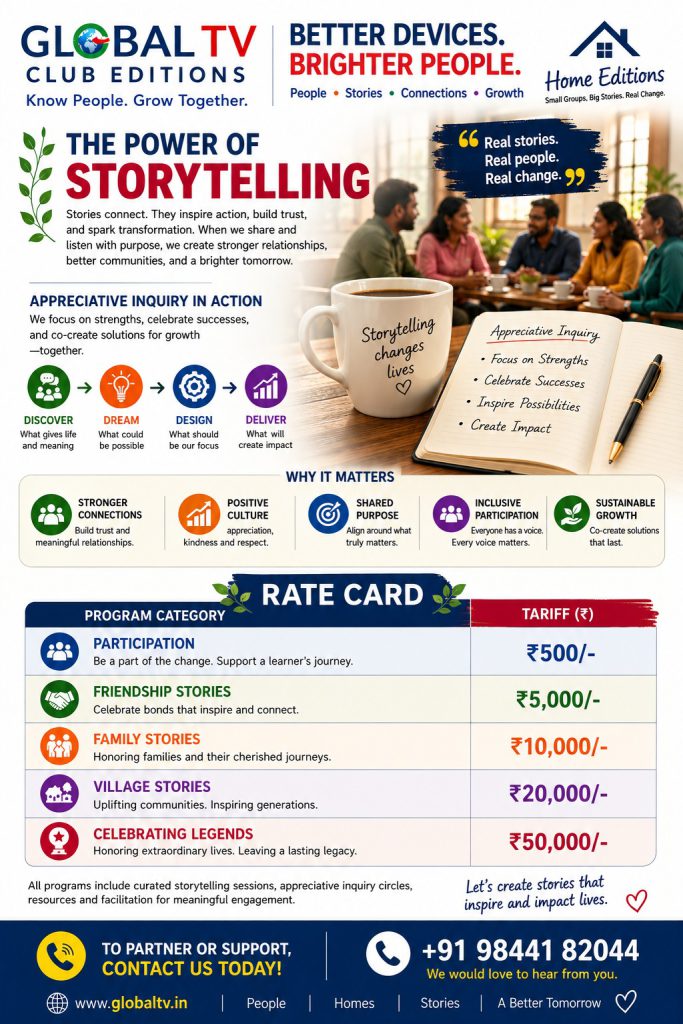
Do You Love Storytelling? | You can Partner with Global TV to Create an Appreciative Storytelling Circle | Global TV

Appreciative Inquiry Circles | Listening, Learning, and Creating Prosperity Together with Global TV

NV Paulose, Chairman, Global TV +91 98441 82044

There is a powerful idea behind every meaningful community: people already possess stories, experiences, skills, and possibilities that can help one another grow. The challenge is to create a space where those strengths can be heard, appreciated, and transformed into action. Appreciative Inquiry Circles, in collaboration with Global TV, are envisioned as such spaces.

Rather than beginning with the question, “What is wrong?”, an Appreciative Inquiry Circle begins with a different question: “What is working, what have we learned, and what could we create together?”

It is an approach to conversation, storytelling and collective action that brings people together around strengths, possibilities and shared aspirations. Global TV adds an important dimension to this process: the ability to capture, edit, organise and share those stories, allowing conversations that begin in a small circle to reach a much wider community. The initiative welcomes people with different interests and abilities. Those who enjoy Speaking and Listening, Shooting and Editing, Organising and PR, or Finance and Planning can all find a meaningful role.

1. From Complaint Boxes to Possibility Circles

Many organisations and communities have become accustomed to collecting complaints. Complaint boxes, feedback forms and problem lists have their place, but they can unintentionally create a culture in which people become experts at identifying what is wrong without necessarily becoming equally confident about imagining what could be better.

Appreciative Inquiry offers another starting point. An Appreciative Inquiry Circle asks people to recall moments when something worked particularly well. It invites them to talk about people who made a difference, relationships that helped them through difficult situations, achievements that deserve recognition and experiences that revealed unexpected possibilities.

The intention is not to pretend that problems do not exist. It is to change the starting point of the conversation. Instead of asking only: “What went wrong?” we can also ask:

“When did we get it right?”
“What made that possible?”
“What can we learn from it?”
“What would happen if we created more of it?”

These questions can transform the atmosphere of a group.

A circle becomes a place where people listen to one another, discover strengths they had overlooked and begin imagining a future together. This is where storytelling becomes particularly powerful. A story is not merely an account of something that happened. It can carry experience, emotion, wisdom, identity, and a great possibility to create a bright future.

2. The Power of Speaking and Listening

At the heart of every Appreciative Inquiry Circle are two simple human abilities: speaking and listening. Speaking gives people an opportunity to tell their stories in their own words. Listening gives those stories value. There is a growing need for spaces where people are not competing for attention but genuinely listening to one another. A young person may have an insight that an experienced professional has never considered. A parent may carry a story of resilience that can inspire an entire community. A senior citizen may possess decades of knowledge that would otherwise disappear without being recorded.

The Speaking and Listening team can help create the conditions for these stories to emerge. Participants can learn how to ask thoughtful questions, conduct conversations, facilitate circles and listen without immediately judging or interrupting. They can also learn the art of identifying the moments in a conversation that deserve to become stories.

Global TV provides a platform for taking those conversations further. A circle may begin with five or ten people around a table. But through responsible storytelling and media production, the learning can travel beyond that room. The objective is not to make celebrities out of participants. It is to make ordinary experiences visible and valuable.

3. Shooting and Editing: Turning Conversations into Stories

Every meaningful conversation contains moments worth remembering. The Shooting and Editing team helps preserve those moments. This is where technology becomes an instrument of storytelling rather than an end in itself. People interested in cameras, mobile phones, sound, lighting, video editing, photography, graphics, or publishing can contribute to the initiative. They can learn to document Appreciative Inquiry Circles and transform conversations into accessible stories.

The emphasis should remain on authenticity. Good storytelling does not require elaborate equipment. It requires attention: a good question, a genuine answer, a meaningful expression, an important detail, and the patience to let a story unfold. Participants can develop practical skills in interviewing, framing, recording sound, editing, captioning, and preparing stories for digital platforms. In this way, Shooting and Editing becomes a form of community career.

A friendship can become a story. A family experience can become a lesson. A community achievement can become an example for others. The camera becomes a bridge between people.

4. Organising, PR, Finance and Planning: Making the Circle Sustainable

Great conversations need great organisation if they are going to become a continuing movement. That is why Appreciative Inquiry Circles are not only for speakers, storytellers or media enthusiasts. They also need people who enjoy Organising and PR, and those who are comfortable with Finance and Planning.

The Organising and PR team can help identify participants, coordinate meetings, communicate with communities, invite guests, develop partnerships and share stories responsibly. They can help ensure that the right people are brought together and that every circle has a clear purpose.

The Finance and Planning team provides another essential foundation. A sustainable initiative needs budgets, transparent financial processes, resource planning, sponsorship development, and careful documentation. Even a small circle needs to understand what it costs to organise an event, produce content, and maintain continuity.

These roles may appear different from storytelling, but they are part of the same ecosystem.

  • Speaking creates understanding.
  • Shooting captures experience.
  • Editing shapes the story.
  • Organising brings people together.
  • PR builds relationships.
  • Finance and Planning make continuity possible.

Together, these capabilities turn an interesting idea into a functioning community initiative.

5. From Circles to a Culture of Appreciation

The ultimate ambition of Appreciative Inquiry Circles is not to conduct a series of meetings. It is to cultivate a culture of appreciation, participation and possibility. Imagine communities in which people regularly gather to ask what is working, celebrate one another’s contributions, document meaningful experiences and explore what they can accomplish together.

Imagine those stories being recorded and shared through Global TV. Imagine young people learning media skills by documenting the achievements of their own communities. Imagine professionals sharing knowledge. Imagine families telling stories that might otherwise remain private memories. Imagine local groups discovering that their experience can inspire another group hundreds of kilometres away. That is the potential of the initiative.

The four pathways; Speaking & Listening, Shooting & Editing, Organising & PR, and Finance & Planning, allow people with very different talents to participate. You do not have to be a professional broadcaster. You do not have to own expensive equipment. You do not need to arrive with a fully developed project. You simply need an interest in people, stories and possibilities.

Global TV can become a partner in helping these circles move from conversation to documentation, from documentation to storytelling, and from storytelling to connection. The central philosophy is simple:

  • Appreciate what is.
  • Imagine what could be.
  • Create what matters.

An Appreciative Inquiry Circle gives people a place to begin.

Tom Cyriac | A Visionary Leader Shaping the Future of Ethical Debt Recovery | Global TV

Tom Cyriac | A Leader Who Puts People and Customers First

NV Paulose, Chairman, Global TV +91 98441 82044

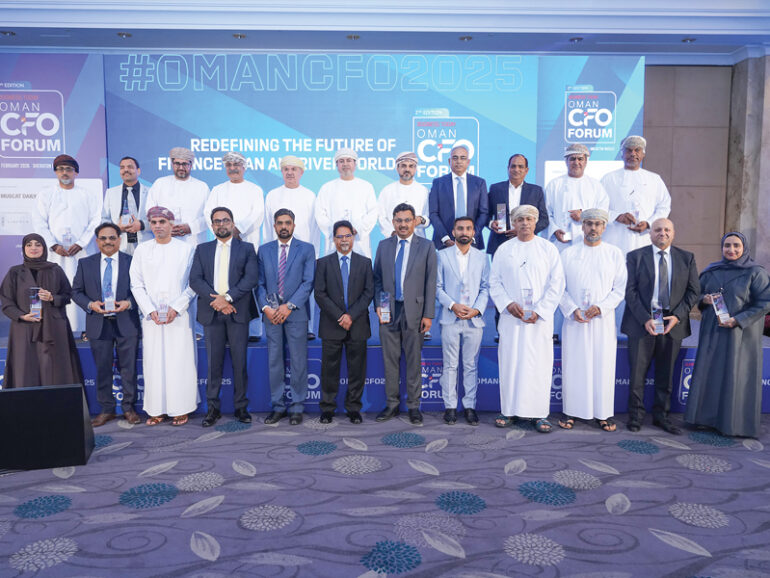
Muscat, Oman: Sri. Tom Cyriac, Chief Operating Officer of SADAD International LLC, is a respected business leader whose career shows the value of learning, adapting, and putting people first. With more than four decades of experience, Tom Cyriac has worked across several industries, including technology, automotive, media, financial services, and debt recovery. His journey began in 1985 as a Sales Executive with Usha Computers in Chennai.

Over the years, he took on different roles and responsibilities, gaining valuable experience in business, customer service, and operations. Each stage of his career helped shape the leader he is today. Today, Tom Cyriac leads SADAD International LLC, the debt collection and credit risk management company of Bahwan International Group in Oman. Under his leadership, SADAD has grown into a respected recovery services company with offices in Oman, Saudi Arabia, the UAE, and Bahrain.

A Different Way of Looking at Debt Recovery

Tom Cyriac believes that debt collection should not be about simply demanding payment from customers. His philosophy is simple. A customer who is unable to pay today may be able to become a paying customer again in the future. This belief has helped SADAD build a more respectful and customer-friendly approach to debt recovery. The company focuses on communication, understanding, and finding practical solutions. Tom Cyriac believes that customers should be treated with respect even when they are facing financial difficulties. This approach helps protect customer relationships while also achieving good results for clients.

Learning From Different Cultures | Turning Experience Into Leadership

One of the most important lessons Tom has learned during his career is that every person is different. While leading teams made up of people from six or seven nationalities in Oman, he learned that the same management style does not work for everyone. People have different cultures, backgrounds, and family responsibilities. Good leaders need to understand these differences.

Instead of asking employees to change themselves to fit his leadership style, Tom chose to adapt his own approach. This has helped him become a better listener and a more understanding leader. He believes that having people from different cultures is one of an organisation’s greatest strengths.

Caring for Employees

Tom Cyriac also believes that looking after employees is an important part of leadership. Debt collection can be a difficult job. Employees often speak with customers who are going through financial problems. This can create pressure and emotional challenges for the people handling these cases.

At SADAD, Tom has encouraged an open and supportive culture. Team leaders stay in regular contact with employees and provide support when difficult situations arise. Employees also have access to senior leadership when they need help. This culture of trust and respect has helped SADAD maintain strong employee engagement and retention.

Ready for the Future | A Leader Ready for the Next Transformation

Tom Cyriac’s career has also been a story of adapting to technology. When he started his career, computers were still new to many businesses. During his MBA studies, he learned about computers mainly through books because access to computers was limited. Today, he sees artificial intelligence and automation as important parts of the future of business. However, he believes technology should support people rather than replace the human side of leadership. For Tom, qualities such as honesty, empathy, resilience, and the ability to understand people will always be important.

Four Decades of Learning

Tom Cyriac’s career is a strong example of how continuous learning can build great leadership. From sales and technology to financial services and debt recovery, every stage of his career has given him new lessons and experiences. His recognition in TradeFlock’s Most Innovative Global COOs 2026 reflects this long journey and his contribution to modern business leadership.

His message to future leaders is simple: Keep learning, accept change, understand people and always remember the human side of business. Sri. Tom Cyriac’s journey shows that great leadership is not only about achieving business results. It is also about earning trust, supporting people and building relationships that last.

ALPHA BETA: From Abandoned Laptops to Active Homes | Global TV

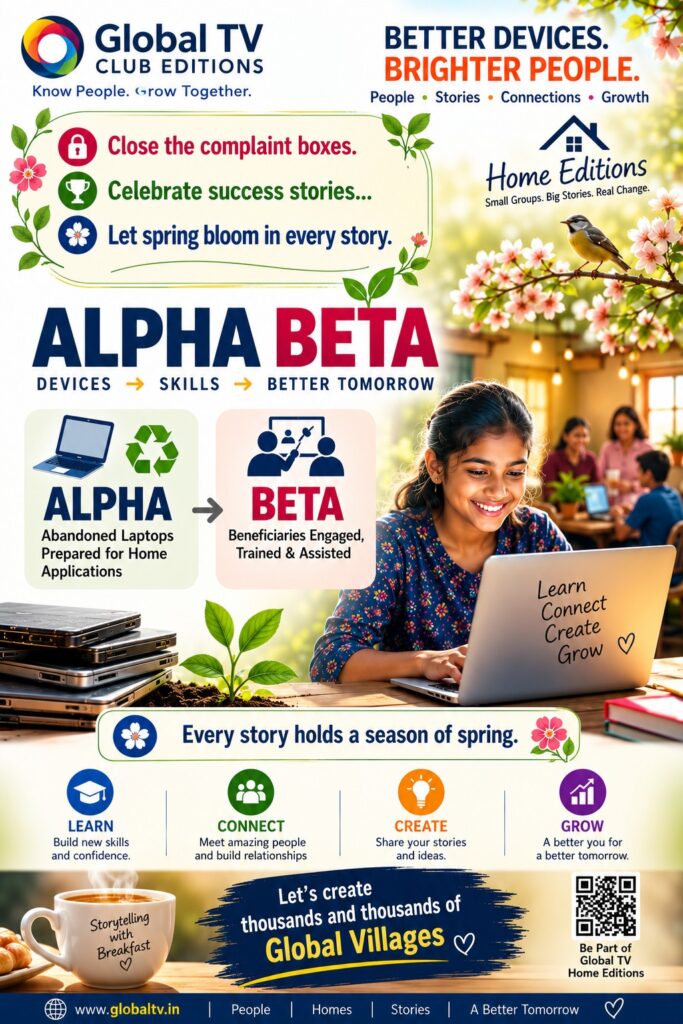
A Technology, Training and Participation Initiative for Global TV Home Editions

NV Paulose, Chairman, Global TV +91 98441 82044

A laptop that is no longer useful to one person can become an opportunity for another.

Across homes, offices, institutions and organizations, computers are regularly replaced while many remain capable of supporting learning, communication, creativity and productive work. The challenge is not always the absence of technology. Often, it is the absence of a pathway that connects unused technology with people who can put it to meaningful use.

ALPHA BETA proposes such a pathway.

  • ALPHA stands for Abandoned Laptops Prepared for Home Applications.
  • BETA stands for Beneficiaries Engaged, Trained & Assisted.

Together, ALPHA BETA creates a simple model:

  • ALPHA prepares the technology.
  • BETA prepares the people.

The result is not merely the distribution of laptops. It is the creation of new possibilities within homes.

ALPHA: Giving Laptops a Second Life

The first stage begins with laptops that have been abandoned or otherwise become surplus to their original users. Instead of allowing these devices to remain unused, ALPHA seeks to collect them, assess their condition, repair or upgrade them where practical, install appropriate software, test them and prepare them for useful home applications. The objective is simple: turn dormant hardware into productive equipment.

A prepared laptop can become a learning device for a student, a communication tool for a family, a work instrument for a home-based entrepreneur, a media-production device for a young person, or a gateway to digital knowledge. The laptop itself is only the starting point.

BETA: Preparing People, Not Just Devices

Technology becomes valuable when people know how to use it. That is the purpose of BETA: Beneficiaries Engaged, Trained & Assisted. The people receiving or using ALPHA-prepared laptops are not expected to figure everything out alone. BETA provides engagement, practical training and continuing assistance.

Training can begin with fundamentals—using the operating system, managing files, communicating online, searching for information and maintaining digital safety—and develop toward more productive capabilities such as writing, research, content creation, online collaboration, media production and home-based work. The emphasis is not on giving someone a device and walking away. It is on helping the person move from access → confidence → capability → participation.

From Device to Development

This is where ALPHA BETA becomes more interesting than a conventional computer-donation programme. The laptop is not the final product. The empowered user is the final product.

A device sitting unused has limited value. A person who can use that device to learn, communicate, create, collaborate or earn has considerably greater potential. ALPHA therefore addresses the technology gap. BETA addresses the capability gap. Together, they can address a deeper problem: the gap between having access to the digital world and being able to participate meaningfully in it.

ALPHA BETA and Global TV Home Editions

This is where the model can connect naturally with Global TV Home Editions. Global TV’s Home Editions concept is built around small groups coming together in homes to connect, collaborate and co-create. It deliberately lowers the barrier to participation: a professional studio is not required; a home, a few people and basic technology can be enough to begin. ALPHA BETA can strengthen that model by helping more homes acquire both the equipment and the skills needed to participate.

The relationship can therefore be understood in three layers:

ALPHA → Device
Prepare the laptop.

BETA → Capability
Engage, train and assist the user.

HOME EDITION → Participation
Use the home as a place for communication, learning, storytelling and collaboration.

This creates a powerful progression: From unused laptop → prepared laptop → capable user → active home → connected community.

From Watching to Creating

One of the most important possibilities is the movement from passive digital consumption to active creation. A person who previously used technology primarily to watch videos or browse social media can begin writing, interviewing, documenting, editing, researching and publishing.

A family can record Storytelling and experience sharing. A student can interview successful people. A local group can discuss creating a new possibility for its community. A retired person can share knowledge and memories. A young person can develop communication and media skills.

This is closely aligned with the Home Editions philosophy of moving people from watching to creating and encouraging ordinary people to become contributors and editors.

A Small Laptop Can Open a Large Door

ALPHA BETA does not require every home to become a professional media studio.

It begins much smaller.

  • One laptop.
  • One person.
  • One family.
  • One small group.
  • One Home Edition.
  • That is enough to start.

Global TV’s wider model similarly emphasizes small, home-based initiatives that can develop into larger networks of communication, knowledge and opportunity. Its Tele Village concept, for example, connects Home Editions, Home Studios and home-based Reading Centres as local platforms for communication, learning and opportunity creation. ALPHA BETA can become one practical enabling layer within that ecosystem.

A Circular Model

The most interesting possibility is that ALPHA BETA could eventually become circular. A laptop begins its life with an organization or individual. It becomes surplus. ALPHA recovers and prepares it. BETA trains a new user. The user participates in a Home Edition and develops new skills. That user may eventually become a trainer, editor, contributor, mentor or supporter.

And the cycle continues. The original discarded laptop has therefore created much more than another computing device. It has helped create human capability.

The Bigger Vision

The ambition of ALPHA BETA should not be measured simply by the number of laptops collected. A better set of questions would be:

  • How many people became digitally capable?
  • How many homes became productive digital spaces?
  • How many young people learned useful skills?
  • How many stories were created?
  • How many collaborations began?
  • How many people moved from being consumers of digital content to creators and contributors?

That is the real measure of impact. Global TV already describes its broader vision in terms of connecting people, communities and societies, while placing young people at the centre of digital participation and opportunity creation. ALPHA BETA can give that vision a very tangible starting point.

Start With What Already Exists

The beauty of the idea is its simplicity. There is no need to wait for a perfect programme, a large building or expensive infrastructure. There are already unused laptops. There are already people who need access. There are already homes. There are already stories. There are already people willing to teach and people willing to learn. ALPHA BETA connects them.

  • ALPHA finds and prepares the technology.
  • BETA engages, trains and assists the people.
  • Global TV Home Editions gives them a place to connect, create and contribute.

That is the opportunity:

ALPHA BETA

  • From Abandoned Laptops to Active Homes.
  • Not simply giving away computers.
  • Giving technology a second life—and people a new opportunity to use it.

Mangaluru Matters | Bringing meaningful conversations on the issues, challenges and changing realities of Mangaluru city and Coastal Karnataka to a wider audience | Global TV

Mangaluru Matters: A New Platform Bringing Coastal Karnataka’s Stories to the Forefront

NV Paulose, Chairman, Global TV +91 98441 82044

MANGALURU: A new discussion platform, ‘Mangaluru Matters’, is bringing meaningful conversations on the issues, challenges and changing realities of Mangaluru city and Coastal Karnataka to a wider audience.

Hosted by journalist and anchor Donald Pereira, the programme aims to go beyond simply highlighting problems. Its focus is on asking the right questions, understanding issues from multiple perspectives and exploring practical solutions for society. The inaugural episode focuses on one of the region’s most important institutions, print journalism. Titled “The Legacy, Challenges and Future of Print Media in Mangaluru,” Episode 1 examines the rich history of newspapers in the region, the challenges facing traditional newsrooms and the rapidly changing media landscape shaped by digital platforms.

The discussion features two experienced voices from the journalism fraternity, Ravindra Shetty, Resident Editor, Vijaya Karnataka, Times of India Group, Mangaluru, and Pushparaj B.N., President, Working Journalists Association, Dakshina Kannada District, Mangaluru. The conversation explores how traditional newspapers are adapting to the digital era, the continuing responsibilities of journalism, changing reader expectations and the future of print media in Coastal Karnataka.

The launch of Mangaluru Matters marks an important effort to create a platform where significant local issues receive informed, balanced and constructive attention. From media and public systems to women’s safety, civic issues and public infrastructure, the series brings together subject experts, journalists, politicians, officials, public representatives and social workers to examine matters that directly affect the community.

At a time when public discussions are increasingly fast paced and fragmented, Mangaluru Matters seeks to encourage deeper conversations that move beyond identifying problems and focus on finding meaningful solutions. With its emphasis on facts, diverse viewpoints and constructive discussions, the programme also aims to bring attention to stories and developments that often remain outside the mainstream spotlight.

‘Mangaluru Matters’ begins its journey with a clear objective: to ask the right questions, encourage meaningful dialogue and work towards finding solutions for society.

The inaugural episode on the past, present and future of print media marks the beginning of a promising journey into the issues that truly matter to Mangaluru and Coastal Karnataka. Mangaluru Matters, bringing the pulse of Coastal Karnataka into focus, one important conversation at a time.

SDM Colleges Managlore | Independence Day Celebrations | Global TV

80ನೇ ಸ್ವಾತಂತ್ರ್ಯ ದಿನಾಚರಣೆ: ಎಸ್‌ಡಿಎಂ ಕಾಲೇಜಿನಲ್ಲಿ ವಿಶೇಷ ಕಾರ್ಯಕ್ರಮ

NV Paulose, Chairman, Global TV +91 98441 82044

ಮಂಗಳೂರು, ಆಗಸ್ಟ್ 15: ಶ್ರೀ ಧರ್ಮಸ್ಥಳ ಮಂಜುನಾಥೇಶ್ವರ ಕಾಲೇಜ್ ಆಫ್ ಬಿಸಿನೆಸ್ ಮ್ಯಾನೇಜ್‌ಮೆಂಟ್, ಕೊಡಿಯಾಲ್‌ಬೈಲ್, ಮಂಗಳೂರು ವತಿಯಿಂದ 80ನೇ ಸ್ವಾತಂತ್ರ್ಯ ದಿನಾಚರಣೆಯನ್ನು ಗೌರವಪೂರ್ಣವಾಗಿ ಆಚರಿಸಲಾಯಿತು.

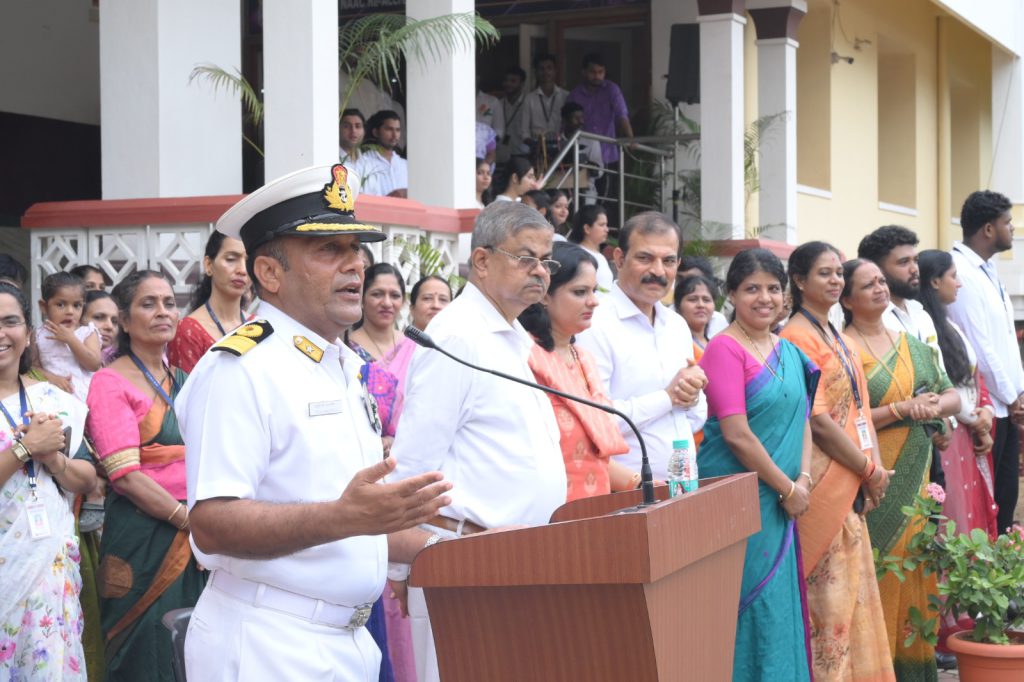
ಎಸ್‌ಡಿಎಂ ಕಾಲೇಜಿನ ಆವರಣದಲ್ಲಿ ಬೆಳಿಗ್ಗೆ 8.45ಕ್ಕೆ ಆಯೋಜಿಸಲಾದ ಈ ಕಾರ್ಯಕ್ರಮಕ್ಕೆ ಭಾರತೀಯ ನೌಕಾಪಡೆಯ ನಿವೃತ್ತ ಕಮೋಡೋರ್ ಅತುಲ್ ಕುಮಾರ್ ರಾಸ್ತೋಗಿ ಅವರು ಮುಖ್ಯ ಅತಿಥಿಯಾಗಿ ಭಾಗವಹಿಸಿ ಧ್ವಜರೋಹಣ ಮಾಡಿ ದರು. ಸ್ವಾತಂತ್ರ್ಯ ಹೋರಾಟಗಾರರಿಗೆ ಗೌರವ ಸಲ್ಲಿಸುವುದು ಹಾಗೂ ದೇಶದ ಏಕತೆ, ವೈವಿಧ್ಯತೆ ಮತ್ತು ಸ್ವಾತಂತ್ರ್ಯದ ಮೌಲ್ಯಗಳನ್ನು ಸ್ಮರಿಸುವುದು ಈ ಕಾರ್ಯಕ್ರಮದ ಪ್ರಮುಖ ಉದ್ದೇಶವಾಗಿದೆ ಎಂದು ತಮ್ಮ ಭಾಷಣದಲ್ಲಿ ಸಂದೇಶ ನೀಡಿದರು.

ಕಾರ್ಯಕ್ರಮದಲ್ಲಿ ಎಸ್‌ಡಿಎಂ ಲಾ ಕಾಲೇಜಿನ ಪ್ರಾಂಶುಪಾಲ ಡಾ. ತಾರಾನಾಥ ಶೆಟ್ಟಿ, ಹಾಗೂ ಎಸ್‌ಡಿಎಂ ಕಾಲೇಜ್ ಆಫ್ ಬಿಸಿನೆಸ್ ಮ್ಯಾನೇಜ್‌ಮೆಂಟ್‌ನ ಉಪ ಪ್ರಾಂಶುಪಾಲೆ ಶ್ರೀಮತಿ ದಿವ್ಯ ಉಚ್ಚಿಲ್, ಮಾಜಿ ಪ್ರಾಂಶುಪಾಲರಾದ ಡಾ ದೇವರಾಜ್ ಕೆ,  ಬೋಧಕ ಹಾಗೂ ಬೋಧಕೇತರ ಸಿಬ್ಬಂದಿ ಮತ್ತು ವಿದ್ಯಾರ್ಥಿಗಳು ಭಾಗವಹಿಸಿದರು.

ದೇಶಭಕ್ತಿ ಮತ್ತು ರಾಷ್ಟ್ರೀಯ ಏಕತೆಯ ಸಂದೇಶವನ್ನು ಸಾರುವ ಗೀತೆಗಳನ್ನು ಹಾಡಲಾಯಿತು. ಕಾರ್ಯಕ್ರಮದ ನಿರೂಪಣೆ ಕು ವಾರುಣಿ, ಸ್ವಾಗತ ಕು ರಚನಾ, ವಂದನಾರ್ಪಣೆ ಕು ಜೇಷ್ಠ ಮಾಡಿದರು. ಕಾರ್ಯಕ್ರಮದ ಸಂಯೋಜನೆಯನ್ನು ಶ್ರೀಮತಿ ಶಶಿಪ್ರಭಾ ಮತ್ತೂ ಶ್ರೀಯುತ ಸುದರ್ಶನ್ ನೆರವೇರಿಸಿದರು.