
Understanding the Difference Between Organ and Tissue Donation
Rotarian Lal Goel, Founder & Charter President, Rotary Club of Organ Donation International, Chairman, Organ Donation India Foundation & GYAN
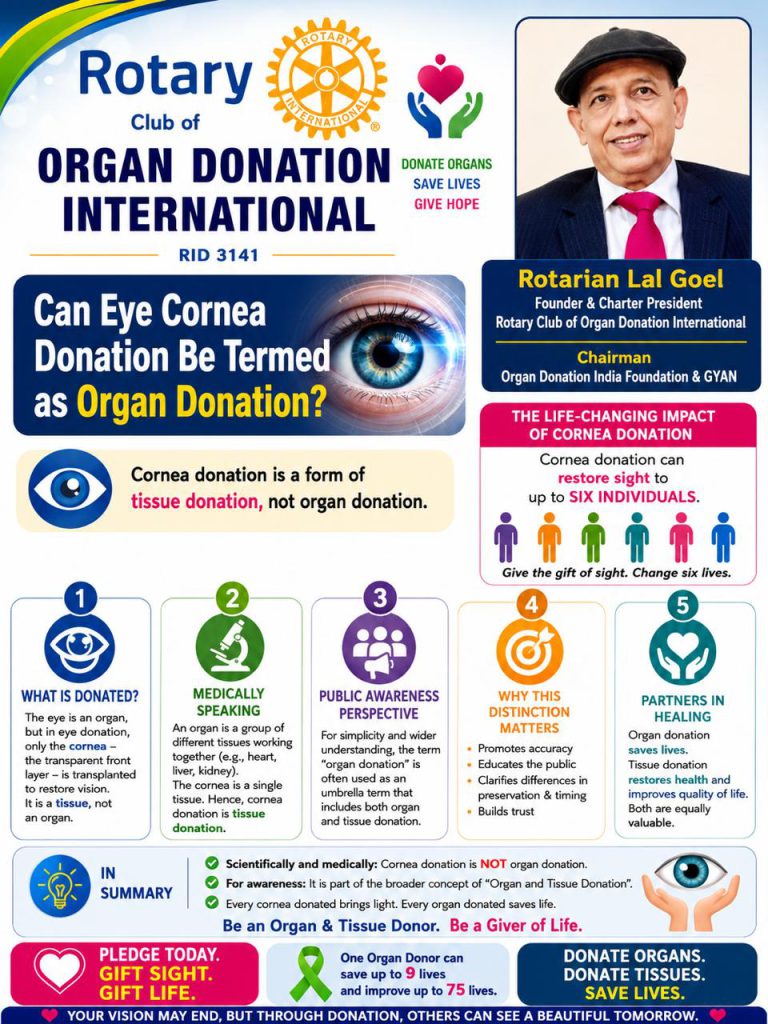
The phrase “eye donation” is widely used by the public, media, and awareness campaigns alike. Medically, however, what is donated is the cornea—a tissue, not an organ. Getting this distinction right matters: it improves public understanding without sacrificing scientific accuracy.
Organ vs Tissue: The Core Difference
An organ is a group of different tissues working together for a specific function. Examples include the heart, liver, kidneys, lungs, pancreas, and intestines. These organs are composed of blood vessels, nerves, muscles, and connective tissues functioning as one unit.
A tissue, on the other hand, is a collection of similar cells performing a particular function. Examples include the cornea, skin, bone, tendons, heart valves, and blood vessels.
The eye itself is an organ, but in routine eye donation for transplantation, the organ is not transplanted. Instead, only the cornea—the transparent, dome-shaped front layer of the eye—is used to restore sight in patients with corneal blindness. Medically speaking, therefore, cornea donation is tissue donation.
Why Is It Often Called “Eye Donation”?
The term has persisted for decades because it is simple and immediately understandable. During retrieval, the whole eyeball may sometimes be removed to safely recover the cornea at the eye bank, even though only the corneal tissue is ultimately used for transplantation—hence the popular but imprecise name.
Today, many eye banks perform in-situ corneal retrieval, where only the cornea is removed, leaving the rest of the eye intact.
So Can Cornea Donation Be Classified as “Organ Donation”?
From a scientific and medical standpoint, the answer is no—cornea donation is tissue donation.
However, in public awareness efforts, “organ donation” is often used as an umbrella term that includes both organ and tissue donation. National campaigns, hospitals, and NGOs commonly use the combined phrase:
“Organ and Tissue Donation.”
This approach keeps messaging simple while remaining broadly accurate.
Why This Distinction Matters
Using correct terminology has several advantages:
- It promotes scientific accuracy.
- It helps educate the public about different types of donations.
- It clarifies that tissue donation has different preservation methods and transplantation timelines compared to organ transplantation.
- It builds trust through accurate information.
At the same time, awareness campaigns should avoid unnecessary complexity. When people understand the life-changing impact of cornea donation, they are more likely to pledge.
The Life-Changing Impact of Cornea Donation
Corneal blindness affects millions worldwide, caused by infection, injury, hereditary disease, or nutritional deficiency. Unlike damage to the retina or optic nerve, it can often be treated successfully through corneal transplantation.
One donated pair of corneas can restore sight to up to six individuals, helping them regain independence, return to work or study, and improve their quality of life.
Unlike most organs, corneas do not require transplantation within hours. They can be preserved in specialised media, allowing surgeons time to plan procedures effectively.
Organ Donation and Tissue Donation: Partners in Saving and Improving Lives
Although medically different, both forms of donation are equally valuable.
Organ donation primarily saves lives by replacing failing vital organs such as the heart, liver, kidneys, lungs, pancreas, and intestines.
Tissue donation primarily restores health and quality of life. Corneas restore vision, skin treats severe burns, bones assist reconstruction, tendons restore movement, and heart valves save patients with serious cardiac conditions.
Together, they represent one of humanity’s greatest gifts.
Conclusion
So, can cornea donation be considered organ donation?
The answer depends on the context.
Scientifically and medically, no. Cornea donation is tissue donation, because the cornea is a tissue and not an organ.
From a public awareness perspective, yes—but only as part of the broader concept of “Organ and Tissue Donation.” The most precise terminology remains:
“Eye Cornea Donation — a Form of Tissue Donation.”
As awareness grows, it is important to balance scientific accuracy with public understanding. Whether an organ saves a life or a cornea restores sight, every donation leaves a lasting legacy of hope.
A life saved is priceless. A life restored to vision is equally precious.


