
A cautionary tale about trust, technology, and the helplessness of a passenger who only wanted to reach Jaipur
Global TV Article Keeping anonymity of the author
Sometimes, a journey begins long before we board an aircraft.
It begins with hope, anticipation, and the simple belief that technology has made our lives easier.
For me, my journey to Jaipur began with exactly that belief. I had secured admission for higher studies in Jaipur and was preparing for an important new chapter in my life. Like many travellers, I wanted to find an economical flight from Mangalore to Jaipur. Having regularly used Skyscanner to compare flight fares, I turned to the platform once again, trusting the process that had served me before.
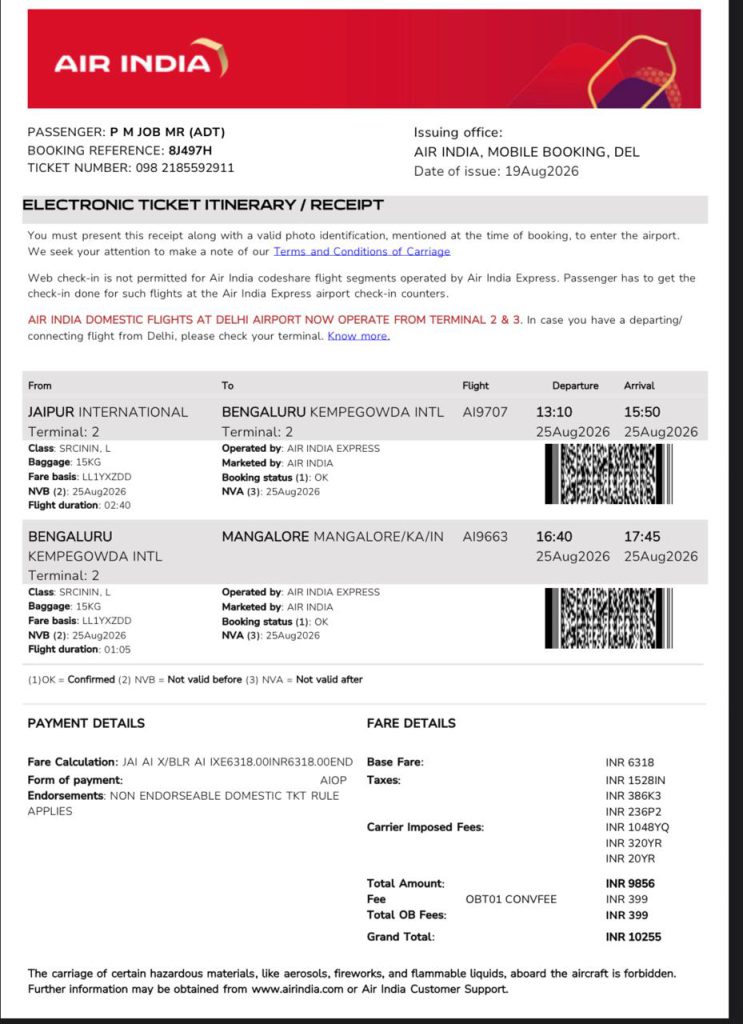
What followed, however, turned that excitement into anxiety, helplessness and fear.
On 15 August 2026, while searching for a flight, I was shown an Air India option at what appeared to be a lower fare. I proceeded through the booking process and, after entering my passenger details, was redirected to a website called Flight Network.
Everything appeared normal.
I entered my details and proceeded to payment. I first attempted to pay using my debit card. After entering my card details, I was taken to the OTP page. I entered the OTP repeatedly—four times—but each attempt failed. Assuming that there might be some technical issue with the card payment, I changed the payment method to Google Pay.
This time, everything seemed to work.
I was redirected to Google Pay. The amount was confirmed. I entered my transaction PIN. The payment went through.
₹23,456 was debited from my bank account.
Google Pay displayed the transaction as successful.
At that moment, I believed the most difficult part was over. I expected the flight ticket confirmation to arrive within minutes.
Instead, the nightmare began.
There was no ticket.
There was no proper booking confirmation.
The booking page simply returned to the payment screen.
I waited. I checked my email repeatedly. Eventually, I received a system-generated email from Flight Network mentioning Order No. 1148-567-117. The email stated that my payment had been received and was being processed, but that the booking had not yet been confirmed. I was asked not to make another reservation and was told that a confirmation email would be sent once the payment was confirmed.
So I waited.
One hour passed.
Then two.
Then four.
There was still no ticket.
I tried contacting customer service. The telephone number provided on the website did not respond. Emails resulted only in automated replies. I then attempted to use their online customer-service facility, hoping that the order number would at least allow me to track the booking.
Instead, I received another shock.
After entering my order number and email address, the website informed me that the order did not exist.
The order number had been given to me by the very website that had taken my money.
Now I was left with ₹23,456 less in my bank account, no flight ticket, no confirmed booking, and seemingly no human being willing to answer my questions.
I immediately contacted the airline.
The answer was devastating.
I was informed that no booking had been made in my name on that date.
I was also told that other people had reportedly faced similar problems after making flight bookings through the same website.
At that point, what had initially seemed like a technical failure began to look like something far more serious.
I contacted Canara Bank, explained the entire incident and requested that the transaction be cancelled or stopped. Because it was a holiday and the next working day was two days later, I was advised to approach the bank directly.
I also raised a complaint with the cybercrime authorities.
My cybercrime complaint number is:
2627BE6080
Despite repeated attempts to obtain clarification from Flight Network, there was still no confirmation and no cancellation. My emails went unanswered except for automated responses. The website’s customer-service mechanism was of no practical help.
On 17 August 2026, I personally visited my bank and explained everything to the Branch Manager. A written complaint was submitted, requesting action regarding the disputed transaction. I was again advised to pursue the matter with the cybercrime authorities.
I subsequently contacted the cybercrime authorities and provided the details available to me. I was asked to appear in person with the relevant complaint and transaction details.
And here lies the most difficult part of this entire experience.
I am not merely fighting for money.
I am trying to begin my future.
I have secured admission for higher studies in Jaipur and am required to report for my programme. While I should be thinking about my studies, my new surroundings and the life that lies ahead, I am instead spending my time trying to understand how a payment of ₹23,456 could disappear into a transaction where no airline ticket was ever issued.
The amount may be a number on a screen to someone else.
To me, it represents savings, effort and security.
It represents the money I set aside while preparing for an important turning point in my life.
What makes this experience even more disturbing is the sense of trust involved.
I did not begin the booking process believing that I was walking into a trap. I was using a flight-search platform that I had used before. I was shown what appeared to be a genuine airline option. I followed the booking process presented to me. I made the payment through a recognised digital payment platform. Google Pay confirmed the transaction.
For an ordinary passenger, everything looked legitimate.
That is precisely why such incidents are frightening.
Online fraud does not always arrive looking like fraud.
Sometimes it arrives disguised as a discount.
Sometimes it comes through a website that looks professional.
Sometimes the payment succeeds while the service never materialises.
And sometimes the victim is left running from one institution to another—bank, airline, website, payment platform and cybercrime authorities—trying to prove what should have been obvious from the beginning:
Money was taken. A service was not provided. And someone must be held accountable.
I am sharing my experience not merely to seek the recovery of my money, but to warn other travellers.
A cheaper fare is never worth compromising your financial security.
Before making an online flight booking, verify exactly who is taking your payment and whether the booking is being made directly with the airline or through a legitimate, traceable travel agency. Do not assume that because a flight appears on a flight-comparison platform, the entire transaction will necessarily be handled by that platform or by the airline itself.
Most importantly, when something goes wrong, do not remain silent.
Preserve every piece of evidence: screenshots, emails, payment confirmations, transaction IDs, order numbers, website details, bank statements and correspondence with the airline and booking company. Report the incident to your bank and the appropriate cybercrime authorities immediately.
I still hope that this matter will be resolved and that my ₹23,456 will be recovered.
But I also hope that my experience serves a larger purpose.
I hope it prevents another student, another family, another elderly traveller or another ordinary person from experiencing the same helplessness.
Because behind every online transaction is a real human being.
Behind every rupee deducted from an account is someone’s hard work.
And behind every failed booking may be a journey that someone desperately needs to make.
I was simply trying to book a flight to Jaipur to begin my higher studies.
Instead, I found myself having to fight a completely unexpected battle before my journey could even begin.
I hope my money comes back.
But more than that, I hope my experience reminds us that in an increasingly digital world, convenience must never come at the cost of vigilance—and that when ordinary people are deceived, they deserve not silence and automated replies, but answers, accountability and justice.


