
Mangalore Speakers Hive | Fast Growing into an Ecosystem of Collective Collaborative Co-Creation
NV Paulose, Chairman, Global TV +91 98441 82044
Our voice. Our strength. Our Hive. There is something wonderfully appropriate about calling a community of speakers a Hive. Dr. Zita Lobo Scuba-dived into the hive and presented the power of being together; together far better, together for better. A bee, by itself, can do only so much. But a hive is a different proposition altogether. Its strength lies in collaboration, many individuals working with a shared purpose, producing something far greater than what any one of them could produce alone.
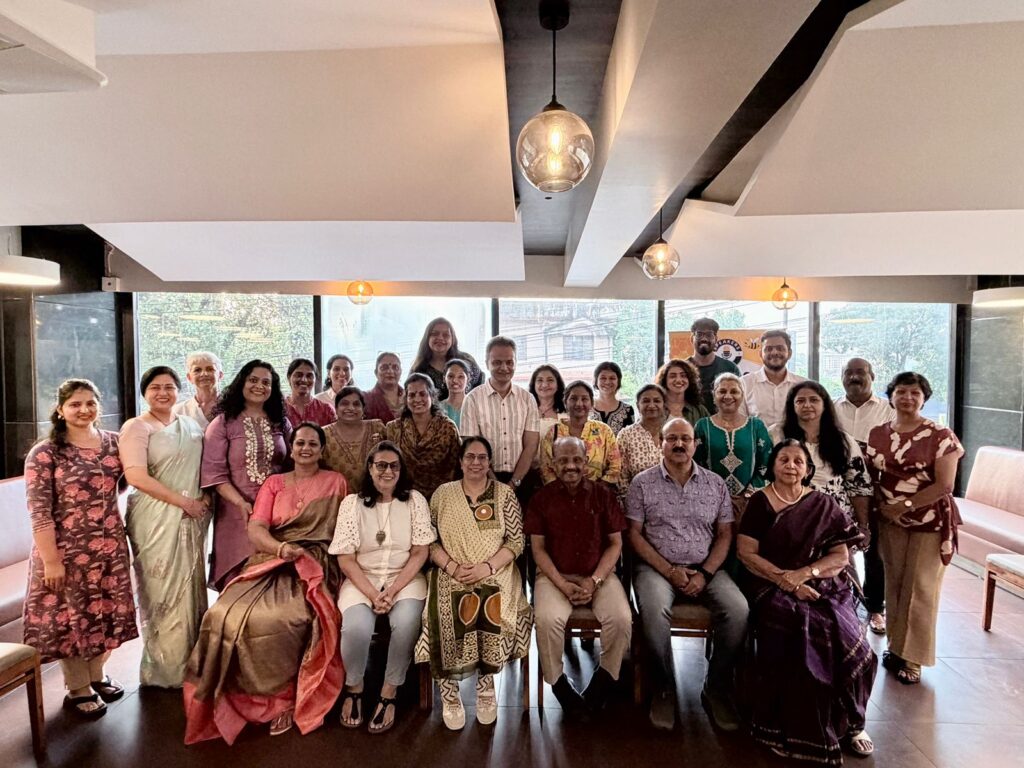
That was the spirit behind the second meeting of Mangalore Speakers Hive, held on August 29 at Shri Shankara Bhavana on Airport Road, Mangalore. The evening’s theme was “Hivemind”, while its word of the day was “synergy”, the idea that the whole can be greater than the sum of its parts. The metaphor was more than decoration. It captured what the gathering itself was attempting to become: a place where people come together, speak, listen, challenge, learn, and grow. And perhaps that is where the story moves beyond ordinary speakers. This is not merely about producing better speakers.
It is about producing queen bees, the people who can shape conversations, influence thought, tell compelling stories, take others along with them, and lift society to the heights of its dreams; to the honeypoint at the top of the hill and to the top of the tall tree on top of the hill.
A Hive with a Method
The meeting followed a carefully designed format. The Hive Talks segment featured three prepared speeches, each lasting between three and five minutes. This was followed by a Just a Minute Talk segment, where participants had to think and speak on the spur of the moment. Peer reviews then brought another essential ingredient into the mix: constructive feedback.
There were also dedicated roles for the Timekeeper and Wordsmith, along with voting, awards, and announcements. It may sound structured, even formal. But that structure serves a purpose. Speaking is a craft. And like every craft, it improves through repetition, observation, and honest feedback. At the Hive, the speaker gets the stage. The audience becomes the mirror.
Three Lives, Three Stories
The prepared speeches demonstrated exactly why public speaking is about much more than vocabulary and pronunciation. The first speaker, Maria D’Costa, took the audience through the stages of her life in a speech titled “Time pays, but enthusiasm pays much more.”
Her story travelled from being a young girl receiving her first salary of just twenty rupees to a life marked by education, challenges, teaching, and continued professional engagement. One of the striking messages in the speech was that while time inevitably passes, enthusiasm is what keeps a person moving forward. The feedback she received captured an important distinction. Her speech was praised for its enthusiasm, gestures, and voice modulation, with the reviewer suggesting that stronger use of the stage could make the narrative even more memorable. In other words, the story was already strong.
The next step was to make the physical delivery tell the story too. That is the kind of fine-tuning the Hive appears designed to encourage. What the reviewer could not notice was her conscious choice not to move more than a martial artist would, giving respect to her own age so as not to fall on the stage.
The second speech, Rani Mathias’s “A Life of Chance, Choice and Change”, used the three Cs as a framework for telling her life story. Chance. Choice. Change. Her journey moved from childhood, challenging youth, and family responsibilities to hotel management, marriage, motherhood, teaching, and eventually a new direction in life. What made the speech particularly effective was its architecture. A personal story was given a simple framework that allowed the audience to follow the journey. The reviewer praised its craft, eloquence, humour, open gestures, and voice modulation, while pointing to eye contact as an area for further improvement. Again, the lesson was not simply “speak well.” It was: connect better. (Read at the bottom to connect here)
When a Story Becomes a Picture
The third prepared speech, Devika Purushottam’s “Go Be a Blessing”, brought another dimension to the evening: imagery. The feedback highlighted the speech’s anecdotes, analogies, gestures and its ability to engage the audience. At one point, the speaker created a sense of suspense around a seemingly simple problem and allowed listeners to follow the story towards its resolution.
That is an important part of becoming a compelling speaker. Facts inform. Stories stay. And when a speaker can make an audience see what is being described, communication becomes more than the transfer of information. It becomes an experience.
The Grammar of Good Speaking
One of the more fascinating aspects of the meeting was that the learning did not stop with the speeches. The evaluation segment by Super Speaker Bharathi Shevgur went deep into the mechanics of language: word choice, pronunciation, alliteration, grammar, sentence construction, idiomatic usage, and even the difference between “if I were” and “if I was” in different contexts. The point was not to turn the Hive into a grammar classroom. It was to make speakers conscious of the tools they already possess. Words are codes, but a good speaker turns those codes into music. That thought from the meeting captures something fundamental about public speaking: what we say matters, but how it sounds matters too. And then there is the matter of endings.
Many speakers can start well. Many can sustain an audience’s interest. But knowing how to land the final sentence and leave the audience with something to remember is a skill in itself. The feedback at the Hive paid attention to precisely these details.
The Courage to Think Differently
Perhaps the most interesting philosophical thread of the evening emerged from the discussion around the Hive itself. What happens when someone refuses to simply follow the group? Is that person a problem? Or an asset? The meeting leaned towards the latter. A community in which everyone thinks exactly alike may be comfortable, but it is unlikely to remain intellectually alive. Different minds bring different perspectives. Disagreement can force people to examine assumptions, consider another side and think more deeply. That is particularly relevant in an age when technology can make conformity easier. If everyone sounds alike, thinks alike, and communicates alike, where does originality come from? A healthy Hive needs cooperation. But it also needs different kinds of bees.
More Than a Speakers’ Club
The reactions from visitors and newer members suggest that this distinction is already being felt. Some participants came with previous experience. Others were newer to the format. One new member openly asked how topics would be selected, how the speeches worked, and how newcomers would find their way through the process. The response was reassuring: there would be a manual, guidance, fellow members to approach, and training sessions to help people understand the system. That is significant. A speaking forum can easily become a place where confident speakers become more confident. A learning community should do something else. It should make the hesitant speaker believe that he or she belongs on the stage too. That may ultimately be the Hive’s greatest opportunity.
From Speakers to Tastemakers
The phrase “Speak. Lead. Grow.” sits at the heart of the Mangalore Speakers Hive identity. The progression is worth noticing. First, speak. Then, lead. Ultimately, grow. And perhaps the next word in that journey is influence. A tastemaker is not necessarily the loudest person in the room. A tastemaker is someone whose ideas, stories, questions or way of looking at the world affect the people around them.
That requires communication, certainly. But it also requires curiosity, listening, courage, empathy and the willingness to think differently. The Hive’s emphasis on peer review, impromptu speaking, vocabulary, storytelling and constructive evaluation points in that direction. It is not trying merely to teach people how to stand behind a microphone. It is creating a space in which people can discover what their voice is capable of doing.
The Honey Is the Collective Achievement
The bee metaphor returned repeatedly through the meeting. One bee may produce only a tiny quantity of honey over its lifetime. But the Hive produces abundance because thousands of individual efforts become one collective result. That is perhaps the simplest way to understand Mangalore Speakers Hive. Maria’s enthusiasm. Rani’s life lessons. Devika’s storytelling. The reviewers’ observations. The impromptu speakers’ courage. The Wordsmith’s attention to language. The Timekeeper’s discipline. The audience’s attention. The newcomer’s questions. The experienced member’s guidance. Each is a small contribution. Together, they become the Hive.
Most of the participants in the hive were well-known names in the city; the youngsters came with vigour, energy and purpose. No one was casual in the crowd. And if the second meeting is any indication, Mangalore Speakers Hive is beginning to understand that its real product is not speeches. It is people who become better because they spoke, and because others listened. That is where the journey from speakers to society builders truly begins. Speak. Connect. Grow. And let the Hive make the honey.
Beyond the Reflection: Finding Ourselves in the Story and Truly Connecting with Others
(Connecting story here)
The reviewer of Rani Mathias’ session praised its craft, eloquence, humour, open gestures, and voice modulation, while pointing to eye contact as an area for further improvement. Again, the lesson was not simply “speak well.” It was: connect better.
There is an old story, one of those strange and beautiful stories that stay with you because their meaning reveals itself only after you have finished hearing them. A boy lived near a silent lake in the wild. He was young and exceptionally handsome. Every day, almost as a ritual, he would go to the lake and sit beside its still waters. He would lean over the surface and lose himself in the sight of his own reflection.
The lake was so quiet and clear that it became a perfect mirror. The boy would gaze at himself for hours, completely absorbed in his own beauty. He forgot the passing of time, forgot the world around him, forgot even where he was. One day, as he leaned farther and farther over the water, he lost his balance, fell into the lake, and drowned. The news of his death spread through the wilderness, and a great sorrow seemed to descend upon the forest.
Among those who witnessed this sorrow were the Vanadevathas, the spirits of the forest, who passed by the lake every day. They had often seen the handsome boy sitting there, gazing into the water. Now, when they returned, they noticed something strange. The water of the once clear lake had become salty.
They felt sorry for the lake. “Poor lake,” they said. “You must have cried so much after the boy’s death that your tears have made your waters salty.” The lake was puzzled. “Was the boy really so handsome?” it asked. The Vanadevathas looked at it in surprise. “What do you mean? You saw him every day. Surely you know how handsome he was.” And then the lake quietly replied: “No. I never saw the boy.”
The Vanadevathas were bewildered. “How could that be? He came here every day. He sat beside you every day. He looked into you every day.” The lake remained silent for a moment before saying: “I was not looking at him. I was looking at myself reflected in his eyes.” And perhaps that is the sadness hidden inside the story.
The lake had mistaken the boy’s gaze for its own reflection. The boy had been looking at himself in the lake, while the lake had been looking at itself in the boy. Each had become absorbed in a reflection, and neither had truly seen the other. Perhaps this is also what happens when we speak without truly connecting. We can become so conscious of our own voice, our gestures, our eloquence, our performance, even the impression we are making, that we forget the person standing before us.
Eye contact asks us to do something very different. It asks us to stop looking at our own reflection and to actually see the other person. To look into another person’s eyes is not merely a technique of good speaking. It is an act of recognition. I see you. I am here with you. I am speaking to you, not merely in front of you. And yet, there is another side to the story.
When a speaker becomes truly immersed in the story being told, when the words are no longer a performance but something genuinely lived and felt, something beautiful happens. The audience begins to see their own reflections in the story. Each listener finds something different there: a memory, a feeling, a question, a moment from their own life, or perhaps a part of themselves they had almost forgotten.
Then the speaker need not keep wondering, “How am I doing? Are they listening? Am I making the right impression?” The attention shifts naturally from the self to the story, and from the story to the people receiving it. So perhaps the answer is not to become overly conscious of eye contact, gestures, or technique. Be yourself. Become immersed in what you have to say. Look up, see the people before you, and keep going. When you are truly present in your story, you no longer need to search for the audience’s reflection. They will find themselves in your story.


What a smashing report of an amazing meeting. Spot on reporting of the highest calibre. And at lightning speed too!!
Kudos to Paulose sir
Mangalore is not necessarily where everything originated. But when Mangalore took something up, it transformed it entirely. What began as a response to local needs was developed, refined and transformed into something with global relevance and impact. That is the defining character of Mangalore; a city that does not merely adopt, but transforms; a city that takes what exists, changes it fundamentally, and gives it a new life and a global reach.
Mangalore Speakers Hive can be another such transformation. I am sure you will transform the way people speak, communicate and express themselves hereafter. Take this vision to every campus, build a Speakers Hive in every institution, grow faster and reach every young mind that can benefit from it. Let us grow together and let the spirit of Mangalore spread far and wide, like the fragrance of Athens. Read our article about Mangalore https://globaltv.in/ctim/
Paul
Chairman
Global TV
Mr. Paulose deserves all praise and appreciation for his invaluable effort of putting together a detailed report of the entire meeting, (in record time ),a generous encouraging evaluation of the meeting thereby making it a synergetic read.
Every expression spoke volumes of how attentive, Mr. Paulose was and that makes his position as a global leader ,well deserving !
A review of this magnitude will certainly draw a hive full of bees , not just in Mangalore but beyond .
Do attend our meetings and Hivers would love to hear you speak too !
What a marvellous and wonderfully detailed report! Every minute of the proceedings seems to have been captured and narrated with such remarkable accuracy. Thank you, Paulose, for this excellent coverage.
I would genuinely love to know how you managed to capture so many details simply by sitting in the audience and observing the proceedings. Your ability to notice, remember, and present every aspect so accurately is truly commendable. Kudos to you for this exceptional art of observation and presentation!
Thank you once again for this generous gesture and for helping bring our efforts to a wider audience. We are only taking our baby steps in our journey to establish Mangalore Speakers Hive, and such coverage and encouragement will certainly help us gain greater visibility and reach.
Really appreciate your support. Thank you once again, Paulose!
Dear Sir, I was so thrilled and focused to be in the company of great stalwarts like you. Most of you are personally known to me and are personalities I look up with respect. Storytelling is my passion, no one can forget wonderful stories.
And if you ask, how did I do that, it is like you are asking a snake catcher about how he or she does that, or the lady in 40 rules of love, asking the wandering Shams about drying the books back from the pond. Love collaborating with great minds like you.
Mulla Poompodi Ettu Kidakkum
Kallinum Undam oru saurabhyam.
Love, Respect and Regards
Paul
Chairman
Global TV
Happy to see the Mangalore Speakers Hive Chapter growing in quantity and quality… All the very best to keep spreading your wings.