
When We Pluck the Flower and Ignore the Plant
NV Paulose, Chairman, Global TV +91 98441 82044
History is often written as a chronicle of great events, powerful leaders, and technological revolutions. Yet beneath every transformation lies something far less visible: an idea. Every civilization has advanced because someone imagined a possibility that others could not yet see. Some of these ideas were embraced and nurtured. Many others were dismissed, delayed, or quietly forgotten, only to reappear years later through different people and under different circumstances.
This recurring pattern raises a profound question. Do ideas belong to individuals, or are individuals merely participants in a larger process of discovery?
I have often reflected on a simple thought: there is a divine intelligence that governs the conduct of the universe, and we are all part of it. This is not a religious assertion. It is a philosophical observation born from watching history unfold. Human beings do not create reality; they discover aspects of it. Ideas emerge through minds that are prepared to perceive possibilities hidden from others. Some are recognized in their own time. Others must wait for history to catch up.
The tragedy of civilization is not merely that great ideas are rejected. It is that societies often fail to recognize the living source from which those ideas arise.
Seeing the Future Before It Arrives
At the beginning of this century, India stood at the threshold of the digital age. Broadband connectivity was limited. Streaming media was almost unknown. Social media platforms that dominate public discourse today either did not exist or were in their infancy. Television remained what it had been for decades: a one-way broadcasting medium. Information flowed from the broadcaster to millions of passive viewers. The audience watched, but it did not participate.
Amid this technological landscape, a different possibility began to emerge.
Instead of treating television as a device for broadcasting information, it could be reimagined as an interactive communication platform. Every viewer could become a participant. Instead of transmitting programmes from a single source to a passive audience, television could become a digital meeting place where citizens, institutions, governments, educators, and communities communicated with one another.
The distinction may appear subtle, but it represents a fundamental shift in philosophy.
- Broadcasting creates audiences.
- Communication creates relationships.
- Broadcasting distributes information.
- Communication builds communities.
Looking back from today’s world of streaming platforms, interactive media, video conferencing, citizen journalism, and digital civic engagement, such a vision appears almost obvious. Yet two decades ago it was far from conventional thinking.
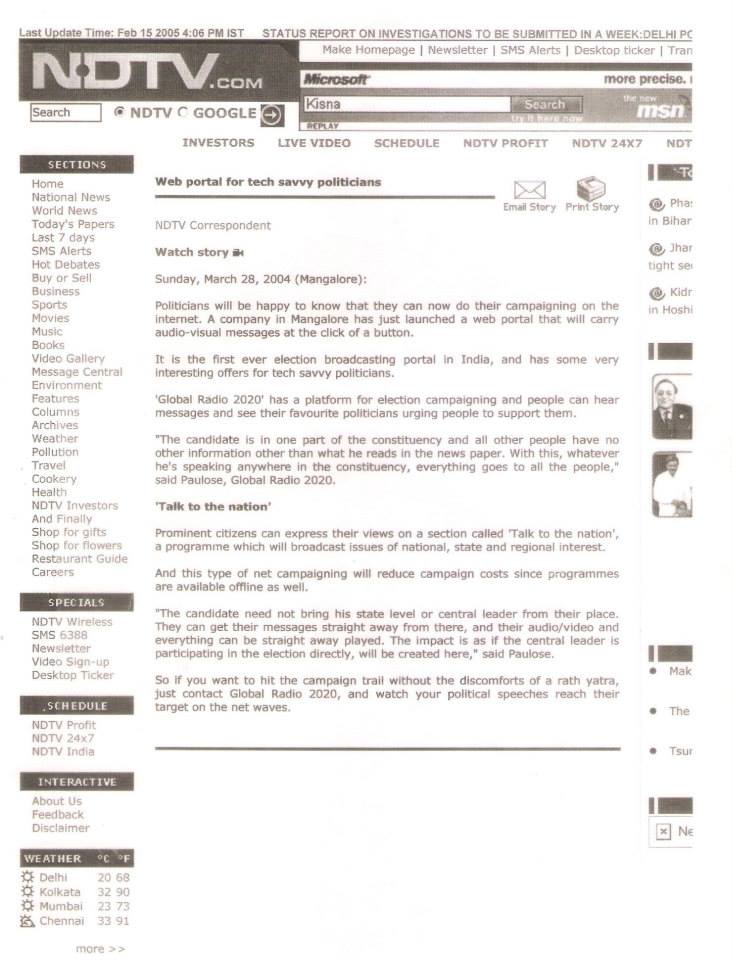
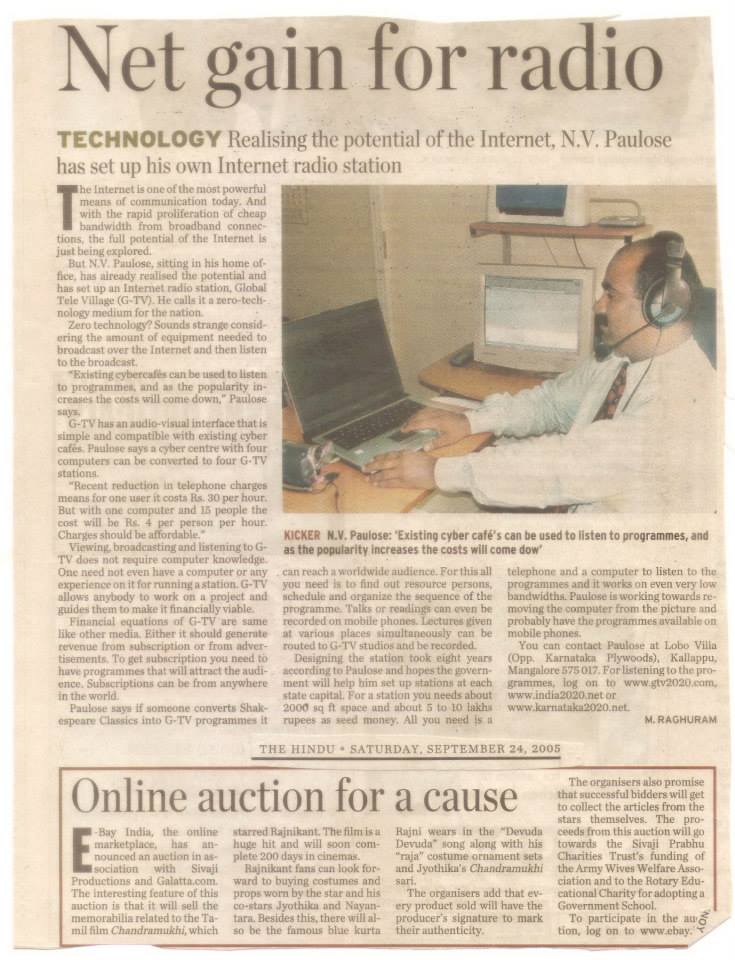
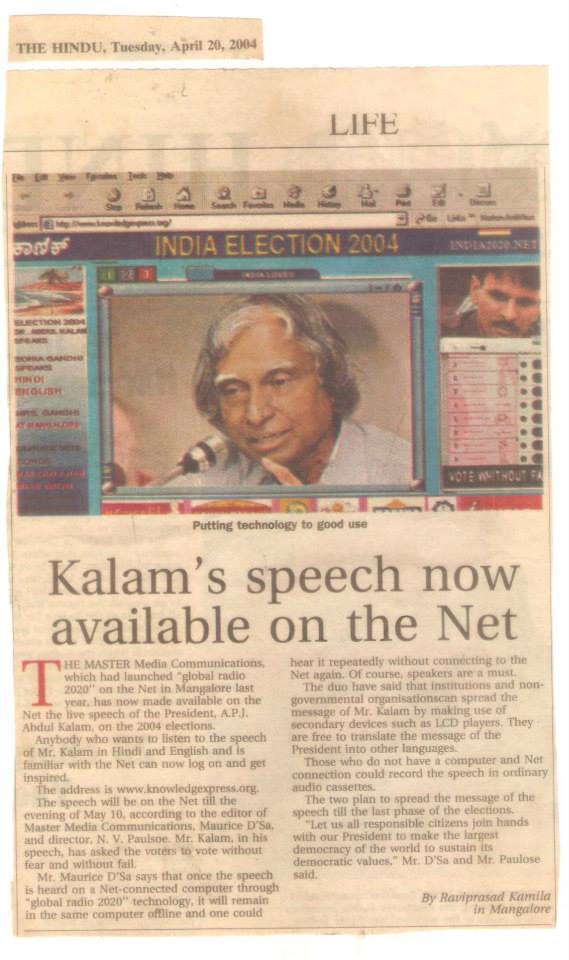
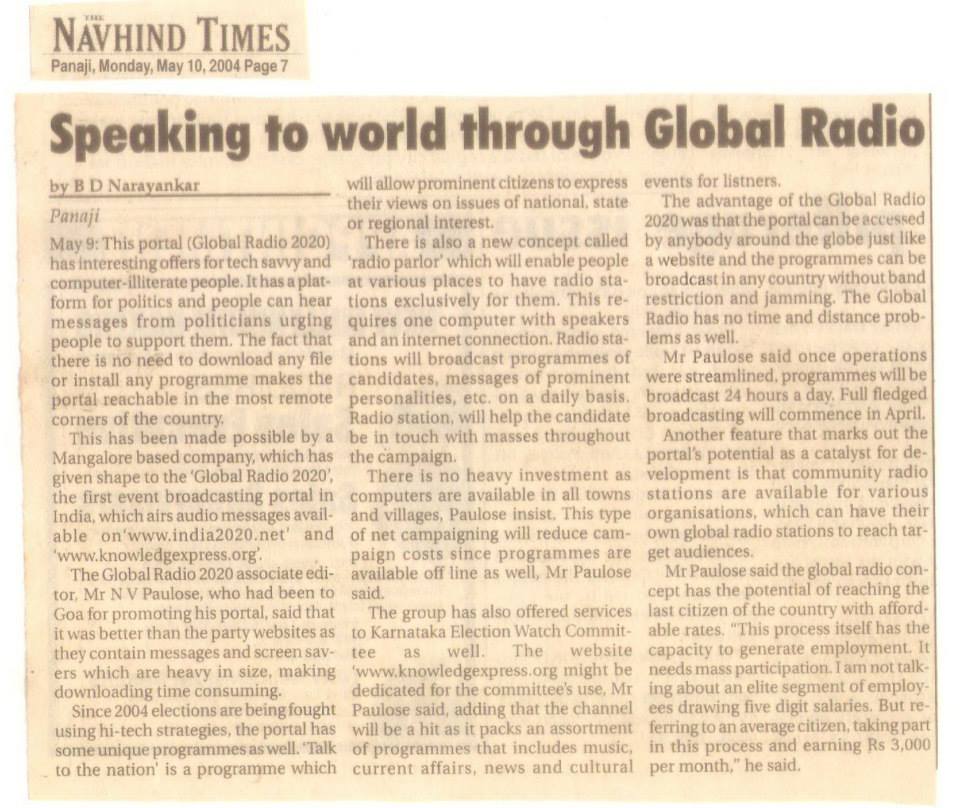
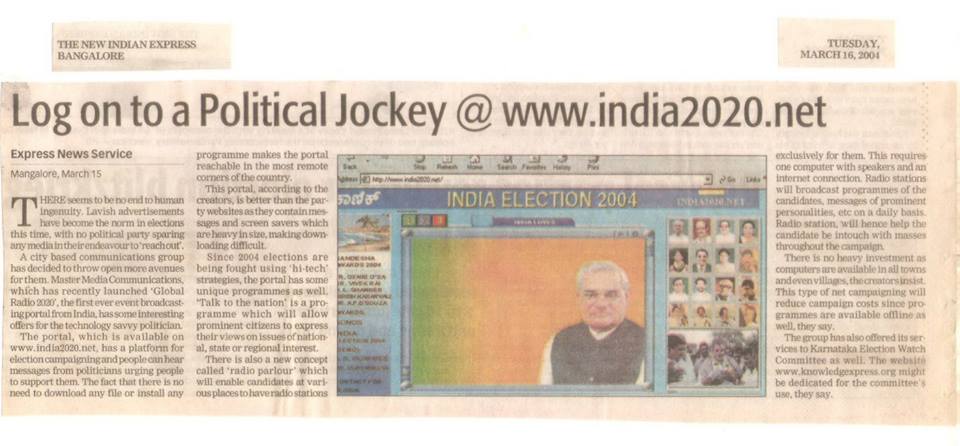
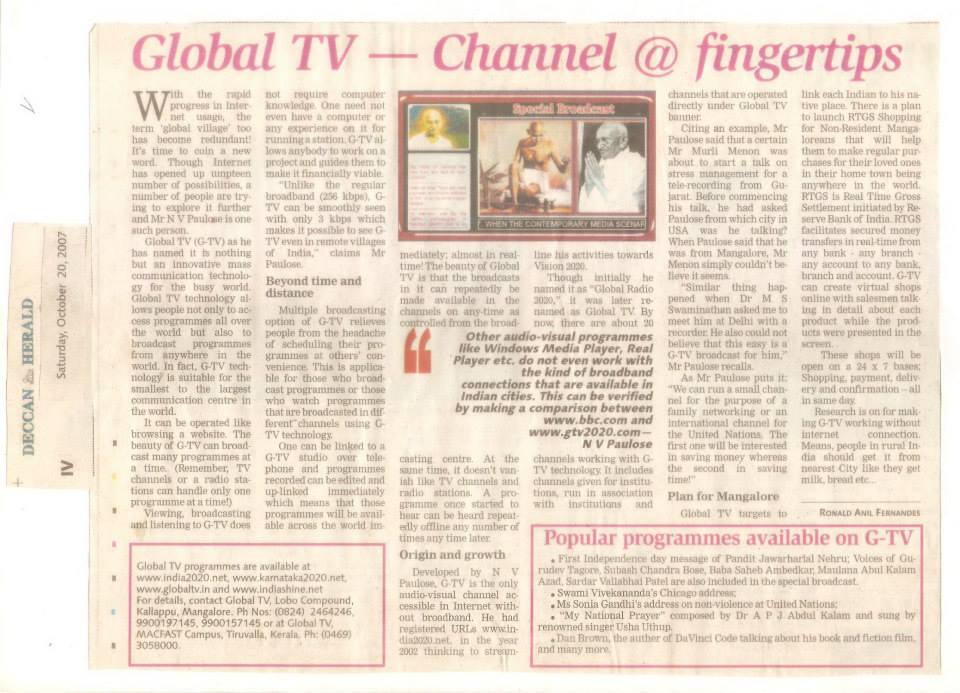
Several respected newspapers documented these efforts.
The Hindu reported experiments involving Internet television and the online dissemination of important public addresses, including speeches by Dr. A. P. J. Abdul Kalam. The Indian Express, Deccan Herald, Navhind Times, and NDTV carried reports describing Internet broadcasting, election information portals, community-based digital communication, and new ways of using emerging technologies to connect people.
At the time, these initiatives were viewed as interesting experiments. Today, they read like early glimpses of a future that had not yet arrived. History has a curious habit of making yesterday’s vision appear obvious only after it becomes reality.
Beyond Technology
Many people assume that innovation is primarily about technology.
- It is not.
- Technology is merely an instrument.
- Innovation begins with changing the way we understand a problem.
- The real question was never how to improve television.
- The question was whether television itself had been misunderstood.
For nearly a century, television was defined by its hardware. Cameras produced images. Broadcasting stations transmitted signals. Receivers displayed programmes. But perhaps television was never merely a broadcasting system. Perhaps it was always capable of becoming an interactive communication network.
This shift resembles the transformation of the telephone. A telephone is not valuable because it transmits sound. It is valuable because it enables human connection.
Similarly, the future of television was not about producing better broadcasts. It was about enabling richer communication.
This distinction changes everything.
- A broadcaster speaks.
- A communicator listens.
- A broadcaster informs.
- A communicator engages.
- A broadcaster creates spectators.
- A communicator creates participants.
The digital age has gradually confirmed this transformation. Today’s media ecosystem is no longer defined by one-way broadcasting. Viewers create content, respond instantly, participate in discussions, collaborate across continents, and influence public conversations in real time.
What once appeared visionary has quietly become everyday reality.
Recognition and the Courage to Trust Vision
History occasionally presents remarkable examples of societies recognizing creative potential before its value becomes universally accepted. One such example is Sam Pitroda. Rajiv Gandhi did not merely appreciate a technical proposal concerning telecommunications. He recognized an individual whose way of thinking could reshape India’s future. More importantly, he entrusted the originator with the opportunity to participate in implementing that vision.
This distinction deserves careful attention. Imagine an alternative history.
Suppose the proposal had been accepted but handed to someone else merely because that individual happened to be politically connected or administratively convenient.
Would the outcome have been identical? No one can answer with certainty. But history repeatedly suggests that ideas cannot always be separated from the minds that produced them.
Vision evolves continuously during implementation. The creator understands subtleties that rarely appear in written documents. Innovation is not a single moment of inspiration. It is an ongoing conversation between observation, experimentation, correction, and imagination.
Recognizing an idea is important. Recognizing the person capable of nurturing that idea may be even more important.
The Flower Is Not the Plant
There is a simple metaphor that captures this truth.
An idea is like a flowering plant. Everyone admires the flower. Some even pluck it. But the flower is not the plant. The flower is only the visible expression of a much deeper living system. Hidden beneath the surface are roots drawing nourishment from the earth. The stem continues to grow.
New buds continue to form. The plant possesses the capacity to produce countless flowers throughout its life. If someone plucks the flower and runs away, they possess beauty for a short while. Eventually the flower withers. What they never acquired was the living system that produced it. Ideas behave in precisely the same manner.
Organizations frequently believe they can separate an idea from its creator and expect the same creative process to continue elsewhere. Sometimes they obtain immediate results. Often they lose the far greater opportunity. They acquire one flower while abandoning the garden.
A Lesson from a Malayalam Proverb
Malayalam expresses this wisdom with remarkable simplicity.
“ഉപ്പോളം വരുമോ ഉപ്പിലിട്ടത്?”
Can something preserved in salt ever become equal to salt itself?
The proverb reminds us that something derived from an original source cannot automatically become identical to the source. This is not a criticism of those who implement ideas. Implementation is indispensable. But implementation without understanding is rarely equivalent to creation accompanied by continuous refinement. Societies sometimes assume that once an idea has been documented, anyone can reproduce its future. History suggests otherwise. The most valuable asset is often not the proposal. It is the creative intelligence that continues generating new possibilities long after the first proposal has been written.
The Illusion That Everything Can Be Bought
Modern civilization has become extraordinarily successful at assigning monetary value.
Land has a price. Technology has a price. Labour has a price. Even intellectual property can be purchased.
This success has encouraged an illusion: that creativity itself can also be bought.
- Money can finance innovation.
- Money can reward innovation.
- Money can accelerate innovation.
But money cannot manufacture originality. Original insight cannot be ordered like machinery. No budget has ever guaranteed imagination. No committee has ever voted an invention into existence.
The deepest source of creativity remains beyond financial calculation. This is why organizations that attempt merely to purchase ideas often discover that genuine innovation gradually disappears.
The visible products remain. The invisible source has quietly departed.
Why Ideas Return
History contains another remarkable pattern.
Ideas often reappear. Scientific principles are rediscovered. Mathematical truths emerge independently in different civilizations. Technological breakthroughs occur simultaneously in different countries. Philosophical insights return across generations.
This does not necessarily imply coincidence. It suggests that reality continually offers opportunities for discovery. When conditions become favourable, prepared minds perceive similar truths.
One individual may be ignored. Another may arrive. The pathway changes. The underlying possibility remains. Ideas possess an extraordinary power because they are rooted not merely in personal ambition but in the structure of reality itself.
The Intelligence Behind Civilization
This brings us back to the thought with which we began. There is a divine intelligence that governs the conduct of the universe, and we are all part of it. Whether one interprets this as the intelligence inherent in nature, the deep order of reality, or the unseen logic through which civilizations evolve, the essential insight remains unchanged.
- Human beings are not isolated creators.
- We are participants.
- We discover.
- We interpret.
- We contribute.
Every great innovation represents a dialogue between the human mind and the deeper order of existence. No individual owns truth. No institution owns wisdom. At best, we become temporary custodians of insights that pass through us. Some societies recognize those insights while they are still unfolding. Others notice only after history has already moved on.
A Responsibility for the Future
The greatest responsibility of any civilization is therefore not merely to celebrate success after it becomes obvious. Its responsibility is to recognize living sources of creativity while they are still quietly growing.
History does not reward societies simply because they possess resources. It rewards those that possess discernment. The future rarely announces itself with certainty. It first appears as an unusual idea in the mind of someone willing to imagine possibilities beyond conventional thinking.
If that person is ignored, the idea may disappear for a time. Or it may re-emerge elsewhere, through another individual, another institution, or another generation. Reality is patient. Human institutions are not always so.
The Way Ahead
The history of civilization is not merely the history of inventions.
- It is the history of recognition.
- Again and again, humanity has faced the same choice.
- Will we admire only the flower, or will we nurture the plant?
Will we collect ideas after they become fashionable, or will we recognize the minds capable of producing them?
The newspaper reports published two decades ago were not merely records of technological experiments. They documented an emerging philosophy: that communication technologies should empower participation rather than passive consumption; that television could evolve from a broadcasting medium into an interactive communication platform; and that digital networks could strengthen communities rather than simply distribute content.
Today, much of the world is moving in precisely that direction.
The lesson extends far beyond one individual or one innovation.
- Ideas cannot be reduced to commodities.
- They are living expressions of a deeper creative process.
- One may appropriate a proposal.
- One may imitate an invention.
- One may delay recognition.
- But one cannot permanently possess the source of creativity by taking only its visible expression.
- To pluck the flower is easy.
- To understand the plant requires wisdom.
And perhaps the true measure of a civilization is not how many flowers it gathers, but how carefully it learns to recognize, protect, and cultivate the gardens from which they bloom.


