
Retirement Is Not the End of a Career. It Is the Beginning of a More Meaningful One.
NV Paulose, Chairman, Global TV +91 98441 82044
Retirement is often perceived as the final chapter of professional life; a time to slow down, relinquish responsibilities, and enjoy the freedom earned through decades of hard work. Yet, for many individuals, retirement brings an unexpected question: What comes next? After years of following schedules, meeting targets, managing teams, and fulfilling professional obligations, the sudden freedom of retirement can feel both liberating and unsettling. The familiar structure of work disappears, but the desire to remain productive, relevant, and purposeful does not necessarily fade.
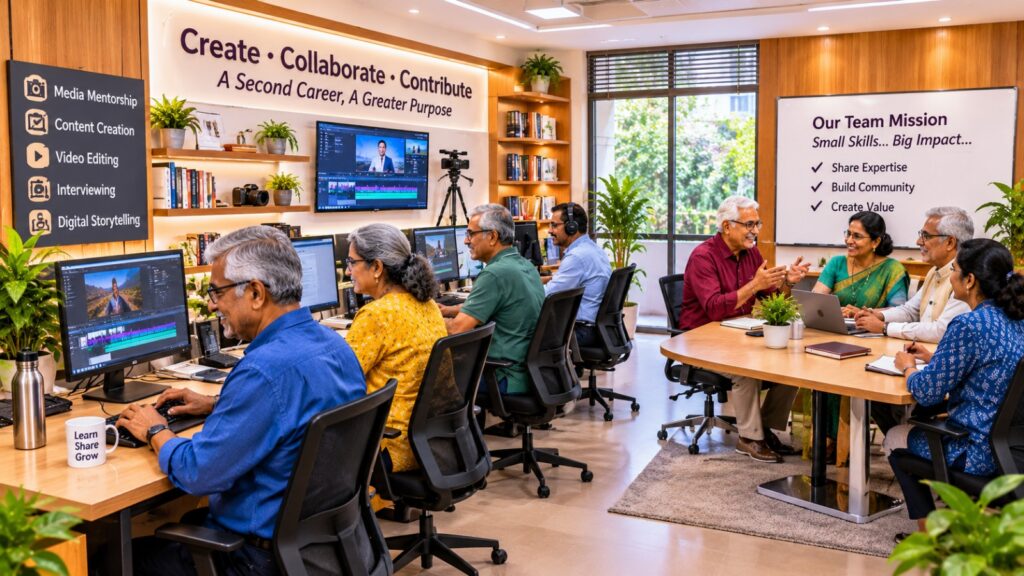
What if retirement were not a withdrawal from professional life but an opportunity to redesign it? What if the experience accumulated over decades could become the foundation of a new career driven not by necessity or status, but by passion, purpose, and personal fulfilment? The emerging idea of a post-retirement career is much more than continuing to work. It is about discovering an unexplored dimension of oneself and transforming that discovery into a sustainable, meaningful pursuit.
Beyond the Traditional Meaning of Retirement
For generations, retirement followed a predictable pattern: complete one’s professional responsibilities, receive retirement benefits, and transition into a quieter life. While this remains a desirable choice for many, changing lifestyles, longer life expectancy, technological advancements, and evolving social expectations are creating new possibilities.
Today, retirement can represent the beginning of a substantial new phase of life. Individuals may have several decades ahead of them, along with valuable professional experience, established networks, and a deeper understanding of their strengths. The challenge is not simply finding something to do. It is identifying something worth doing. A lasting post-retirement career should ideally combine three essential elements: personal interest, accumulated expertise, and a genuine need in the world around us. When these elements intersect, retirement can become an opportunity to create value in ways that were previously impossible.
Discovering the Passion That Was Left Behind
Many people spend their working years pursuing careers shaped by educational qualifications, financial responsibilities, family expectations, or organisational demands. Their personal interests often remain secondary. Retirement offers the rare opportunity to revisit those forgotten aspirations. Perhaps someone who spent thirty years in banking always wanted to teach young people financial literacy. A former engineer may have nurtured an interest in sustainable agriculture. A teacher might wish to explore writing, counselling, or community development. A corporate executive may discover a passion for mentoring entrepreneurs.
The first step towards a new career is therefore not searching for vacancies or business opportunities. It is looking inward. A useful starting point is to reflect on three questions:
- What activities have consistently brought me satisfaction, even when there was no financial reward?
- What skills have people repeatedly appreciated or sought my help with?
- What problems in my community or society would I genuinely enjoy helping to solve?
The answers may reveal a passion that has existed for years but never received sufficient attention. However, passion should not be confused with temporary enthusiasm. A lasting career requires sustained interest, patience, and a willingness to learn. Testing an interest through small projects, volunteering, or short-term assignments can help determine whether it has the potential to become a long-term pursuit.
A New Dimension: Turning Experience into Social Capital
One of the most overlooked advantages of retirement is the ability to convert professional experience into social capital. Social capital refers to the trust, relationships, knowledge, and collective resources that individuals develop throughout their lives. Unlike financial assets, these resources can grow through sharing and collaboration.
A retired professional may possess decades of institutional knowledge, practical problem-solving abilities, leadership experience, and valuable professional relationships. These qualities can become powerful assets in fields such as mentoring, consulting, education, social entrepreneurship, and community development. Consider a retired human resources professional who begins helping small businesses establish expansion drives. A former government officer might assist rural communities in understanding public welfare schemes. An experienced manufacturing specialist could mentor young entrepreneurs in improving operational efficiency.
Such pursuits create a distinctive advantage: they combine the wisdom of experience with the energy and innovation of younger generations. The new career is no longer merely an individual enterprise. It becomes a bridge between generations, institutions, and communities.
The Japanese Cottage-Industry Model: Master a Small Skill, Build a Team Career
A promising dimension of post-retirement careers lies in adopting the Japanese-inspired cottage-industry model, where individuals develop mastery in a specialised area and contribute their expertise to a larger collaborative enterprise. Instead of attempting to build a large business or compete for conventional employment, retirees can establish small, skill-based professional ventures that become valuable components of a wider network.
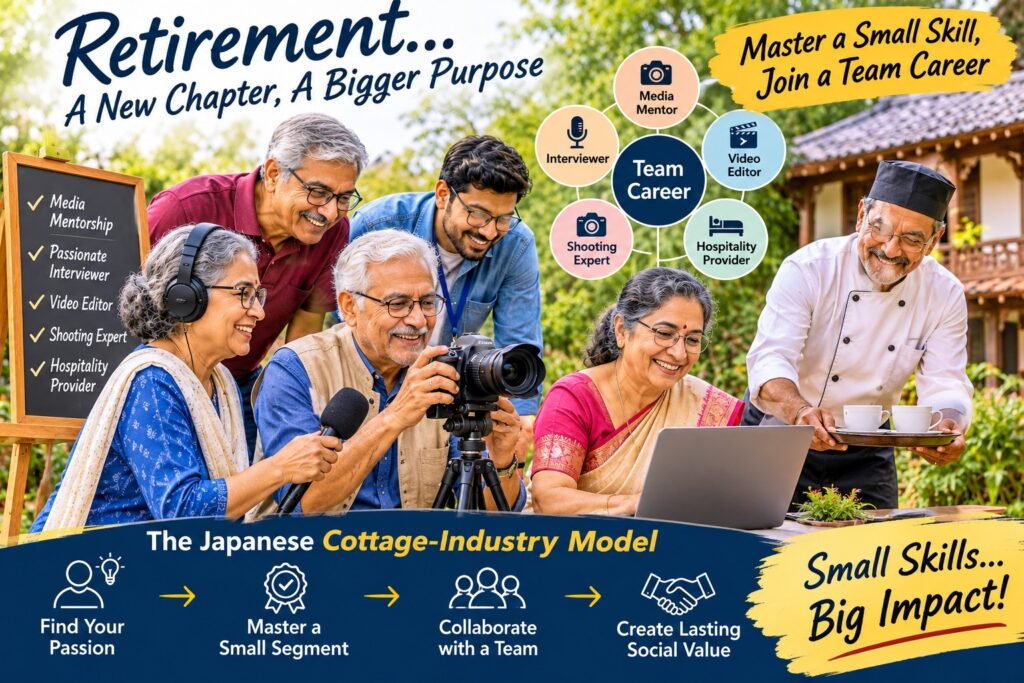
The central principle is simple: master a small segment, develop a distinctive identity, and join a team career. For instance, a retired professional with an interest in communication could become a media mentor, helping aspiring journalists, content creators, and young entrepreneurs develop their interviewing, presentation, and storytelling abilities. Someone with a natural curiosity about people and events could pursue a career as a passionate interviewer, conducting conversations with local achievers, entrepreneurs, artists, educators, and community leaders.
Similarly, an individual with an interest in visual storytelling could specialise in amateur video editing, transforming interviews, personal narratives, and community events into engaging digital content. A retiree with an eye for composition and an interest in technology could become a shooting expert, specialising in video recording, photography, lighting, or location-based content production.
Those who enjoy interacting with people and creating welcoming environments could explore hospitality-based careers, offering accommodation, local experiences, traditional cuisine, or cultural immersion to visitors. Such activities can evolve into small, independently operated enterprises that contribute to a larger tourism or community-based network.
The possibilities extend to podcast production, voice coaching, documentary assistance, event hosting, content research, digital archiving, and storytelling workshops. Each individual need not master every aspect of media production or hospitality. Instead, the emphasis is on developing excellence in one particular area.
From Individual Expertise to Team Career
The real strength of this model emerges when several specialised individuals collaborate.
A passionate interviewer may work with a video-shooting expert, who in turn collaborates with an amateur editor and a media mentor. Together, they can create interviews, documentaries, podcasts, educational programmes, or digital stories for organisations and communities.
Likewise, a hospitality provider can collaborate with local storytellers, photographers, cultural guides, and content creators to develop distinctive visitor experiences.
This creates a decentralised professional ecosystem in which each participant operates independently while contributing to collective projects. Individuals retain control over their schedules, work at a comfortable pace, and earn according to their contribution.
The model also encourages intergenerational collaboration. Retired professionals bring experience, credibility, patience, and interpersonal wisdom, while younger team members contribute technological fluency, contemporary creative practices, and access to emerging digital platforms.
Rather than competing with younger professionals, retirees become essential collaborators who strengthen the entire team.
Building a Cottage Industry Around Passion
The Japanese-inspired cottage-industry approach offers an alternative to the conventional idea that a successful second career must involve establishing a large enterprise.
A retiree can begin with a simple camera, a basic editing tool, a specialised knowledge area, or a welcoming home environment. Over time, consistent quality, professional relationships, and collaborative opportunities can transform a modest activity into a sustainable livelihood.
The objective is not to prove that one is still professionally active. It is to create a working life that reflects who one has become—while contributing a distinctive skill to a larger professional community. Retirement can therefore become the beginning of a team career: small in scale, specialised in expertise, flexible in commitment, and lasting in purpose.
From Passion to a Viable Career
Passion provides direction, but sustainability requires planning. A retirement career must be evaluated realistically, particularly when financial security, health, family commitments, and available time are important considerations. The transition can begin with a simple three-stage process.
Stage One: Explore and Experiment
Identify a potential field and undertake small, low-risk experiments. Attend workshops, volunteer, conduct informal interviews, or offer a limited service. The purpose is to understand the practical realities of the chosen activity before making a substantial commitment.
Stage Two: Build Credibility and Capability
Professional experience is valuable, but a new field may require updated knowledge or different methods of working. Digital literacy, communication skills, online collaboration, and contemporary industry practices can become important. Short courses, professional certifications, peer networks, and practical projects can help bridge the gap between past experience and present requirements.
Stage Three: Develop a Sustainable Model
Once the activity demonstrates genuine interest and demand, establish a clear working structure. This may include defining services, identifying potential clients, setting reasonable fees, developing partnerships, and creating a manageable schedule. A modest beginning is often more sustainable than a large investment driven by enthusiasm alone.
Technology: The Great Enabler of Second Careers
Technology has significantly expanded the possibilities available to retirees. Digital platforms enable individuals to teach, consult, publish, collaborate, and reach audiences beyond their immediate geographical surroundings. A retired professional can conduct online workshops, provide remote advisory services, publish specialist knowledge, or build a digital community around a particular interest.
Importantly, technology does not require individuals to abandon their experience or reinvent themselves completely. Instead, it provides new ways to communicate and apply what they already know. Learning to use digital tools should therefore be viewed as an investment in independence and opportunity. The ability to adapt to new technology can transform a locally limited passion into a wider professional pursuit.
Redefining Success in the Second Career
A meaningful second career should generate financial returns while providing considerable emotional, intellectual, and social benefits. For some, success means helping a young entrepreneur establish a business. For others, it means publishing a book, teaching a new generation, preserving traditional knowledge, or contributing to environmental conservation.
Financial sustainability remains important, especially for those who need additional income. However, the broader measure of success should include personal satisfaction, continued learning, meaningful relationships, and the positive impact created through one’s work. This is where the post-retirement career differs fundamentally from conventional employment. It allows individuals to define achievement according to their own values.
The Importance of a Supportive Ecosystem
Discovering and pursuing a passion need not be a solitary journey. Families can encourage retirees to explore new interests rather than assuming that retirement must mean complete withdrawal from professional activity. Communities can create opportunities for experienced individuals to share their knowledge. Educational institutions, businesses, and non-profit organisations can develop programmes that connect retired professionals with emerging needs.
A particularly promising model is intergenerational collaboration, in which experienced professionals work alongside younger individuals who bring technological fluency, contemporary perspectives, and entrepreneurial energy. Such partnerships can create mutual learning opportunities while strengthening the wider community. Retirement, in this sense, becomes not merely an individual transition but a valuable social resource.
Conclusion: Your Next Chapter Is Yours to Create
The most rewarding careers are not always those that begin with a carefully defined professional ambition. Sometimes, they emerge from curiosity, forgotten interests, meaningful relationships, and the desire to contribute. Retirement provides the freedom to explore these possibilities without being constrained by conventional expectations.
The journey from passion to a lasting career requires self-awareness, experimentation, continuous learning, practical planning, and the courage to begin again. It may not always be easy, but it offers something that conventional career progression often cannot: the opportunity to align work with personal meaning.
The real question, therefore, is not whether one should continue working after retirement. It is whether there is an unexplored passion, an untapped skill, or a meaningful contribution waiting to become the foundation of a new chapter. Retirement does not diminish the value of experience. It creates the opportunity to use that experience differently.


