
Navigating the Architecture of Joy | A Deep Exploration of desire, contentment, and human flourishing
NV Paulose. Chairman. Global TV +91 98441 82044
Human existence is defined by an enduring and restless pursuit. From the earliest moments of recorded history to the hyperconnected digital age, individuals across every culture have sought the elusive state known as happiness. Yet this pursuit is frequently marked by a profound paradox. People achieve professional milestones, accumulate material wealth, and indulge in sensory pleasures, only to find themselves standing at the summit of success with a lingering sense of emptiness. This fundamental human conundrum forms the bedrock of an upcoming and deeply thoughtful work titled The Power of Positive Pleasure: The Book of the Three Ps, authored by the Kerala based counselling psychologist Josi Pampadiyil Joseph. Scheduled for publication in July 2027 by O Books under Collective Ink, this anticipated volume invites readers to reexamine the very mechanics of desire, contentment, and human flourishing.
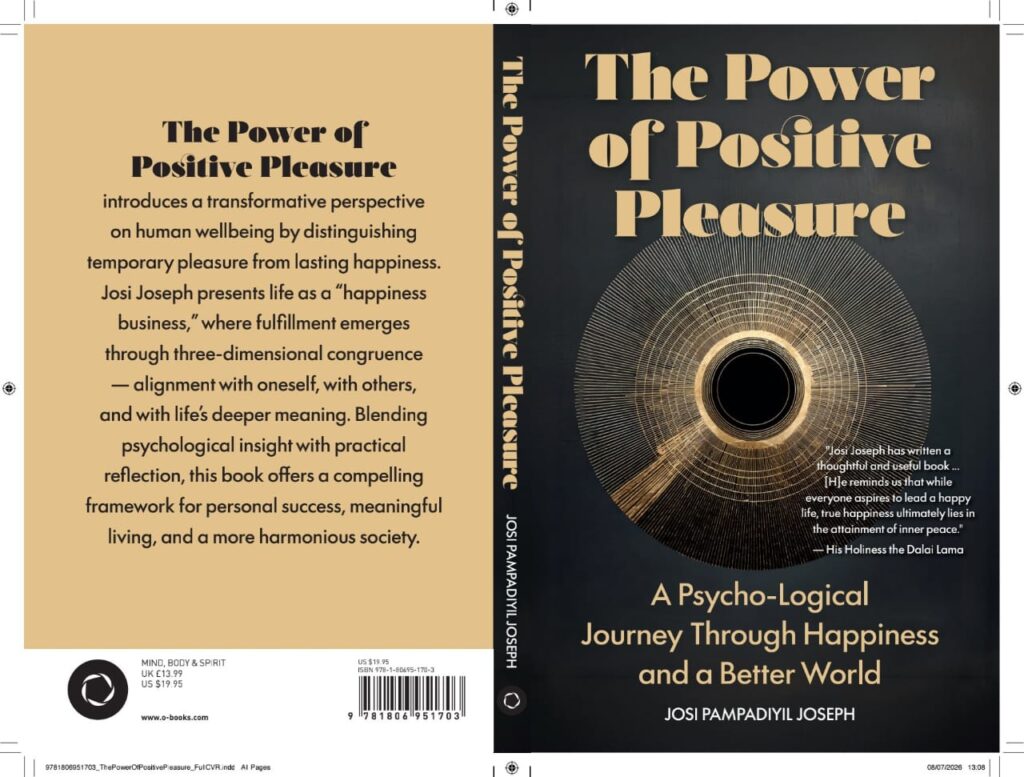
The endorsement by His Holiness the Dalai Lama provides a vital spiritual and philosophical anchor for the book, explicitly validating its core psychological premise. Featured prominently on the front cover, the Dalai Lama observes that Josi Joseph has written a thoughtful and useful book, reminding readers that while everyone aspires to lead a happy life, true happiness ultimately lies in the attainment of inner peace. This comment directly highlights the foundational distinction between fleeting external pleasures and the enduring stillness of the inner self. By placing inner peace at the center of the human quest, the endorsement affirms that psychological well being cannot be achieved through relentless external striving, but must instead begin with internal harmony and spiritual balance.
This philosophical perspective is further reinforced by the additional quote featured on the publisher’s official description page. The Dalai Lama expands on this theme by stating that when the mind is at peace, happiness becomes a constant companion, by day and by night. This poetic observation encapsulates the essence of the framework presented in the book. It suggests that a peaceful mind creates an unshakeable inner ecosystem that remains resilient regardless of outer circumstances or life changes. Together, these endorsements elevate the work from a practical self help guide to a profound, universally relevant reflection on the art of living well.

The relevance of such an inquiry in contemporary society cannot be overstated. Modern life bombards the human consciousness with endless streams of sensory gratification. Social media platforms, commercial advertising, and cultural narratives conspire to equate pleasure with ultimate fulfillment. People are conditioned to believe that purchasing the next luxury item, securing a higher social status, or experiencing a fleeting thrill will permanently cure the quiet desolation of the soul. However, the transient nature of these experiences leaves a vacuum. Sensory pleasure is inherently ephemeral, fading almost as quickly as it is consumed. Josi Joseph addresses this existential dilemma by confronting the limits of momentary gratification and directing attention toward a more durable and profound psychological state.
The Anatomy of the Happiness Business and the Threefold Harmony
At the conceptual heart of the forthcoming book lies a compelling metaphor. The author introduces the provocative idea of life as a happiness business, implying that personal fulfillment is not a matter of random chance or passive luck. Instead, achieving a state of enduring well being requires deliberate strategy, emotional investment, and active management across three distinct relational dimensions. This framework transforms the abstract concept of joy into an actionable blueprint for daily living, shifting the focus from external achievement to internal equilibrium.

The first dimension identified within the work focuses on the relationship with oneself. True psychological stability cannot be constructed on a foundation of self ignorance or internal conflict. Modern individuals often become strangers to their own internal landscapes, driven by repressed emotions, unexamined anxieties, and unrealistic societal expectations. The framework proposed by Josi Joseph emphasizes the necessity of radical self understanding, genuine self acceptance, and deep internal balance. When a person makes peace with their own vulnerabilities and recognizes their intrinsic worth, the desperate dependency on external validation begins to dissolve. Inner peace becomes the anchor that stabilizes the individual against the turbulent winds of circumstance.
The second dimension expands outward to encompass the relationship with others. Human beings are fundamentally social creatures, wired for connection, empathy, and community. Yet contemporary civilization frequently fosters isolation masked as connectivity, leading to widespread loneliness and superficial interactions. The author argues that sustainable happiness is impossible in an interpersonal vacuum. By cultivating positive, meaningful, and harmonious human relationships, individuals build a supportive ecosystem that nurtures emotional resilience. Authentic connection involves moving beyond transactional associations into spaces of genuine vulnerability, mutual respect, and shared purpose.
The third and final dimension elevates the perspective to the relationship with life itself. This sphere addresses the existential hunger that plagues modern humanity. People can possess peace of mind and loving companions, yet still feel adrift if their existence lacks a coherent trajectory. Finding deep purpose, anchoring values, and discovering meaning in the broader fabric of existence allows individuals to transcend ordinary daily struggles. This tier connects the personal journey to a universal canvas, suggesting that true fulfillment emerges when an individual realizes they are part of something much larger than themselves. Through this three dimensional alignment, the work establishes a comprehensive roadmap for personal success, relational harmony, and societal well being.
Bridging Psychological Complexity and Human Clarity
To fully appreciate the intellectual depth of The Power of Positive Pleasure, one must examine the broader intellectual trajectory of its creator. Josi Joseph brings the seasoned perspective of a professional counselling psychologist to the page, combining clinical insight with philosophical reflection. His academic and professional explorations consistently seek to demystify human behavior, translating complex emotional patterns into accessible frameworks for everyday transformation. This commitment to clarity is visibly reflected in his recent scholarly contributions, including his 2026 academic article titled From Psychological Complexity to Human Clarity, which advocates for understanding human action through the twin lenses of positive orientation and logical thinking.
The integration of psychological rigor with practical wisdom is what distinguishes this forthcoming volume from conventional self help literature. Many popular books on happiness rely on vague motivational platitudes that offer temporary emotional highs but fail to provide lasting structural change. In contrast, the methodology championed by Josi Joseph is rooted in a disciplined approach to the human mind. By encouraging individuals to examine their cognitive patterns, confront emotional blockages, and adopt a constructive outlook, the work bridges the gap between clinical theory and lived experience. It respects the intelligence of the reader, offering tools that can be implemented systematically in personal and professional spheres.
Furthermore, the philosophical resonance of the work is underscored by notable endorsements. The publisher features a powerful reflection attributed to the Dalai Lama, which emphasizes that while everyone aspires to lead a happy life, ultimate fulfillment relies upon the cultivation of inner peace. This alignment with universal spiritual and philosophical traditions reinforces the core thesis of the book. It demonstrates that the pursuit of positive pleasure is not merely a modern therapeutic indulgence, but rather the continuation of an ancient human quest to harmonize the internal spirit with the external world.
Redefining Success and Cultivating a Better World
As society looks toward the future, the frameworks presented in The Power of Positive Pleasure offer a timely antidote to the anxieties of the twenty first century. The relentless pressure to produce, consume, and succeed has generated an epidemic of burnout, stress, and existential fatigue. By reframing pleasure as a positive force that must be integrated with self awareness, relational depth, and existential purpose, the author challenges prevailing cultural norms. He suggests that true success is measured not by the accumulation of accolades or material goods, but by the quality of one’s consciousness and the depth of one’s contributions to the human community.
This vision extends far beyond individual transformation, holding profound implications for collective and societal harmony. When individuals achieve internal balance, they naturally project patience and empathy into their families, workplaces, and neighborhoods. The ripples of personal self awareness expand outward, fostering communities built on cooperation rather than competition, and understanding rather than conflict. The book ultimately posits that healing the world begins with healing the individual psyche, making a compelling case for a gentler, more mindful approach to human civilization.
In conclusion, The Power of Positive Pleasure stands as a major upcoming contribution to the literature of personal growth and psychological well being. Through its insightful exploration of the three dimensions of fulfillment, its grounding in practical philosophy, and its visionary call for a more harmonious society, Josi Joseph has crafted a work of enduring significance. As readers await its publication in July 2027, the announced concepts already serve as a powerful reminder that happiness is not a prize to be won through relentless striving, but a state of grace to be cultivated through inner peace, meaningful connections, and a profound alignment with the purpose of life.


