
SOUTH INDIAN DIARY WITH ROTARIAN LAL GOEL | GLOBAL TV
From a 3 AM Alarm to the Airwaves of Chennai
A day of flights, friendship, nursing students, technology, Tamil, and organ donation
31st July — 3:00 AM
Some journeys begin with excitement. Some begin with a cup of coffee. And some begin with the most unwelcome sound in the world—the alarm ringing at 3:00 AM!
For me, 31st July began exactly that way.
The alarm went off at three in the morning, reminding me that I had very little time to waste. Within minutes, I was out of bed and into my morning routine. By 4:30 AM, I was ready and sitting in an Uber heading towards Terminal 2 of Mumbai Airport.
My destination was Chennai.
My mission was, as always, organ donation awareness.
My flight was scheduled for 6:30 AM, and the first programme of the day was waiting for me in Chennai. So there was little room for delays, detours or the luxury of a leisurely morning.
But airports have their own way of adding surprises to even the busiest schedules.
A Pleasant Surprise at the Check-in Counter
While standing at the Air India check-in counter, I suddenly remembered an old acquaintance whom I had known for almost 20 years—Ms Krithi.
Krithi had been associated with Jet Airways during its days of glory. She had now moved to Air India.
I was thinking about her when, almost magically, there she was!
And as always, she greeted me with her ever-smiling face.
It is amazing how sometimes a two-minute conversation can do what a strong cup of coffee cannot.
We exchanged a few words, recalled old times and smiled at the coincidence. Those two minutes somehow made me feel completely fresh and ready for the long day ahead.
I proceeded to the Air India Business Lounge, where I quickly had a black coffee before boarding.
The coffee was good.
But the unexpected meeting with Krithi was probably the real morning energiser!
And Then… a 40-Minute Delay
Once comfortably seated on the aircraft, I thought I could relax.
But flights, like life, don’t always follow our schedules.
The Air India flight was delayed by about 40 minutes because of the late arrival of international connecting passengers.
For someone who had a packed schedule ahead, forty minutes can feel like forty hours.
Fortunately, the delay did not completely disrupt the day’s plans.
When we finally landed at Chennai, the delay had effectively come down to around 30 minutes, and I was still confident that we would reach the first programme on time.
And waiting for us at Chennai Airport was someone who has become an important part of my Chennai journeys.
The Regal President Arrives
As always, Regal President Rtn Hemalatha Bhandari was there inside the terminal to receive us.
Something is reassuring about seeing a familiar face in an unfamiliar airport.
The moment we arrived, the porter took care of my luggage, and we walked out of the terminal.
Two Rotarians were waiting for us.
One was from our own Rotary Club of Organ Donation International and Principal Aide to President Rtn J H Martin.
The other was Rtn Biju Narayan from the Rotary Club of Chennai Sagar.
After my traditional welcome, there was hardly any time for formalities.
The Chennai clock was ticking.
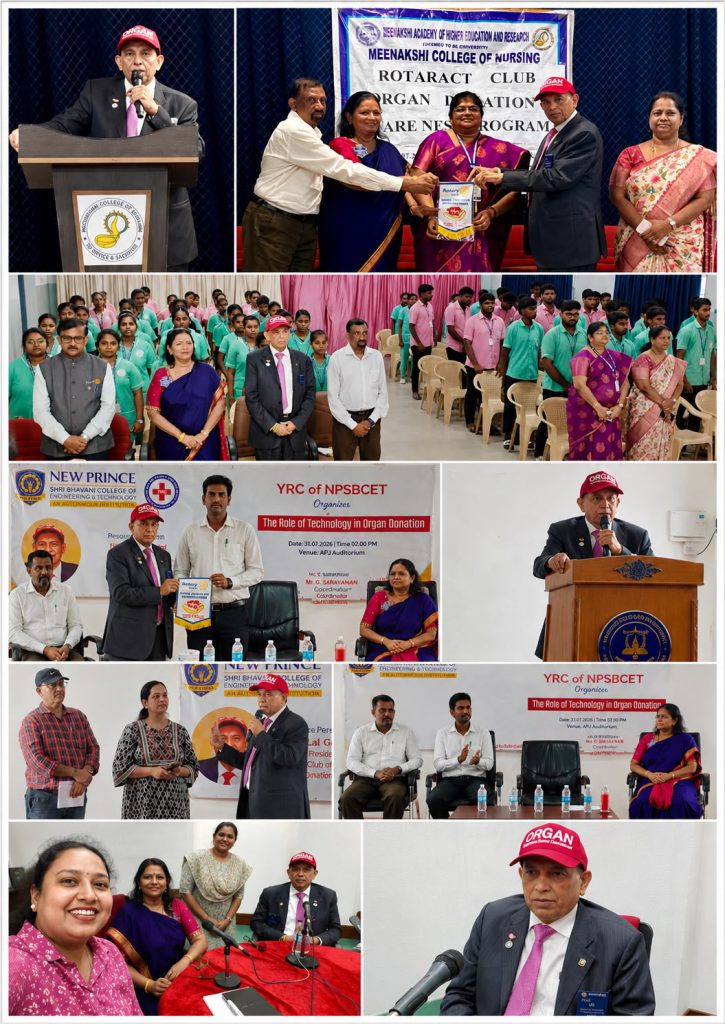
Our first destination was Meenakshi College of Nursing at Chikkarayapuram.
And the subject waiting for me there was one very close to my heart:
“THE ROLE OF NURSES IN ORGAN DONATION”
The programme was organised by the Rotary Club of Chennai Golden Galaxy in association with the Rotary Club of Organ Donation International.
When Nurses Become Organ Donation Warriors
The hall was filled with nursing students and faculty members.
Among those present were Dr Fabiola M. Dhanaraj, Principal, Dr B. Jayabharathi, Vice-Principal, and Rtn Jegannath Nambi, President, Rotary Club of Chennai Golden Galaxy, along with many others.
Looking at the young nursing students, I was reminded once again why awareness programmes are so important.
Doctors may diagnose and treat
Surgeons may perform complex procedures.
But nurses are often the professionals who remain closest to patients and families during the most difficult moments of their lives.
And when it comes to organ donation, that human connection can make all the difference.
I spoke for nearly one and a half hours.
But it wasn’t a one-way lecture.
It became a conversation.
The students asked questions. I answered them. They raised doubts about organ donation, brain death, consent, the role of families and the responsibilities of healthcare professionals.
The more questions they asked, the more convinced I became that India’s young nursing professionals could become a powerful force in creating organ donation awareness.
Before my talk, Regal President Rtn Hemalatha Bhandari introduced me.
But she did something that immediately changed the atmosphere.
She spoke in Tamil.
The students applauded enthusiastically.
I looked at her and thought to myself:
“Perhaps I should finally learn Tamil!”
After all, if I want to be part of such wonderful conversations, knowing the local language would certainly help.
The programme ended on a very positive note, but there was no time to linger.
Another programme was waiting.
One Hour on the Road—and Another Full Hall
From Meenakshi College of Nursing, we had approximately one hour of driving before reaching our next destination:
New Prince Shri Bhavani College of Engineering & Technology at Gowrivakkam.
By the time we arrived, Dr T. Saravanan, Principal, was eagerly waiting to receive us.
After a welcome round of fresh juice—which was particularly refreshing after the morning’s hectic schedule—we entered a large hall.
Once again, students and faculty members filled the venue.
But this time, my topic was different:
“THE ROLE OF TECHNOLOGY IN ORGAN DONATION”
The audience was largely young and technically inclined.
And that made the interaction especially interesting.
Technology is changing almost every aspect of our lives.
It is transforming healthcare.
It is improving diagnosis.
It is making communication instantaneous.
And it has enormous potential in organ donation as well—from donor registration and awareness campaigns to data management, matching, transportation, communication and coordination.
But what impressed me most was the curiosity of the students.
They had questions.
Lots of them!
And once again, I realised that awareness is not about standing on a stage and delivering a speech.
Here comes our member from Chandigarh, a Liver Donor, Rtn Roopa Arora and her husband the Liver recipient Rtn P K Ratan. I called them on stage and asked questions about their experiences with liver Transplantation. Their narrative gave credibility to what I was explaining.
It is about creating a space where people feel comfortable asking questions.
The programme was proceeding beautifully.
Perhaps a little too beautifully for our schedule!
Because there was another important appointment waiting for us.
“Sir, Please Wind Up!”
Our Regal President suddenly transformed from a gracious host into a strict headmaster!
She reminded me that we had to leave early because our next destination was All India Radio, Chennai, and we had to reach there on time.
I knew better than to argue with the headmaster!
After the customary exchange of mementoes, we quickly said our goodbyes and got back into the car.
Another long drive lay ahead.
From College Halls to the Airwaves
The destination was All India Radio, Chennai.
And here, our Regal President had a special advantage.
She had been a regular part-time news reader at All India Radio, Chennai.
That explained why, the moment we entered, it felt as though we had arrived at the home of an old friend.
From the peon to the Director, almost everyone seemed to know her.
We were treated like VVIPs!
There was no waiting around.
We were quickly escorted to the recording room.
And there she was:
RJ Kaviya Sanjeevi.
I soon discovered that Kaviya was not someone who would allow a guest to simply speak in generalities.
She was sharp.
Knowledgeable.
Focused.
And very much to the point.
In other words, she was ready to grill me!
We recorded two episodes, discussing organ donation and the need to create greater awareness among the public.
The interaction was extremely interesting.
After the recording, Kaviya revealed another fascinating part of her professional journey.
She was essentially a journalist, having earlier worked with both The Times of India and The Indian Express.
That explained her questioning style!
She knew exactly what to ask, how to ask it and, more importantly, when an answer needed to be clarified.
Behind the microphone, meanwhile, every detail was being carefully watched.
The recording engineer, Er T. E. Vimala, was extremely particular about the minutest details.
Sound quality.
Timing.
Clarity.
Every little thing mattered.
And when the final recording was completed, I realised that organ donation awareness had once again travelled through another medium—from a college classroom to the radio waves of Chennai.
Back to the Toyota Cresta
With the recording completed, we took leave of the wonderful All India Radio team.
And once again, we were back in the luxurious Toyota Cresta of our Regal President.
By now, the car had almost become our mobile office, meeting room, resting place and transport headquarters—all rolled into one!
Hemalatha dropped me at my hotel.
But there was no thought of a relaxed Chennai evening.
The next morning was already planned.
We had to leave at 4:15 AM for Puducherry.
And waiting there would be not one, not two, but three organ donation programmes lined up back-to-back.
Another day.
Another journey.
Another set of audiences.
Another opportunity to spread the message that organ donation is not merely a medical subject.
It is a human responsibility.
A Very Early Night
After the day’s hectic schedule, I finally reached my room.
A good, relaxing bath felt like a reward.
Then came an early dinner.
And at around 10:00 PM, I was in bed.
For me, that was unusually early—almost two hours earlier than my normal bedtime.
But the body had earned its rest.
The alarm would ring again soon.
The journey would continue.
And the message would continue.
Because when the cause is bigger than the individual, tiredness becomes secondary.
One Day. Three Venues. Hundreds of Young Minds. One Message.
As I looked back on the day before falling asleep, I realised how much had happened in just a few hours.
A 3 AM alarm.
A 4:30 AM Uber ride.
A flight from Mumbai to Chennai.
A chance meeting with an old friend from the Jet Airways days.
A quick black coffee.
A delayed flight.
A warm welcome at Chennai Airport.
A nursing college.
One and a half hours of questions and answers.
A President speaking Tamil and winning applause.
A second college.
Technology and organ donation.
Another enthusiastic group of students.
A strict reminder to wind up!
A long drive.
All India Radio.
Two recorded episodes.
An inquisitive journalist-turned-RJ.
A meticulous recording engineer.
And finally, a comfortable hotel room for a few precious hours of sleep.
Yet, behind all these events was one common thread:
ORGAN DONATION.
Every student who asked a question had taken one step closer to understanding the subject.
Every faculty member who listened could carry the message forward.
Every nurse who becomes aware can influence patients and families.
Every engineering student who understands the role of technology can potentially contribute new ideas.
Every radio listener who hears the message may discuss it with a family member.
And perhaps, someday, one of those conversations may help save a life.
That is why I continue to travel.
That is why I wake up at 3 AM.
That is why a delayed flight, a long road journey, endless meetings and very little sleep do not discourage me.
Because somewhere, in some hospital, a family is waiting.
A patient is waiting.
And another human being may have the power to give them a second chance at life.
One organ donor can save multiple lives.
But before someone becomes an organ donor, someone has to create awareness.
Someone has to start the conversation.
Someone has to remove the myths.
Someone has to explain brain death.
Someone has to tell a family that donation is not about death—it is about giving life another chance.
And that someone could be you.
So, as this first chapter of my South Indian Diary comes to an end, I leave you with a simple request:
Please take care of your health.
But more importantly,
please take care of your organs.
They may one day become the greatest gift you can give to another human being.
The journey to Puducherry was only a few hours away.
And the diary was far from over.
South Indian Diary with Rotarian Lal Goel will continue in the next issue.
Until then—
Stay healthy.
Take care of your organs.
Talk to your family about organ donation.
And consider becoming an organ donor.
Because sometimes, the greatest journey of an organ begins when its owner’s journey comes to an end.


