
The Mentor Within: Helping People Discover the Strength They Already Carry
- The journey of a mentor who helps people discover their hidden potential and turn challenges into possibilities. The Mentor Who Helps You See What You Can Become
NV Paulose, Chairman, Global TV +91 98441 82044
What if the greatest obstacle in a person’s life is not a lack of ability, but the inability to recognize the ability that is already within? It is an idea that runs quietly through the life and work of Dr. Kusum Thantry D’Sa. Again and again, she has found herself entering unfamiliar territory, taking on responsibilities she did not initially believe she was equipped for, and discovering often only after the event that she possessed abilities she had never consciously recognized. Today, that experience has become central to the way she works with people. For Dr. Kusum, mentorship is not about giving people ready-made answers. It is about helping them understand themselves, question what is holding them back, and discover possibilities they may have overlooked. In many ways, she learnt this philosophy by living it herself.
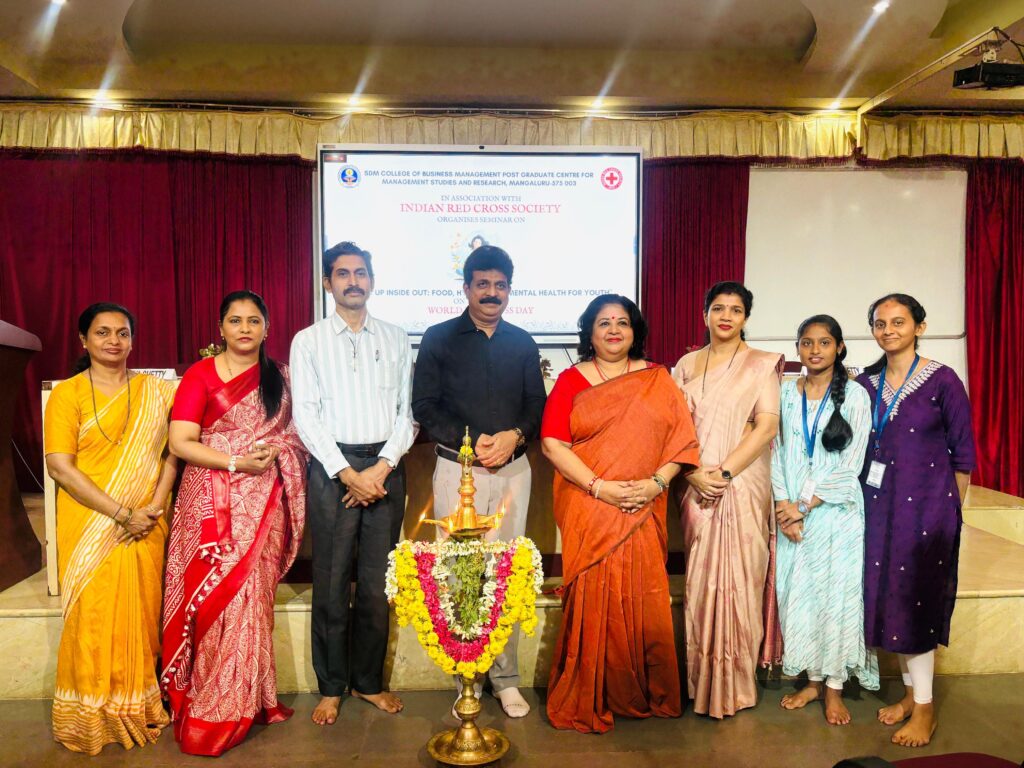
The ability she did not know she possessed
One of the stories from her professional life illustrates this beautifully. She was once asked to interview engineering candidates, although engineering was not her specialist field. Her natural response was not to claim expertise she did not have. Instead, she prepared. She developed a set of questions based on her experience of questioning and evaluating students, had the technical aspects reviewed by someone qualified, and conducted the interviews. She was subsequently asked to interview shortlisted candidates again. What surprised her was not that she had been able to do the job. It was that she had never known she was particularly good at evaluating people. She had simply accepted the responsibility and done what was required. That experience reveals something important about her philosophy: competence is sometimes discovered through action, rather than confidence.
We often wait to feel capable before attempting something. Her life suggests the opposite can also be true. Sometimes we have to attempt something first in order to discover what we are capable of. It is an idea that has repeatedly played out in her own journey, from education and institutional leadership to counselling and personal development.
Questioning the rule behind the rule
Another defining characteristic of Dr. Kusum’s personality is her willingness to question conventions. But she does not describe herself as someone who simply rejects rules. Her deeper concern is with rules that are followed without understanding their purpose. One experience from her early professional life involved the expectation that women should wear sarees in the workplace. Rather than simply accepting it as an unquestionable norm, she checked the relevant regulations. She discovered that what had been treated as a rule was, in fact, more of an unwritten convention.
That distinction stayed with her. For Dr. Kusum, the important question is not merely, “What does the rule say?” It is: “Why does the rule exist, and is following it actually serving the person?” That philosophy later appeared in other areas of her life, including education, where she encountered situations in which rigid application of a regulation could deny a child an opportunity. Her instinct was to look for the purpose behind the system. This is an important quality in a mentor. A mentor does not merely teach people to obey or disobey. A mentor teaches them to think.
When difficulty becomes a teacher
Dr. Kusum’s life has not followed a straight or predictable path. There have been professional disruptions, changes in institutions, family responsibilities, unexpected transitions, and periods when carefully made plans did not unfold as expected. She interprets many of these experiences through a spiritual understanding of karma and the lessons of the soul. That is her personal worldview. But beneath the spiritual explanation lies a remarkably practical principle. When asked what difficulties ultimately do to a person, her answer is essentially: “I will become better.”
That may be one of the most useful lessons in her story. She does not present adversity simply as something to escape. Difficulty can also become training. A person who has faced uncertainty may become more adaptable. Someone who has experienced disappointment may become stronger. Someone who has had to rebuild may become better equipped to help another person rebuild. In that sense, her own difficulties became part of her education. A transformational mentor does not necessarily make life easier for someone. Sometimes, the mentor helps the person become strong enough to meet life differently.
Dr. Kusum is a mentor who believes that life itself is a continuous learning process. Her message is simple yet powerful: difficulties should not become reasons to stop; they should become opportunities to understand, learn, and grow. Through her talks and interactions, she encourages people to look beyond immediate setbacks, question what they do not understand, and develop the willingness to keep learning. In a world where knowledge is increasingly accessible, she believes that people have an unprecedented opportunity to learn, explore new ideas, and consciously shape their lives.
What makes Dr. Kusum’s approach distinctive is her emphasis on practical self-development. She encourages people to observe their own thoughts, understand their difficulties, use practices such as meditation and visualization where appropriate, and develop habits that strengthen their ability to deal with life’s challenges. Rather than presenting herself simply as someone who has all the answers, she encourages people to become active participants in their own growth. Her larger message is one of resilience and possibility: when we learn to understand our difficulties instead of being defeated by them, every challenge can become a stepping stone toward a better version of ourselves. Life is very precious.
The counsellor existed before the title
Perhaps the most revealing part of Dr. Kusum’s journey is that counselling seems to have found her before she formally chose it. People would come to her, sit with her and talk about their personal problems. For a long time, she did not necessarily interpret this as evidence of a particular vocation. It was simply something that happened. Eventually she recognized the pattern. People trusted her enough to tell her things. She listened. She asked questions. She tried to understand what lay beneath the immediate problem.
Later, she formally trained in counselling, including practical work and a substantial number of counselling cases. The training gave structure and discipline to an ability that had already been visible in her life. This distinction matters. Her formal education did not manufacture her interest in people. Rather, it helped her understand and develop something that people had already been coming to her for. In that sense, the profession came after the calling.
Learning how different people need different maps
Her journey did not stop with conventional counselling. Over the years, she explored psychology, spirituality, numerology, astrology, family constellation work and other approaches to understanding human behaviour and experience. Some of these approaches are established psychological practices; others belong to spiritual or metaphysical traditions and remain matters of belief rather than scientifically established mechanisms. Dr. Kusum herself sees them as different ways of understanding a person’s experience. Her approach begins with the individual.
She first tries to understand the person’s psychological and emotional situation. She asks about their beliefs and spiritual background. She then chooses ways of working that she believes the person can understand and engage with. This is perhaps one of the most distinctive aspects of her mentoring philosophy. She does not believe every person needs the same map.
For one person, psychology may provide the language to understand what is happening. For another, faith may provide meaning. For someone else, family relationships may be the key to understanding a recurring pattern. Her role, as she sees it, is to help the person find a framework through which they can begin to make sense of their experience and then take practical steps forward.
From answers to awareness | The unfinished business of life
This is also why the idea of transformation is important. A mentor who simply gives answers can make a person dependent. A mentor who increases awareness can make a person more capable. Dr. Kusum’s stories repeatedly point toward the second model. She encourages people to observe what happens when they try a particular change. She gives them practical steps. She asks them to return and reflect. Over time, she believes, people can develop greater clarity and confidence in their own ability to navigate their lives. The objective is not simply to tell someone what their future will be. It is to help them become more conscious of the choices available to them.
Some of the most moving experiences she describes involve people approaching the end of life. In her counselling work, she has encountered situations involving regret, unresolved relationships, lack of forgiveness and unfinished emotional business. Her focus in such situations is on reducing suffering that may still be within a person’s control: saying what needs to be said, forgiving where possible, resolving relationships, releasing regret and finding peace.
She interprets some of these experiences through her spiritual worldview. Whether one shares that worldview or not, the underlying human lesson is difficult to dismiss: There are things people carry for years that they may never have needed to carry alone. Sometimes transformation does not mean achieving something spectacular. Sometimes it means making peace with something that has been hurting us for decades.
The Hanuman metaphor
There is a particularly powerful metaphor in Dr. Kusum’s thinking: Hanuman. In the traditional story, Hanuman possesses enormous strength but does not fully recognize his own power. It takes another person to remind him of what he is capable of. That metaphor seems to capture something essential about mentorship. Perhaps the finest mentors do not put strength into people. They help people discover the strength that was already there.
The student who thinks she is incapable may need someone to recognize her ability. The professional who has failed may need someone to help him see what the failure has taught him. The person trapped by circumstances may need someone to ask a different question. The individual who has spent years following expectations may need permission to ask, “Is this really the life I want?” And sometimes the person simply needs somebody to say: “Look again. You may be capable of much more than you think.”
A mentor shaped by her own journey
This may ultimately be the most interesting way to understand Dr. Kusum. Her story is not simply a progression from one qualification to another or from one position to another. It is a journey from following systems to questioning systems; from discovering her own abilities to helping others discover theirs; from listening informally to counselling professionally; and from searching for answers to helping people search for meaning. She has repeatedly entered unfamiliar territory and learned by doing.
That experience appears to have shaped the way she now approaches other people’s lives. She knows what it is like not to have all the answers. She knows what it is like to be pushed into circumstances she did not choose. She knows what it is like to discover an ability only after someone else gives her the opportunity to use it. Perhaps that is why her strongest contribution as a mentor may not be any particular technique. It is the ability to make another person pause and reconsider the story they have been telling themselves. Because transformation often begins at precisely that moment.
Not when someone receives an answer. Not when someone is given a solution. But when someone begins to see themselves differently. And perhaps that is the real work of a mentor: not to tell us who we should become, but to help us recognize who we already have the capacity to become.


