
A photograph from outside Mangalore railway police station has raised a simple question about how rules are enforced and how they are applied.
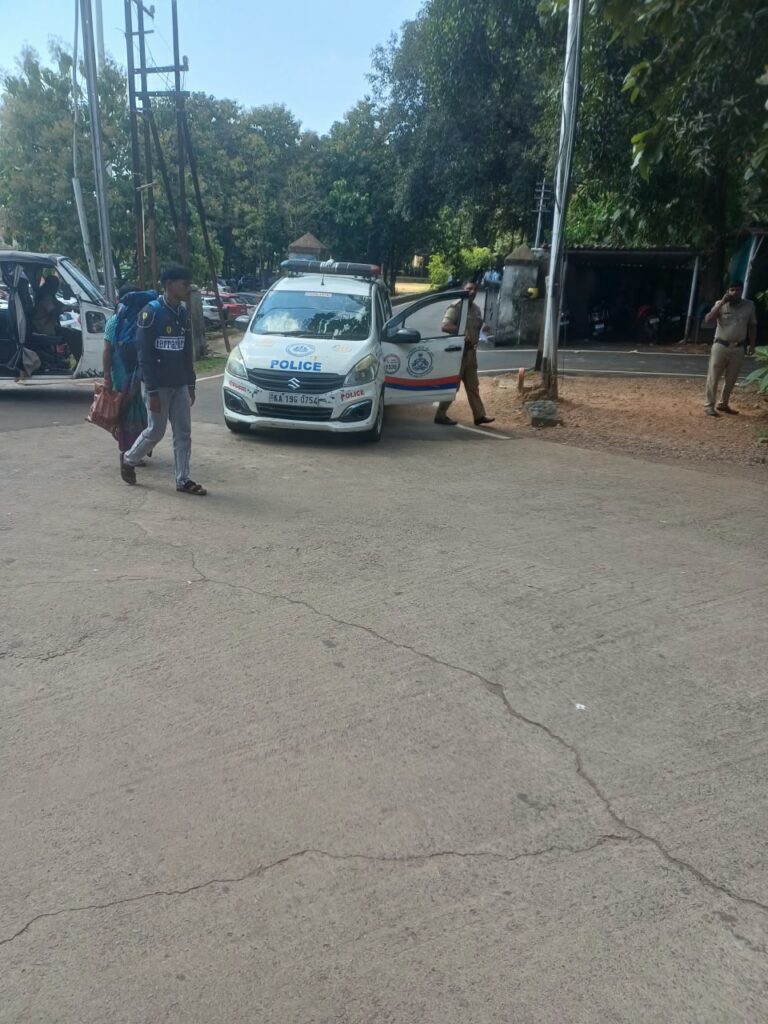
The photograph shows a police vehicle parked in the middle of the road right in front of a railway police station. A police personnel can be seen beside the vehicle, while the driver’s seat appears to be vacant at the time the photograph was taken. An Inspector seems to be approaching the responsible citizen who photographed the violation while he was photographing the vehicle. This raises a broader question about whether those entrusted with enforcing the law should also be mindful of the same rules in their day to day duties.
The incident, however, need not necessarily be viewed as a confrontation between citizens and the police. There can be perfectly legitimate circumstances in which a police vehicle has to be stopped or left unattended for a short while. It could be an emergency, an urgent call, an investigation, or some other official duty. Police personnel often have to respond immediately to situations where convenience and procedure may have to take a back seat to public safety.
At the same time, the episode highlights an issue that deserves consideration. When an ordinary citizen is penalised for a minor violation, the punishment can sometimes appear severe compared with the nature of the offence. This naturally creates an expectation that the same standards should be applied consistently to everyone. The answer need not be to relax enforcement. Rather, fairness, proportionality and a little common sense can go hand in hand with strict enforcement. Genuine emergencies should receive appropriate consideration, while routine violations should be dealt with consistently, irrespective of who commits them.
The photograph, therefore, may be less about one parked police vehicle and more about a principle that is important for public confidence. Laws work best when enforcement is firm, fair and accompanied by an understanding of the circumstances.


