All posts by admin

About admin

Chairman of Global TV | Excellent Writer | Exceptional PR Skills | Author of Six books | MASTER HEALER | +91 98441 82044 |

From Revenue to Wealth | India Must Become the World’s Greatest Platform for Collaboration | Global TV

The next chapter of India’s development is about creating wealth through Massive and Collective Collaboration | The Beehive Model | Global TV

NV Paulose, Chairman, Global TV +91 98441 82044

A beehive does not become prosperous because it collects taxes from its honeybees. It becomes prosperous because every honeybee contributes to creating value. Every bee has a role. Every role strengthens the hive. Every effort produces wealth for the entire colony.

That is perhaps the greatest lesson nature offers humanity | Welcome Heneybees

India stands at a historic moment. We are one of the youngest nations in the world. We possess extraordinary human capital, creative minds, technological capability, cultural diversity, and entrepreneurial spirit. Yet our greatest challenge is not the shortage of talent. Our challenge is the absence of organised collaboration that converts talent into lasting wealth.

For generations, governments have naturally focused on administration, regulation, and revenue collection. Revenue is necessary for every nation. But the next era demands something much larger. India must become a nation whose first instinct is wealth creation. Every policy, institution, university, industry, and citizen should ask one simple question. How do we create more value for society before we discuss how to distribute it?

The future belongs to countries that organise people into productive teams, create meaningful roles, encourage innovation, and convert ideas into sustainable economic activity. Nature has already written the blueprint. The honeybees have simply demonstrated it.

Team formation, role creation, and revenue action must replace isolated individual effort as the foundation of India’s economic thinking and national development.

Every successful civilisation has mastered one principle. Great achievements are never produced by isolated individuals. They are produced by organised teams performing clearly defined roles. India must consciously become a nation that creates teams rather than merely creating jobs. Every district can become a centre for specialised teams. Every university can become a platform for multidisciplinary collaboration. Every entrepreneur can become a team builder. Every village can become a production partner. Every city can become an innovation hub. Every metro can become an international gateway connecting India with the world.

Role creation is equally important. Many talented people remain unemployed not because they lack ability but because traditional job descriptions fail to recognise emerging opportunities. The twenty first century demands entirely new professional identities. The traveller who connects cultures creates economic opportunity. The mentor who develops young entrepreneurs creates future industries.

The connector who introduces businesses, investors, researchers, artists, hospitals, universities, and governments creates value that multiplies across society. These are not supporting roles. They are wealth creating professions. Revenue action must also acquire a broader meaning. Revenue should not begin with taxation. Revenue should begin with value creation. When millions of citizens build products, services, ideas, knowledge, and partnerships, national revenue grows naturally because wealth has first been created.

Every profession should collaborate with every other profession because the greatest economic opportunities exist at the intersection of industries and human imagination.

India has traditionally organised education and business into separate streams. Commerce works separately from science. Tourism operates separately from media. Agriculture develops independently of technology. Healthcare grows independently of hospitality. Education functions independently of industry.

The future belongs to integration.

Imagine Global Television Storytelling Packages combined with Tourism Packages. A documentary about India’s cultural heritage immediately becomes an invitation for international visitors. Every programme becomes both education and tourism promotion. Every destination becomes a classroom. Every traveller becomes a storyteller.

Imagine healthcare combined with hospitality, wellness, artificial intelligence, medical research, language services, and cultural tourism. Imagine education combined with entrepreneurship, international exchange, digital technology, manufacturing, and community development. Imagine agriculture working together with biotechnology, logistics, financial services, food processing, tourism, and environmental conservation. The greatest businesses of the future will not belong to one industry. They will belong to those who connect many industries into one integrated experience. Collaboration is no longer optional. It is becoming the world’s most valuable competitive advantage.

Premium Combo Packages can transform India’s abundant knowledge, culture, healthcare, education, tourism, and innovation into global wealth creating ecosystems.

The modern customer no longer purchases isolated products. People increasingly seek complete experiences. India should therefore become the global leader in Premium Combo Packages. A visitor should not simply purchase a medical treatment. The visitor should receive an integrated healthcare journey including consultation, accommodation, rehabilitation, cultural experiences, local travel, language support, nutrition guidance, wellness programmes, and continued digital follow-up after returning home.

An international student should not merely enrol in a university. The student should experience industry internships, entrepreneurship mentoring, cultural immersion, language learning, innovation laboratories, research partnerships, and career networking. Tourists should not merely visit monuments. They should receive storytelling experiences, local cuisine, traditional arts, village immersion, educational workshops, environmental activities, and digital memories that remain valuable long after the journey ends.

Premium does not necessarily mean expensive. Premium means thoughtfully designed. Premium means complete. Premium means delivering exceptional value through intelligent integration. India has every ingredient required to become the world’s largest creator of affordable premium experiences.

India can become the world’s preferred destination for affordable healthcare, education, innovation, and human connection by exporting complete experiences instead of isolated services.

For decades, India has earned international respect for producing outstanding doctors, engineers, scientists, teachers, researchers, entrepreneurs, and information technology professionals. The next transformation is to organise these strengths into one globally recognised ecosystem. Imagine international families choosing India because they receive world class healthcare at affordable prices together with wellness programmes, educational opportunities for children, cultural experiences, tourism, and lifelong digital medical support. Imagine students choosing India because universities collaborate directly with industries, research laboratories, innovation centres, startup ecosystems, and global mentors. Imagine entrepreneurs arriving not only to invest but to discover collaborators across every discipline.

Imagine retired professionals travelling throughout India as mentors, connecting young innovators with investors, universities, industries, and governments. Travel, mentoring, and connecting people should become recognised engines of economic development. The connector who creates one hundred meaningful collaborations contributes more to national prosperity than many conventional occupations. The mentor who enables ten successful entrepreneurs creates employment for thousands. The traveller who introduces India’s strengths to the world becomes an ambassador of national development. These are professions worthy of recognition, respect, and investment.

The capital of a beehive is its honeybees. The capital of India is its people. When every citizen becomes a creator, every team becomes an innovation centre, every profession collaborates with others, every journey creates knowledge, and every connection generates opportunity, India will no longer compete merely as a large economy. India will become the world’s greatest platform for wealth creation, affordable excellence, and human collaboration. The future will belong to those who create the most value together.
Small Actions at Massive Scale: The Invisible Force That Changes the World

One bee carries only a tiny amount of pollen. Millions of bees sustain ecosystems and help feed the world.

NV Paulose, Chairman, Global TV +91 98441 82044

We have always understood the difference between small actions and large actions. Throwing a stone is a small action. A landslide is a large action. Lighting a candle is a small action. Powering an entire city is a large action. Planting one seed is a small action. Growing a forest is a large action.

This way of thinking seems complete, but it misses an entirely different dimension of human effort. There exists another category that deserves its own place. It is not a large action. It is not simply a collection of small actions. It is a small action performed at a massive scale.

In this dimension, the action itself remains simple. The effort required from each individual hardly changes. What changes is the number of people participating. One person performs a tiny act. A thousand people perform the same tiny act. A million people repeat it. Suddenly, an ordinary action acquires extraordinary power. The transformation does not come from making the action bigger. It comes from making participation bigger.

The Mathematics of Participation

The strength of this idea lies in multiplication rather than magnitude. A single clap lasts only a moment. Thousands of people clapping together produce a sound that shakes an entire stadium. One person planting a tree contributes to nature. One million people planting one tree each create a forest that changes the landscape. A child picking up a piece of litter may not appear to make a difference.

Imagine every student in a city picking up just one piece of litter on the same day. Streets become cleaner. Rivers carry less waste. Public spaces improve. The action never became larger. The number of people performing it became larger. Nature follows the same principle. A single raindrop cannot shape a mountain. Countless raindrops falling over time carve valleys and create rivers. One bee carries only a tiny amount of pollen. Millions of bees sustain ecosystems and help feed the world. Small actions repeated on a massive scale become forces of nature.

When Collaboration Creates Power

Human beings often underestimate what can be achieved together because we tend to judge actions one person at a time. We ask whether one effort is enough. Usually it is not. The real question is whether the same effort can be repeated by thousands of others.

Consider blood donation. One donation may save a life. Thousands of voluntary donations every day sustain hospitals and give hope to patients across a nation. The individual donor performs a simple act. Society experiences an enormous benefit. The same principle applies to water conservation. Saving one litre of water each day seems insignificant. If ten million people save one litre every day, ten million litres are conserved daily. What appeared to be a personal habit becomes a national resource.

This is the remarkable quality of collaborative action. It allows ordinary people to create extraordinary outcomes without asking anyone to perform extraordinary tasks. The burden on each individual remains small while the benefit to society becomes immense.

The Hidden Story Behind Great Achievements

History often celebrates great monuments, scientific discoveries and social movements. We admire the final result because it is visible and impressive. What we rarely notice are the countless small actions that made those achievements possible. Every great building was constructed one brick at a time. Every library was filled one book at a time. Every forest began with individual trees. Every successful community was built through daily acts of trust, kindness and cooperation.

Many of the world’s most valuable knowledge resources exist because thousands of people each contributed a small piece. No single contribution was revolutionary. Together they created something that no individual could have produced alone. The same pattern appears in public health. Washing hands takes only a few seconds. When an entire population adopts the habit, diseases decline dramatically. Vaccination, recycling, energy conservation and literacy campaigns all succeed because millions of people perform small actions consistently.

The greatness lies not in the size of the action but in the scale of participation.

A New Way of Changing the Future

Perhaps the greatest challenge of our time is not finding people willing to perform heroic acts. It is finding simple actions that millions of people are willing to perform.

The most effective ideas are often the simplest. Read for twenty minutes each day. Plant one tree each year. Donate a small amount every month. Save a litre of water. Help one neighbour. Teach one child. Share one useful idea. None of these actions is difficult. None requires exceptional talent or wealth. Yet when embraced by an entire community, they reshape societies.

This way of thinking also changes the meaning of leadership. Great leaders do not always solve problems alone. They design simple actions that everyone can join. Their success comes from making participation easy rather than making individual effort difficult. The future will increasingly depend on this philosophy. Many global challenges are too large for a few people to solve, but they become manageable when millions contribute small, consistent efforts. Climate action, public health, education and environmental restoration all depend on this principle.

We have spent centuries admiring large actions because they are dramatic and visible. A landslide captures attention. A towering bridge inspires awe. A great invention changes history. Yet some of the greatest transformations begin with actions so small that they are almost invisible. Their true strength lies in the number of people willing to perform them together.

Perhaps we need a new way of understanding human effort. Beyond small actions and large actions lies a third dimension. It is the world of small actions at massive scale, where simple individual efforts combine into extraordinary collective achievements. The future may not be shaped by a few people doing great things. It may be shaped by millions of people doing small things together. That is not merely a larger action. It is an entirely new dimension of change.

Albert Jossy Rego | A Legacy of Energy, Enthusiasm, and Service | Global TV

His deliberations are very strong, his convictions are very firm and he is open minded to the entire humanity

NV Paulose, Chairman, Global TV +91 98441 82044

There are some individuals whose presence fills every room with warmth, positivity, and purpose. Mr. Albert Jossy Rego was one such person. His life was defined by the energy, enthusiasm, and compassion with which he embraced every day. Jossy Rego believed in living life wholeheartedly. His infectious enthusiasm inspired those around him, whether in his professional pursuits, community involvement, or personal relationships. He had an extraordinary ability to motivate others, offering encouragement, support, and a smile that made every challenge seem a little lighter.

To know Mr. Jossy Rego was to experience his genuine kindness and unwavering optimism. He celebrated the successes of others as sincerely as his own and was always willing to lend a helping hand without expecting anything in return. His generosity of spirit and approachable nature earned him the admiration and affection of family, friends, colleagues, and the wider community.

His greatest legacy, however, lies not only in what he achieved but in the lives he touched. Jossy Rego leaves behind memories of laughter, meaningful conversations, selfless service, and countless acts of kindness that will continue to inspire those who had the privilege of knowing him.

While his passing leaves an irreplaceable void, his spirit endures in the values he lived by: integrity, compassion, dedication, and an unwavering zest for life. Those memories will remain a source of strength and comfort for all who mourn his loss. We celebrate his life lived with purpose and passion.

Below is frpm his website by Global TV

STRONG, FIRM AND OPEN MINDED!

His deliberations are very strong, his convictions are very firm and he is open minded to the entire humanity! Albert Jossy Rego is a Singer, a Poet, an Orator, a humanist and an activist at times; all put in the costumes of a professional Engineer! He lived major portion of his career at key positions in Kuwait. He always had lived and lives a life that sparkles in its fullest vibrancies. Mr. Albert Jossy Rego is very friendly with those who live life with a good purpose! He share enthusiasm and zeal and expect them back too! Always ready to support charitable initiatives! Music is in his body, mind and spirit. People move on their toes as he immerses himself in the world of Music!

Patient to the core!
Humble to the deep!!
Optimistic to the highest!!!

Unbiased to all and uncompromising to the evil elements in the society; Albert Jossy Rego is a man of action. His heart is filled with affection. He walks the talk in its minute details. Positive thinking and passionate singing are in his personality since childhood. He mingles with all without any kind of barriers. Principles of relations are same at the bottom line and also in the top line.

Tough experiences in life from childhood to throughout have formed him very strong. His performance level crosses every limit. Retired from his high profile job in Kuwait; but; Albert Jossy Rego is un-tired in his career as a Musician and Singer. He is a philanthropist who has influenced the life of many at the turning points of their career. He is always willing to share happiness with fellowmen.

Albert Jossy Rego is now at his Seventy Plus tenure! 7 decades of life with thick experiences at every point. The story starts from a boyhood very much confused with the dual standard in the behavior of elders in society. The priest who spoke about living in love with one another in the sermon but asked him to avoid friendship with other community friends confused him a lot. He did what was logical and ethical at every point in life.

ELVIS PRESLEY OF INDIA!

Music is a Passion for this young at heart man who sings with unnerved zeal even at the age of seventy plus when many others may opt to retire and rest! He is known as the Elvis Presley of India and his music simply captivates the masses.

JOSSY JAZZ!

His unique Music Instrument Jossy Jazz generates marvelous music that moves the audience! To write golden words; you require only an ordinary pen! To play great music; you first should know how to play music; the instrument comes next. Mr. Albert Jossy Rego’s innovation among the music instruments impresses the people very much around the world!

He plays it very well. It goes very well with the orchestra! It creates an impact by making its presence noticed strong and soothing. He has a passion in playing this special instrument. People call it Rego Stick! Some call it Jossy Jazz! Whatever is the name called; it plays music in a unique manner. Kudos to the inventor musician!!

Never Be Lazy! Never discriminate!!

He approaches life always with josh and he share warmth with everyone whom he meets. Never discriminate any human being on any grounds!Instead; respect hard work, sincerity and truthfulness very much! This is his personal advice to you!

Do you pay for your smile?! Asks Mr. Albert Jossy Rego! And the answer most of the times goes into silence! And he alerts us about the world around that smile at each other. What a smile does? It makes the other person joyful and you get a better smile in return.

The most important aspect of a lively person is the smile that he or she shares with you as you meet somewhere at some point of time! Never miss the opportunity to smile. Do it at every next opportunity. You need not pay for your smile and every smile that you give give back to you the abundance of affection in return! So; next time you see a person without a smile on his or her face; give one of yours in advance and it comes back to you in abundance from all over!

Never Run Away from Challenges! You Can Overcome and Win Over them!!

A basic lesson that the new generation should learn from the story of Mr. Albert Jossy Rego is the certainty of success for those who approach life positively, truthfully and with persistence and enthusiasm.

Messages of Mr. Albert Jossy Rego is all the more powerful since it has a solid foundation of experience. He speaks from his heart and every word has a touch of sincerity engraved within. At early seventies, he lives like a young boy of seventeen. The warmth and depth are being filled in his expressions!

He lives an active life. And you will be surprised to know his friends’ circle. People of various stature and profile establish in-depth interpersonal friendship with him. And he speaks out without fear or favor. He not even seeks any favor from anyone. All his prayer is for the nation to be filled with thrilling young minds and the world to experience the tranquility of peace.

Indian Democracy | From Electoral Rule to People’s Sovereignty | Global TV

This democratic chain must ultimately reach the Gram Sabha, where people themselves exercise their authority | Global TV

NV Paulose, Chairman, Global TV +91 98441 82044

India is recognized as the world’s largest democracy. It has a written Constitution, regular elections, elected governments, and institutions representing the people. However, the true meaning of democracy goes beyond the act of voting. Democracy is not merely a system where people choose their representatives once in a few years. It is a system where ultimate power remains with the people at all times.

The central argument is that the present Indian democratic model has developed into a form of political monopoly. This does not refer to any single political party or any particular government. Different governments may follow different approaches; some may be more consultative, while others may be more centralized. However, the basic structure remains similar: once elected, political representatives often begin to exercise power as though authority has permanently shifted from the people to the elected institutions.

In a genuine democracy, elections should not mean that people surrender their sovereignty. The people are the original source of political power. Members of Parliament, Members of Legislative Assemblies, and representatives of local bodies are only trustees of that power. They do not own the authority given to them; they hold it temporarily on behalf of the people.

The weakness of the present system is that after elections, the relationship between citizens and representatives becomes distant. Political parties and elected leaders often become the main decision-makers, while the people become observers until the next election. This creates a situation where power becomes concentrated among political representatives, producing a monopoly over public decision-making.

Democracy should function in the opposite direction. Power should flow from the people upward, not only from the government downward. Parliament, Legislative Assemblies, municipalities, and Panchayats should remain connected with the people they represent. An MP should work in consultation with MLAs, and MLAs should coordinate with local representatives, regardless of political affiliation, because public issues are not limited by party boundaries. Roads, education, healthcare, water, agriculture, employment, and development concerns belong to the people, not to any political party.

This democratic chain must ultimately reach the Gram Sabha, where people themselves exercise their authority. The Gram Sabha should not be treated as a formal meeting whose decisions can be ignored. It should be recognized as an expression of the people’s sovereignty at the grassroots level. Every major decision affecting the community should involve the people’s participation and approval.

The role of citizens in democracy should not be reduced to choosing leaders. Citizens must have the continuing power to question, approve, reject, and influence decisions. Representatives are not rulers over the people; they are servants entrusted with responsibilities by the people.

An important principle of true democracy is that public confidence is the foundation of political authority. When people clearly express sustained dissent against the actions of a representative or government, that dissent cannot be dismissed. The authority to govern comes from the people, and when that confidence is lost, democratic morality requires the leader to reconsider their position. A leader who no longer enjoys the trust of the people should either correct the course of action, seek renewed public approval, or step aside.

Today, the absence of people from democratic forums is often interpreted as acceptance. This is a mistake. Silence does not always mean consent. When people stop attending Gram Sabha meetings or public consultations, it may indicate disappointment, distrust, or a belief that their voices do not matter. Such absence should be understood as a possible form of dissent, requiring deeper attention from representatives.

A democracy becomes weak when elected representatives believe that winning an election gives them unlimited authority. An election provides a mandate to serve, not a license to govern without accountability. The mandate belongs to the people, and the people retain their right to question and evaluate those who exercise power in their name.

The solution is not to reject representative democracy but to complete it. Representative institutions must be combined with continuous public participation. MPs, MLAs, Panchayat members, and other representatives should function through regular consultation with citizens. Technology, public meetings, and local institutions can create stronger channels for people to express their views and participate in governance.

The essence of democracy is not the existence of elections alone. Many systems can conduct elections, but true democracy exists only when people remain the ultimate decision-makers. If power becomes permanently concentrated among elected representatives, democracy slowly turns into a monopoly of political authority. If power remains with the people, representatives become accountable trustees of public will.

India’s democratic future depends on restoring this fundamental principle: sovereignty belongs to the people. Representatives may exercise power, but they do not possess it. Governments may make decisions, but their legitimacy comes from the continuing confidence of the people. Democracy must not end at the polling booth; it must continue every day through the active authority of the people.

Only then can democracy become a system where power genuinely rests in the hands of the people, as it was intended to be.

Umapathi Bhat | Unwavering commitment to environmental conservation and ecological awareness | Global TV

Sasya Samanvaya to Host Insightful Talk on Karnataka’s Forest Conservation Efforts

NV Paulose, Chairman, Global TV +91 98441 82044

Bengaluru, July 2026:
Sasya Sampada’s monthly knowledge-sharing initiative, “Sasya Samanvaya – A Talk Series,” will present an engaging online session on Sunday, July 26, 2026, from 7:00 PM to 8:00 PM IST via Google Meet. The session aims to bring together nature lovers, environmental enthusiasts, students, researchers, and the general public to explore critical issues related to vegetation, ecology, traditional knowledge, and sustainable living.

The featured speaker for this month’s edition is renowned environmentalist Umapathi Bhat, who will deliver a thought-provoking lecture on “The Role of Forests in Karnataka’s Environmental Conservation” (Kannada: ಪರಿಸರ ಸಂರಕ್ಷಣೆಯಲ್ಲಿ ವನಗಳ ನಿವಾರ್ಣದ ಮಹತ್ವ). The presentation will examine the ecological significance of Karnataka’s forests, the challenges they face, and the collective responsibility of communities in preserving these invaluable natural resources.

The programme will consist of a 40-minute presentation followed by a 15-minute interactive question-and-answer session, allowing participants to engage directly with the speaker. Registration is open through the Google Form shared by the organisers, and the meeting link will be circulated to registered participants via the group’s communication channels.

A Lifetime Dedicated to Nature

Umapathi Bhat is widely respected for his unwavering commitment to environmental conservation and ecological awareness. Over the years, he has inspired countless individuals through his work in promoting forest conservation, biodiversity protection, and sustainable environmental practices. His ability to connect scientific understanding with practical conservation efforts has earned him recognition among environmental circles.

Known for his simple yet impactful communication style, Bhat has consistently emphasized the importance of community participation in protecting natural ecosystems. He believes that environmental conservation is not solely the responsibility of governments or organizations but a shared duty of every citizen. His lectures encourage people to appreciate nature while adopting environmentally responsible lifestyles.

Through decades of dedicated service, Umapathi Bhat has become a trusted voice in environmental education. His efforts to spread awareness among students, farmers, volunteers, and the wider public have significantly contributed to strengthening environmental consciousness. His passion for safeguarding forests and promoting ecological balance continues to inspire the next generation of conservationists.

The organisers, Team Sasya Sampada, have invited all interested participants to join this enriching session and gain valuable insights into the indispensable role forests play in maintaining ecological balance and ensuring a sustainable future for generations to come.

Gen Hope | Wider range of ideas, cultures, and perspectives than previous generations | largely because of the internet and social media | Global TV

We constantly interact with people from different backgrounds, listen to diverse opinions, and learn that there isn’t always one right answer.

NV Paulose, Chairman, Global TV +91 98441 82044

You see, this is exactly what I mean. Sometimes it feels like there is an expectation that there is only one “correct” way to speak or express ourselves. But who decided that standard? Many of those expectations were created by older generations, who grew up in a completely different social and cultural environment. They were taught to speak in a certain way, to hold back certain opinions, and to fit into a mold of what was considered “appropriate.” That doesn’t automatically make every other way of communicating wrong.

Every generation is shaped by the world it grows up in. Our generation has been exposed to a much wider range of ideas, cultures, and perspectives than previous generations, largely because of the internet and social media. We constantly interact with people from different backgrounds, listen to diverse opinions, and learn that there isn’t always one right answer. Naturally, our language, our confidence, and the way we express ourselves have evolved. A change in expression should not be mistaken for a lack of values or sensibility.

When young people communicate more directly, it is often interpreted as being rude or insensitive. I don’t agree with that assumption. Being straightforward is not the same as being disrespectful. Our generation tends to say what it thinks openly instead of hiding behind indirect language. Earlier generations often had to suppress their thoughts because society expected them to conform. They were expected to follow certain rules without questioning them. While many individuals did challenge those norms and broke those barriers, those people were exceptions rather than the rule.

Today, because of greater exposure and access to information, young people are more willing to question traditions, authority, and systems that don’t seem fair. Social media has given everyone a platform to express opinions that may never have been heard before. I am not saying that everything happening on social media is positive. I don’t believe that using abusive language or insulting others is a form of freedom. If someone says that being disrespectful or using curse words is insensitive, I completely agree. Freedom of expression should never become an excuse for disrespect.

But expressing an opinion honestly, asking difficult questions, or refusing to blindly accept old ideas should not be labelled as insensitivity. There is a significant difference between challenging a system and disrespecting people. Unfortunately, many young people are often judged simply because they question things that previous generations accepted without discussion.

As a woman, I feel this difference even more strongly. I believe many women would relate to this experience. For generations, women were expected to remain silent, obey authority, and avoid questioning social expectations. Today, many women are educated, financially independent, and aware of their rights. Naturally, they are more confident in expressing their opinions. When they speak firmly or question unfair practices, they are sometimes described as being arrogant, difficult, or insensitive. In reality, they are simply exercising a voice that earlier generations were often denied.

At the same time, I recognize that I have been fortunate in many ways. The level of education I received and the freedom my parent gave me have played a huge role in shaping the person I am today. They encouraged me to think independently, to communicate honestly, and to trust them. That privilege has given me confidence, but I also understand that not everyone grows up in the same environment.

Many people my age have lived very different lives. Some of my closest friends have spent years lying to their parents about even the smallest things. Surprisingly, some of them continue to do so even at the age of twenty-seven, despite earning their own money and being financially independent. That isn’t because they are dishonest by nature. It is because they grew up in homes where honesty was met with punishment instead of understanding. They learned that telling the truth would only lead to restrictions, criticism, or conflict.

My experience was completely different. I don’t even remember lying to my mother when I was seven years old. Even if I wanted to step outside to buy a chocolate or meet someone for a short while, she always knew where I was. I never felt the need to hide things because I was raised in an environment where communication was encouraged rather than feared. That difference didn’t happen by chance—it came from the values, trust, and education my parents gave me.

This is why I believe we should be careful before judging an entire generation. People’s behaviour is often a reflection of the environment they grew up in. Some learned to speak openly because they were given the freedom to do so. Others learned to hide the truth because they never had that freedom. Neither experience represents an entire generation.

Instead of dismissing young people as insensitive, perhaps we should acknowledge that society has changed. Every generation speaks differently because every generation grows up under different circumstances. The younger generation is not trying to be disrespectful; it is trying to be heard. It is trying to question systems that no longer make sense, advocate for fairness, and create conversations that previous generations often avoided.

Maybe this isn’t a question of one generation being right and the other being wrong. Maybe it is simply a generation gap. Older generations value restraint because that is how they were raised. Younger generations value openness because that is the world they have inherited. Neither perspective is entirely wrong. But if we genuinely want to understand one another, we have to stop confusing directness with disrespect and questioning with insensitivity. Only then can we have conversations that bridge the gap instead of widening it.

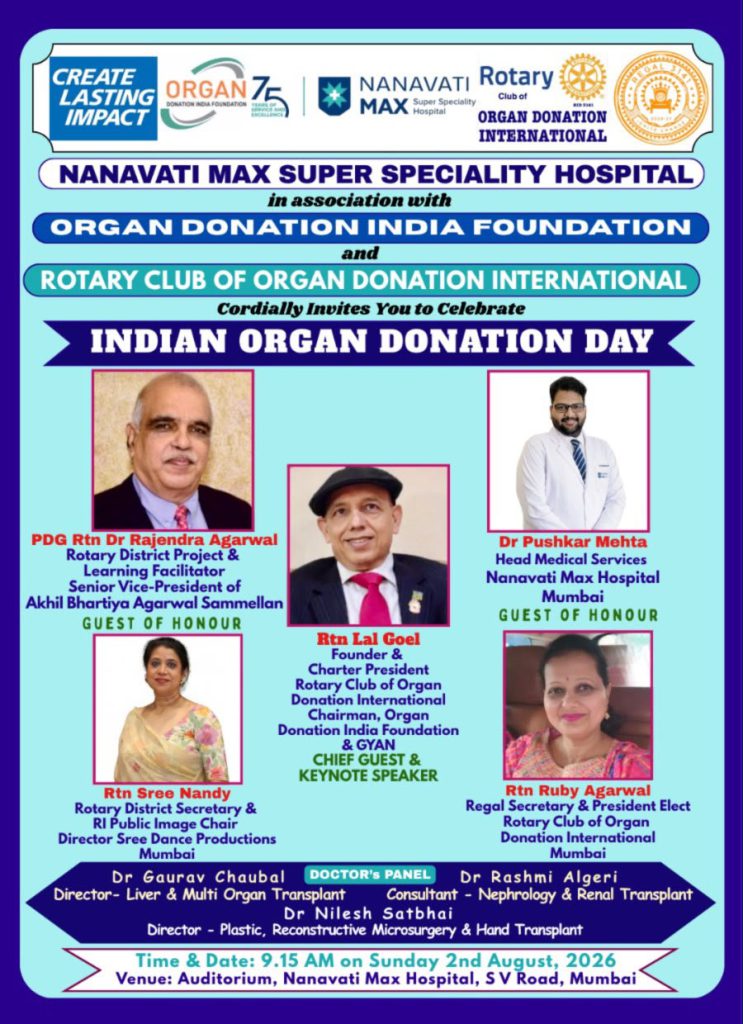
INDIAN ORGAN DONATION DAY 2026 | A Collective Commitment to Saving Lives Through Organ Donation | Global TV

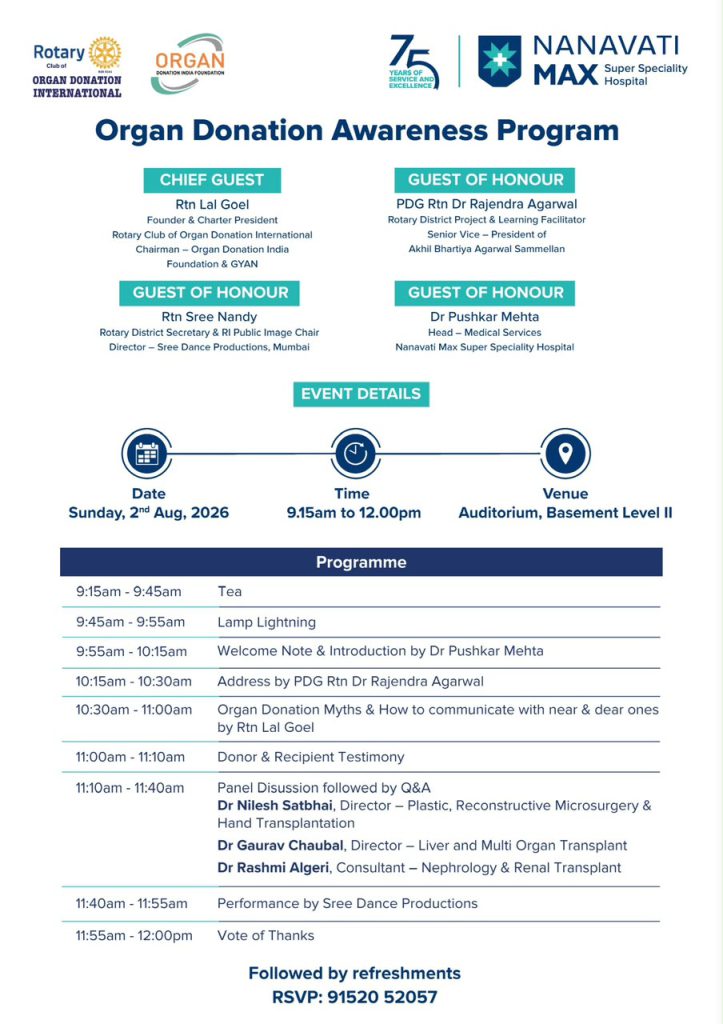
ROTARIAN LAL GOEL TO DELIVER THE KEYNOTE ADDRESS AT INDIAN ORGAN DONATION DAY 2026 CELEBRATIONS AT NANAVATI MAX SUPER SPECIALITY HOSPITAL, MUMBAI

NV Paulose, Chairman, Global TV +91 98441 82044

To commemorate Indian Organ Donation Day, Nanavati Max Super Speciality Hospital, in association with the Organ Donation India Foundation and the Rotary Club of Organ Donation International, will organise a special Organ Donation Awareness Programme on Sunday, 2nd August 2026, from 9:15 AM to 12:00 Noon at the Auditorium, Nanavati Max Super Speciality Hospital, Mumbai.

The programme aims to raise awareness about the life-saving impact of organ donation, dispel common myths, and encourage families to discuss and support this noble cause.

Chief Guest & Keynote Speaker

The highlight of the programme will be the keynote address by Rtn Lal Goel, Founder & Charter President of the Rotary Club of Organ Donation International and Chairman of the Organ Donation India Foundation & GYAN. Recognised as one of India’s leading advocates for organ donation awareness, he has dedicated more than a decade to promoting deceased organ donation through public education, policy advocacy, and community engagement across the country.

His keynote address, “Organ Donation: Myths and How to Communicate with Near & Dear Ones,” will focus on dispelling common misconceptions about organ donation, highlighting the importance of discussing one’s wishes with family members, and inspiring people to pledge their organs. He will also share practical guidance on how informed decisions and meaningful family conversations can help save lives and create a culture of organ donation.

Guests of Honour

The programme will also be graced by distinguished Guests of Honour:

  • PDG Rtn Dr Rajendra Agarwal – Rotary District Project & Learning Facilitator and Senior Vice-President, Akhil Bhartiya Agarwal Sammellan.
  • Dr Pushkar Mehta – Head, Medical Services, Nanavati Max Super Speciality Hospital.
  • Rtn Sree Nandy – Rotary District Secretary and RI Public Image Chair, Mumbai.

Their presence reflects the shared commitment of the medical fraternity and Rotary leadership towards strengthening organ donation awareness in India.

Expert Panel Discussion

Another major attraction of the programme will be an interactive panel discussion, moderated by Rtn Lal Goel, featuring eminent transplant specialists:

  • Dr Gaurav Chaubal – Director, Liver & Multi-Organ Transplant.
  • Dr Nilesh Satbhai – Director, Plastic, Reconstructive Microsurgery & Hand Transplant.
  • Dr Rashmi Algeri – Consultant, Nephrology & Renal Transplant.

The experts will discuss recent advances in transplantation, address frequently asked questions, and provide valuable insights into organ donation and transplantation in India.

The programme will also feature inspiring donor and recipient testimonials, an interactive question-and-answer session, and a cultural performance by Sree Dance Productions.

Organ donation is one of the greatest gifts a person can leave behind. A single deceased organ donor can save multiple lives and improve many more through tissue donation. This awareness programme seeks to inspire individuals and families to make informed decisions, pledge their organs, and become ambassadors for this humanitarian cause.

Together, let us celebrate the Gift of Life and strengthen India’s movement towards a healthier, more compassionate society through organ donation.

RS Shettian | A Tribute to Mr. R. S Shettian | Chairman, Athena Institute of Health Sciences | A Leader with million-dollar smile | Global TV


“A leader’s greatest legacy isn’t built in brick and mortar…but in the lives they touch and the confidence they instil….
With his signature smile and unwavering Integrity Mr.RS Shettian doesn’t just managed he transformed aspirations into institutions of excellence:”
Mr. R.S Shettian stands as a beacon of visionary leadership, whose unwavering commitment to education, healthcare, and social upliftment has left an enduring mark on the community and society at large. As the Chairman of Athena Institute of Health Sciences, his foresight and dedication have transformed aspirations into institutions of excellence, nurturing generations of healthcare professionals guided by knowledge, ethics, and compassion.
His leadership is defined not only by strategic brilliance but also by a deep sense of responsibility toward society. Through his invaluable contributions, Mr.R.S Shettian has championed access to quality education and healthcare, empowering individuals and strengthening communities. His belief that education and service are the twin pillars of societal progress continues to inspire faculty, students, and stakeholders alike.
Beyond institutional achievements, Mr. RS Shettian’s legacy is reflected in the lives he has touched—through mentorship, philanthropy, and a steadfast commitment to social good. His vision transcends the present, laying a foundation for sustainable impact and inclusive growth.
A hero in the Shettian family:
Mr. R.S Shettian was a man of exemplary character in every role he embraced. He was a devoted and loving son, a constant source of strength and support to his siblings, and a model husband whose life was rooted in mutual respect, care, and understanding. As a father, he was deeply inspiring and guiding his children with wisdom, values, and unconditional love, shaping them into individuals of integrity and purpose.
He was a respectful and caring father-in-law, cherished for his kindness and gracious nature. As a grandfather, his love knew no bounds, an extremely affectionate, gentle, and joyful, he created memories that will forever live in the hearts of his grandchildren. To his extended family, he was a sweet and loving uncle, always present with warmth, encouragement, and a reassuring smile.
Through these relationships, Mr. R.S Shettian revealed the true measure of his life is not only in his achievements, but in the love, unity, and values he nurtured within his family. His legacy lives on through them, and through the countless lives he touched with his compassion and grace.
A Caring friend:
Mr. RS Shettian was not only a visionary leader and an accomplished institution builder, to me but he was also a wonderful, caring, and deeply valued friend. His warmth, kindness, and genuine concern for others defined his relationships and left a lasting impression on everyone fortunate enough to know him.

As a friend, he was compassionate, supportive, and ever-ready to offer guidance or a listening ear. His humility and sincerity made people feel respected and valued, regardless of position or circumstance. These personal qualities, combined with his remarkable leadership, made him a rare individual who led with both intellect and heart.
Mr. RS Shettian’s friendship was a source of strength and inspiration, just as his professional life was a source of pride and progress for the community and society. He will be remembered not only for his visionary contributions and service, but also for the goodness, care, and friendship he so generously shared.
I deeply miss his everyday walking and exercise routine at the Hebich Technical Training Institute campus. His presence during those quiet hours was comforting and inspiring a familiar sight that reflected his discipline, simplicity, and commitment to a healthy, balanced life. Those daily walks were more than a routine; they were moments that quietly motivated others and brought a sense of life and warmth to the campus.
His absence is felt in those paths he once walked, yet his spirit continues to remain there in the values he lived by and the example he set for all of us.Top of Form
I deeply miss our Sunday conversations after church. If I was ever absent, he would thoughtfully enquire about me through my wife, a gesture that reflected his genuine care and attentiveness. Those small yet meaningful moments revealed the kindness of his heart and the personal interest he took in the lives of others. They are memories I will always cherish.
He never missed wishing me on my birthday and wedding anniversary, a thoughtful habit that spoke volumes about his warmth, attentiveness, and the genuine value he placed on personal relationships.Bottom of Form

He was an inspiring leader in our community and society, whose vision, integrity, and compassion uplifted countless lives and set a lasting example for generations to follow.
With profound respect and gratitude, we honour Mr. R. S Shettian for his exemplary leadership, his selfless service, and his enduring contributions to the community and society. His journey is a testament to the power of vision guided by purpose, and his legacy will continue to inspire for generations to come.

Chetan.R
Principal,
Hebich Technical Training Institute,
Balmatta,Mangalore-575 001
Landline1.0824-2422036 &
landline 2.0824 -2985578
Mob:+91 9972007578
Website: www.hebichinstitute.edu.in
Instagram:www.instagram.com/hebichinstitute/

Sarvotham Shetty | From Corporate Culture to the Collaborative Mindset | Global TV

Amazing Transformation and Continuous Journey of Sarvotham Shetty Towards Exceptional Excellence | Global TV

NV Paulose, Chairman, Global TV +91 98441 82044 | A P Raviraj, Associate Editor +91 99867 73524

In the remarkable journey of the Indian diaspora, there are individuals whose contributions extend far beyond their professional achievements. Their dedication, vision, and commitment create institutions that preserve heritage, unite communities, and inspire generations. Sri Sarvotham Shetty is one such distinguished personality whose life reflects determination, leadership, cultural passion, and an unwavering spirit of service.

Native Roots & Foundation | Mumbai: The First Roof | Making of a Visionary Leader

Born in the small village of Pareeka in Udupi district of Karnataka to Sri Mattar Parari Soorappa Hegde and Smt. Pareeka Saraswathi Hegde, Sarvotham Shetty grew up surrounded by the rich traditions and cultural values of coastal Karnataka. His humble beginnings shaped his personality and gave him the strength, discipline, and simplicity that later became the foundation of his leadership.

After completing his pre university education in Perdoor and Hiriyadka, he moved to Mumbai with dreams of higher education and professional growth. Life in the city demanded courage and perseverance. Following the principle of earning while learning, he worked in hotels and later in a solicitor’s office while continuing his studies. His determination helped him complete a Government Commercial Diploma from Bombay University and later earn his Bachelor of Commerce degree from the prestigious R.A. Podar College of Commerce and Economics in 1978.

Mumbai became the place where his leadership qualities and artistic talents emerged. As an active student leader, he represented R.A. Podar College as a Student Representative to the Senate of the University of Bombay in 1977. At the same time, his passion for theatre and cultural activities continued to grow.

His memorable performance in the Kannada play “Haggada Kone”, written by renowned writer Parvathavani, brought him appreciation among cultural circles. His love for Kannada and Tulu traditions inspired him to establish Kala Jagattu in 1979 with the support of his friends. As Founder President, he created a platform that promoted Kannada and Tulu theatre in Mumbai. The organization became a respected cultural forum and served as the first major expression of his lifelong mission to preserve and promote regional heritage.

Professionally, his association with Syndicate Bank strengthened his knowledge of banking, finance, and administration. The experience he gained during these years later helped him manage large community organisations with professionalism and efficiency.

Building a Cultural Oasis in the Arabian Desert: The Evolution of Community Leadership

A significant transformation in Sarvotham Shetty’s life began when he moved to Abu Dhabi following an invitation from International Distribution Establishment, a leading business organisation in the UAE. His dedication, sincerity, and administrative skills helped him rise to a senior management position, where he served successfully for more than two decades before starting his own entrepreneurial ventures.

While building his professional career, he remained deeply connected to his cultural roots. During his early years in the UAE, he observed that thousands of Indians living away from their homeland needed a platform to preserve traditions, celebrate festivals, encourage talent, and maintain emotional connections with Karnataka. With this vision, Sarvotham Shetty began creating institutions that became important pillars of the Indian community in the Gulf.

As President of Abu Dhabi Karnataka Sangha since 1981, he transformed the organisation into a vibrant centre for Kannada cultural activities. Under his leadership, the Sangha organised literary programmes, theatre performances, cultural festivals, and interactions with artists and writers from Karnataka. His efforts ensured that Kannadigas living abroad remained connected to their language and heritage.

He was also instrumental in establishing UAE Bunts Association and UAE Tulu Koota, which provided platforms for community interaction and cultural celebration. These organisations became symbols of unity, friendship, and collective identity among expatriates.

One of the greatest milestones in his leadership journey was his election as the first Kannadiga President of India Social and Cultural Centre, Abu Dhabi. He created history by becoming the only person to be unanimously elected as President in the 55-year history of this prestigious organisation. He served as President twice and had earlier served as Vice President, earning widespread trust and respect from the Indian community.

His contribution to Tulu culture also reached global recognition. As International President of Tuluva Mahasabha International, he played a major role in organising historic events such as Vishwa Tulu Ayono in 2016 and Vishwa Tulu Sammelana in Dubai in 2018. These gatherings brought together thousands of Tulu speaking people from different parts of the world.

Through his vision and dedication, Sarvotham Shetty created a cultural ecosystem where traditions could flourish even thousands of kilometres away from Karnataka.

Sarvotham Shetty’s leadership qualities became evident during his college years. His organisational abilities and commitment to public service continued to grow with time. In 1979, he played a pioneering role in forming the UAE Bunts Association, an organisation that has become one of the most respected community forums for Bunts in the Gulf. As its President for nearly five decades, he has guided its growth with remarkable dedication and vision. His commitment to leadership development also led him to become the Founder Vice President of the first Toastmasters Club in Abu Dhabi, where he encouraged communication excellence and confidence among professionals.

Further extending his service to the Indian business community, he served as Chairman of the Indian Professional and Entrepreneur Forum for two years and later as an Executive Committee Member of the Indian Business and Professional Group, where he headed the Membership Division for five years, strengthening professional networking and community engagement across the UAE.

Leadership Beyond Boundaries: Education, Sports and Community Empowerment

For Sarvotham Shetty, community service has always extended beyond cultural programmes. He believes that a strong community must focus on education, youth development, sports, and leadership opportunities. Since 1997, he has served as a Board Director of Abu Dhabi Indian School, one of the leading educational institutions in the Gulf region. As Chairman of the Education and Sports Division, he has contributed significantly towards student development by encouraging discipline, creativity, teamwork, and leadership qualities.

His involvement in education reflects his belief that children growing up outside India should have a strong connection with their heritage while preparing themselves for a global future.

His contribution to sports promotion in the Gulf is equally remarkable. Recognising that sports can bring people together, he introduced and promoted throwball among the Indian community in the UAE. The sport gradually gained immense popularity and became an important part of community life.

For the past three decades, he has organised the prestigious Koosamma Shambu Shetty Memorial Throwball Tournament for ladies, gentlemen, and children. The tournament attracts teams from various Gulf countries as well as cities across India, including Mumbai, Pune, Bengaluru, Delhi, and Haryana. It has become a symbol of friendship, participation, and healthy competition.

His leadership style combines professional management skills with genuine concern for people. The discipline acquired through his corporate career helped him plan and execute large-scale community initiatives effectively.

Even after decades of service, his passion for creativity remains strong. He entered the world of cinema through his memorable acting performance as Rathnakara Jantottu in the Kannada film “Gajanana Cricketers”, demonstrating that his artistic spirit continues to inspire him.

A Legacy of Excellence and an Inspiration for Future Generations

The remarkable contributions of Sri Sarvotham Shetty have been recognised through numerous awards and honours from organisations across India and abroad. These recognitions represent not only his achievements but also the gratitude and respect of countless people whose lives have been enriched by his service. The Government of Karnataka honoured him with the prestigious Karnataka Rajyotsava Award in 1998 under the Horanadu Kannadiga category for his outstanding contribution to promoting Kannada culture outside India.

Under his leadership, Abu Dhabi Karnataka Sangha received the Suvarna Karnataka Rajyotsava Award in 2006 for its dedicated service towards Kannada and Karnataka causes in foreign land. Among his many honours are the Aryabhata International Award in 2008 for social service and community welfare, the Globalman Award in 2009, the Sunderram Shetty Award in 2016, the Mayura Vishwa Kannadiga Award in 2017, the Tulu Prashasthi in 2017, the Vishwa Kannadiga Award in 2018, the Kadamba Award in 2018, the Lifetime Achievement Award from Vishwa Buntere Sammelana in 2018, and the Rangachavadi Award in 2019.

He has also received the Dr. D.K. Chowta Award in 2022, Karnataka Ratna Dr. Jawre Gowda Award in 2022, Baleyendra Prashasthi in 2022, Anivasi Tuluva Sadhaka Award in 2023, and Vishwa Deshi Vanijyodhyami Prashasthi in 2024. Beyond awards and titles, his greatest achievement remains the strong community spirit he has created. He has brought people together through culture, education, sports, and social initiatives. A dramatist, entrepreneur, educationist, sports promoter, cultural ambassador, and community leader, Sri Sarvotham Shetty represents the finest qualities of leadership and service.

Supported by his wife Smt. Usha from Kaup Kothwalguthu and children Samarth and Samyuktha, who have established successful professional careers in Abu Dhabi, he continues to inspire those around him.

From the quiet village of Pareeka to the international stage of Abu Dhabi, his journey talks about an extraordinary transformation from professional excellence to collaborative leadership. He did not simply preserve Kannada and Tulu traditions; he created a global platform where culture, friendship, and community continue to thrive. Sri Sarvotham Shetty is a powerful example of how one person’s vision, dedication, and commitment can create a legacy that transcends borders and inspires generations.

Longevity Summit | August 15 – 16 | Luxury Fairmont Mumbai | Global TV

India Set to Host Landmark Longevity Summit 2026 in Mumbai

NV Paulose, Chairman, Global TV +91 98441 82044

In a major stride toward positioning India as a global epicenter for healthspan and preventive healthcare, the inaugural Longevity Summit India 2026 has been officially announced. This landmark event is scheduled to take place on August 15 to 16 in the year 2026 at the luxury Fairmont Mumbai. Presented as a collaborative venture between Le Florence India, Fairmont Mumbai, and AIWO, the summit aims to pioneer the first ever Longevity Expo in India. The initiative sets out to establish a global benchmark where cutting edge science, preventive wellness, technological innovation, and luxury hospitality converge to transform how society approaches aging.

With the global wellness economy projected to reach eight and a half trillion dollars by 2027, the summit addresses a crucial medical and cultural paradigm shift. Rather than focusing solely on extending numerical lifespan, the event emphasizes maximizing healthspan, which represents the period of a person’s life spent in vibrant health. Organizers describe the gathering as an essential platform where conscious living and scientific discovery come together. The ultimate vision is to establish India as a leading authority in human performance and proactive medical intervention.

The schedule across the two day event is organized around the five core dimensions of human longevity. On the initial day, discussions and practical demonstrations concentrate on the Earth Body and Water Body dimensions. These sessions focus heavily on physical foundations, cellular health, Blue Mind neuroscience, and Watsu somatic aquatic therapy immersions. Delegates will explore how foundational cellular structures and emotional intelligence directly influence physiological stability and overall biological resilience.

The second day shifts focus toward the Air Body, Fire Body, and Flow dimensions. Speakers and workshops during this phase will examine mental mastery, cognitive optimization, and purpose driven living. Highlights include in depth explorations of brain enhancement techniques, biohacking therapies, and specialized panel discussions centered on human coherence. These presentations aim to provide actionable protocols for improving mental clarity, stress management, and sustained cognitive function throughout the human lifecycle.

Beyond the theoretical presentations and academic panels, attendees will have direct access to experiential wellness technologies on site. These offerings include extreme cold therapy operating at minus 110 degrees Celsius, advanced infrared treatments, metabolic diagnostic testing, and specially curated longevity nutrition menus. The inclusion of these technologies allows delegates to experience state of the art therapeutic interventions firsthand while learning about their underlying biological mechanisms.

Leading the Chief Advisory Council for the summit is Dr. Arpit Bansal, a recognized cancer surgeon, gut microbiome specialist, TEDx speaker, and prominent advocate of Medicine 3.0 principles. The event expects to draw over 500 curated delegates, representing an elite network of ultra high net worth individuals, company founders, venture capital investors, medical experts, and biohacking practitioners. This gathering provides an unprecedented networking environment designed to spark investment and foster cross disciplinary collaboration in longevity science.

More than 25 distinguished international speakers and panelists are set to present their research and insights at the event. Notable contributors include AIWO mentor C. Sivasankaran, Hydrolux Australia founder Katrina Skrypal, nutrition and peptide specialist Shirley D’Souza, StemMax chief executive officer Dr. Prabhu Mishra, water body and heart rate variability specialist Dr. Anais Verena Garcia, neurologist Dr. Sweta Adatia, CeraThrive founder Sarah Turner, Mind Medicine Australia founder Tania de Jong, artificial intelligence and human development specialist Dr. Gino Yu, and quantum biology specialist Dr. Chris Kacher.

The gathering is supported by a robust network of industry partners, including prominent health and lifestyle organizations such as The Wellness Co., Decode Age, Fast and Up, GlobalSpa, BookMyShow, and Evavo. Together, these partners and organizers are creating a comprehensive platform intended to redefine the future of healthcare in Asia and beyond. For interested participants and delegates seeking further information or registration details, event organizers can be reached directly via official organizational channels.