Success begins with a simple exercise. Do not start by asking, “How do I make money?” Instead, ask, “Who are my friends and what can we create together?”
NV Paulose, Chairman, Global TV +91 98441 82044
Imagine opening your contact list on your phone. There may be hundreds or even thousands of names. Most people see only names and phone numbers. A Dreamer sees possibilities.
Make an imaginary selection of ten people. Do not overthink the process. They may be family members, former colleagues, teachers, entrepreneurs, artists, farmers, professionals, students, or friends. The only requirement is that you know them well enough to begin a conversation. These ten people become your First Circle. The objective is not to sell something to them. The objective is to understand what economic activities can emerge through collaboration. Meet each person in your First Circle and ask these four questions:
What have been the major turning points in your life?
Can you share some of your most notable success stories?
What are the challenges you have overcome, and how did you overcome them?
What are the valuable lessons from your life?
Record the Conversation and send it to Global TV. When people respond to the Four Questions, they are not merely sharing memories. They are revealing their strengths, values, relationships, and life experiences. Appreciative Inquiry teaches us that every individual has something that works well, something worth celebrating, and something that can contribute to the future. Every conversation opens the door to new possibilities.
A turning point in someone’s life may reveal an opportunity that changed an entire family or community. Understanding how that transformation happened may inspire new projects or guide others facing similar situations. A success story may contain a practical model that can be documented, published, taught, or replicated elsewhere. What worked once can often work again in a different context.
A challenge that was successfully overcome becomes a source of resilience and practical wisdom. The methods, decisions, and attitudes that helped someone overcome adversity can become valuable learning resources for students, entrepreneurs, professionals, or community leaders. The lessons learned through years of experience become intellectual capital. These insights can evolve into mentoring programmes, workshops, articles, documentaries, books, podcasts, or community dialogues that benefit future generations.
As these stories emerge, new possibilities begin to appear. A remarkable life journey may become a role model for a new initiative. A successful initiative may become a collaborative venture for others to join. An innovative solution to a local problem may inspire new enterprises. A personal story revealed through the conversation may connect people who have never collaborated before. A lifetime of experience may become the foundation for mentoring future leaders. A community achievement may inspire tourism, research, or public recognition. A simple conversation may uncover opportunities for collaboration that none of the participants had previously imagined.
This is the essence of Appreciative Inquiry. Instead of asking, “What is missing?” we ask, “What is already working, and how can we build upon it?” Every conversation begins by discovering strengths. Every strength becomes a possibility. Every possibility becomes the seed of a new Circle, and every Circle creates new Cycles of learning, collaboration, innovation, and sustainable economic activity.
None of these activities require large investments. They require observation, conversation, and coordination.
Now imagine connecting these ten people with one another. The teacher collaborates with the photographer to create educational videos. The farmer works with the hotel owner to organize farm visits for tourists. The software engineer builds a website for local businesses. The lawyer and banker conduct financial literacy workshops. The homemaker and nutritionist create healthy cooking programs.
The possibilities multiply because value is created between people, not within isolated individuals. This is where the concept of Circles and Cycles begins to operate. The Circle consists of ten trusted individuals. The Cycle begins when they repeatedly interact. They meet. They exchange ideas. They identify opportunities. They create projects. They document outcomes. They publish stories.
They attract new participants. They generate income. They reinvest in the community. Then the cycle starts again. With every completed cycle, trust grows stronger, knowledge becomes richer, and new economic opportunities emerge. An important realization follows. The value of the circle is not measured by the wealth of its members. It is measured by the diversity of their knowledge, relationships, experiences, and willingness to collaborate. Ten ordinary people working independently may produce ten separate outcomes.
The same ten people working as a connected circle can produce dozens of new opportunities that none of them could have created alone. This is the power of network economics. The exercise should not end with identifying ten people. Repeat it every month. Select another ten contacts. Explore their abilities. Connect them with existing circles. Document the collaborations. Observe which activities generate social value, economic value, and long-term relationships. Over time, one circle becomes many circles.
Many circles become a community. Communities become regional networks. Regional networks become a knowledge economy. Revenue is no longer viewed as the result of selling products. It becomes the natural outcome of connecting people, enabling collaboration, and repeating productive cycles.
Progress does not begin with capital. Progress begins with a conscious decision to look at ten familiar names and ask a new question: “What can we build together?”
India Against Corruption versus Incentives Against Corruption | An Appreciative Inquiry Approach to Strength-Based Development |
For many years, discussions on corruption in India have centred on exposing wrongdoing, strengthening laws, increasing surveillance, and imposing stricter punishments. These measures are essential because every nation requires institutions that uphold accountability and the rule of law. However, experience also shows that punishment alone cannot transform a culture. A society that concentrates only on identifying failures often overlooks the tremendous power of recognising and rewarding success. India has reached a stage of development where it can complement its efforts against corruption with a positive and forward looking philosophy that may be called Incentives Against Corruption.
The idea is simple yet transformative. Instead of asking only how corruption can be prevented, we should also ask how honesty, innovation, public service, and opportunity creation can be encouraged. This represents a shift from a deficit based approach to a strength based approach. Appreciative Inquiry teaches that organisations and societies grow more effectively when they discover their strengths, celebrate excellence, and build upon successful practices. Rather than treating development as a constant battle against problems, it encourages us to create conditions where positive behaviour becomes both natural and rewarding.
India possesses immense human talent, entrepreneurial energy, scientific capability, and democratic vitality. These strengths become more powerful when every citizen sees themselves not merely as a beneficiary of development but as an active participant in creating it. Incremental improvements made consistently across millions of individuals and institutions can ultimately generate exponential progress. The future therefore belongs to societies that encourage contribution rather than mere compliance.
The Youth as the Brightest Stars of India’s Development
Young people occupy a special place in this developmental galaxy because they possess the energy to question existing practices, the creativity to imagine better solutions, and the courage to transform ideas into action. Every student who learns with curiosity, every young researcher who pursues innovation, every aspiring entrepreneur who creates employment, every skilled professional who upholds ethical values, and every volunteer who serves the community contributes to the nation’s progress.
The youth should not see themselves merely as future leaders but as present-day opportunity creators. Their responsibility extends beyond seeking careers to building careers for others through innovation, enterprise, scientific discovery, and social leadership. When millions of young Indians channel their knowledge, talent, and integrity towards solving real problems, they become the brightest stars in India’s developmental galaxy, illuminating the path towards inclusive and exponential national progress.
Learn from the Milky Ways
Nature often provides profound lessons about growth, resilience, and cooperation. The Milky Way did not emerge through one spectacular event. It evolved through the collective existence of billions of stars that together formed one magnificent galaxy. Every star contributes to a larger system whose beauty and strength arise from interconnectedness rather than isolation. Human societies can draw inspiration from this natural principle.
Economic and social development follows a similar pattern. A nation’s success rarely depends upon a few extraordinary individuals alone. Instead, it emerges from millions of ordinary citizens making meaningful contributions every day. Every teacher who inspires students, every farmer who improves productivity, every scientist who develops new knowledge, every entrepreneur who creates employment, every government official who simplifies procedures, and every worker who performs their duties with integrity becomes part of the nation’s developmental galaxy.
This perspective changes the way we understand progress. Instead of waiting for revolutionary breakthroughs, we begin to appreciate continuous improvement. A simpler government procedure, a faster approval system, a better classroom, a cleaner public office, a more transparent procurement process, or an innovative business idea may appear modest in isolation. Yet when such improvements occur across thousands of institutions, they combine to produce extraordinary national transformation.
Incremental thinking should never be mistaken for limited ambition. It is the disciplined pursuit of countless improvements that eventually produces exponential outcomes. The world’s most successful economies have demonstrated that sustained excellence emerges through continuous refinement rather than occasional dramatic reforms. India can embrace this philosophy by encouraging every citizen and every institution to become a source of new opportunities.
A ship rarely sinks because of one catastrophic event alone. More often, its decline begins with a small opening that is ignored until it becomes impossible to control. Corruption follows a remarkably similar pattern. Major scandals frequently begin with minor compromises that appear insignificant at the time. A delayed file, an unnecessary approval, a small favour, an overlooked irregularity, or a slight misuse of authority gradually weakens institutional integrity.
When these small breaches become routine, public confidence begins to decline. Honest citizens become discouraged. Businesses lose trust in administrative systems. Investors hesitate. Young people begin to believe that success depends more upon influence than merit. The cumulative effect extends far beyond financial loss. It erodes the moral foundations upon which sustainable development depends.
The response to this challenge should certainly include strong legal enforcement. However, lasting solutions also require building environments where ethical behaviour becomes the most attractive option. Human beings respond not only to fear of punishment but also to recognition, respect, and opportunity. If public institutions consistently reward integrity, innovation, and service, they gradually reshape organisational culture.
Government departments often devote considerable energy to identifying mistakes while paying comparatively little attention to recognising excellence. Honest officials who simplify procedures, reduce delays, improve citizen satisfaction, or introduce innovative practices should receive visible appreciation. Professional advancement, public recognition, financial incentives, and opportunities for leadership can encourage many others to follow similar paths. When integrity becomes associated with success rather than sacrifice, it acquires a powerful social influence.
Let Government Offices Become Centres of Opportunity Creation
Government offices have traditionally been viewed as centres of regulation and administration. Their essential responsibility has been to implement laws, manage public resources, and provide services. These functions remain indispensable. Yet the role of government can be expanded further. Every public office can also become a centre of opportunity creation.
Every interaction between government and citizens possesses the potential to generate economic activity, innovation, employment, and social progress. When an entrepreneur receives timely approvals, new businesses emerge. When infrastructure projects proceed efficiently, private investment increases. When licensing procedures become transparent, entrepreneurship flourishes. Administrative efficiency therefore becomes an engine of development rather than merely an exercise in regulation.
This perspective invites public officials to think differently about their work. Instead of asking only whether rules have been followed, they can also consider how their decisions contribute to employment, investment, education, technological advancement, environmental sustainability, and community welfare. Such questions encourage administrators to become facilitators of development while remaining faithful to legal and ethical standards.
Performance evaluation within government could gradually include indicators that reflect opportunity creation alongside administrative efficiency. Departments that consistently improve citizen satisfaction, reduce unnecessary procedures, encourage investment, strengthen local enterprises, or introduce successful innovations deserve recognition. Public administration becomes more meaningful when its success is measured not merely by files processed but also by lives improved.
Government officials frequently possess deep knowledge of local challenges and institutional realities. When encouraged to innovate, they can identify practical reforms that external observers might overlook. Creating systems that reward constructive ideas would transform government offices into laboratories of continuous improvement. Such a culture would not only improve governance but also strengthen public trust.
Add a Career Model to Complement the Capital Model
Economic development has traditionally emphasised capital. Discussions frequently focus on financial investment, industrial expansion, infrastructure, technology, and markets. These remain vital components of prosperity. However, capital alone cannot create a dynamic society. Human capability, creativity, knowledge, and purpose are equally important. India therefore requires a complementary Career Model alongside the Capital Model.
The Career Model recognises that every individual possesses the potential to create value throughout their professional journey. Careers should not be viewed merely as paths towards employment or higher income. They should become platforms for innovation, collaboration, mentorship, entrepreneurship, and public contribution.
Established organisations possess valuable experience, infrastructure, market access, and institutional knowledge. Young professionals, researchers, and students often contribute fresh ideas, technological expertise, and creative thinking. Instead of operating in separate worlds, these groups can work together to develop new products, services, and enterprises. Existing establishments can become incubators where new ventures emerge from internal innovation and collaborative research.
Such an approach creates opportunities without requiring every entrepreneur to begin from the beginning. New ideas receive the benefit of existing organisational support while established institutions remain innovative and competitive. This partnership between experience and creativity strengthens economic resilience and accelerates technological progress.
Educational institutions also play a central role within this model. Universities should encourage students not only to seek employment but also to identify opportunities for solving real social and economic challenges. Industry, academia, and government can collaborate to transform research into practical applications that generate employment and improve quality of life. Career success therefore becomes closely connected with national development.
Announce Incentives Against Corruption and Reward Opportunity Creation
The next stage of India’s development requires a significant change in public policy. Fighting corruption should continue with determination, yet it should be complemented by a comprehensive framework that actively rewards ethical conduct and measurable public value. Incentives Against Corruption represent this constructive philosophy.
Government officials who simplify procedures, improve transparency, generate employment, encourage investment, or create measurable public benefits should receive incentives linked to their achievements. Such incentives need not be limited to financial rewards. Professional recognition, accelerated career progression, specialised training, and opportunities to lead important initiatives can become equally powerful forms of encouragement.
The private sector can also become an important partner in this national effort. Establishments that demonstrate exceptional contributions to employment generation, skill development, research, technological innovation, environmental sustainability, and regional economic growth may receive carefully designed tax incentives. These incentives should reward measurable outcomes that contribute to long-term national prosperity rather than short-term gains.
An especially important objective is to encourage existing businesses to become platforms for creating new ventures. When employees are supported in developing innovative ideas within established organisations, entrepreneurship expands without weakening institutional stability. New enterprises emerge from accumulated knowledge, experienced leadership, and collaborative effort. This creates an economy where opportunity multiplies continuously.
Transparency remains essential throughout this process. Modern digital technology allows governments to measure performance with increasing accuracy. Public dashboards that report improvements in service delivery, employment generation, investment facilitation, and citizen satisfaction can strengthen accountability while inspiring healthy competition among departments and regions. Citizens become active participants in monitoring and celebrating progress.
The philosophy of Incentives Against Corruption does not replace legal enforcement. Rather, it complements it by recognising an important truth about human behaviour. Societies flourish when they reduce the rewards for unethical conduct while simultaneously increasing the rewards for integrity, creativity, and service. Positive incentives create aspirations. Aspirations inspire effort. Sustained effort produces lasting transformation.
India stands at an extraordinary moment in its history. It possesses one of the world’s youngest populations, expanding technological capability, vibrant democratic institutions, growing entrepreneurial confidence, and remarkable cultural diversity. These strengths provide a unique foundation for the next phase of national development. The challenge before the nation is not simply to eliminate corruption but to create an environment where honesty, innovation, and opportunity become the most rewarding choices.
The image of the Milky Way reminds us that greatness is created through countless individual contributions. Every honest public servant, every responsible entrepreneur, every dedicated teacher, every innovative student, every skilled worker, and every engaged citizen represents a star contributing to the larger constellation of national progress. Development is strongest when every individual participates in building the future.
The warning that a hole in a ship marks the beginning of its end reminds us that even small compromises must never be ignored. Yet it also teaches a hopeful lesson. Every repaired weakness strengthens the entire vessel. Every act of integrity strengthens public trust. Every new opportunity strengthens the economy. Every innovative idea strengthens the nation.
India therefore has an opportunity to move beyond a narrative that focuses solely on resisting corruption. It can embrace a broader vision that rewards integrity, celebrates innovation, encourages collaboration, and inspires every citizen to become a creator of opportunities. Let government offices become centres of opportunity creation. Let careers complement capital. Let established institutions nurture new ventures. Let public policy recognise those who generate measurable value for society. Let tax incentives encourage exponential opportunity creation. Above all, let every citizen become an active participant in building a stronger, more prosperous, and more ethical India. Incremental thinking pursued consistently across millions of minds can indeed produce exponential progress for generations to come.
Fit and Best | New Career Opportunities Through Storytelling | A Vision for Career Development
NV Paulose, Chairman, Global TV +91 98441 82044
In a rapidly changing world, communities need innovative solutions that address multiple challenges at the same time. The most impactful ideas are often those that create more than one positive outcome through a single integrated approach. The concept of “Two Birds with One Shot” represents this philosophy — achieving two meaningful goals through one powerful initiative.
The Fitness Park Storytelling Model is an example of such an opportunity. By bringing together physical wellness, physiotherapy, media, and community storytelling, fitness parks can become more than spaces for exercise. They can develop into vibrant ecosystems where people improve their health, share their experiences, and create new professional opportunities.
Fitness Parks as Centres for Health and Wellness
The first major objective of a fitness park is to build a healthier community by encouraging active living. Modern lifestyles have increased challenges such as physical inactivity, stress, obesity, and lifestyle-related health concerns. Accessible fitness spaces can play an important role in helping people adopt healthier habits.
A fitness park provides an environment where individuals can exercise regularly, improve mobility, prevent injuries, recover through guided movement, and develop sustainable wellness routines. When fitness trainers, physiotherapists, and wellness professionals become part of this ecosystem, the park transforms into a centre for preventive healthcare rather than simply a place with exercise equipment.
However, health transformation is not only about physical improvement. Every individual who changes their lifestyle carries a personal story of determination, struggle, and success. These stories have the power to inspire others.
Turning Health Journeys into Career Opportunities
The second opportunity created through this model is the development of storytelling and media careers around health journeys. Every fitness park contains countless human stories — a person recovering from an injury, someone beginning their first fitness journey after years of inactivity, an individual gaining confidence through exercise, or someone overcoming personal challenges.
These experiences can be documented and shared through videos, podcasts, interviews, documentaries, and digital media platforms. This creates opportunities for storytellers, photographers, videographers, content creators, interviewers, and health communicators.
In this way, the fitness park becomes not only a place where people improve their physical health but also a platform where meaningful human experiences are captured and shared with the wider community.
The Power of Combining Fitness and Storytelling
Fitness and storytelling strengthen each other because both are built around transformation. Without storytelling, fitness may remain only a personal activity. Without real human experiences, media can become only entertainment. When combined, they create inspiration and emotional connection.
A person watching another individual’s transformation story may find the motivation to begin their own health journey. A physiotherapy success story can educate thousands of people about recovery and prevention. A fitness achievement can encourage an entire community to become more active.
Stories give people a reason to believe that change is possible.
Creating a New Definition of Work and Impact
Traditional employment often focuses on the question, “What work do you do?” The future model may focus more on the question, “What impact do you create?”
Within the Fitness Park Storytelling Model, professionals take on deeper roles. A fitness trainer is not only someone who teaches exercises; they become a guide who supports personal transformation. A physiotherapist is not only someone who treats injuries; they become a partner in recovery and long-term wellness. A storyteller is not only someone who creates content; they become someone who preserves human experiences and spreads inspiration.
This approach creates stronger connections between professionals and communities while opening new pathways for meaningful careers.
Developing the Five Cs Through the Fitness Park Model
The Fitness Park Storytelling Model also helps develop five important human qualities: Concentration, Communication, Confidence, Creativity, and Compassion.
Concentration improves as individuals become more aware of their bodies, goals, and personal progress. Communication becomes stronger as health knowledge is shared through simple and relatable stories. Confidence grows when people see real examples of transformation and believe they can achieve similar results.
Creativity develops through innovative wellness programmes, media projects, and community activities. Compassion increases as people understand and support the different health journeys of others. Together, these five qualities help create stronger individuals and stronger communities.
A Vision for the Future Fitness Park
The fitness park of the future can become a multi-purpose community ecosystem with different zones serving different needs. The Health Zone can include fitness training, physiotherapy, and rehabilitation services. The Story Zone can provide podcast studios, interview spaces, and digital storytelling facilities. The Learning Zone can offer workshops, health education programmes, and skill development opportunities.
The Community Zone can become a place for events, group activities, and social connections where people come together to encourage and support each other.
Such a model transforms a simple public space into a centre for health, learning, creativity, and collaboration.
A Park That Creates Health, Stories, and Opportunities
The idea of “Two Birds with One Shot” is about designing solutions that create multiple benefits from one vision. A Fitness Park combined with storytelling has the potential to achieve two powerful outcomes: creating healthier communities and generating new career and entrepreneurial opportunities.
The future of wellness is not limited to exercise machines, buildings, or physical spaces. It is about people, stories, relationships, and meaningful work.
A fitness park can become more than a place people visit for exercise. It can become a place where people heal, learn, share, create, work, and inspire one another.
Seven-Year-Old Joash Ajoy Mallekkattu Achieves Remarkable Feat, Enters India Book of Records
NV Paulose, Chairman, Global TV +91 98441 82044
Seven-year-old Joash Ajoy Mallekkattu has brought pride to his family by achieving a unique record in the India Book of Records. Joash, a native of Mumbai and currently residing in Daman, successfully identified and named 185 different dog breeds in just 6 minutes and 26 seconds. He accomplished this challenging task by observing pictures of dogs displayed on a laptop screen and accurately recalling the names of each breed.
The record, titled “Maximum Dog Breeds Identified and Named by a Child,” highlights Joash’s impressive memory, concentration, and passion for learning about dogs. Some of the well-known breeds he identified include the English Bulldog, Pharaoh Hound, Spanish Mastiff, Great Dane, German Shepherd, and many more from around the world. His ability to recognise such a large number of breeds at a young age showcases his curiosity and dedication.
Born on 8 April 2019, Joash achieved this milestone at the age of 7 years, 2 months, and 26 days. His accomplishment was officially verified and confirmed by the India Book of Records on 4 July 2026. The achievement stands as an inspiration for young children to explore their interests, develop their talents, and pursue knowledge with enthusiasm.
Joash’s remarkable achievement becomes even more special as he comes from a family with a strong academic background. He is the grandson of Dr. Antony A. J., a respected academician and educationist who has contributed significantly to the field of technical education. Dr. Antony A. J. has served as the Principal of Bearys Institute of Technology, Mangaluru, and has been actively involved in engineering education and research.
A passionate educator, Dr. Antony A. J. has encouraged innovation and learning among students throughout his academic career. His interest in research and technology is reflected through his participation in international academic forums, including presenting a technical paper at the International Conference on Recent Advances in Engineering and Technology (ICRAET-18) held in Las Vegas, USA. His dedication towards higher education and knowledge-sharing has made him an inspiration to many aspiring engineers.
The achievements of both grandfather and grandson represent two generations united by a love for learning and excellence. While Dr. Antony A. J. contributed to the world of engineering education by guiding students and promoting technical knowledge, young Joash has created his own identity through his exceptional memory and passion for dogs. His entry into the India Book of Records is a proud milestone for the family and a reminder that curiosity, encouragement, and dedication can help young talents achieve extraordinary success.
Joash has grown up in an environment that encourages learning, curiosity, and excellence. The values of dedication, discipline, and passion for knowledge that have been part of his family’s journey are reflected in Joash’s remarkable accomplishment at such a young age. His record achievement adds another proud chapter to the family’s legacy of learning and achievement.
The Evolution of an Action Framework | Turning Awareness Into Action | Transforming Individuals Into Changemakers | Global TV
NV Paulose, Chairman, Global TV +91 98441 82044
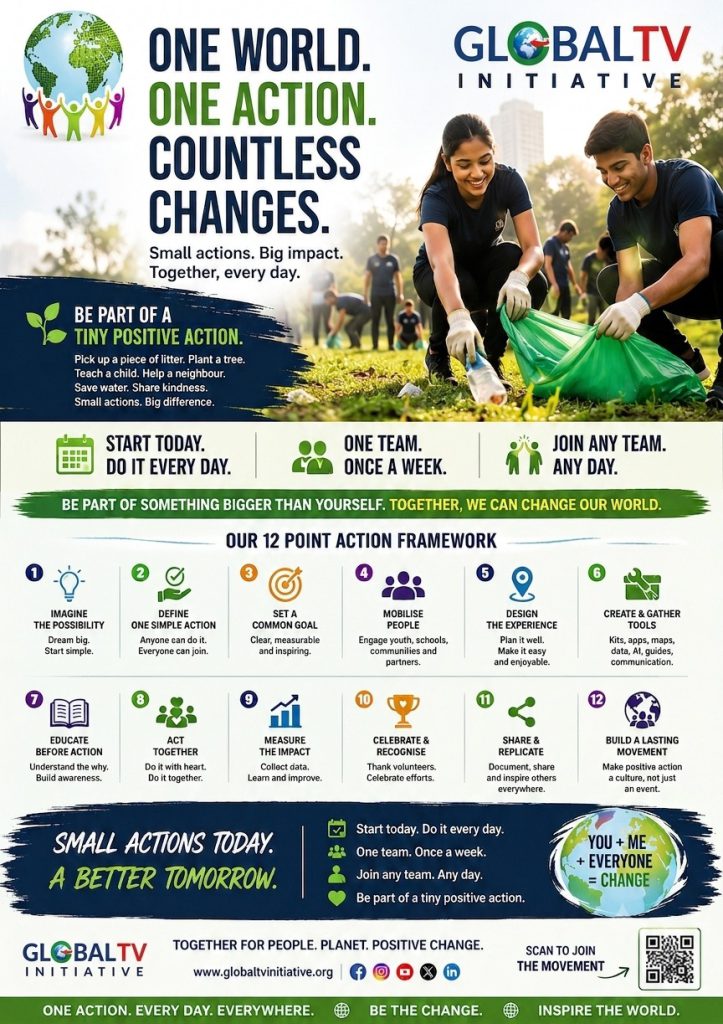
The world faces complex environmental and social challenges that cannot be solved through awareness alone. Real transformation begins when people move from understanding problems to taking meaningful action. The Global TV Initiative has created a powerful three-level action framework designed to empower individuals, communities, and organizations to create measurable and lasting change.
By transforming simple daily choices into collective responsibility, this movement guides people from personal commitment to community participation and ultimately toward proactive prevention.
Level 1: The Foundation
One World. One Action. Countless Changes.
Every movement begins with a single step.
Level 1 focuses on building awareness and inspiring individuals to adopt simple positive habits that create a ripple effect across society.
The message is simple: Small actions create extraordinary impacts.
Key Highlights:
Individual Responsibility
Everyone has the power to contribute. Actions such as picking up litter, planting trees, conserving water, reducing waste, or helping educate a child can create meaningful change.
Daily Commitment
The initiative encourages every person to take at least one positive action every day, transforming responsibility into a way of life.
The 12 Point Action Framework
A guided journey that takes participants from “Imagine the Possibility” to “Build a Lasting Movement,” helping transform ideas into sustainable action.
Core Philosophy:
“You + Me + Everyone = Change.”
Level 2: The Action Phase
Spot It. Stop It.
Awareness becomes powerful when it leads to action.
Level 2 moves participants beyond personal habits and empowers them to become active citizens who identify challenges, report issues, and work together to create solutions.
Key Highlights:
Observe and Report
Citizens are encouraged to recognize environmental and community challenges, document them, and bring attention to issues that require action.
Collaborative Problem Solving
By connecting citizens with local authorities, community groups, and NGOs, reported issues can become opportunities for collective solutions.
Technology-Enabled Tracking
Digital platforms help monitor reports, verify progress, highlight achievements, and celebrate community success stories.
Core Philosophy:
“Small problems today can become bigger problems tomorrow. Your awareness. Your report. Our change.”
Level 3: Proactive Prevention
Click Before a Pick.
The next evolution of responsibility is prevention.
Level 3 introduces a proactive approach where citizens do not simply respond to problems. They help prevent them before they happen.
Key Highlights:
Document First: “Click It”
Before removing waste or solving an issue, citizens capture clear evidence through photographs. This creates a verified record that helps track patterns and measure impact.
Prevent Harm: “Stop It”
By encouraging accountability and awareness, communities can discourage harmful actions such as littering and environmental neglect.
Create Data Driven Change
Every documented intervention becomes valuable information that can help organizations and authorities identify root causes and develop long term solutions.
Core Philosophy:
“Stop before an adverse action. Build an alert, responsible, and accountable society through documentation and prevention.”
The Strategic Progression
Level
Main Focus
Primary Action
Ultimate Goal
Level 1
Awareness and Daily Habits
Perform small positive actions
Create an action oriented mindset
Level 2
Identification and Reporting
Spot and report community issues
Enable community driven solutions
Level 3
Prevention and Verification
Click before you pick and intervene responsibly
Build an alert, accountable society
Join the Movement Today
Change begins with one person, one decision, and one action.
Whether you are picking up a single piece of plastic, reporting a community concern, or documenting a problem before it happens, your action contributes to creating a cleaner, safer, and more responsible world.
Together, we can build a future where every citizen becomes a guardian of the planet and every community becomes a force for positive change.
One Action. Every Day. Everywhere.
Join the Global TV Initiative movement and become part of the change.
Call to Lead an Action on a Regular Basis +91 98441 82044
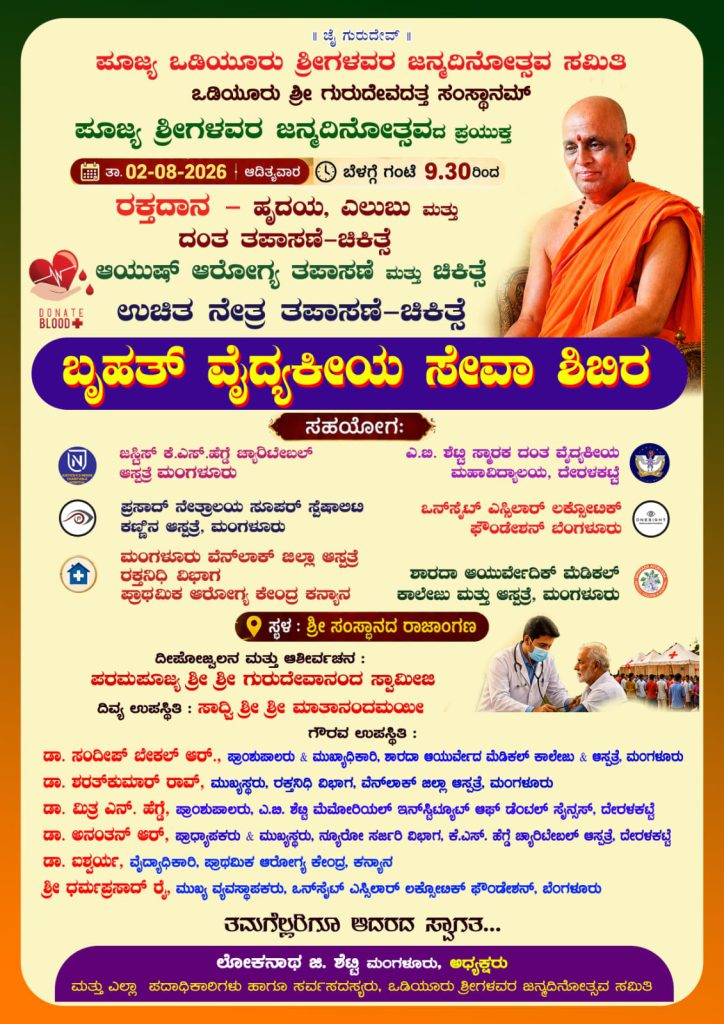
Odiyur Shri Gurudevadatta Sansthanam to Organise Mega Free Medical Camp on August 2
NV Paulose, Chairman. Global TV +91 98441 82044
Odiyur, Karnataka | August 2, 2026
As part of the birth anniversary celebrations of Poojya Odiyur Shri Gurudevananda Swamiji, the Birth Anniversary Celebration Committee of Odiyur Shri Gurudevadatta Sansthanam will organise a Mega Free Medical Service Camp on Sunday, August 2, 2026, at the Rajangana of the Sansthanam.
The camp will offer a wide range of free healthcare services, including blood donation, cardiac, orthopaedic and dental check-ups and treatment, AYUSH health check-ups and treatment, and free eye screening and treatment.
The medical camp is being conducted in collaboration with Justice K.S. Hegde Charitable Hospital, Mangaluru; A.B. Shetty Memorial Institute of Dental Sciences, Deralakatte; Prasad Netralaya Super Speciality Eye Hospital, Mangaluru; Onsite Essilor Luxottica Foundation, Bengaluru; Wenlock District Hospital Blood Bank, Mangaluru; Primary Health Centre, Kaniyoor; and Sharada Ayurvedic Medical College and Hospital, Mangaluru.
The programme will begin with the lighting of the ceremonial lamp and blessings by Paramapoojya Shri Shri Gurudevananda Swamiji, in the divine presence of Sadhvi Shri Shri Matanandamayi.
Several distinguished guests from the medical fraternity will grace the occasion, including Dr Sandeep Bekal R., Principal and Chief Executive Officer, Sharada Ayurvedic Medical College & Hospital; Dr Sharathkumar Rao, Head of the Blood Bank, Wenlock District Hospital; Dr Mithra N. Hegde, Principal, A.B. Shetty Memorial Institute of Dental Sciences; Dr Ananthan R., Professor and Head of the Department of Neurosurgery, Justice K.S. Hegde Charitable Hospital; Dr Aishwarya, Medical Officer, Primary Health Centre, Kaniyoor; and Mr Dharmaprasad Rai, Chief Manager, Onsite Essilor Luxottica Foundation, Bengaluru.
The organising committee, headed by Lokanath G. Shetty, President, has extended a warm invitation to devotees and the general public to participate in the medical camp and make use of the free healthcare services.
Questioning Authority Is Only the Beginning; Creating Opportunities Is the Real Revolution
NV Paulose, Chairman, Global TV +91 98441 82044
India is witnessing an extraordinary moment in its democratic and developmental journey. Across universities, workplaces, villages, cities and digital platforms, young people are questioning authority, demanding accountability and asking difficult questions about examinations, employment, governance and social justice. Such questioning is healthy. Every vibrant democracy needs citizens who refuse to accept mediocrity, injustice and inefficiency.
But questioning alone cannot transform a nation. It can awaken society, but it cannot build institutions, create livelihoods or solve problems. The next step is leadership. The youth who have found the courage to question authority must now discover the courage to accept responsibility.
Transformation does not begin with an invitation from the government, a corporation or any institution. It begins the moment individuals decide that they will become part of the solution instead of remaining permanent critics of the system. India’s future will not be shaped merely by those who govern. It will be shaped equally by those who choose to act.
Beyond Protest: Leadership Begins with Responsibility
History teaches us that every generation has questioned the generation before it. Many of society’s greatest reforms emerged because young people challenged established ideas. But history also teaches another important lesson: every successful movement eventually produces builders.
The freedom movement did not end with protests. It produced institutions. The Green Revolution was not merely about identifying food shortages. It mobilised scientists, farmers and policymakers to increase agricultural productivity. India’s digital transformation did not happen because people complained about paperwork. It happened because innovators created better systems.
Today’s youth stand at a similar crossroads.
Many believe the system has failed them. They point to unemployment, delays, corruption, examination irregularities, environmental degradation and social divisions. These concerns are real and deserve attention. Yet there is another reality that often receives less attention: inaction exists everywhere.
It is not only governments that delay action. Educational institutions postpone innovation. Businesses hesitate to invest in people. Communities wait for someone else to initiate change. Families discourage experimentation. Citizens often remain spectators instead of participants.
This collective inaction creates imbalance. The antidote is positive intervention. Instead of asking, “Who will solve this problem?” young people can begin asking, “What part of this problem can I solve?” Every neighbourhood has challenges waiting for local leadership. Every village has untapped talent. Every town has opportunities for innovation. Every district has knowledge that can be organised and shared. Leadership begins where excuses end.
Employment versus Engagement: A New National Conversation
India has traditionally measured success through employment statistics. Employment is undoubtedly important. Every young person deserves the opportunity to earn a dignified livelihood. Yet employment alone cannot define a meaningful life.
A person may be employed but disengaged, performing routine tasks without creativity or purpose. Another person may initially earn modestly but remain deeply engaged in solving problems, building networks and creating value. Over time, the second individual often creates far greater impact.
India therefore needs a new conversation; not Employment versus Unemployment, but Employment versus Engagement. Engagement means participating actively in improving society.
An engineering graduate can organise repair clinics for rural equipment. A commerce student can teach financial literacy. Medical students can conduct preventive health awareness programmes. Law students can educate citizens about legal rights. Technology professionals can train children in digital skills.
Retired teachers can mentor first-generation learners. Farmers can share innovative cultivation practices. Artists can revive local life through various forms of arts. Each of these initiatives creates knowledge, confidence and opportunities.
Engagement transforms idle human potential into productive social capital. The greatest waste in any country is not unemployment alone. It is the underutilisation of human capability. If millions of Indians devoted even a few hours each week to constructive community initiatives, the cumulative national impact would be enormous. Engagement generates energy. Energy generates innovation. Innovation generates opportunity. Opportunity eventually generates employment. The sequence matters.
Every initiative must now become outcome-based. For too long, we have celebrated activity without measuring impact. We organise meetings without action, workshops without follow-up, campaigns without continuity and programmes without lasting value. The era of mock initiatives must give way to real initiatives that solve real problems for real people. Whether it is a youth club, a college project, a village committee or a start-up, every effort should begin with a simple question: What value will this create, for whom, and how will we know it has succeeded? The outcomes, whether new skills, improved livelihoods, healthier communities, better learning or stronger local enterprises, should be documented, shared and replicated so that success becomes contagious.
When every initiative creates measurable value, wealth follows naturally. Wealth is not merely financial capital. It is the accumulation of knowledge, trust, skills, relationships, confidence and opportunity. As these forms of wealth multiply, economic prosperity also expands. India therefore needs a bottom-up economic revolution in which millions of citizens become creators rather than consumers of opportunity. Every neighbourhood can become an innovation hub, every village a centre of entrepreneurship, every educational institution a laboratory for problem solving and every citizen a contributor to national development. When people stop waiting for solutions and start creating value where they are, the nation does not merely grow. It transforms itself into an economy driven by participation, purpose and shared prosperity.
From Workers to Knowledge Workers: India’s Next Evolution
Industrial societies depended largely on physical labour. Success was measured by the number of workers employed in factories and production units. The twenty-first century demands something different. India must evolve from producing workers to nurturing knowledge workers.
Knowledge workers create value through ideas, creativity, analysis, collaboration and innovation. They solve problems instead of merely performing assigned tasks. They continuously learn and help others learn. Artificial Intelligence will accelerate this transformation.
Many fear AI because they believe machines will replace jobs. While certain routine tasks will indeed become automated, entirely new opportunities will emerge for those who possess curiosity, adaptability and problem-solving abilities. The challenge is therefore not simply technological. It is educational.
Schools, colleges and universities must cultivate lifelong learners instead of examination specialists. Young people should develop the capacity to ask questions, integrate knowledge from different disciplines and apply learning to real-world problems.
Every Indian district possesses unique knowledge: traditional agriculture, local crafts, biodiversity, healthcare practices, entrepreneurship, culture and history. Organising this knowledge, digitising it and sharing it globally can generate livelihoods while preserving heritage.
Knowledge multiplies when shared. Unlike physical resources, it grows through collaboration. India’s demographic dividend will become a demographic advantage only when its youth become creators of knowledge rather than passive consumers of information.
Education for Innovation and Sustainability
Education must prepare people not only to earn a living but also to solve problems and sustain life. For decades, education has been organised around acquiring information and securing employment. The next era demands something different. Education must become a continuous process of innovation, experimentation and value creation. Every learner should leave school or university with the confidence to identify a local problem, assemble a team, design a solution and measure its outcome. Innovation is not an activity reserved for scientists or entrepreneurs. It is a habit of looking at familiar challenges with fresh eyes and creating practical solutions that improve everyday life.
Nature itself teaches us the principle of sustainability. We do not depend upon a blood bank for our daily survival. Our bodies continuously generate, circulate and recycle blood through an extraordinary natural system. Society must learn from this wisdom. Instead of waiting endlessly for external support, communities should develop the capacity to generate and regenerate their own knowledge, skills, leadership and opportunities. Sustainable development begins when every community becomes capable of renewing its own resources instead of depending entirely on outside intervention.
Everything becomes possible when people organise themselves into purposeful teams with clearly defined roles. Every meaningful initiative requires thinkers, organisers, communicators, mentors, trainers, researchers, technologists and community leaders. When these roles are distributed wisely, ordinary citizens achieve extraordinary outcomes. India has millions of educated young people searching for meaningful work. One of the largest untapped opportunities lies in connecting people through stories. Every successful farmer, artisan, teacher, entrepreneur, innovator and social worker has a story that can inspire others. Documenting these stories, presenting them through digital platforms, conducting learning journeys, building knowledge networks and facilitating collaborations can itself become a sustainable revenue model. Knowledge has economic value when it helps others learn, innovate and succeed.
The Indian telecom revolution offers an important lesson. There was a time when long distance telephone calls were expensive and available only to a privileged few. The breakthrough did not come simply from better technology. It came from reimagining access. The nationwide network of STD booths allowed ordinary citizens to become entrepreneurs with modest investments. Affordable call rates encouraged people to communicate more frequently. Lower prices did not reduce the market. They expanded it dramatically. Greater access created greater demand. Greater demand created millions of conversations, thousands of small businesses and widespread economic activity. The telecom revolution demonstrated that when technology, affordability and entrepreneurship come together, an entire nation benefits. Education must now achieve a similar transformation. Instead of treating knowledge as something to be stored within classrooms, we should make it widely accessible, encourage people to share it, create value from it and enable millions of educated Indians to build careers by connecting people, ideas and opportunities. This can become India’s next great revolution, driven not merely by information but by innovation, sustainability and shared prosperity.
Creating Opportunities for Others is also an opportunity
Success has traditionally been measured by personal achievement. How much do I earn? What position do I hold? How influential am I? These questions are understandable, but they are incomplete. The defining question of this century should be:
How many opportunities have I created for others?
Creating opportunities is perhaps the greatest opportunity available today. An entrepreneur who employs fifty people creates fifty futures. A teacher who inspires one thousand students shapes one thousand journeys. A mentor who guides young innovators creates businesses that may employ thousands.
A volunteer who helps women form self-help groups creates financial independence. A software developer who builds an educational platform empowers millions. Opportunity creation has a multiplier effect. This philosophy should become a national movement.
Every citizen can ask a simple question each week:
“How many people became more capable because of my efforts?” If every educated Indian mentored just five young people annually, the nation’s learning capacity would expand dramatically. If every successful entrepreneur supported one emerging entrepreneur, innovation would spread far beyond metropolitan cities. If every retired professional shared decades of experience with younger generations, India would preserve invaluable institutional wisdom. Transformation is rarely the result of one extraordinary leader. It is usually the result of millions of ordinary people taking extraordinary responsibility.
From Protest to Participation
The concerns being expressed by Gen Z should not be viewed merely as a movement against the Government. They should be recognised as an invitation for national introspection. Every generation raises questions that compel society to examine its priorities and its direction. The responsibility for responding to these questions does not rest with the Government alone. The opposition, educational institutions, businesses, civil society organisations, professional bodies and citizens all have an equal opportunity to become part of the solution. Instead of asking who is responsible for the problem, we should ask who is willing to take responsibility for creating opportunities.
Economic wellbeing cannot be delivered only through public policy. It must become a shared national mission. Every institution in the country can create opportunities by identifying local strengths, nurturing talent, sharing knowledge and encouraging entrepreneurship. Every household can become a centre of learning, mentoring and innovation. Every enlightened individual can guide others, build networks and open doors for those who need support. When millions of citizens begin creating opportunities for one another, economic growth becomes inclusive, resilient and sustainable.
Leadership itself must be redefined. Instead of measuring leaders by the positions they hold, we should measure them by the number of people they enable. Imagine every leader aspiring to become either a 1K Leader or a 1M Leader. A 1K Leader creates, mentors and coordinates a purposeful community of one thousand people. One practical model is a 10 × 10 × 10 team structure. Ten people each mentor another ten, and each of those ten supports ten more. This simple framework creates a network of one thousand (In a strict sense, it is a teamwork of 1110 people, but in teams of 11, the mentor and 10 members team as a single team) engaged individuals who can learn together, solve problems together, and create opportunities together. Leadership then becomes a process of multiplication rather than control.
Such a model begins with thoughtful discussion, because understanding a problem is the first step towards solving it. But discussion must never become the destination. Every conversation should conclude with a clear action, a defined responsibility, a measurable outcome and a date for review. Think to understand. Discuss to refine ideas. Organise to build capable teams. Act to create measurable value. Share the outcomes so that others can learn and replicate success. A nation progresses not because it talks about change, but because every meaningful conversation is translated into sustained and purposeful action.
AI: Artificial Intelligence, Appreciative Inquiry and Additional Income
Artificial Intelligence dominates global discussions. Most conversations focus on automation, algorithms and technological disruption. Yet AI can inspire a broader philosophy. AI certainly stands for Artificial Intelligence. But for India, it can also represent Appreciative Inquiry and Additional Income.
Appreciative Inquiry encourages societies to identify strengths rather than obsess only over weaknesses. Instead of asking, “What is wrong with India?” we should also ask, “What already works well, and how can we expand it?” Every village has successful people. Every town has committed teachers. Every city has social innovators. Every district has inspiring entrepreneurs and leaders. Learning from success accelerates progress.
AI as Additional Income Through Storytelling
AI can also represent Additional Income, and one of the greatest opportunities to create it is through storytelling. Every individual has a story. Every family has a legacy. Every village has a history. Every entrepreneur has a journey. Every farmer has an innovation. Every artisan has a tradition. Every teacher has a lesson. These stories are valuable assets waiting to be discovered, documented and shared. In the knowledge economy, stories are not merely memories. They become intellectual capital that educates, inspires, connects people and creates economic value. Every story documented creates work for researchers, writers, editors, photographers, videographers, translators, designers and digital publishers.
India should organise storytelling the way the nation organises the IPL. Every successful person should become the owner, mentor and captain of a small storytelling team of ten people. We need not wait for a few large organisations to create opportunities. Instead of one industrialist managing one large enterprise, let lakhs of successful individuals each nurture a team of ten. Every team can identify local stories, document community innovations, connect people with opportunities and create knowledge assets. Thousands of such teams working across the country would become a nationwide storytelling network, creating both livelihoods and social capital.
Artificial Intelligence can make this movement faster and more effective. It can transcribe conversations, translate stories into multiple languages, organise digital archives and help distribute knowledge across the world. But technology cannot replace the human ability to listen, build trust and recognise the significance of an ordinary life. Every meaningful story begins with a human conversation. Every conversation builds relationships. Every relationship creates collaboration. Every collaboration creates new roles. Every new role creates additional income. Storytelling therefore becomes both a knowledge movement and an economic movement.
India therefore needs a human-centred AI movement where storytelling becomes the foundation of community development. Let every successful individual build and guide a team of ten storytellers. Let every district become a living repository of knowledge. Let every village document its wisdom and every town celebrate its innovators. When thousands of such teams begin working simultaneously, they will create millions of opportunities for educated youth. The next economic revolution will not be built only by large corporations or government programmes. It will be built by ordinary citizens who organise themselves into small teams, discover extraordinary stories and transform those stories into knowledge, opportunity and shared prosperity.
A People’s Movement for Career-Intensive Development
Governments naturally focus on large-scale, capital-intensive investments: highways, railways, airports, ports, digital infrastructure, manufacturing zones, renewable energy and urban development. These investments are essential because they create the physical foundation for economic growth.
Physical infrastructure alone cannot unlock India’s full potential. Alongside capital-intensive initiatives, the nation needs career-intensive initiatives led by its people. Communities can establish mentorship Teamworks. Professionals can create district knowledge centres. Universities can launch innovation clubs and innovative initiatives. Retired experts can offer career guidance.
Entrepreneurs can incubate local enterprises. Youth groups can organise skill-sharing programmes. Women’s organisations can promote financial literacy and digital entrepreneurship. Civil society can connect experienced professionals with first-generation learners.
These initiatives require modest financial investment but enormous human commitment. They create careers rather than merely jobs. They develop confidence instead of dependence. They cultivate leadership instead of passive expectation. India’s greatest resource is not its minerals, industries or technology. It is its people. When people begin investing in one another, national development acquires unstoppable momentum.
From Critics to Creators
India stands at an important turning point. Young people have demonstrated that they are willing to question authority, challenge injustice and demand accountability. These are valuable democratic contributions. But the next chapter requires something even greater. India today requires a generation that does not wait for permission to improve society. A generation that measures success not merely by employment but by engagement. A generation that evolves from workers into knowledge workers. A generation that creates opportunities rather than merely seeking them.
A generation that understands AI not only as Artificial Intelligence but also as Appreciative Inquiry and Additional Income. A generation that complements government-led capital-intensive development with people-led career-intensive initiatives. The greatest transformation in India’s history will not occur because someone at the top announces it. It will happen because millions of citizens quietly begin solving problems where they live, work and learn. The future belongs not to those who merely criticise the system, but to those who improve it. India does not need an invitation to begin its next renaissance. It needs citizens who recognise that the invitation has always been within themselves.
Twenty Five Years in the Indian Air Force: Stories Behind the Uniform | Global TV
NV Paulose, Chairman, Global TV +91 98441 82044
Some journeys are defined not by a single achievement but by the way different chapters of life come together. The story of Wing Commander Arijit Ghosh is one such journey. A cricketer who represented his state at the Ranji Trophy level, an officer who served the Indian Air Force for more than two decades, and an author who has dedicated himself to preserving the stories of air warriors, Ghosh represents a rare combination of sporting discipline, military commitment and literary passion.
His life reflects the values that connect the cricket field and the armed forces: preparation, teamwork, resilience and the ability to remain calm under pressure. His transition from sport to service was not merely a change of profession. It was a continuation of the same principles that shaped him from his early years. Through his books, articles and public conversations, Wing Commander Ghosh has brought the world of the armed forces closer to ordinary citizens. His writing does not only describe aircraft, operations or military achievements. It focuses on the people behind the uniform, their sacrifices, their families, their challenges and their unwavering commitment to the nation.
From the Cricket Pitch to the Blue Uniform: A Journey of Discipline and Purpose
Before he became known as an Air Force officer and author, Arijit Ghosh was a talented cricketer. His association with competitive cricket and his achievement of playing at the Ranji Trophy level reflected his dedication and sporting ability. Cricket teaches lessons that extend far beyond the boundary line. It demands patience, teamwork, strategic thinking and the ability to perform when expectations are high. These qualities later became valuable assets during his years in uniform.
The decision to join the Indian Air Force marked the beginning of a new chapter. The sporting field and the military environment may appear different, but both require a strong sense of discipline and collective responsibility. In both worlds, individual performance matters, but success depends on trust among teammates. The transition also reflected a deeper desire to contribute to something larger than personal achievement. The recognition and challenges of sport gave way to the responsibility of national service. The cricket bat was replaced by the Air Force uniform, but the commitment to excellence remained unchanged.
Twenty Five Years in the Indian Air Force: Stories Behind the Uniform
During his long association with the Indian Air Force, Wing Commander Ghosh experienced the unique demands of military life. Service in the Air Force requires technical knowledge, emotional strength and the ability to make important decisions under challenging circumstances.
As an Air Traffic Controller, he worked in an environment where accuracy and alertness were essential. Every movement in the skies requires coordination, communication and responsibility. The role demanded not only professional expertise but also the ability to remain composed in situations where every second mattered. The most meaningful part of his Air Force journey was not only the technology or operations. It was the people. Military life creates bonds that are difficult to explain to those outside the forces. Officers and personnel serve in demanding conditions, often away from their families and familiar surroundings. They share experiences that create lifelong friendships and a deep sense of belonging.
These encounters shaped his understanding of the human side of defence service. Behind every mission are individuals with personal stories, aspirations and sacrifices. It was this realisation that later inspired him to document the experiences of air warriors.
Preserving the Legacy of Air Warriors Through Writing
After his years of active service, Wing Commander Ghosh found another way to continue contributing to the armed forces. Through writing, he became a chronicler of courage and commitment.
His books, including Air Warriors and Air Warriors 2, aim to preserve the memories and experiences of those who have served in the Indian Air Force. These works bring attention to the dedication of personnel whose contributions often remain unknown outside military circles.
His approach to writing is not limited to recording events. He focuses on the emotions, challenges and personal journeys of air warriors. The result is a collection of stories that allows readers to understand the sacrifices behind national security. Military history is often presented through major battles, aircraft, strategies and commanders. Wing Commander Ghosh adds another important dimension by highlighting the individual. The young officer adjusting to a new posting, the family supporting a loved one in uniform, and the personnel performing their duties without public recognition all become part of the larger story.
Through his books and articles, he has helped ensure that these experiences are not forgotten. His work serves as a bridge between the armed forces and society, allowing civilians to understand the dedication and professionalism that define military service.
Beyond Service: A Voice for Military History and Strategic Awareness
Wing Commander Ghosh’s interests extend beyond personal memories of service. He has developed a reputation as a writer and commentator who explores military history, defence awareness and strategic issues. His writings on historical events, including the Christmas Truce of 1914 during the First World War, demonstrate his interest in the human dimensions of conflict. The episode remains significant because it showed moments of humanity even during one of history’s most devastating wars.
His articles on military synergy and cooperation reflect his understanding of the evolving nature of warfare. Modern conflicts require coordination, integration and cooperation between different capabilities. The importance of joint operations and strategic thinking has become increasingly significant in contemporary defence planning.
What makes his work distinctive is his ability to communicate complex subjects in an accessible manner. Defence matters can sometimes appear distant or technical, but Ghosh presents them through stories and explanations that connect with a wider audience. His role today extends beyond that of a former officer. He is a storyteller, historian and communicator who continues to share the lessons of service with a new generation.
A Legacy Built on Service, Sport and Storytelling
Wing Commander Arijit Ghosh’s journey is a reminder that a person’s contribution does not end when one chapter closes. The values learned on the cricket field strengthened his military career, and the experiences gained in uniform inspired his writing.
From representing himself on the cricket ground to representing the nation in the Air Force, his life has been shaped by commitment and purpose. His books and articles ensure that the stories of countless air warriors reach a wider audience. Through his work, Wing Commander Ghosh continues to honour those who serve and reminds society that behind every uniform is a human story waiting to be told.
The next chapter of India’s development is about creating wealth through Massive and Collective Collaboration | The Beehive Model | Global TV
NV Paulose, Chairman, Global TV +91 98441 82044
A beehive does not become prosperous because it collects taxes from its honeybees. It becomes prosperous because every honeybee contributes to creating value. Every bee has a role. Every role strengthens the hive. Every effort produces wealth for the entire colony.
That is perhaps the greatest lesson nature offers humanity | Welcome Heneybees
India stands at a historic moment. We are one of the youngest nations in the world. We possess extraordinary human capital, creative minds, technological capability, cultural diversity, and entrepreneurial spirit. Yet our greatest challenge is not the shortage of talent. Our challenge is the absence of organised collaboration that converts talent into lasting wealth.
For generations, governments have naturally focused on administration, regulation, and revenue collection. Revenue is necessary for every nation. But the next era demands something much larger. India must become a nation whose first instinct is wealth creation. Every policy, institution, university, industry, and citizen should ask one simple question. How do we create more value for society before we discuss how to distribute it?
The future belongs to countries that organise people into productive teams, create meaningful roles, encourage innovation, and convert ideas into sustainable economic activity. Nature has already written the blueprint. The honeybees have simply demonstrated it.
Team formation, role creation, and revenue action must replace isolated individual effort as the foundation of India’s economic thinking and national development.
Every successful civilisation has mastered one principle. Great achievements are never produced by isolated individuals. They are produced by organised teams performing clearly defined roles. India must consciously become a nation that creates teams rather than merely creating jobs. Every district can become a centre for specialised teams. Every university can become a platform for multidisciplinary collaboration. Every entrepreneur can become a team builder. Every village can become a production partner. Every city can become an innovation hub. Every metro can become an international gateway connecting India with the world.
Role creation is equally important. Many talented people remain unemployed not because they lack ability but because traditional job descriptions fail to recognise emerging opportunities. The twenty first century demands entirely new professional identities. The traveller who connects cultures creates economic opportunity. The mentor who develops young entrepreneurs creates future industries.
The connector who introduces businesses, investors, researchers, artists, hospitals, universities, and governments creates value that multiplies across society. These are not supporting roles. They are wealth creating professions. Revenue action must also acquire a broader meaning. Revenue should not begin with taxation. Revenue should begin with value creation. When millions of citizens build products, services, ideas, knowledge, and partnerships, national revenue grows naturally because wealth has first been created.
Every profession should collaborate with every other profession because the greatest economic opportunities exist at the intersection of industries and human imagination.
India has traditionally organised education and business into separate streams. Commerce works separately from science. Tourism operates separately from media. Agriculture develops independently of technology. Healthcare grows independently of hospitality. Education functions independently of industry.
The future belongs to integration.
Imagine Global Television Storytelling Packages combined with Tourism Packages. A documentary about India’s cultural heritage immediately becomes an invitation for international visitors. Every programme becomes both education and tourism promotion. Every destination becomes a classroom. Every traveller becomes a storyteller.
Imagine healthcare combined with hospitality, wellness, artificial intelligence, medical research, language services, and cultural tourism. Imagine education combined with entrepreneurship, international exchange, digital technology, manufacturing, and community development. Imagine agriculture working together with biotechnology, logistics, financial services, food processing, tourism, and environmental conservation. The greatest businesses of the future will not belong to one industry. They will belong to those who connect many industries into one integrated experience. Collaboration is no longer optional. It is becoming the world’s most valuable competitive advantage.
Premium Combo Packages can transform India’s abundant knowledge, culture, healthcare, education, tourism, and innovation into global wealth creating ecosystems.
The modern customer no longer purchases isolated products. People increasingly seek complete experiences. India should therefore become the global leader in Premium Combo Packages. A visitor should not simply purchase a medical treatment. The visitor should receive an integrated healthcare journey including consultation, accommodation, rehabilitation, cultural experiences, local travel, language support, nutrition guidance, wellness programmes, and continued digital follow-up after returning home.
An international student should not merely enrol in a university. The student should experience industry internships, entrepreneurship mentoring, cultural immersion, language learning, innovation laboratories, research partnerships, and career networking. Tourists should not merely visit monuments. They should receive storytelling experiences, local cuisine, traditional arts, village immersion, educational workshops, environmental activities, and digital memories that remain valuable long after the journey ends.
Premium does not necessarily mean expensive. Premium means thoughtfully designed. Premium means complete. Premium means delivering exceptional value through intelligent integration. India has every ingredient required to become the world’s largest creator of affordable premium experiences.
India can become the world’s preferred destination for affordable healthcare, education, innovation, and human connection by exporting complete experiences instead of isolated services.
For decades, India has earned international respect for producing outstanding doctors, engineers, scientists, teachers, researchers, entrepreneurs, and information technology professionals. The next transformation is to organise these strengths into one globally recognised ecosystem. Imagine international families choosing India because they receive world class healthcare at affordable prices together with wellness programmes, educational opportunities for children, cultural experiences, tourism, and lifelong digital medical support. Imagine students choosing India because universities collaborate directly with industries, research laboratories, innovation centres, startup ecosystems, and global mentors. Imagine entrepreneurs arriving not only to invest but to discover collaborators across every discipline.
Imagine retired professionals travelling throughout India as mentors, connecting young innovators with investors, universities, industries, and governments. Travel, mentoring, and connecting people should become recognised engines of economic development. The connector who creates one hundred meaningful collaborations contributes more to national prosperity than many conventional occupations. The mentor who enables ten successful entrepreneurs creates employment for thousands. The traveller who introduces India’s strengths to the world becomes an ambassador of national development. These are professions worthy of recognition, respect, and investment.
The capital of a beehive is its honeybees. The capital of India is its people. When every citizen becomes a creator, every team becomes an innovation centre, every profession collaborates with others, every journey creates knowledge, and every connection generates opportunity, India will no longer compete merely as a large economy. India will become the world’s greatest platform for wealth creation, affordable excellence, and human collaboration. The future will belong to those who create the most value together.