
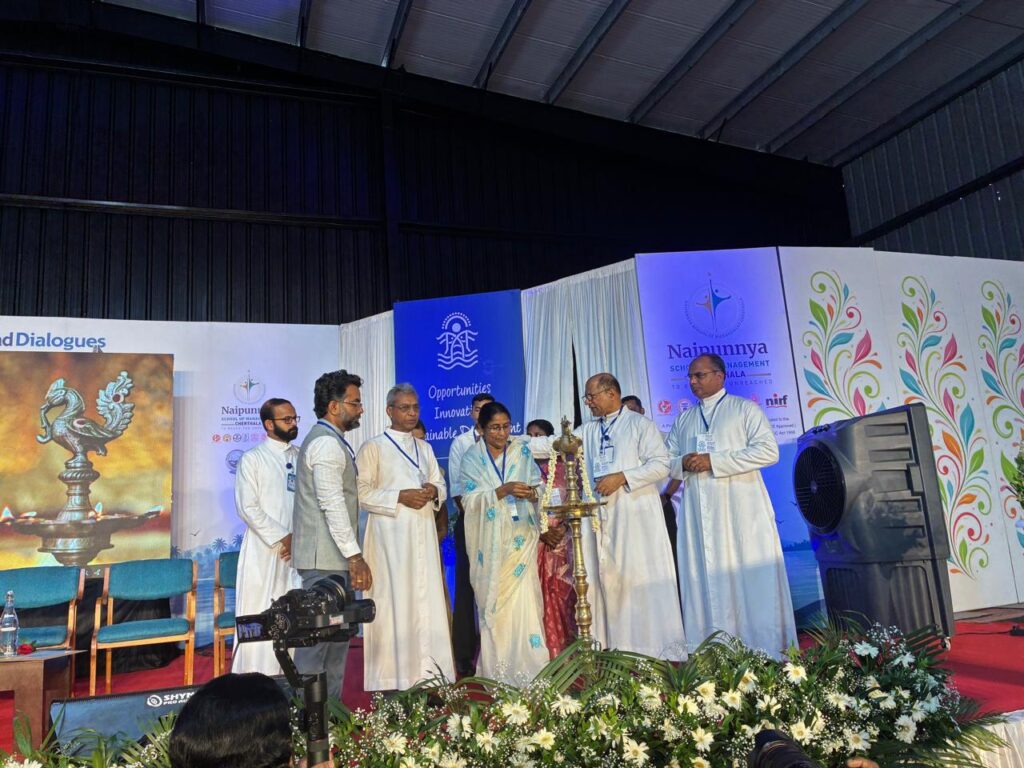
Inaugurating the symposium, Shanimol Osman highlighted this wider perspective. Her message was optimistic.
NV Paulose , Chairman, Global TV +91 98441 82044
At the Global Symposium on Keralam’s Blue Economy in Cherthala, Deputy Speaker Shanimol Osman presented a vision in which the sea is not merely a resource to be used, but a living system to be respected, protected and connected with Kerala’s people, education and economy.
The future of Kerala may be inseparable from the sea. With its long coastline, ports, backwaters, rivers, fishing communities and maritime traditions, the state possesses an extraordinary combination of natural and human resources. But transforming this potential into a sustainable blue economy requires more than infrastructure and investment. It requires a change in the way we look at the sea and its relationship with our lives.
Inaugurating the symposium, Shanimol Osman highlighted this wider perspective. Her message was optimistic. Kerala has enormous possibilities before it, but those possibilities can be realised only when development goes together with respect for the sea and protection of its ecological wealth.
The Sea Is More Than a Resource
Transforming Kerala to a fast growing economy through collective collaboration | Vembanadu Dialogue
The sea is often viewed through the narrow lens of fisheries, ports, tourism or shipping. Its significance, however, is much greater. It connects nations, economies and communities. It carries food, energy, people and trade. It supports millions of livelihoods and influences climate and ecosystems.
Shanimol Osman’s reference to the Strait of Hormuz brought this global dimension into focus. Hormuz demonstrates how a relatively narrow maritime passage can have enormous consequences for the world economy. It reminds us that the sea is not an empty space separating countries. It is one of the great networks through which the modern world functions.
Team Conversation Organising Team sharing pleasantries | Organisers of Vembanadu Dialogues Cherthala
For Kerala, the lesson is equally important. The Arabian Sea is not simply on the western edge of the state. It is part of Kerala’s economic geography and its future possibilities.
But the first principle must be respect.
The blue economy cannot mean taking everything possible from the sea. It must mean understanding the sea, protecting marine ecosystems and building economic activity around the capacity of nature to sustain itself.
Mission Samudra and a Connected Kerala
This vision has acquired a concrete policy dimension through Mission Samudra, the ₹400 crore initiative announced by Chief Minister V D Satheesan in the 2026 27 Budget. The programme seeks to integrate Kerala’s coastline, ports and inland waterways and strengthen the state’s position in the global maritime economy.
Mission Samudra is envisaged not simply as a port development programme. Its broader idea is to connect the sea, roads, railways, inland waterways, logistics and industry into one economic system. The government has identified Vizhinjam and Kochi along with Kerala’s other ports and waterways as components of a wider maritime network. Plans include logistics facilities, manufacturing and processing zones, shipbuilding and maritime services, while Vizhinjam is being positioned for green bunkering.
The significance of this approach lies in connectivity. A port becomes much more valuable when it is efficiently connected to the interior of the state. A fisherman benefits when the value chain around fisheries becomes stronger. A manufacturer benefits when goods can reach international markets efficiently. A tourism destination benefits when transport and maritime infrastructure are thoughtfully integrated.
The blue economy can therefore become a networked economy, connecting Kerala’s villages and towns with national and international markets.
People Must Remain at the Centre
Infrastructure alone cannot create a blue economy. People are the most important part of the equation.
Kerala’s fishing communities possess generations of knowledge about the sea. Coastal families understand seasonal patterns, currents, marine life and changing conditions in ways that cannot simply be reproduced in a textbook. Farmers, boat operators, coir workers, tourism professionals, scientists, entrepreneurs and young people all contribute different forms of knowledge.
A future blue economy must bring traditional knowledge and modern science together.
It must also ensure that coastal communities participate in the opportunities created by new investments. Ports, logistics centres, shipbuilding, marine tourism, aquaculture, research and maritime services should generate skills and employment for local populations and create opportunities for communities to participate in the new economy.
The real measure of a blue economy is therefore not only the amount of investment it attracts. It is also the extent to which it improves people’s lives while preserving the ecosystems on which those lives depend.
The Challenge of Students Going Abroad
Usman also drew attention to another issue deeply connected with Kerala’s future: the large number of students seeking higher education abroad, including cases where students may enrol in institutions that do not provide the academic standards or recognition they expected.
The answer is not to discourage young people from gaining international exposure. International education can bring valuable knowledge, experience and connections. The larger question is whether Kerala can create strong educational opportunities at home so that going abroad becomes a choice rather than a necessity.
This is where the proposed Kerala Knowledge Valley becomes significant.
The 2026 27 Budget allocated ₹100 crore for the Knowledge Valley initiative, with the stated objective of attracting leading international universities and strengthening Kerala as a destination for higher education, research and innovation. The government has proposed changes to the private university framework to facilitate the entry of internationally reputed universities and premier institutions.
The vision extends beyond simply bringing university names to Kerala. The larger opportunity is to create an ecosystem in which universities, research centres, industries, start ups and students interact with one another.
Such an ecosystem could be particularly valuable for the blue economy. Kerala will need ocean scientists, marine engineers, environmental experts, logistics professionals, maritime lawyers, data scientists, tourism specialists, entrepreneurs and skilled workers. Research centres can work with ports and industries. Universities can develop new technologies. Young entrepreneurs can turn research into businesses.
Education therefore becomes an important part of blue economy infrastructure.
A Knowledge Powered Blue Economy
This creates an important connection between the two themes of Usman’s address.
Mission Samudra can build maritime infrastructure.
Knowledge Valley can build human capacity.
One can connect Kerala to the world through the sea. The other can connect Kerala’s young people to the world through knowledge.
Together, they suggest a future in which Kerala does not merely send its students and skilled people elsewhere, but increasingly attracts knowledge, research, investment and talent into the state.
This could be particularly important for the blue economy, where tomorrow’s opportunities may lie in fields that are rapidly developing, including marine biotechnology, sustainable aquaculture, ocean data, climate science, renewable energy, green shipping, marine robotics, coastal resilience and new forms of maritime logistics.
A Future Vision for Kerala
The vision emerging from Cherthala is therefore larger than the development of another economic sector.
It is a vision of a Kerala that knows the value of its natural resources, respects the sea, protects its ecosystems, empowers its coastal communities and invests in the knowledge and aspirations of its young people.
The sea can become a highway for trade. Ports can become gateways to global markets. Backwaters can support sustainable tourism and livelihoods. Universities can become centres of marine research. Young people can become entrepreneurs and innovators. Traditional communities can contribute knowledge accumulated over generations.
But all these elements must remain connected.
The future blue economy should not separate the economy from ecology, infrastructure from people, or education from employment. It must recognise that they are parts of one system.
That is the larger message behind the optimism expressed by Shanimol Usman. Kerala has the opportunity to build a model in which development and environmental responsibility are considered together.
Respect the sea. Protect the sea. Understand its resources. Invest in its people. Build knowledge around it. Connect Kerala’s natural wealth with the aspirations of its next generation.
That is not merely a plan for a blue economy. It is a vision of Kerala’s future


