
Language, Education and the Courage to Question: Deepa Bhasthi at the P. P. Gomati Education Trust Annual Lecture
NV Paulose, Chairman, Global TV +91 98441 82044
Writer and translator Deepa Bhasthi delivered an engaging and thought-provoking address at the annual lecture organized by the P. P. Gomati Memorial Education Trust. Drawing from her personal experiences as a student, reader, writer and translator, she reflected on the importance of education, language, democracy and critical thinking in contemporary society.
The event was held in honour of Professor P. P. Gomati, a distinguished educator whose lifelong commitment to women’s education and social progress continues to inspire students and educators alike. The values she championed provided a fitting context for Bhasthi’s reflections on learning, inclusion and social responsibility.

At the beginning of her address, Bhasthi spoke warmly about the teachers who had shaped her intellectual journey. She paid special tribute to Dr. D. S. Poornananda, whom she described as one of her favourite teachers at Mangalore University. She recalled that his classes had profoundly influenced her way of thinking and had almost single handedly transformed her worldview. The intellectual perspective she first encountered under his guidance, she said, continues to inform her writing and public engagements to this day.
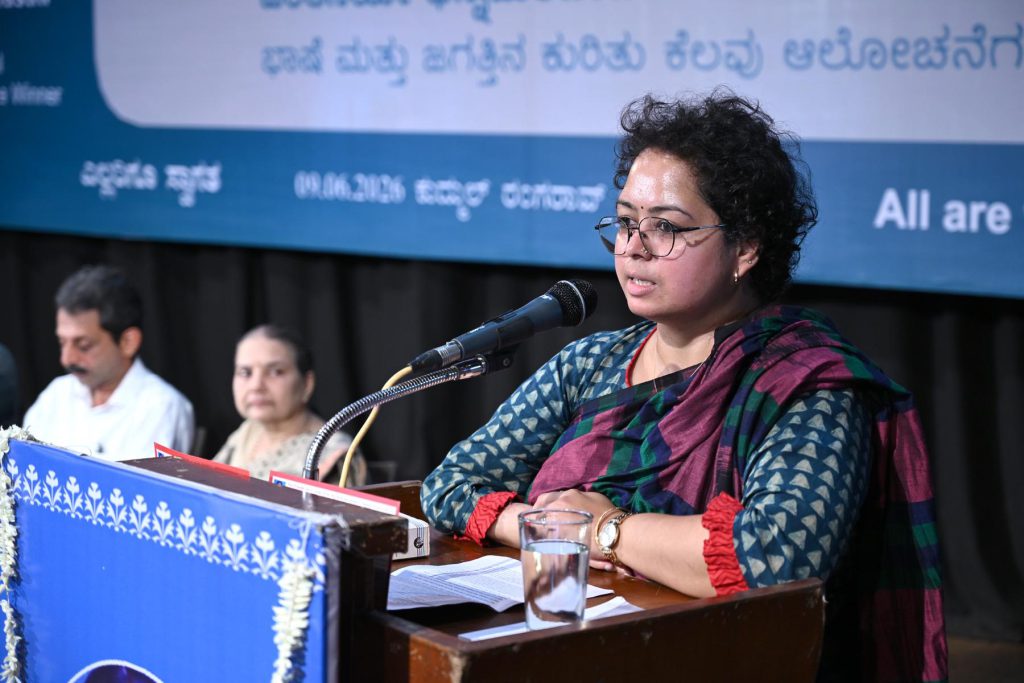
Bhasthi also remembered the late Professor Pattabhirama Somayaji, her English teacher and mentor, who helped her imagine a life devoted to ideas, literature and learning. Growing up in the small town of Madikeri, she said, his encouragement made her believe that an intellectual life was not only possible but attainable. She acknowledged that without the generosity and guidance of teachers such as these, she would not have reached the place she occupies today as a writer and translator of international standing.
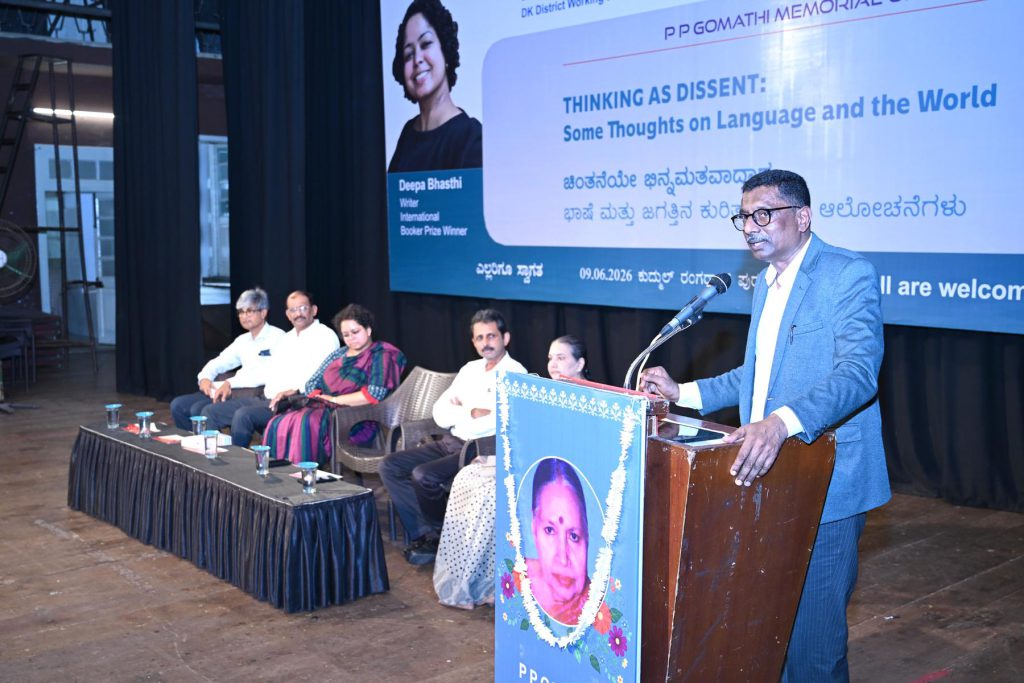
Education, she suggested, is not simply a means to secure employment or achieve social mobility. It is a way of learning how to engage with the world and understand one’s place within it.
A major theme of the lecture was the significance of language. Reflecting on the international recognition she received for her work as a translator, Bhasthi noted that global acclaim had strengthened her connection to Kannada rather than weakened it. She spoke of the privilege of introducing Kannada literature to readers across the world and of representing a language that remains relatively unfamiliar outside its linguistic region.
For Bhasthi, language is much more than a tool for communication. It carries memories, histories, traditions, stories, music and collective experiences. It shapes how communities understand themselves and how they relate to the world around them.
At the same time, she argued that love for a language should not be blind. Genuine affection requires engagement, reflection and a willingness to acknowledge shortcomings. Languages remain vibrant only when they are actively used, enriched and adapted to changing circumstances.
This idea informed her broader reflections on citizenship and democracy. Bhasthi emphasized that love for one’s country should not be confused with loyalty to a government. In a democracy, she argued, questioning authority and expressing disagreement are not acts of disloyalty. Rather, they are essential aspects of democratic participation. The ability to ask difficult questions and challenge injustice helps preserve the values on which democratic societies are built.
Another significant aspect of her address was the celebration of linguistic diversity. While expressing her deep attachment to Kannada, Bhasthi reminded the audience that Karnataka is home to many languages, including Tulu, Kodava, Konkani, Beary and Malayalam. Each language, she observed, represents a unique cultural inheritance and deserves equal respect. The value of a language cannot be measured by the number of its speakers, its age or the existence of a written script.
Throughout the lecture, Bhasthi returned to the themes of inclusion and equality. Echoing the ideals associated with Professor Gomati’s life and work, she highlighted the continuing importance of education, especially for women and marginalized communities. Education, she maintained, remains one of the most powerful means of creating a fairer and more humane society.
The lecture ultimately served as a reminder that learning involves more than acquiring information. It requires curiosity, empathy and the willingness to think critically. Through her reflections on language, education and democracy, Deepa Bhasthi encouraged the audience to value diversity, engage thoughtfully with society and retain the courage to question. In doing so, she reaffirmed the enduring relevance of the principles that Professor P. P. Gomati dedicated her life to advancing: education, equality and the belief that informed and engaged citizens are essential to a just society.
Indian English and Multilingual Identity
Deepa Bhasthi argues that Indian English is just as rich, complex, and nuanced as varieties such as Irish English or Caribbean English. Yet, unlike those forms, Indian English is often not celebrated for its uniqueness and is instead treated as somehow inferior or “not cool enough.” She criticizes this double standard and encourages people not to be ashamed of living in multiple languages. According to her, language should be a source of freedom and expression rather than insecurity or hierarchy.
Her Strong Opposition to AI in the Arts
Bhasthi says that one of the questions she is asked most frequently is about AI. She makes her position clear: while she supports AI when it helps scientific and medical advancements, she strongly opposes its use in creative fields. She does not want AI writing books, composing music, creating paintings, or producing other forms of artistic work. In her view, AI-generated art lacks the depth, effort, and humanity that make art meaningful.
The Example of Studio Ghibli
To explain her concerns, Bhasthi discusses the famous Japanese animation studio Studio Ghibli and its co-founder, the filmmaker and animator Hayao Miyazaki. She highlights how Ghibli films are painstakingly hand-drawn, with countless hours of human labour invested in every frame. Miyazaki has long resisted excessive reliance on technology in artistic creation, and Bhasthi agrees with his criticism of AI-generated art. She argues that quickly producing “Ghibli-style” images through AI diminishes decades of dedication, craftsmanship, and creativity by artists who developed that distinctive style.
The Human Cost of AI Art
According to Bhasthi, using AI for creative work ignores the effort, struggle, learning, and emotional investment that artists bring to their craft. Art is not simply a finished product; it is the result of human experience, imagination, and perseverance. She believes that replacing these processes with machine-generated outputs strips away the humanity at the heart of artistic creation.
Technology and the Loss of Independent Thinking
Bhasthi warns that AI and algorithm-driven technologies can reduce people’s capacity to think independently. She argues that the human brain is extraordinary and has evolved over thousands of years, yet many people are increasingly willing to hand over intellectual and creative responsibilities to machines. In her view, algorithms influence what people think, wear, eat, watch, and believe, gradually encouraging conformity and limiting individuality.
Using the Internet Responsibly
Although she is critical of AI, Bhasthi does not reject technology entirely. She acknowledges that the internet is an essential and powerful tool that she uses in her own work. The internet can help people organize, question authority, express dissent, and connect with others. However, she emphasizes that individuals must retain control over how they use technology rather than allowing technology to control them.
Thinking as an Act of Dissent
A central theme of her talk is the importance of thinking critically. She urges people to question information before accepting or sharing it, especially in an age of misinformation and AI-generated content. Before forwarding messages, believing viral stories, or reacting to sensational news, people should verify facts and examine sources. For Bhasthi, independent thinking is itself a form of dissent.
Attention as a Valuable Resource
Bhasthi argues that attention is one of the most valuable resources people possess. Social media companies and powerful technology firms compete constantly for it. She notes that excessive screen use is not just a problem among young people; older generations are often equally attached to their devices. Protecting one’s attention, she says, creates space for reflection, critical thought, and personal autonomy.
Democracy and the Importance of Dissent
She stresses that dissent is essential to a healthy democracy. Asking questions, challenging authority, and expressing disagreement are not threats to democracy but vital components of it. When dissent is suppressed, democracy itself is weakened. Citizens therefore have both the right and the responsibility to think independently and voice concerns.
A Book Recommendation on Dissent
As a recommendation, Bhasthi introduces the book India: Dissent 3000 Years of Difference, Doubt and Argument, edited by Ashok Vajpeyi. The book collects writings from many traditions and periods of Indian history, including Buddhist women poets, Kabir, Sufi writers, Gandhi, Ambedkar, and others. She encourages readers to explore it because it demonstrates how questioning authority and challenging injustice have always been part of India’s intellectual and cultural traditions.
Dissent as an Indian Tradition
Bhasthi rejects the claim that dissent is a foreign or Western concept. She argues that Indian history is filled with examples of people questioning authority, resisting oppression, and debating social, religious, and political ideas. The diversity and richness of Indian society, she says, are the result of centuries of dialogue, disagreement, reform, and struggles for justice.
The Importance of Poetry and Art
Toward the end of her talk, Bhasthi encourages people to read poetry. She describes poets as voices that express truths and emotions that others may struggle to articulate. Poetry, she says, reaches the deepest parts of language and human experience. Experiencing human-made art is one of the most meaningful aspects of being alive, and poetry helps preserve that humanity.
Closing Poem and Final Message
She concludes by reading a poem by Adam Gondvi (in translation). The poem celebrates truth, resistance, and the idea that no group has exclusive ownership over a nation. Through it, Bhasthi reinforces her central message: questioning authority, defending individuality, valuing human creativity, and protecting the right to dissent are essential parts of both democracy and human life.


