
Kerala Students Develop a Pioneering Retrofitted Autonomous EV Powered by Sodium-Ion Battery
Peerumade, Kerala: In a breakthrough that blends sustainability with cutting-edge technology, a team of final-year engineering students from Mar Baselios Christian College of Engineering and Technology, Peerumade, has developed a pioneering retrofitted autonomous electric vehicle powered by a sodium-ion battery. The innovative project, named EVIO800, is gaining widespread attention for its originality, practicality, and future potential.
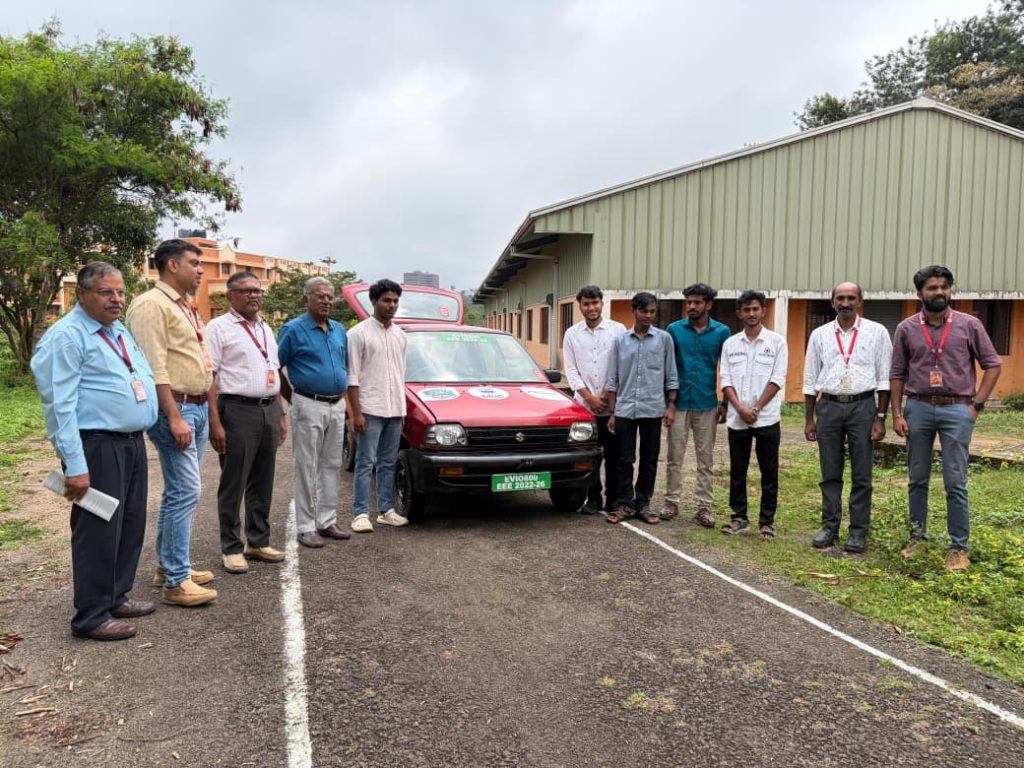
The project team comprises five students Jiss M Skaria, Nithin Rajesh, Akhil Padmajan, Anson Shaji, and Anujith Joseph who have worked collaboratively to transform a conventional vehicle into an intelligent, eco-friendly autonomous system. Their achievement stands out not only for its technical sophistication but also for its strong focus on sustainability and affordability.
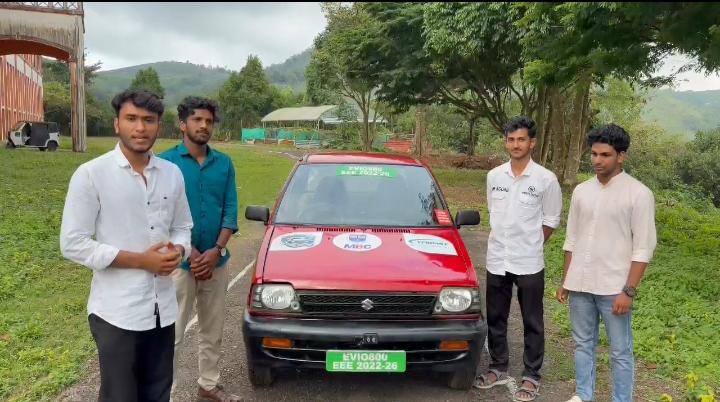
Unlike traditional electric vehicles that rely on lithium ion batteries, EVIO800 is powered by a sodium-ion battery, an emerging technology known for its abundance, lower cost, and environmental benefits. By adopting sodium ion chemistry, the team has addressed key challenges related to resource availability and long-term sustainability, making their solution especially relevant for developing regions.
The vehicle is retrofitted, meaning an existing vehicle was upgraded rather than built from scratch. This approach significantly reduces costs and demonstrates a scalable model for converting conventional vehicles into smart electric ones. The EVIO800 is equipped with advanced sensors, cameras, and onboard processing systems that enable autonomous navigation, obstacle detection, and real-time decision-making.
A major highlight of the project is its integration of artificial intelligence to optimize driving performance and energy consumption. The system ensures efficient power usage while maintaining safety and reliability, making it a practical solution for future mobility needs.
The project was sponsored by Verdant Telemetry & Antenna Systems, whose support played a crucial role in the development and successful execution of the idea. The team also benefited from guidance provided by faculty members and technical mentors throughout the project lifecycle.
Importantly, the project received full support from the Department of Electrical and Electronics Engineering, with continuous encouragement and guidance from the Head of the Department and faculty members. Their mentorship played a vital role in refining the technical design, troubleshooting challenges, and ensuring the successful completion of the project.
Speaking about their achievement, the team shared their vision of taking EVIO800 beyond the academic stage. They aim to develop this concept into a startup focused on sustainable and intelligent transportation solutions. With growing global interest in alternative battery technologies and autonomous systems, the project positions them at the forefront of next-generation mobility innovation.
This remarkable accomplishment not only brings pride to their institution but also highlights Kerala’s growing contribution to advancements in green technology. EVIO800 is not just a student project it represents a bold step toward the future of transportation, driven by innovation, sustainability, and youthful ambition.


