
A Jesuit Who Helped Shape Modern India | The Xavier Board: A Lasting Educational Legacy
NV Paulose, Chairman, Global TV +91 98441 82044
There are certain lives that cannot be confined to a single profession, institution, or generation. The life of Rev. Fr. Jerome D’Souza, SJ (1897–1977) is one such life. He was a priest, educator, scholar, administrator, statesman, diplomat, social thinker and, above all, a man deeply committed to the service of India.
Born on 6 August 1897, Fr. Jerome D’Souza belonged to the Mangalorean Catholic community. From his early years he displayed an extraordinary intellectual curiosity and a remarkable gift for languages. He eventually became proficient in several Indian and European languages. His education at St. Aloysius College, Mangalore, St. Joseph’s College, Tiruchirappalli, and the University of Madras laid the foundation for a life that would bring together education, faith and public service.
After completing his studies, Jerome began teaching at St. Joseph’s College, Tiruchirappalli. Yet the influence of the Jesuits upon him gradually awakened a deeper vocation. On 28 May 1921, he entered the Society of Jesus. After his philosophical and theological formation, including studies in Belgium and France, he was ordained a priest on 30 August 1931. His return to India marked the beginning of an extraordinary educational career.
An Educator and Institution Builder
Fr. Jerome soon became a distinguished professor and administrator at St. Joseph’s College, Tiruchirappalli. He eventually became its principal and rector. In 1938 he was appointed rector, becoming the first Indian to hold that position at the institution.

In 1942 he was transferred to Loyola College, Madras, where he again served as rector and principal. His leadership was characterised by intellectual breadth, administrative ability, courage and an unusual capacity to understand people. But Jerome’s vision of education went beyond examinations and degrees. For him, education was a means of forming responsible citizens and building a just society. He believed that educational institutions had a duty to contribute to the common good of the nation. This conviction would soon bring him far beyond the walls of a college campus.
A Jesuit in the Making of the Indian Republic
Perhaps the most extraordinary chapter of his life began in the years immediately preceding Indian independence. Fr. Jerome became acquainted with leading figures of the Indian national movement, including C. Rajagopalachari and Jawaharlal Nehru. His learning, balanced judgement and ability to engage people across political and religious boundaries earned him their respect.

In 1946, he became a member of the Constituent Assembly of India, the historic body entrusted with framing the Constitution of independent India. He served during the crucial period in which the foundations of the Republic were being debated and established. For a Catholic priest and Jesuit to participate in this process was remarkable.
Yet Jerome did not approach the Constituent Assembly merely as a representative of a religious community. His speeches reveal a much broader vision. He was concerned with how India could protect its minorities while simultaneously building a united and integrated nation. He made important contributions to discussions concerning religious freedom and minority rights and played a significant role in the debates surrounding what became Article 25 of the Constitution, which guarantees freedom of conscience and the right freely to profess, practise and propagate religion.
His approach was neither separatist nor defensive. He sought a balance between legitimate minority rights and the larger national interest. That was perhaps one of the great qualities of Fr. Jerome: he could defend the rights of his community without losing sight of the nation as a whole.
A Bridge Between Church and Nation
After independence, his public responsibilities continued to grow. In 1949, Prime Minister Jawaharlal Nehru nominated Fr. Jerome as a member of India’s delegation to the United Nations General Assembly. He eventually attended four sessions: in 1949, 1951–52, 1955 and 1957. He was also involved in matters concerning India’s international relations and questions affecting the Catholic Church in the newly independent nation.
This was an extraordinary position for a Jesuit priest. Yet it reflected the confidence that India’s political leadership placed in his judgement. Jerome was able to move comfortably between worlds that were often difficult to bring together: Church and State, faith and secular democracy, education and public policy, India and the international community.
The Xavier Board: A Lasting Educational Legacy
One of Fr. Jerome’s lesser-known but extremely significant contributions was his role in the establishment of the Xavier Board of Higher Education in India (XBHEI). The Xavier Board’s own historical account records that the organisation was established in May 1951 at St. Joseph’s College, Bangalore. Its purpose was to create a national organisation bringing together Catholic higher-education institutions in India and coordinating their educational efforts. Fr. Jerome D’Souza, SJ is explicitly listed among the pioneering figures who took the lead in this initiative.

The Xavier Board itself identifies Fr. Jerome as one of its pioneers and places his contribution in the context of his wider work in education and nation-building. This connection is particularly significant because it shows that his educational vision was not limited to the administration of individual colleges. He was thinking nationally. He understood that Catholic institutions of higher education needed cooperation, coordination, and a common voice while remaining committed to academic excellence, service, and the values of the Gospel. In this sense, Fr. Jerome helped lay the foundations for a network that continues to represent Catholic higher education in India.
Education for a Changing India
The early 1950s were years of enormous transformation. India had gained political independence, but the country still faced poverty, illiteracy, social inequality and the immense challenge of nation-building. Fr. Jerome believed that education had to respond to these realities.

In 1951, at the request of the Jesuit Superior General, he also helped establish what became the Indian Social Institute, initially in Pune. The institution was conceived as a response to India’s pressing social problems and eventually became an important centre for social research, training and action. Thus, his vision of education expanded again from colleges to national educational coordination, to social transformation.
A Man of Many Worlds
Fr. Jerome’s later years took him beyond India. In 1957, he was elected as one of the Jesuit General Assistants and went to Rome, where he served until 1968. His responsibilities brought him into contact with senior Church leaders from around the world. He also served in several ecclesiastical capacities and participated in international discussions concerning missionary and educational work.
Yet despite the extraordinary positions he held, those who knew him remembered not merely his intellect or achievements but his human qualities. The Xavier Board’s account describes him as a man whose dignity initially inspired awe, but whose youthful simplicity, warmth and friendliness became apparent with deeper acquaintance. That combination of intellectual authority with personal warmth seems to have been one of his greatest gifts anyone can retain throughout their life.
Not a Minister, But Something Quite Remarkable
It is worth returning to an important distinction. Fr. Jerome D’Souza was not a cabinet minister of the Government of India. He did not hold ministerial office in the conventional political sense. But his life demonstrates something perhaps even more interesting.
A Jesuit priest from Mangalore became a trusted participant in India’s constitutional and diplomatic life. He sat in the Constituent Assembly, contributed to debates on fundamental rights, represented India at the United Nations, worked with national leaders, helped establish the Xavier Board of Higher Education and founded an important social institution. His influence therefore cannot be measured simply by an official political title. He exercised influence through education, intellect, relationships, public service and moral conviction.
A Legacy That Continues
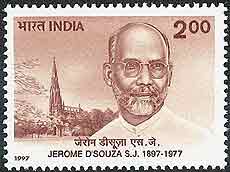
Fr. Jerome D’Souza died on 12 August 1977, leaving behind a remarkable legacy. Two decades later, in 1997, the Government of India honoured him with a commemorative postage stamp on the centenary of his birth. But perhaps the more enduring memorials are the institutions and ideals to which he gave his energy: the educational institutions he strengthened, the Xavier Board he helped establish, the Indian Social Institute he helped create, and the constitutional principles to which he contributed.
His life tells an important story about India itself. The making of modern India was not accomplished only by politicians. It was also shaped by teachers, priests, lawyers, social workers, intellectuals, administrators and countless others who believed that the new nation had to be built through education, dialogue and service. Fr. Jerome D’Souza, SJ belonged to that generation. He was a Jesuit who loved learning, an educator who believed in nation-building, a Christian who understood the importance of religious freedom, and an Indian who could speak confidently to both his country and the wider world. His story deserves to be remembered as the story of an extraordinary Jesuit, and as the story of an Indian who helped his country find its voice in the first years of the Republic.


