
Drawing a Nation’s Conscience: Indian Cartoonists on Tibet (1950 to 2025)
NV Paulose, Chairman, Global TV +91 98441 82044
History is often written by statesmen, diplomats and scholars. Yet some of the most profound truths about a nation and its times are captured not in official documents but in the strokes of an artist’s pen. Political cartoons have a unique ability to distill complex events into powerful images that linger in public memory long after headlines fade away.
Indian Cartoonists on Tibet (1950 to 2025) is a remarkable testament to this enduring power of visual storytelling. Published by Friends of Tibet Foundation and The Alcove Publishers, the book is much more than a collection of cartoons. It is a visual chronicle of seventy five years of political history, moral reflection and artistic courage.

The volume brings together the works of some of India’s finest cartoonists whose pens have followed the story of Tibet from the Chinese occupation and the Dalai Lama’s exile to changing India China relations and the continuing aspirations of the Tibetan people. Through satire, wit and poignant imagery, these artists have documented one of the most important geopolitical and humanitarian issues of modern Asia.
What makes this book exceptional is its ability to present history through the eyes of artists who were not merely observers but also commentators and, at times, the conscience of society. Every cartoon asks difficult questions about freedom, justice, diplomacy and moral responsibility. Each drawing reminds readers that the Tibet issue is not a distant historical episode but a subject deeply connected to India’s own political and strategic journey.
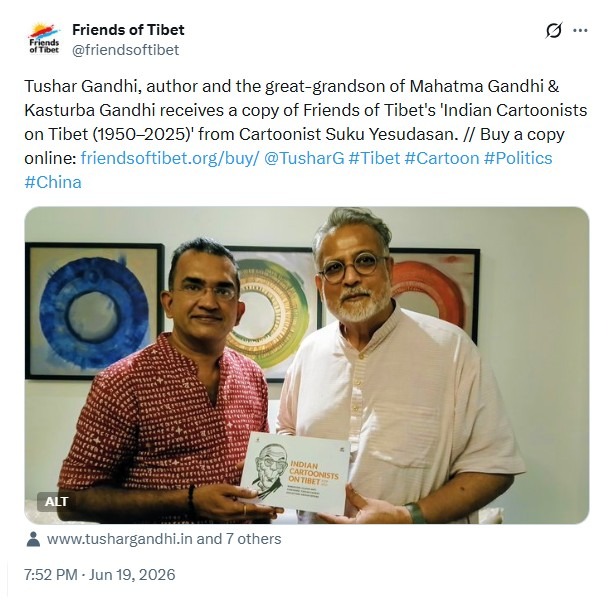
The publication has already attracted the attention of notable personalities. One memorable occasion saw celebrated cartoonist Suku Yesudasan present a copy of the book to Tushar Gandhi, the author and great grandson of Mahatma Gandhi and Kasturba Gandhi. The meeting symbolized the coming together of two powerful traditions: the Gandhian commitment to truth and non violence and the cartoonist’s role in speaking truth to power.

Another significant moment was the presentation of the book to Claude Arpi, the distinguished French born author and Tibetologist who contributed the narrative to the volume. Arpi has spent decades researching Tibet and the Himalayan world and his involvement enriches the book with historical depth and intellectual insight.
The publication also serves as a tribute to His Holiness the Fourteenth Dalai Lama, whose life and teachings have inspired generations around the world. Throughout the collection, the Dalai Lama appears not merely as a political figure but as a universal symbol of compassion, resilience and hope.
At a time when questions of borders, identity and international relations once again dominate public discourse, Indian Cartoonists on Tibet (1950 to 2025) arrives with extraordinary relevance. It reminds us that art has the power to preserve memory and challenge indifference. A single cartoon can reveal truths that lengthy speeches often fail to communicate.
This book is therefore not simply an anthology of drawings. It is a historical archive, a tribute to artistic freedom and a celebration of the enduring friendship between India and Tibet. Above all, it is a reminder that the pen remains one of humanity’s most powerful instruments of witness.
In these pages, the cartoonists of India have done more than draw history.
They have kept it alive.


