
The Heartbeat of a Language Beyond Words
NV Paulose | Rex Fernandes | Antonio Fernandes
A language is not merely a collection of words arranged to communicate thoughts, exchange information or conduct transactions. Its real beauty lies in its ability to express what the human heart feels but often struggles to articulate. Some languages communicate facts; some facilitate business; but a few possess the extraordinary ability to turn even an ordinary conversation into an expression of affection, goodwill and human connection. Konkani belongs to this beautiful category. It is not simply a language we speak; it is a language through which we care, bless, console, appreciate and embrace one another.
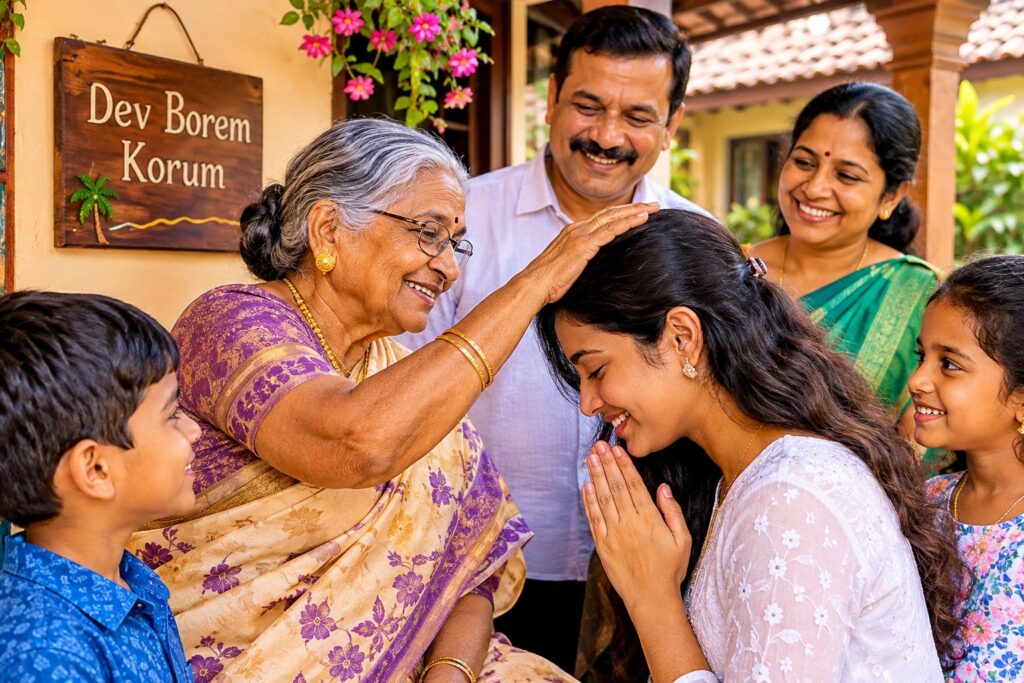
Consider the expression Dev Borem Korum. In an ordinary exchange, we might simply say “Thank you.” But the Konkani expression carries an additional emotional dimension: an acknowledgement of kindness accompanied by a wish for divine goodness upon the person. It is gratitude transformed into a blessing. Similarly, Deva Borem Kar conveys a heartfelt wish that God may bring goodness. These expressions reveal a distinctive cultural warmth: we do not merely acknowledge what someone has done for us; we extend a wish for their well-being. What could be more beautiful than allowing gratitude to become generosity of the heart?
The emotional richness of Konkani becomes even more apparent in everyday greetings. Kaso Asa? (How are you?) may appear to be a routine question, but when spoken with genuine affection, it becomes an expression of personal concern. Borem Asa? (Are you well?) goes beyond the mechanics of greeting and invites us to acknowledge another person’s well-being. The question is not merely about obtaining an answer; it creates an opportunity to connect. Even a familiar greeting can communicate, “I notice you, I remember you, and your well-being matters to me.” This is how an ordinary salutation becomes emotionally meaningful.
When Everyday Expressions Become Extraordinary Blessings
Think of Dev Borem Divos Di (May God give you a good day) and Borem Raat Zavo (May you have a good night). Such expressions transform a simple greeting or farewell into a wish for another person’s happiness. Instead of merely announcing our arrival or departure, we leave behind a positive sentiment. Similarly, Sukhant Rav (May you remain in happiness and peace) carries a warmth that goes beyond a conventional farewell. These expressions remind us that even the smallest interaction can become an opportunity to wish someone well. The beauty is not merely in the words, but in the benevolence they communicate.
Consider another deeply human expression, Kitem Zala? (What happened?). Depending on the situation and tone, this can be much more than a request for information. When someone notices that we are troubled and asks this question with concern, it becomes an invitation to share our pain. Likewise, Chinta Korunk Naka (Do not worry) is not simply advice. It can be an assurance that someone is emotionally present and willing to offer support. Hanv Asa (I am here) can be even more reassuring. Three simple words can communicate companionship, solidarity and the promise that one need not face adversity alone.
The language of compassion also emerges in expressions of affection and encouragement. Mhaka Tuzhi Kalji Asa (I care about you) conveys personal concern in a direct and intimate way. Dev Tuka Borem Korunk (May God do good to you) transforms goodwill into a prayerful wish. Soglem Borem Zavo (May everything turn out well) offers optimism when someone faces uncertainty. These expressions are emotionally powerful because they do not focus on the speaker’s interests. They place another person’s happiness, peace and well-being at the centre of communication. In that sense, Konkani makes everyday conversation an opportunity to practise kindness.
The Tender Language of Gratitude, Affection and Human Connection
Even the expression Mhaka Khub Khushi Zali (I am very happy) acquires a special warmth when used to celebrate another person’s achievement or presence. It conveys that another person’s happiness has become a source of our own happiness. Similarly, Tuje Upkar (Your kindness or favour) can acknowledge a person’s generosity, while Mhaka Khub Borem Dislem (I felt very happy; I was pleased) communicates appreciation beyond a formal acknowledgement. The important distinction is that Konkani expressions often allow us to make another person feel valued rather than merely confirming that an exchange has taken place.
Compassion is perhaps most meaningful when people are experiencing suffering. Expressions such as Dev Tuka Borem Korunk can become words of comfort when someone is unwell or going through hardship. Himmat Dhar (Have courage) encourages someone not to surrender to difficulties. Soglem Borem Zatolem (Everything will turn out well) offers hope when the future appears uncertain. These are not magical solutions to life’s problems, but they can provide emotional strength. A familiar expression in one’s mother tongue can sometimes offer the reassurance that a person desperately needs. Konkani, in such moments, becomes not merely a language of communication but a language of companionship.
Another beautiful dimension is the way blessings and respectful expressions connect generations. Words spoken by parents, grandparents and elders carry the emotional authority of experience and affection. Dev Tuka Borem Korunk becomes a blessing offered with genuine concern. Sukhant Rav becomes a wish for a peaceful life. Even a simple Borem Asa (It is well; all is well) can convey reassurance in the right context. These expressions create an emotional continuity between generations. Children inherit not only the vocabulary of their elders but also the sentiments, values and cultural memories embedded in their speech. The language thus becomes a living inheritance of affection.
A Language That Embraces Hearts and Bridges Generations
The emotional power of Konkani is also visible in its ability to welcome people. Dev Borem Korum is not restricted to an exchange between close friends or relatives; it can be extended to anyone whose kindness deserves acknowledgement. Ye, Ye (Come, come) can turn an arrival into a moment of welcome. Tum Ilyar Khushi Zali (I am happy that you came) makes a visitor feel appreciated. Such expressions remind us that hospitality is not simply about offering food, shelter or physical comfort. It begins with making another human being feel wanted and respected.
Konkani’s diversity makes this emotional heritage even richer. Its regional forms, dialects and cultural traditions have given it a wide range of expressions and nuances. The precise words may differ between communities and geographical regions, but the underlying human sentiments remain familiar: gratitude, affection, concern, respect, hope and goodwill. We should celebrate this diversity rather than insist that every expression must have one standard form. A living language grows through the people who use it. Its richness is found not only in literary works and formal speeches but also in the spontaneous words exchanged in homes, neighbourhoods, marketplaces and community gatherings.
However, a language of compassion must also inspire compassionate behaviour. We cannot celebrate the tenderness of Konkani expressions while practising intolerance, humiliation or exclusion. The true meaning of Dev Borem Korum should be reflected in our willingness to wish goodness upon others. The spirit of Chinta Korunk Naka should inspire us to support those who are worried. The warmth of Mhaka Tuzhi Kalji Asa should be visible in the way we care for people. Compassion must not remain imprisoned in beautiful expressions. It must find its way into our actions, relationships and attitudes towards people of every language, religion and background.
Preserving Konkani Means Preserving the Humanity Within Us
Our responsibility towards Konkani, therefore, goes far beyond teaching children to speak it or encouraging them to read and write in it. We must help them experience its emotional richness. Let children hear their grandparents speak it with affection. Let parents use it to express appreciation, encouragement and concern. Let young people discover that their mother tongue can be modern, creative, relevant and emotionally fulfilling. Let Konkani find its place in literature, education, digital communication, public life and everyday relationships. A language survives when people use it, but it flourishes when people find meaning and joy in using it.
We must also recognise that Konkani should not be measured exclusively by its economic or transactional usefulness. Of course, it serves important practical purposes in business, administration and social interaction. But its contribution to human life is much greater. It can turn a greeting into concern, gratitude into a blessing, reassurance into companionship, and farewell into a wish for happiness. The English expression “Thank you” is valuable, just as expressions of gratitude in every other language are valuable. Yet Dev Borem Korum gives us a beautiful example of how a community’s language can add a spiritual and emotional dimension to an everyday exchange. This is not a claim of superiority over other languages; it is an appreciation of the distinctive warmth of Konkani.
Ultimately, the greatness of Konkani will not be measured only by the number of people who speak it, the books published in it or the institutions established to promote it. It will also be measured by the affection it nurtures, the loneliness it alleviates, the relationships it strengthens and the compassion it inspires. Let us pass Konkani on to future generations not merely as an ancestral inheritance of words, but as an inheritance of kindness, gratitude, humility and human solidarity. Let every Dev Borem Korum be a genuine blessing, every Kaso Asa? a sincere enquiry, and every expression of concern an assurance that someone cares.
For Konkani is not merely a language in which we communicate; it is a language through which we communicate our humanity. It is not just a language of transaction. It is a language of compassion.
Dev Borem Korum!


