നിങ്ങൾ ഒരു സംഭവമാണ്/“You Are Stronger Than You Think”/B.Ed.Collège Motivational talk/Bensic Miranda
Welcome to Family First! Family First is a motivational YouTube channel led by Bensic Miranda and Shilly Bensic. Our mission is to provide valuable insights and guidance for those who want to enrich their family lives, deepen personal relationships, and support students on their educational journey. We also offer resources for spiritual growth and mental health, all grounded in moral values and biblical principles. Our content is designed to inspire positive change and growth. Whether you’re seeking advice on strengthening family bonds, managing personal challenges, or finding motivation in your studies, Family First is here to help. Join us as we share uplifting stohries, practical tips, and inspiring messages that can help you live a more fulfilling, Christ-centered life based on values that matter.
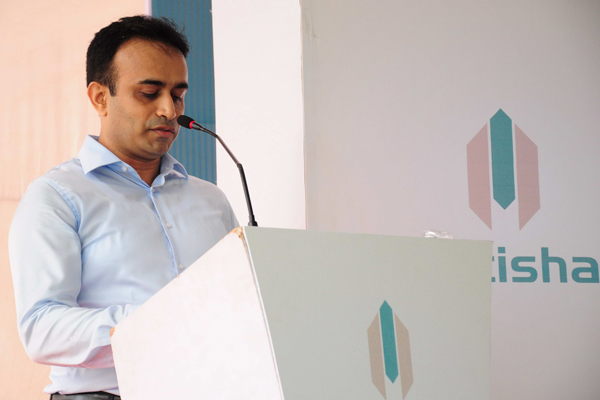
Seeing the Invisible Order, Faith, People, and the Power of Stories | A conversation with Mr. S M Sawood, Executive Director, Mohtisham
NV Paulose, Chairman, Global TV +91 98441 82044
Some conversations do not move in straight lines. They circle, deepen, return, and quietly reveal a worldview shaped by faith, experience, and deep attentiveness to people. My recent interaction with Mr. Sawood was one such conversation. It was a journey through our belief, media, humanity, and purpose. Thoughts are more or less overlapping and immensely merging with one another.
God Without a Self-image: Understanding the Invisible
Mr. Sawood shared a profound reflection. God has no self-image. God is invisible, beyond form and figure. Yet everything, from the smallest particle to the vast universe, operates in a precise order. This, he says, is not accidental. Human beings struggle to fully understand even one human body, despite hundreds of specialists studying it. How then can we imagine comprehending the entire universe. For Mr. Sawood, this realization brings humility. We are minute, yet seen. Insignificant in scale, yet deeply observed. He draws from the Quran, noting how even the movement of wind, tremors, or darkness occurs only by divine permission. Nothing is random. Everything has intent.
I must have added here; meeting someone like him, even after decades of near connections, is not coincidence. It is God’s plan.
Faith Expressed Through Action
Faith, in Mr. Sawood’s understanding, is not abstract philosophy. It is action. He refers to a prophetic teaching that defines three levels of human responsibility.
First, stop injustice with your hand if you can.
Second, speak against it if you lack the power to stop it.
Third, at the least, feel pain in your heart if you can do neither.
If a person lacks even this inner response, he says, something essential is lost. This moral framework, he believes, applies to all humanity, beyond religion. We are responsible for the betterment of others.
I added parallels to this wisdom with Christian teachings. Serving the least is serving God. Feeding the hungry and helping the vulnerable are not just charity acts, in fact they are spiritual investments.
Inheritance Beyond Wealth
One of the most heart touching moments in the conversation was in the reflection of Mr. Sawood on his father. His father embodied hospitality in a big way. Anyone passing by their home would not leave without being spoken to, welcomed, and fed. This, Mr. Sawood believes, is the true inheritance. Not money, but simplicity, love, and openness toward people. These values, I added diligently here, when practiced sincerely, become foundations that flourish across generations.
Homes as Living Ecosystems
Our conversation deeply involved with people and media. We shared insights relevant to urban life and development. We challenged the idea of homes as mere cost centres. According to the conversation evolved, a home can work for its residents if two qualities exist. Hospitality and housekeeping are the two transforming qualities. When people gather meaningfully and effectively, homes become centres of economic, emotional, and social value. Communities thrive not through structures alone, but through the quality of human interaction within them.
Media, Technology, and Common Sense
A pioneer in digital media, NV Paulose was among the first to bring online broadcasting in India, long before high speed internet existed. When global platforms focused on heavy video content that was not accessible to most users, he applied what he calls Common Sense (CS) Technology. By streaming audio along with low resolution videos and moving photo frames, he made Audio Visual Media easily accessible, affordable, and human cantered. This innovation drew attention from national and international platforms, including NDTV. National dailies wrote special articles about him. Dr. Kalam’s and AB Vajpayee’s voice was first heard in internet in the earlier format of Global TV. A song composed by Dr. Kalam was released by Global TV on 25 July 2007
For NV Paulose, technology is not about sophistication. It is only about usefulness in enhancing the quality of life. Role of media is to connect people and to enhance the quality of their life. This is possible only through Appreciative Inquiry (AI) which is new to the Media platforms in India. With global proliferation of civilizations, the best practices at various places should help generations at every other place to benefit from the Global Connectivity. We should organise story telling at every city in the world. This will transform everything instantly.
Appreciative Inquiry: The Science of Stories
Central to Global TV philosophy is Appreciative Inquiry, the practice of discovering strengths rather than faults. Successful people get inspired when they are asked with the following four simple questions.
What were the turning points in your life.
What challenges did you overcome.
What successes do you cherish.
What have you learned so far.
No two answers are ever be the same. People often become emotional, reconnecting with forgotten strength and meaning. We have done over a thousand such stories. We are convinced that the civilization advances through storytelling. That is the primary job of the Media. It is also an opportunity to make Media self-sustainable with the people funding to make the shooting, editing and broadcasting possible.
Leadership, Media, and Letting Go of Control
Reflecting on development and leadership, Mr. Sawood observes that progress comes from people and brains, not merely resources. Yet he warns against excessive control. When humans try to predict, dominate, and manage everything, they end up fighting with God. True results, he says, often emerge from the unknown. Paulose acknowledged his belief and explained why he resisted turning media into a purely profit driven business. Media is not a business, he says. It is a responsibility. Revenue may sustain it, but purpose must guide it. Together the world should travel towards the unknown; the divine. There is only one God.
A Life Anchored in People
Through all these experiences, faith, media innovation, education, and community work, one principle remains constant for both Mr. Sawood and Paulose. People are the primary resource to transform the world.
When people are respected, listened to, and allowed to tell their stories, everything else, technology, economy, development, falls into place.
Today’s world is obsessed with speed, control, and visibility. In today’s Roller coaster world, we should be reminded about the invisible order that matters. Stories matter. People matter. And perhaps God does not need a self-image, because the presence of God is reflected everywhere we choose to see in the world with humility and humanity.
The St. Vincent De Paul Society (SVP), an international service organisation popularly known as SSVP, is celebrating 100 years of its presence in the Mangalore Catholic Diocese. The Centenary Valedictory Ceremony will be held on Sunday, 25 January 2026, at the Father Muller Convention Centre.
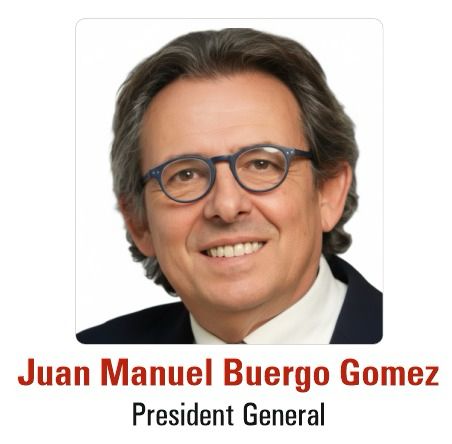
The programme will be presided over by the Most Rev. Dr Peter Paul Saldanha, Bishop of Mangalore. The International President of SSVP, Mr Juan Manuel Buergo Gomez, will arrive from Spain and participate as the Chief Guest. The Most Rev. Dr Aloysius Paul D’Souza, Bishop Emeritus of Mangalore Diocese, Mr Jude Mangalraj, President of the SSVP. National Council, and Mr Joseph Pandian, International Ombudsman, will be present as Guests of Honour.
Members of the Karnataka Legislative Council Mr Ivan D’Souza, Director of Father Muller charitable Institutions Rev. Fr Faustine Lucas Lobo, and renowned Entrepreneur and Philanthropist Mr Joseph Elias Menezes will grace the occasion as Guests of Honour. Along with them, Mr Santiago Manickam, National Secretary of SSVP, Ms Asha Vaz, and youth representative Mr Alister Nazareth will be present on the dais.
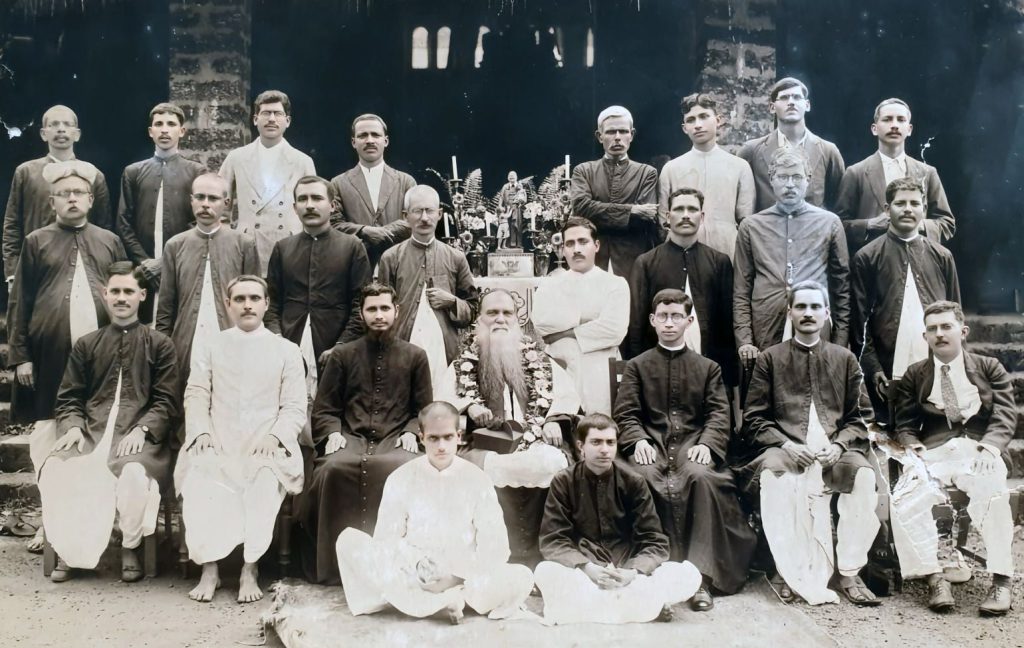
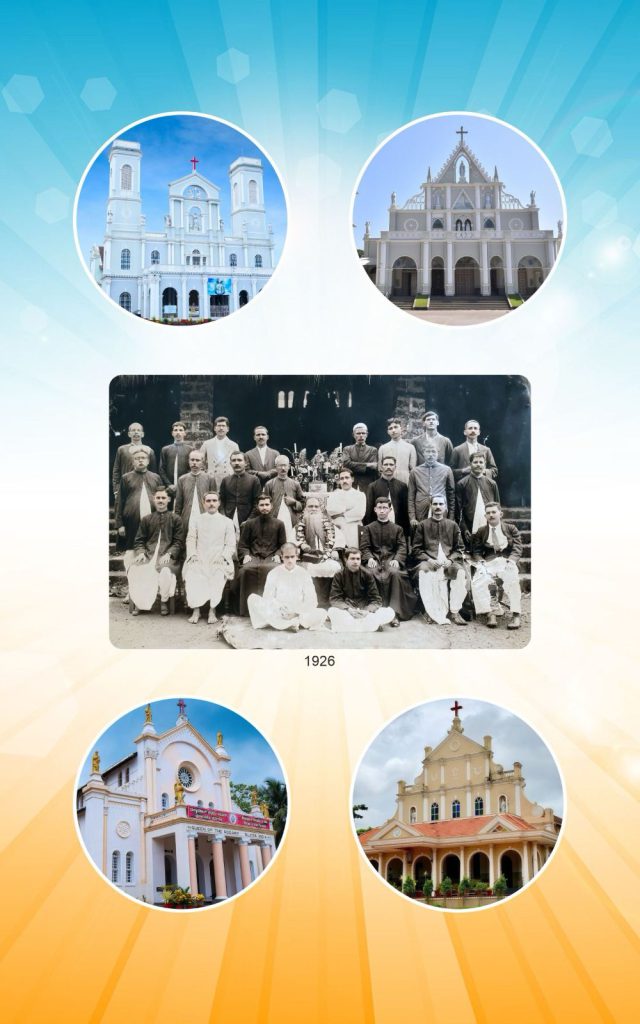
The St. Vincent De Paul Society, the world’s largest Catholic lay service organisation, was established in Mangalore at Bendur Church on 10 January 1926. In the same month, the Milagres unit was formed, followed by two more units in May 1926 at Rosario Cathedral and Bejai Church.
The core mission of the St. Vincent De Paul Society is to visit the poor and the needy and provide them with necessary assistance while strictly maintaining confidentiality and dignity.
At present, under the Mangalore Central Council, there are 111 units, each adopting at least five families in their respective neighbourhoods and caring for them as members of their own family. Currently, 623 adopted families comprising 1,765 family members are being supported. With a total strength of 1,618 members across 111 units and 2 Youth Units, the SSVP continues its service to the poor quietly and without publicity.
In collaboration with Father Muller Medical College Hospital, Mangalore, and Thumbay, a major project providing free medical treatment and dialysis care to members of adopted families is being successfully implemented.
To commemorate the centenary, the St. Vincent De Paul Society has launched two major projects: ‘Shikop’ – Educational support for higher studies to about 405 students from SSVP adopted families. ‘Aasro’ – Financial assistance to 100 families for construction or repair of their houses.
During the valedictory function, the SSVP–Trinity Kidney Care Project will be inaugurated with the support of Joseph E. Menezes’s Trinity Medicare Services Trust, Udupi, to assist kidney patients with medicines and dialysis.
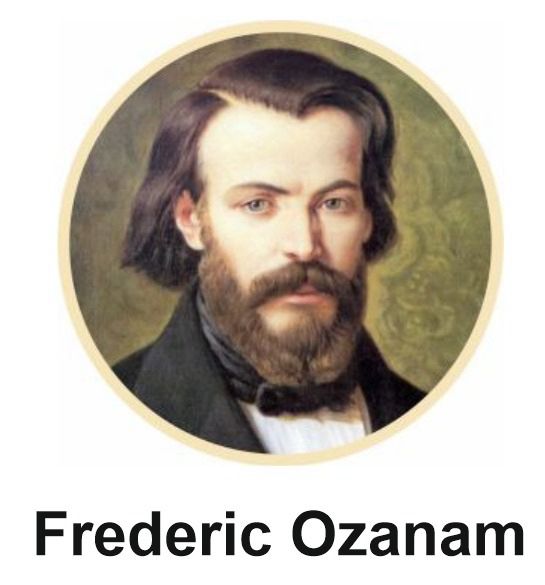
History of the St. Vincent De Paul Society The Society was founded in 1833 in Paris, France, by Blessed Frederic Ozanam, aged 22, along with six companions. Today, it is present in 158 countries worldwide, with over 800,000 members and more than one million volunteers dedicated to serving the poor and marginalised. In India, the Society was established in Mumbai in 1863 and presently has 7,225 units with 65,546 members.
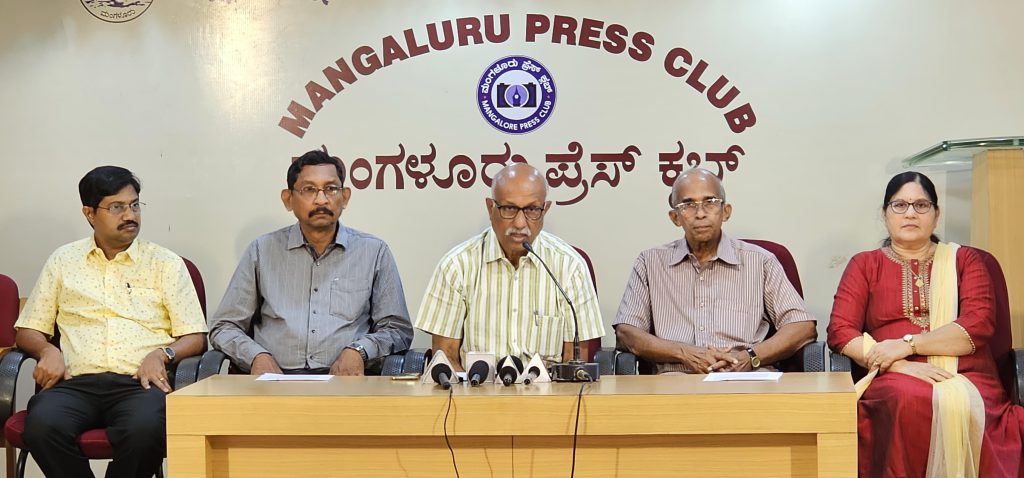
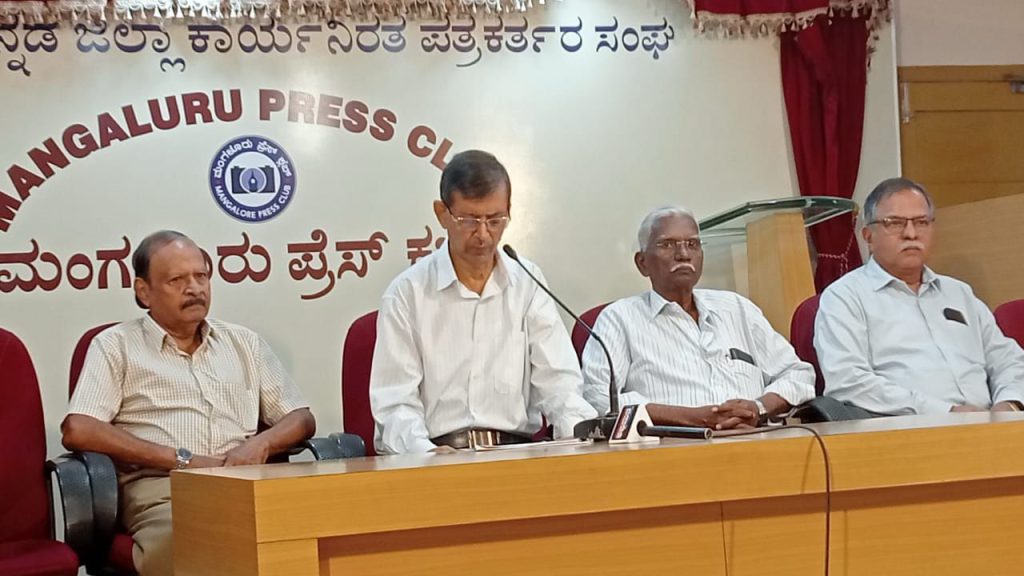
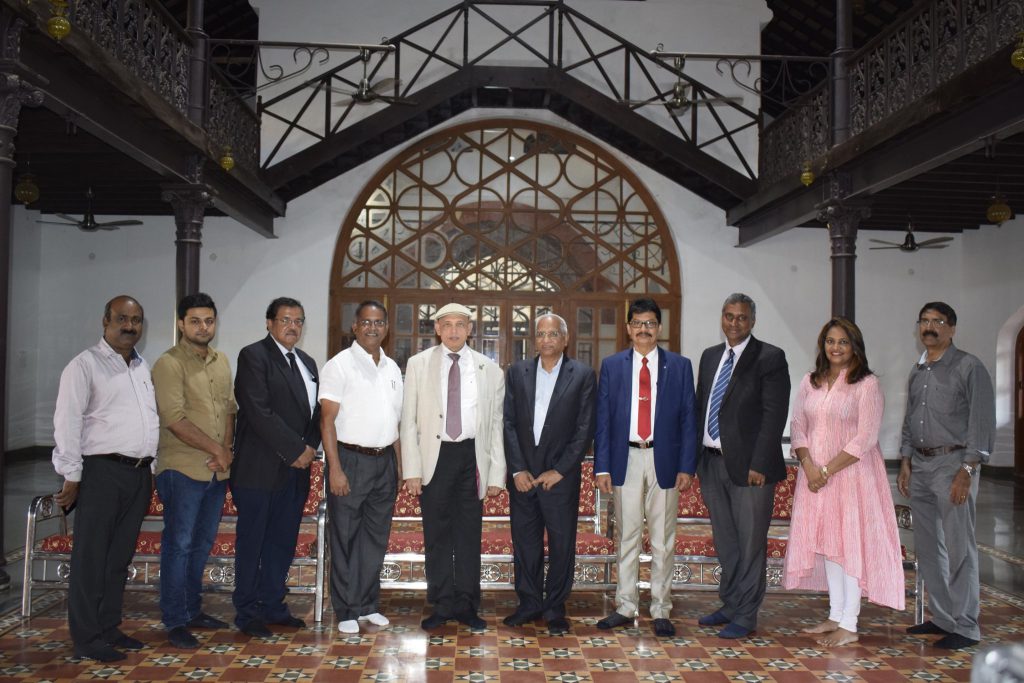
Members present at the Press Meet | 22 January 2026, Press Club, Mangalore.
Joe Coelho : President, Central Council Ligoury Fenandes: Secretary, Central Council Clarence Machado : Treasurer, Central Council Mrs Philomena Menezes: Convener, Centenary Celebration Committee Loyd Rego : Convener, Media Committee
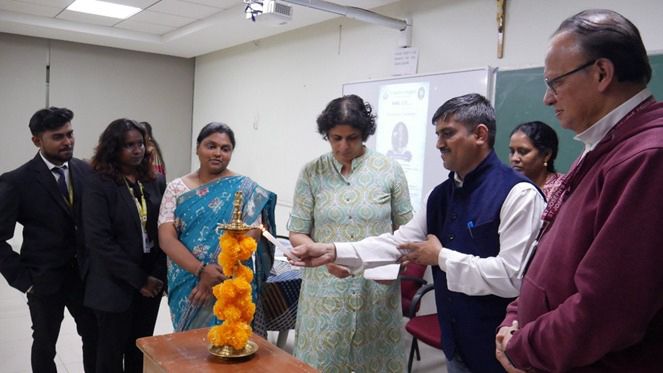
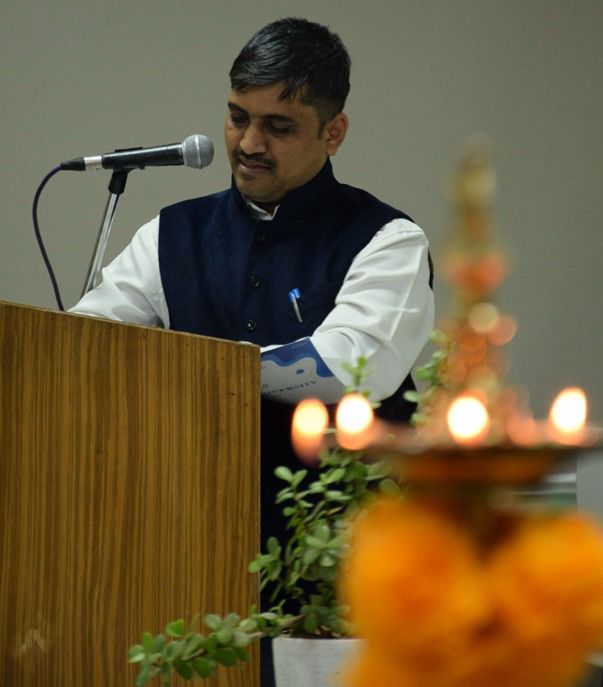
The Computer Science Society, a vital part of the IEEE student chapter at St. Joseph’s University, Bengaluru, celebrated a significant milestone with its inauguration and investiture ceremony on 19th Jan., 2026. The event was a blend of inspiration, knowledge, and vision, reflecting the society’s commitment to excellence and growth in the field of computer science. The ceremony unfolded with a series of well-coordinated events, each contributing to the overall success of the occasion.
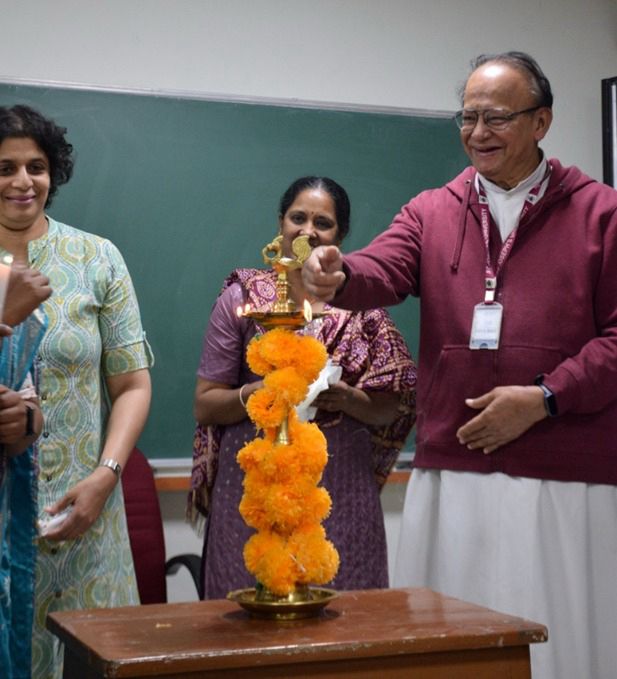
The IEEE Computer Society Investiture Ceremony 2026 at St Joseph’s University, Bengaluru commenced with the gracious arrival of the respected dignitaries, marking the formal inauguration of the event. The ceremony began with an invocation prayer led by Fr. Denzil Lobo SJ, which set a solemn and respectful tone for the proceedings, followed by the ceremonial Lighting of the Lamp, symbolizing knowledge, wisdom, enlightenment, and leadership.
Dr. Deepa Nagalavi, Computer Society Advisor, then introduced the Chief Guest, highlighting his valuable contributions to IEEE, his professional excellence, and his continued mentorship of student communities.
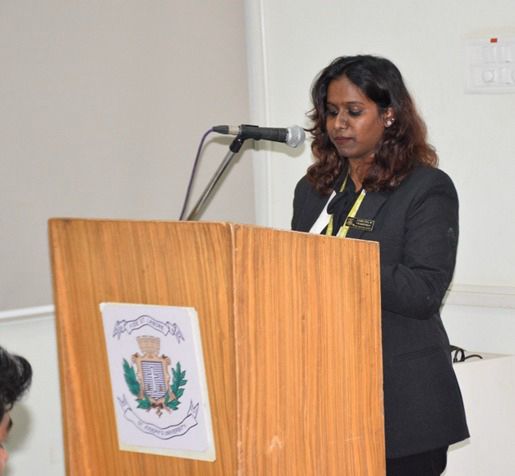
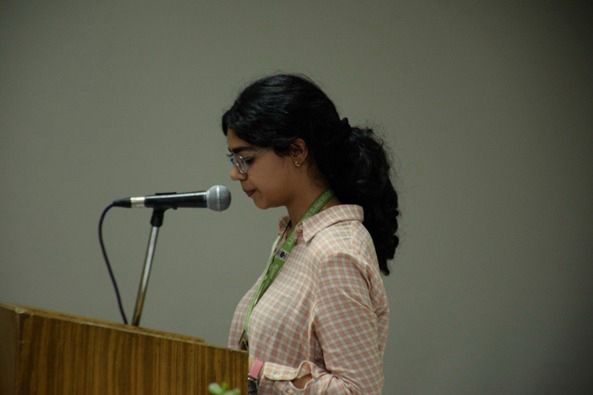
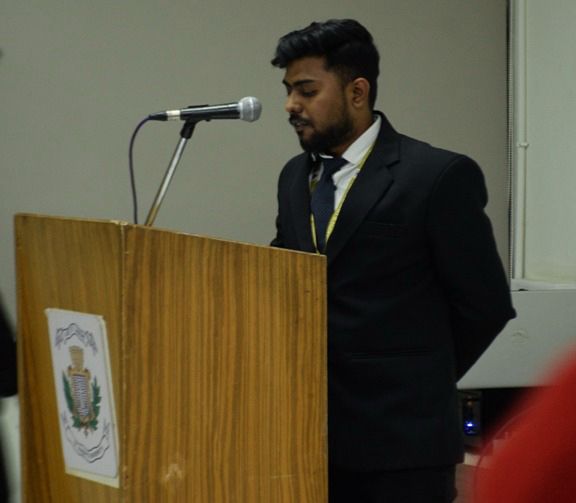
The Chief Guest, Mr. Devendra Gowda, addressed the gathering with an inspiring speech, encouraging students to actively participate in IEEE activities, enhance their technical competencies, embrace innovation, and shoulder leadership responsibilities with integrity and dedication. Following this, student leaders Ms. Rida Quazi and Mr. Farhanulla Sami shared their perspectives, expressing their enthusiasm, vision, and strong commitment to organizing meaningful technical, professional, and community-oriented initiatives under the IEEE Computer Society.
The focal point of the event was the Investiture Ceremony, during which the newly elected office bearers were formally inducted and honoured, followed by the Oath Taking ceremony administered by Dr. Deepa Nagalavi, reaffirming their pledge to serve responsibly and ethically. The program concluded with the Vote of Thanks proposed by Ms. Amrutha M, who expressed gratitude to the dignitaries, faculty members, organizers, and participants for their valuable presence and support. Overall, the ceremony was conducted successfully and emerged as a significant and empowering occasion that set a strong and purposeful foundation for future IEEE Computer Society activities at the university.
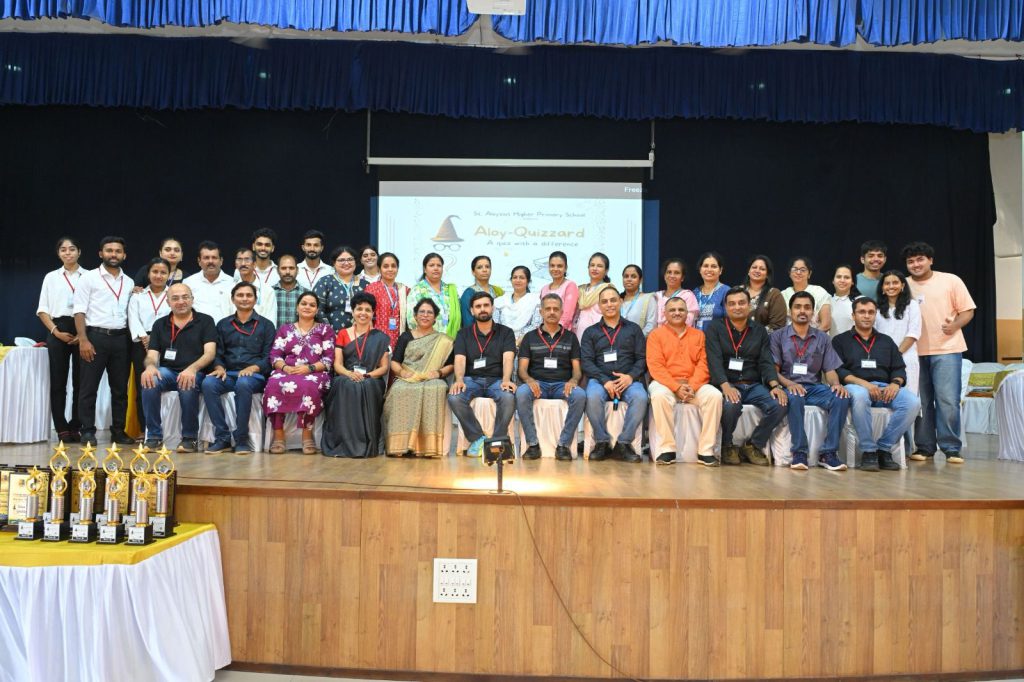
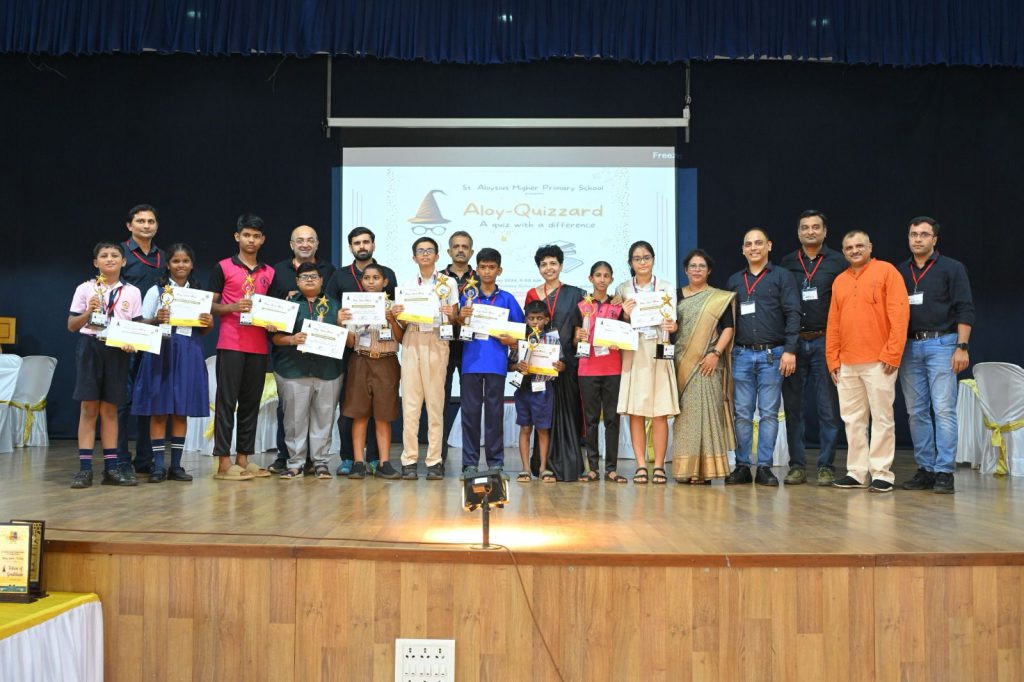
Breaking Barriers: St. Aloysius Hosts ‘Aloy Quiz-Whiz 2026’ to Champion Inclusivity
NV Paulose, Chairman, Global TV +91 98441 82044
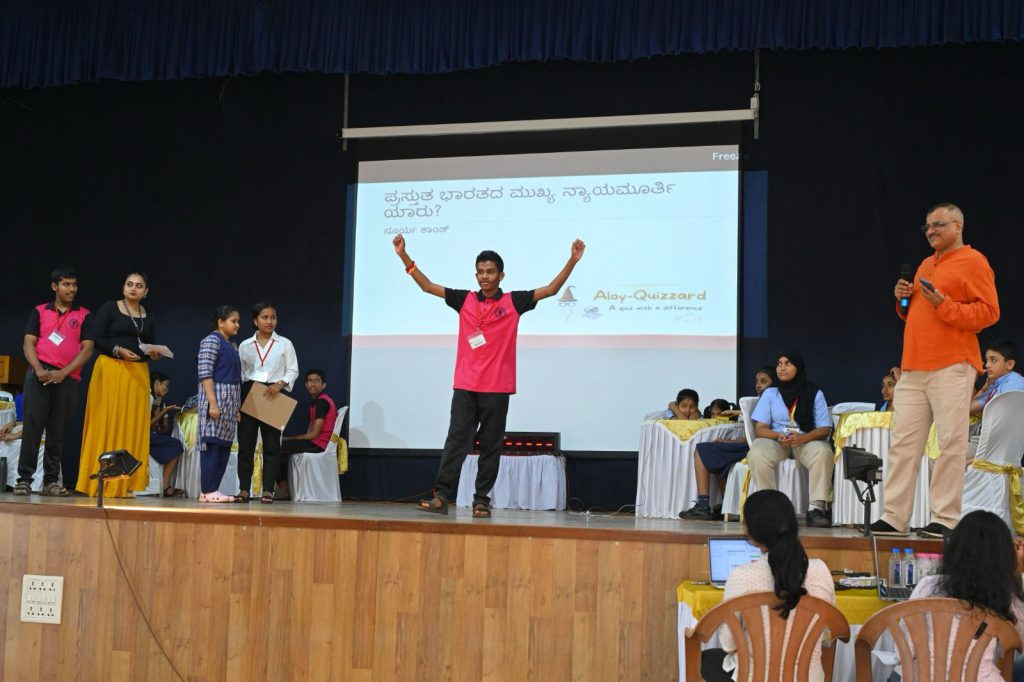
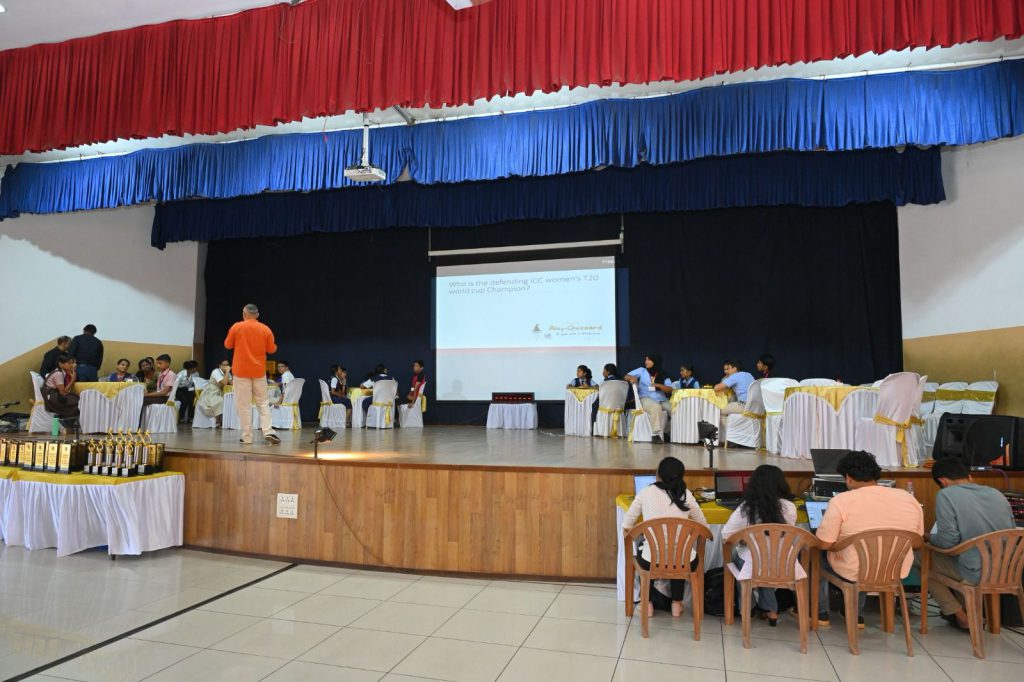
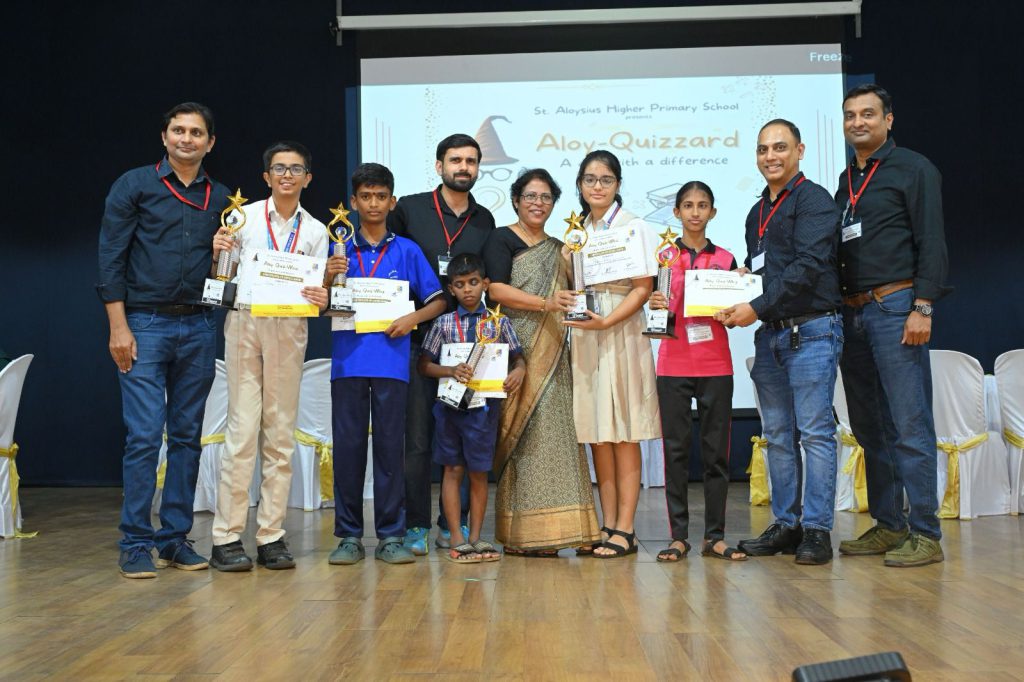
MANGALORE — In a powerful display of teamwork and social integration, the St. Aloysius Higher Primary School Alumni Association, under the aegis of the St. Aloysius College Alumni Association (SACAA), successfully organized ‘Aloy Quiz-Whiz 2026’ on Sunday, January 18. The event, held at the school’s Kodialbail campus, reimagined the traditional quiz format to bridge the gap between students of diverse backgrounds and abilities.
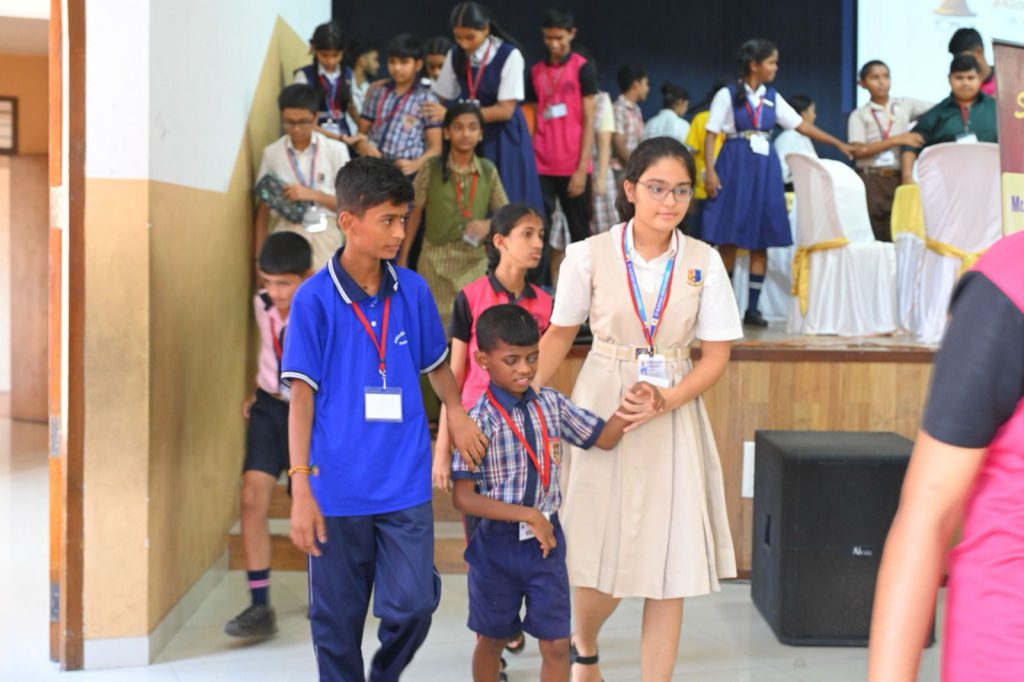
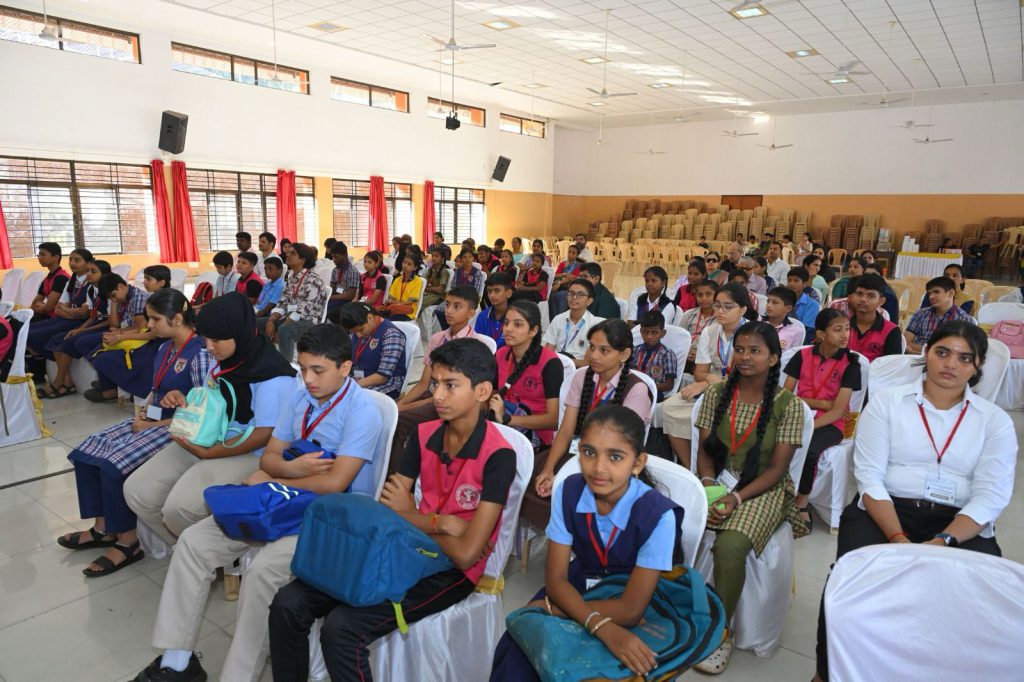
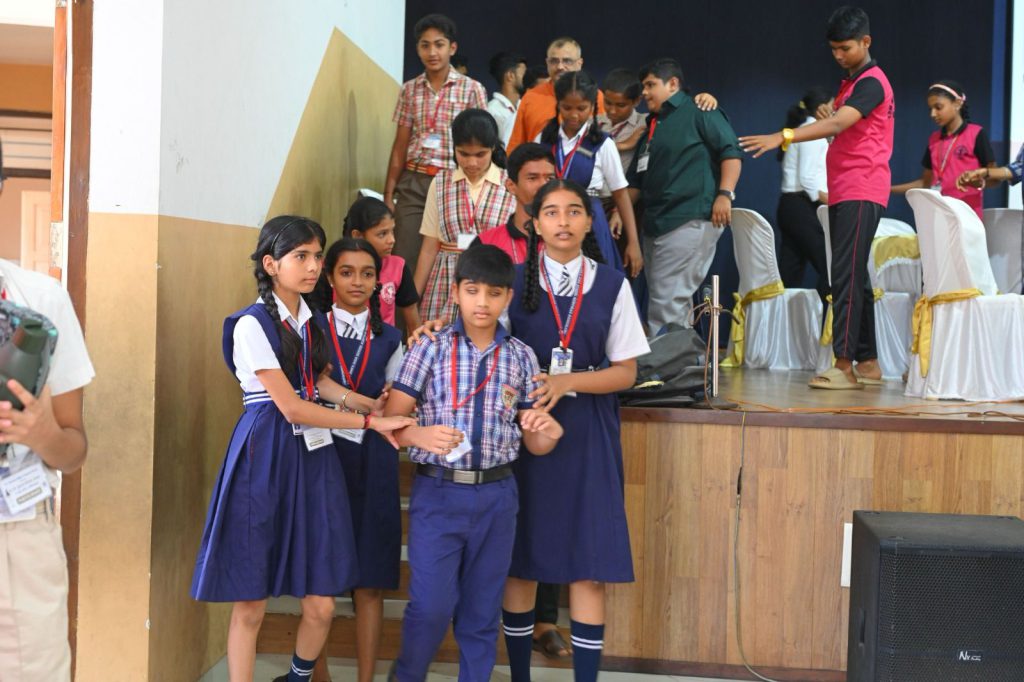
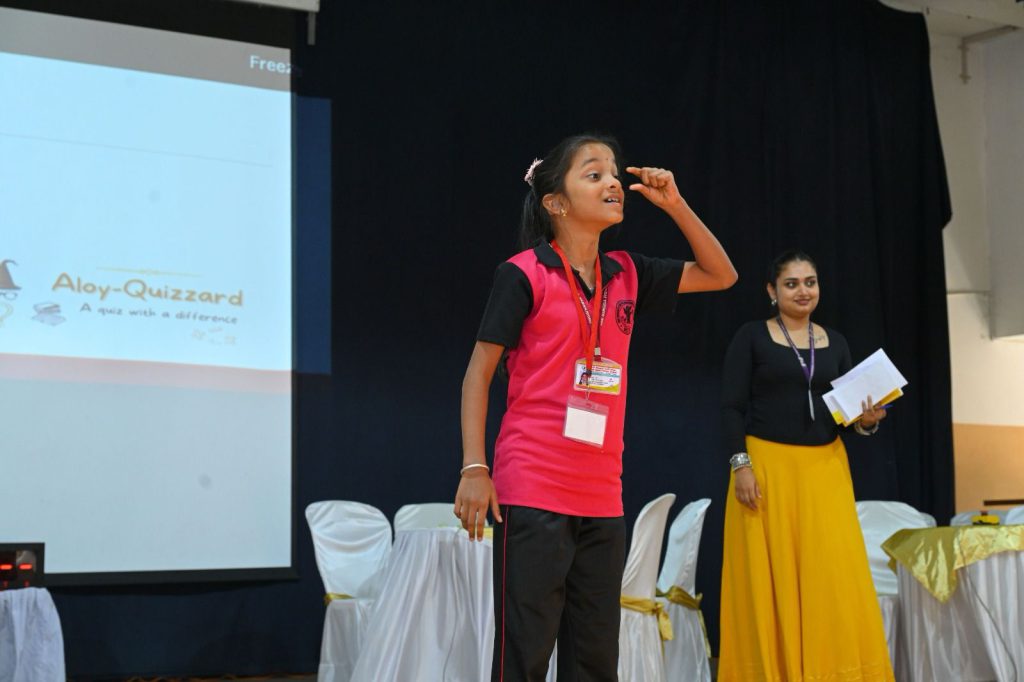
The program commenced at 9:00 a.m. with an audience of approximately 200 people, including students, teachers, and parents. Unlike standard academic competitions, the Aloy Quiz-Whiz utilized an innovative team structure designed to foster empathy and cooperation. Each competing team was a microcosm of society, composed of one visually impaired participant, one student with speech and hearing impairment, one student from a government school, and two students from private schools. This unique structure emphasized that while all quizzes test general knowledge, this specific initiative focused on overcoming natural barriers through cohesive teamwork.
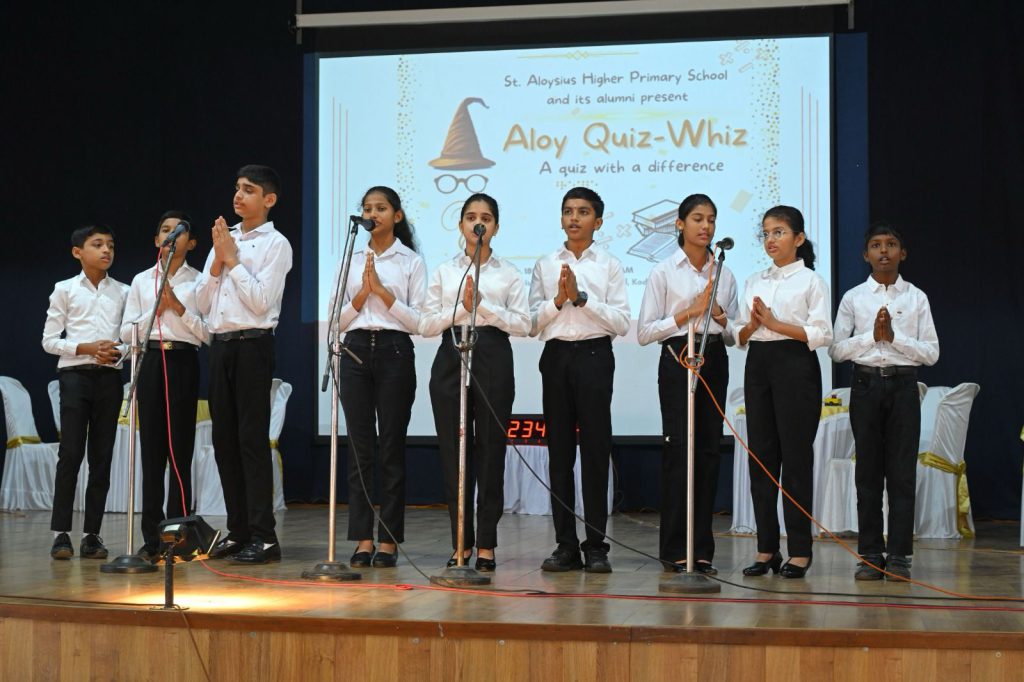
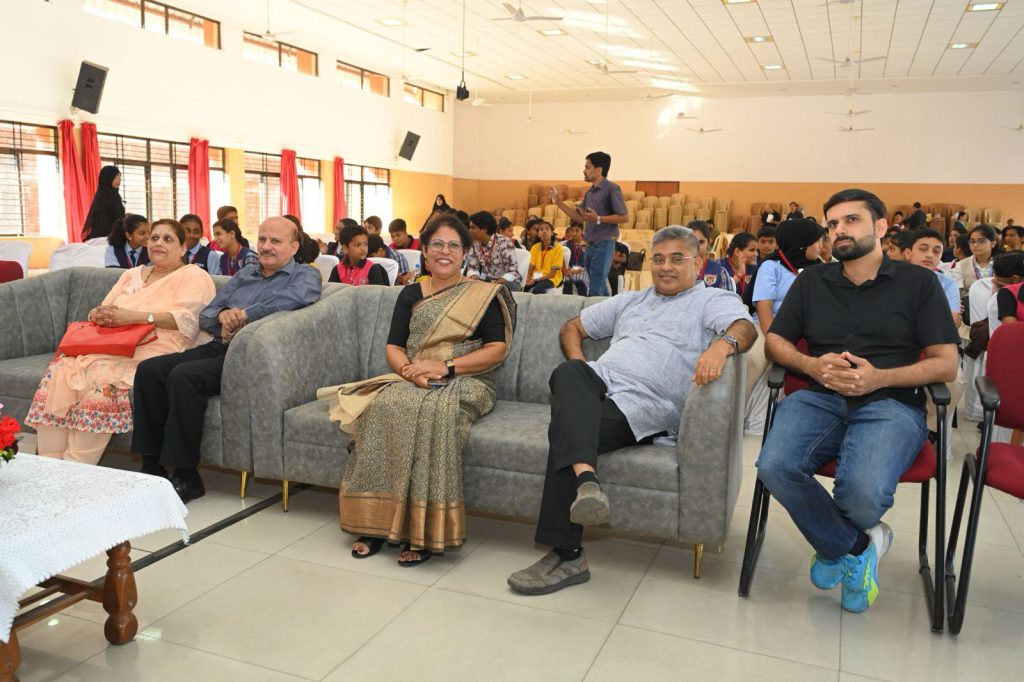
The primary objectives of the quiz were to educate the public on the high capabilities of specially-abled children and to sensitize young students to social diversity. Mrs. Josita Sequeira, Headmistress of the school, delivered the welcome note, followed by an inaugural address by Fr. Melwin Pinto SJ, Rector of St. Aloysius Group of Institutions. Fr. Pinto highlighted the significance of inclusivity, praising the event for its role in social awareness and holistic education. He remarked that he was deeply touched to see the institution hosting an event that brings together schools from across the city.
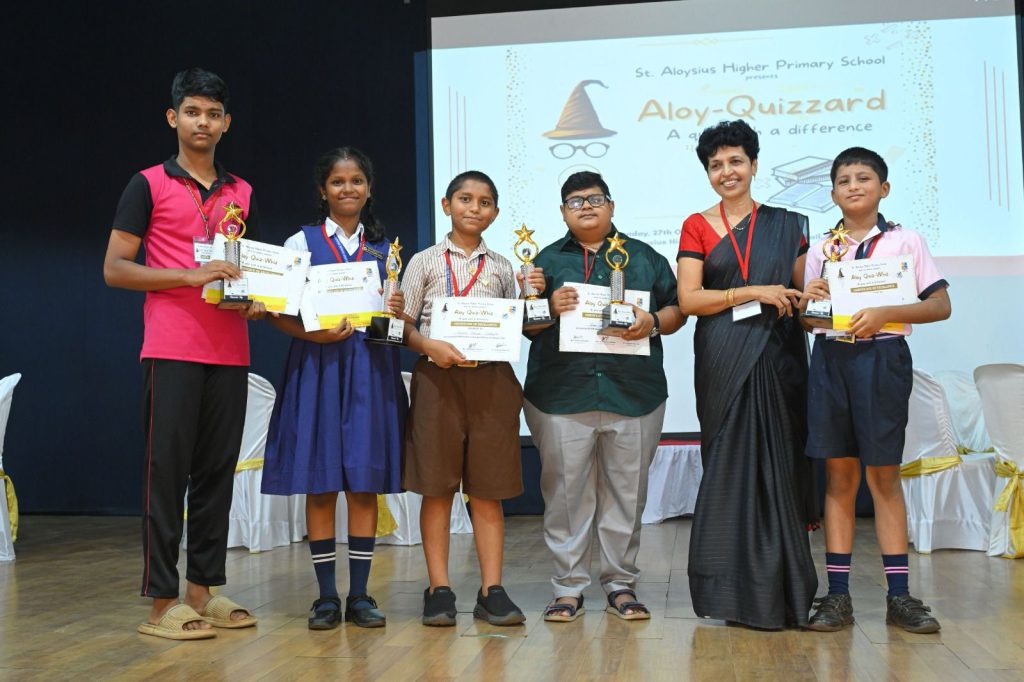
A total of 15 schools participated, including institutions like Presidency School, Lourdes Central School, and the Roman & Catherine Lobo School. The competition was closely contested, with the top honors eventually going to a combined team of students from the Roman & Catherine Lobo School, S.D.M. Mangalajyothi Integrated School, St. Aloysius Gonzaga School, and D.K.Z.P.H.P School, Kapikad. The winning participants included Arya, U. Ameena Nidha, Avika Joshi, Vishnu Dev Panday, and Dilip L.D. The second-place trophy was awarded to a team comprising Shree Manma, Shivaram Nayak, Anmol Cherish Saldanha, Chris Shawn D’Souza, and Sneha.
The impact of the event was echoed by various attendees. Mr. Calistus D’Sa, Principal of the Roman and Catherine School for the visually impaired, noted that this unique format allowed his students to feel truly special and capable of competing on a level playing field. Alumnus Deepak Ramani observed that watching children of all abilities work together served as a reminder of the importance of patience and mutual respect.
The event was smoothly conducted by emcee Ms. Neerada from the Masters of Social Work department at St. Aloysius University. The proceedings concluded with a Vote of Thanks proposed by Mr. Neil Rodrigues, Secretary of the Alumni Association, who noted that the enthusiasm of the children serves as a yearly inspiration for the organizers. The day ended with a communal lunch for all participants and the distribution of participation certificates, marking a successful step forward in the movement for inclusive education in Mangalore.
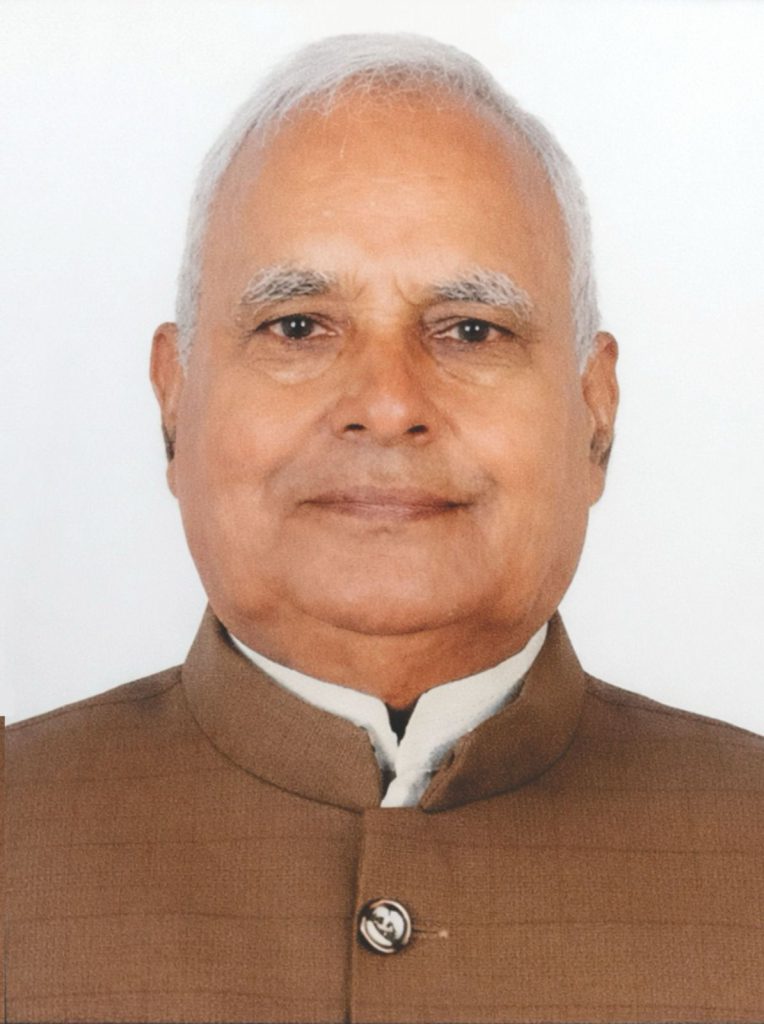
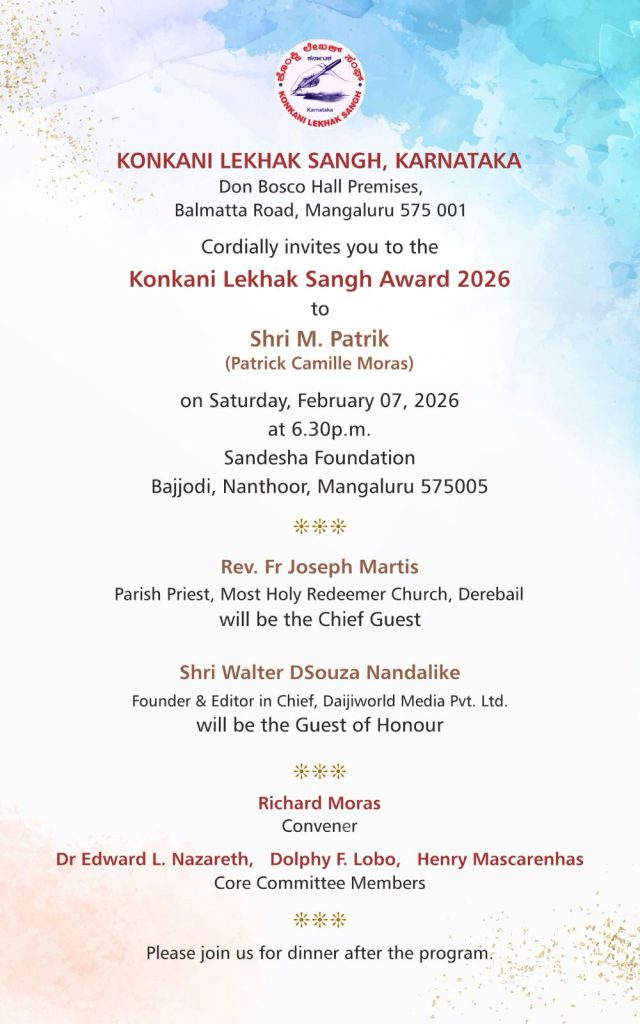
Konkani Literary Award Conferred to: Mr. Patrick Camille Moras (M. Patrik)
NV Paulose, Chairman, Global TV +91 98441 82044
Konkani Lekhak Sangh Karnataka – A voluntary association exclusively formed with the sole intention of promoting Konkani language and literature in the year 2018. From the year 2022, Konkani Lekhak Sangh decided to select and honour a Konkani writer who has immensely contributed to Konkani literature. For the year 2026, Konkani Lekhak Sangh award committee has selected a well known Konkani writer Mr. Patrick Camille Moras (M. Patrik). The award consists of a cash prize of Rs 25000/-, a citation and a Memento.
Born on November 17, 1945, Patrick Camille Moras, known as M. Patrik, rose from a childhood of hardship to become a pillar of Konkani literature. After discontinuing school in fifth grade to support his family, he found a mentor in J.B. Rasquinha, who provided him with books and encouraged him to sell literature books door-to-door.
Starting as a book seller and Associate Editor of Kannik Konkani Magazine at eighteen, he became a prolific author of over 800 short stories, 400 articles, and ten novels. Through his Nityadar Prakashan, he published numerous works, including plays and detective dramas, cementing his legacy as a dedicated servant of the Konkani language. In recognition of his immense contribution to literature, he has been honored with the Honorary Award from the Karnataka Konkani Sahitya Academy and the ‘Sandesha Konkani Literature Award – 2026’ conferred upon M. Patrick.
The award will be conferred at a function on February 07, 2026 at 6.30 p.m., at Sandesha Premises, Sandesha Foundation, Bajjodi, Mangaluru.
Members Present at the Press Meet: Richard Moras – Convener, Dolphy F. Lobo – Committee member, Dr Jerry Niddodi – Advisory Committee member, J.F. DSouza – Advisory committee member
Rotarian Lal Goel | Founder & Charter President | Rotary Club of Organ Donation International | Chairman | Organ Donation India Foundation & GYAN
NV Paulose, Chairman, Global TV +91 98441 82044
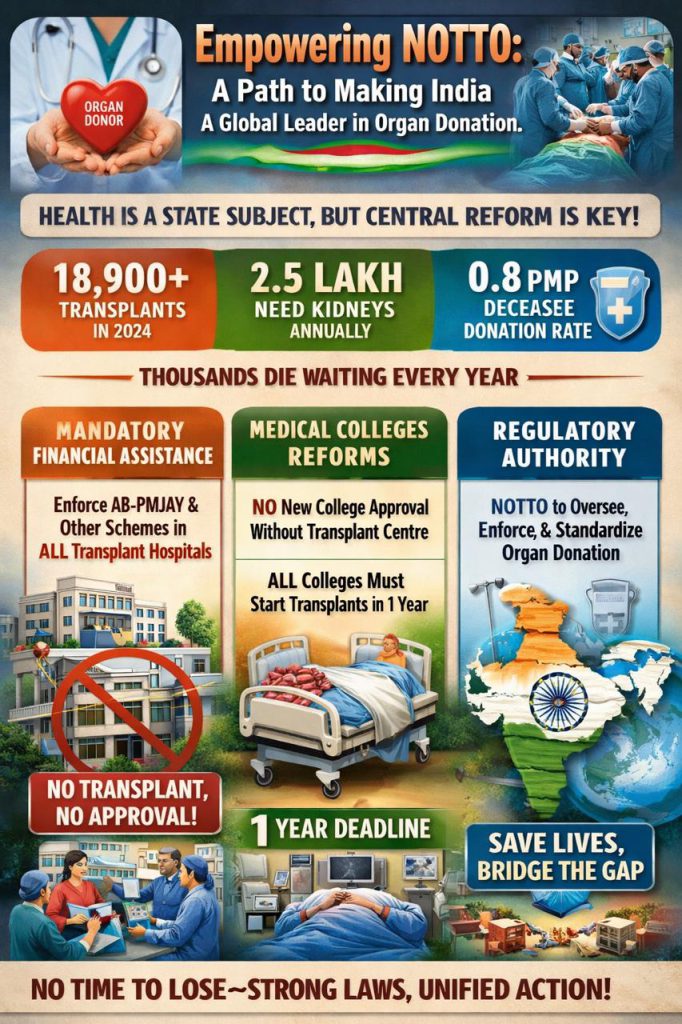
India continues to face a profound and preventable organ shortage crisis, despite notable progress in recent years. In 2024, the country achieved a record 18,900+ organ transplants, ranking third globally after the United States and China. Yet this achievement masks a grim truth: demand vastly exceeds supply.
Annually, nearly 2.5 lakh patients require kidneys, 80,000 need livers, 50,000 need hearts, and 1 lakh need corneas. Waiting lists remain fragmented and opaque, with kidney registries alone numbering over 1.75 lakh. Thousands die each year while waiting—not due to lack of medical capability, but due to systemic failures.
India’s deceased organ donation rate stands at just ~0.8–0.81 per million population (pmp). While an improvement, it remains far below global benchmarks such as Spain (~52.6 pmp) and the United States (~48 pmp).
At the centre of India’s transplant framework is the National Organ and Tissue Transplant Organisation (NOTTO), established under THOTA in 2014. NOTTO has improved coordination, registries, and awareness, including 3.3 lakh+ Aadhaar-linked pledges. However, it lacks statutory authority, enforcement powers, and financial autonomy—severely limiting its impact.
Health Is a State Subject — But the Centre Must Drive Reform
While health is constitutionally a State subject, organ donation and transplantation demand strong central leadership. Only the Central Government can ensure uniformity, accountability, and enforceability across states.
Therefore, Parliament must amend THOTA to empower NOTTO with statutory authority, enabling it to: • Issue binding national regulations • Mandate compliance across states and institutions • Enforce penalties for violations • Ensure equity and transparency in allocation
Without such central legal reform, disparities between states will persist, and lives will continue to be lost due to administrative paralysis.
Why NOTTO Must Be Strengthened as a National Regulator
Regulatory Authority with Enforcement Powers
Like the Securities and Exchange Board of India (SEBI) and the Election Commission of India (ECI), NOTTO must regulate: • Hospitals and transplant centres • Surgeons and transplant teams • Organ retrieval and allocation networks
This includes licensing, inspections, accreditation, suspension, and de-recognition for non-compliance.
Mandatory Implementation of Financial Assistance Schemes
NOTTO must be legally empowered to ensure compulsory implementation of all government financial assistance schemes, including Ayushman Bharat – PMJAY, across all transplant hospitals—public and private.
No transplant centre should be allowed to: • Refuse AB-PMJAY patients • Cherry-pick only paying recipients • Create financial barriers for the poor
Organ transplantation is a public health service, not a luxury commodity.
Medical Colleges: The Missing Backbone of Deceased Donation
No Approval Without Transplant Capability • No new medical college—government or private—should receive approval from regulatory authorities unless it is established as an organ transplant centre with: • Brain death certification capability • ICU donor management protocols • Organ retrieval infrastructure
Teaching hospitals must be leaders in donations, not passive observers.
One-Year Deadline for Existing Medical Colleges • All existing medical colleges, both government and private, must be mandated to initiate organ transplant programs within one year, beginning at least with: • Kidney & Liver transplantation • Brain death identification and donor referral
Failure to comply should invite: • Withdrawal of recognition • Reduction of postgraduate seats • Financial penalties
India cannot afford medical colleges that train doctors but fail to save lives through organ donation.
Expanded Powers and Functions of NOTTO • Legal & Quasi-Judicial Authority: Investigate complaints, adjudicate allocation disputes, impose fines, and recommend prosecution. • Direct Oversight: National registry of centres and surgeons; mandatory audits for poor donor conversion or utilisation rates. • Public Awareness Mandate: Sustained, well-funded national campaigns—on the scale of voter awareness drives. • Real-Time Transparency: Legally mandated live data on waiting lists, transplants, donor conversion, and organ utilisation. • Interstate Authority: Power to override bureaucratic delays in organ sharing, prioritising medical urgency. • Research & Innovation: Funding for organ preservation, immunology, logistics, and emerging technologies.
A Realistic National Target
With decisive reform: • 5 pmp within 5 years is achievable • 10–15 pmp within a decade is realistic
This would mean tens of thousands of additional lives saved annually, reduced black-market risks, and global leadership in ethical transplantation.
The Cost of Inaction
Concerns about regulatory overreach can be addressed through parliamentary oversight, transparent reporting, and independent audits. The real danger lies in inertia.
Every year of delay means: • Preventable deaths • Families destroyed • Public trust eroded
Empowering NOTTO is not administrative reform—it is a moral, medical, and constitutional responsibility.
India has doctors. India has hospitals. India has science.
What we lack is decisive governance.
The question is no longer whether India can lead the world in organ donation— It is whether we choose to.
From Space Missions to Shaping Minds: The Purpose-Driven Journey of Dr. Oommen Tharakan
NV Paulose, Chairman, Global TV +91 98441 82044
On a quiet morning in the mist laced hills of Peerumedu, Kuttikkanam in Idukki District, an unusual sight drew the attention of the world. Students were thrilled, faculty were inspired, and local residents were very proud. A slender rocket stood elegant on a modest launchpad not in Sriharikota, not backed by massive infrastructure, but on the grounds of an engineering college in semi-rural Kerala.
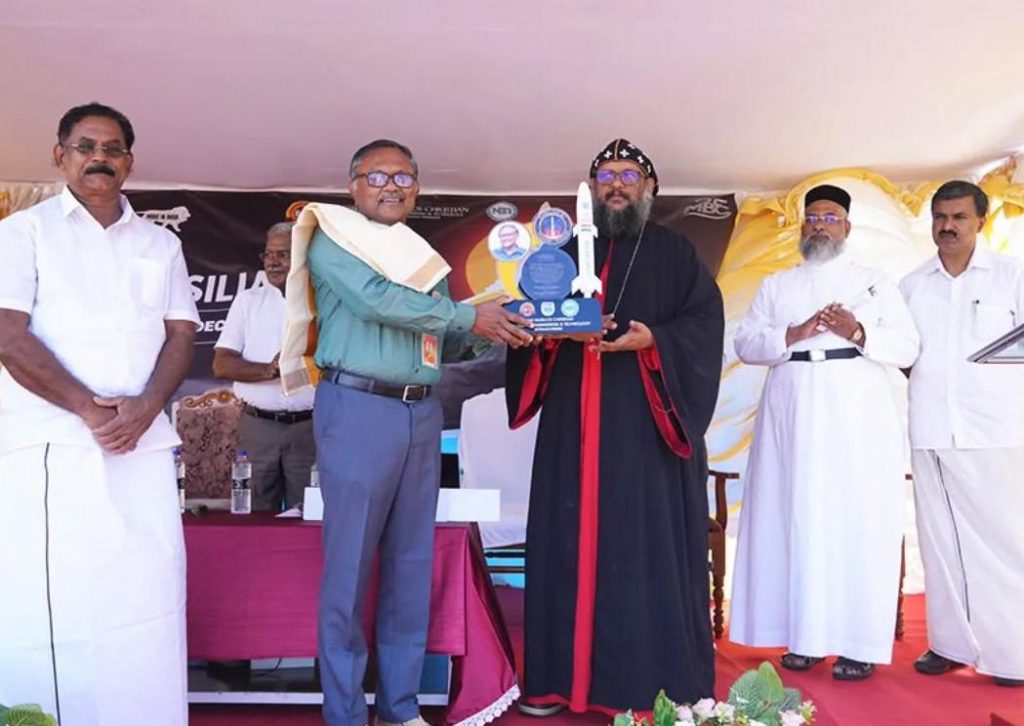
BASILIAN-01 Recognition from HG Zacharias Mar Severios
As the countdown began, there was excitement, nervousness, and disbelief. When the rocket lifted off successfully, it carried more than sensors and circuitry. It carried proof that ambition, when guided by experience and belief, can defy geography.
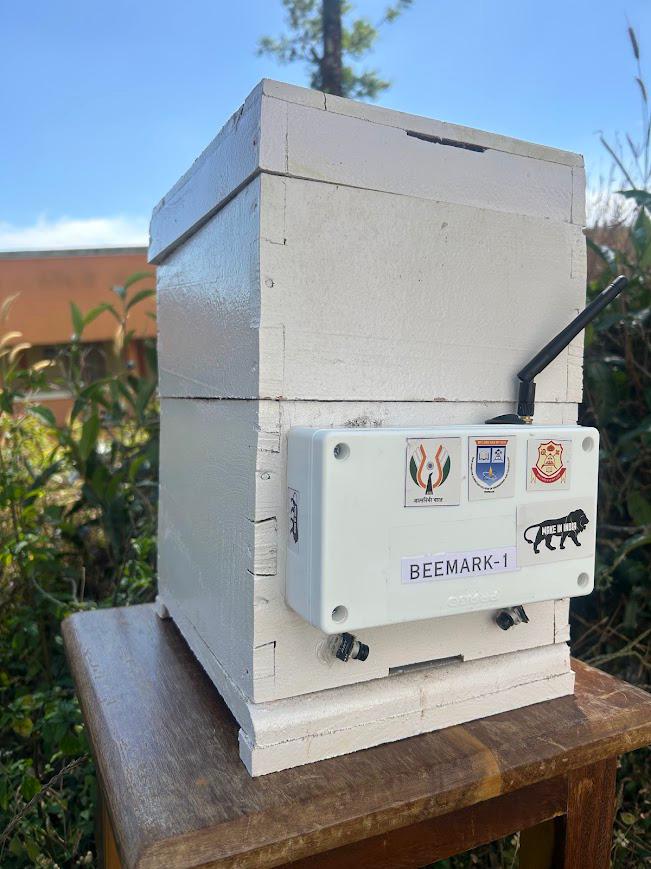
BEEMARK-I embedded in the Beehive
Behind that moment stood Dr. Oommen Tharakan, a man whose professional life had once revolved around India’s most critical space missions, and who later chose a quieter, yet more difficult challenge: building futures through education. His journey from the Vikram Sarabhai Space Centre (VSSC) to the classrooms and laboratories of Mar Baselios Christian College of Engineering and Technology, Kuttikkanam is not a story of stepping back from science, but of stepping deeper into its purpose.
Dr. Oommen Tharakan was awarded the title “Rocket Man of Idukki” in recognition of his pivotal role in leading the Basilian-01 student rocket mission, a landmark achievement in Kerala’s academic space research landscape. Launched on 18 December 2025, Basilian-01 became the first student-built technology demonstrator rocket in Kerala developed outside the ISRO ecosystem, marking a major milestone for independent collegiate aerospace innovation. Drawing on his extensive experience as a former senior scientist at ISRO, Dr. Tharakan provided technical vision, mentorship, and strategic leadership to the student team at Mar Baselios Christian College of Engineering and Technology (MBC Peermade). His guidance not only ensured the mission’s success but also demonstrated how advanced space technology capabilities can be nurtured within regional academic institutions, inspiring a new generation of student innovators.
Early Life and Family Roots
Dr. Oommen Tharakan Kuttiyil Thomas was born in Trivandrum, Kerala, a city renowned for its cultural richness and intellectual traditions. His childhood unfolded in a household deeply rooted in values of faith, discipline, and education. His parents, Thomas Tharakan Kuttiyil Kochummen and Mariamma Thomas Tharakan, instilled in him the importance of perseverance and humility—qualities that would later define his professional and personal journey.
GSLV F-12 Launch
Growing up in Kerala during the 1960s and 1970s meant being surrounded by a society in transition. The state was witnessing rapid developments in education, with literacy rates climbing and scientific curiosity spreading among the younger generation. For young Oommen, this environment was fertile ground. He was fascinated by the mechanics of everyday objects—radios, bicycles, and electrical appliances and books—and often spent hours dismantling and reassembling them. This curiosity was not mere play; it was the seed of a lifelong passion for engineering. During his childhood days his parents promoted writing books and articles in Malayalam and English. His early schooling reflected both diligence and creativity. Teachers often remarked on his ability to grasp complex concepts quickly, but more importantly, they noticed his determination to understand the why behind every principle. Unlike many of his peers, he was not content with rote learning. He sought deeper meaning, often challenging conventional explanations and proposing alternative ways of thinking. This intellectual independence became a hallmark of his later career as a scientist and educator.
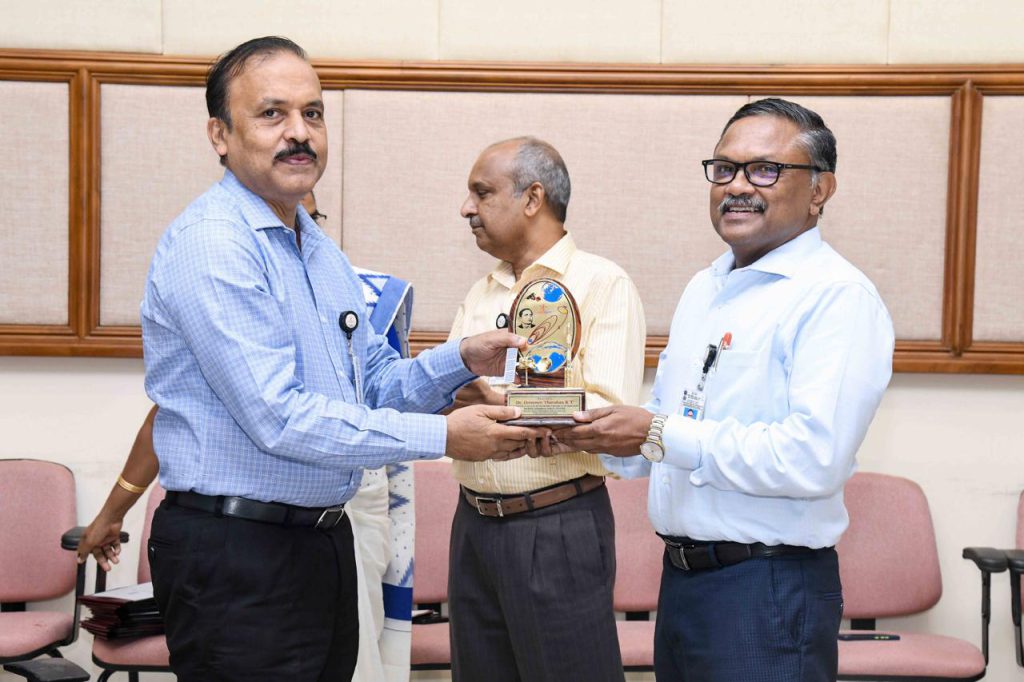
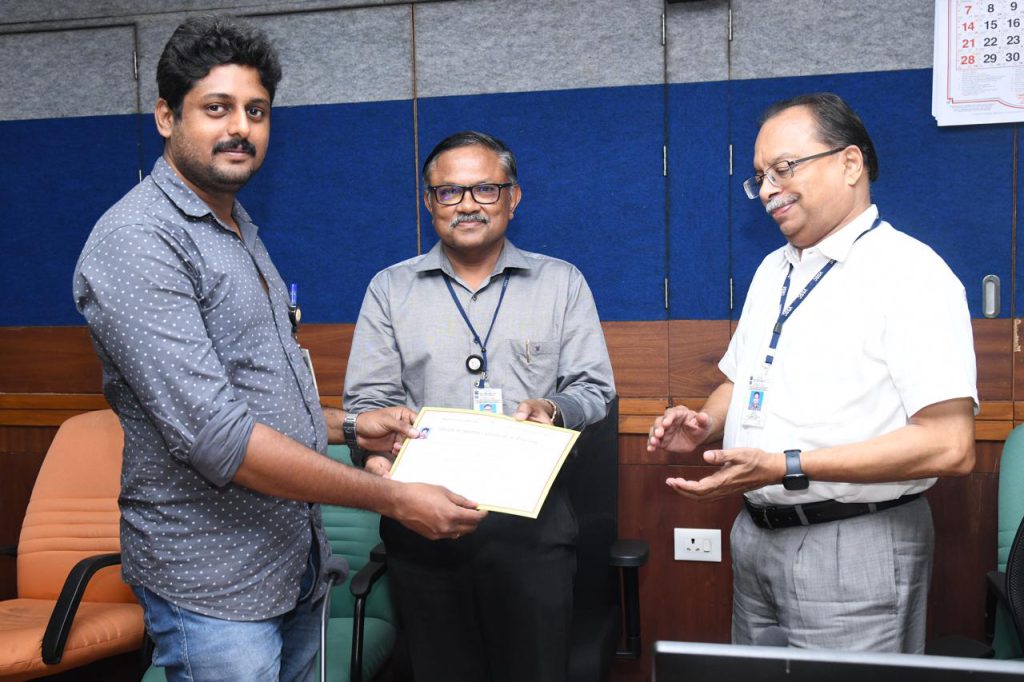
Recognition plaque from Director VSSC
Family traditions also played a significant role in shaping his character. The Kuttiyil household emphasized service to society, respect for knowledge, and resilience in the face of adversity. These values were reinforced through community interactions, church activities, and the close-knit social fabric of Kerala. Oommen learned early that success was not measured solely by personal achievement but by the ability to contribute meaningfully to the community.
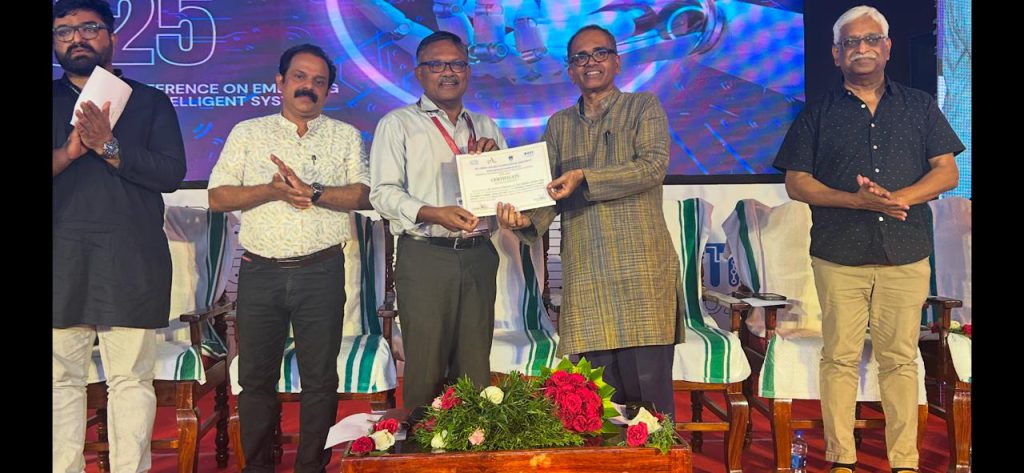
Research Paper Reviewer Certificate from VC, APJ Abdul Kalam Technological University
Another defining aspect of his childhood was exposure to Kerala’s vibrant intellectual culture. The state’s emphasis on education meant that libraries, debates, and science clubs were common even in smaller towns. Oommen participated actively in such forums. These experiences nurtured his confidence and prepared him for the rigorous academic journey that lay ahead.
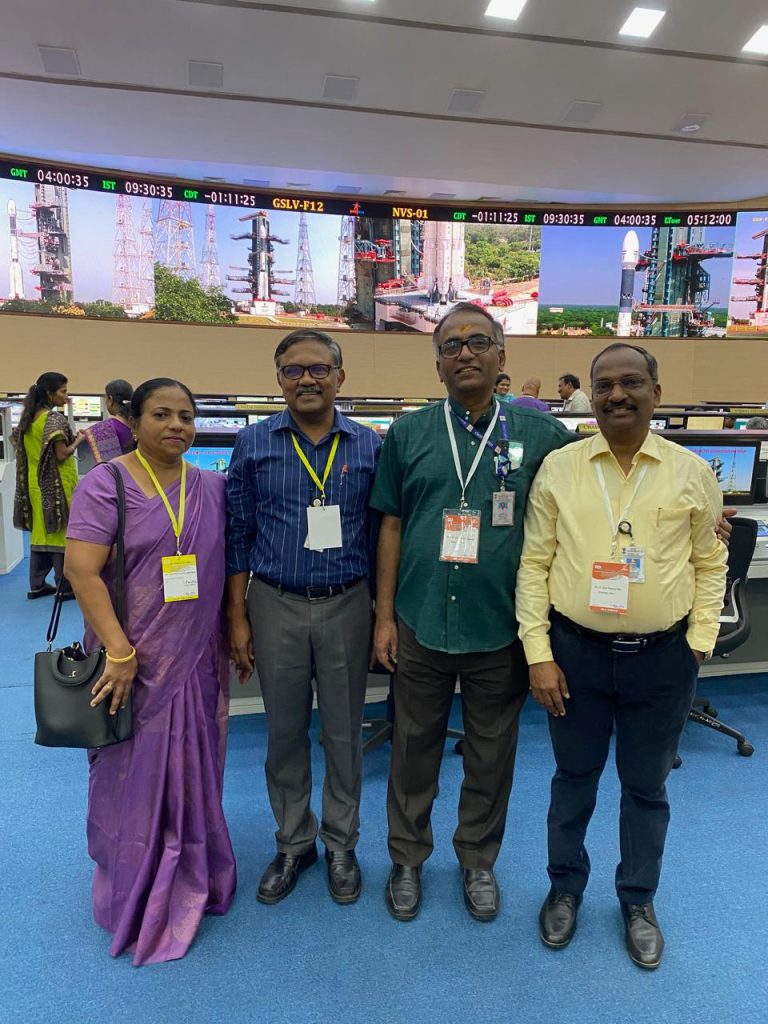
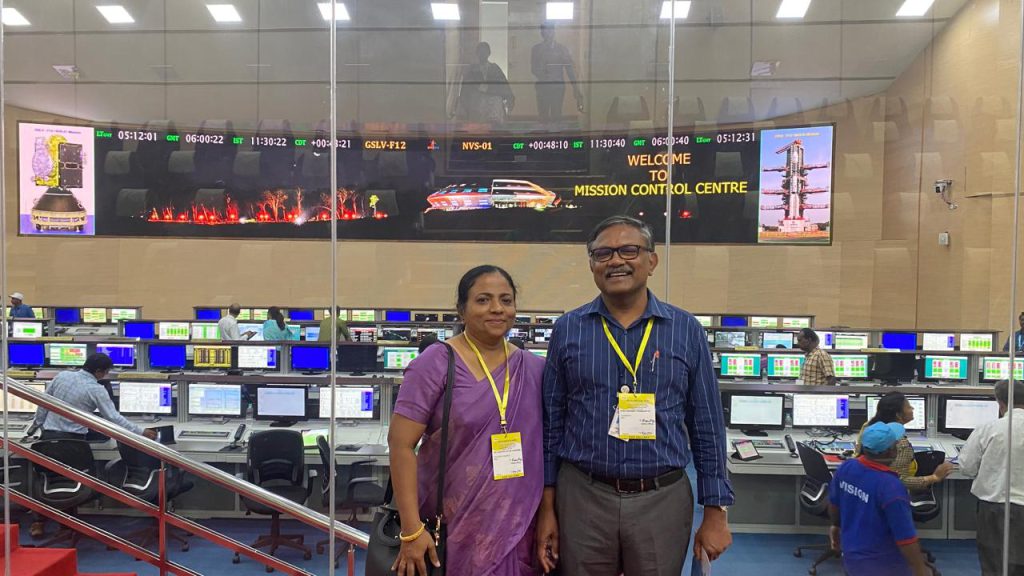
Mission Control Center GSLV F12 launch
By the time he completed his secondary education, it was clear to his family and teachers that Oommen was destined for a career in science and engineering. His decision to pursue a Bachelor of Technology at the University of Kerala was not merely a personal ambition but a natural extension of his early life experiences. The strong foundation laid during his formative years—family values, intellectual curiosity, and community engagement—would serve as the bedrock for his future contributions to India’s space program and academia.
Education and Academic Formation
The pursuit of knowledge was always central to Dr. Oommen Tharakan Kuttiyil Thomas’s life. After completing his schooling in Kerala, he embarked on a journey that would take him through some of India’s most prestigious institutions of higher learning. Each stage of his academic formation not only sharpened his technical expertise but also broadened his intellectual horizons, preparing him for the multifaceted career that lay ahead.
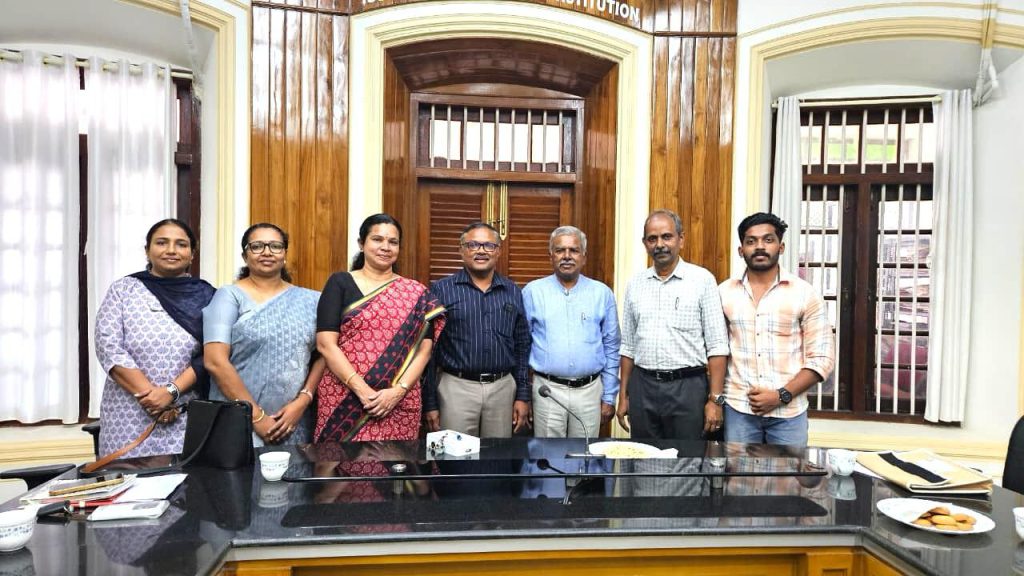
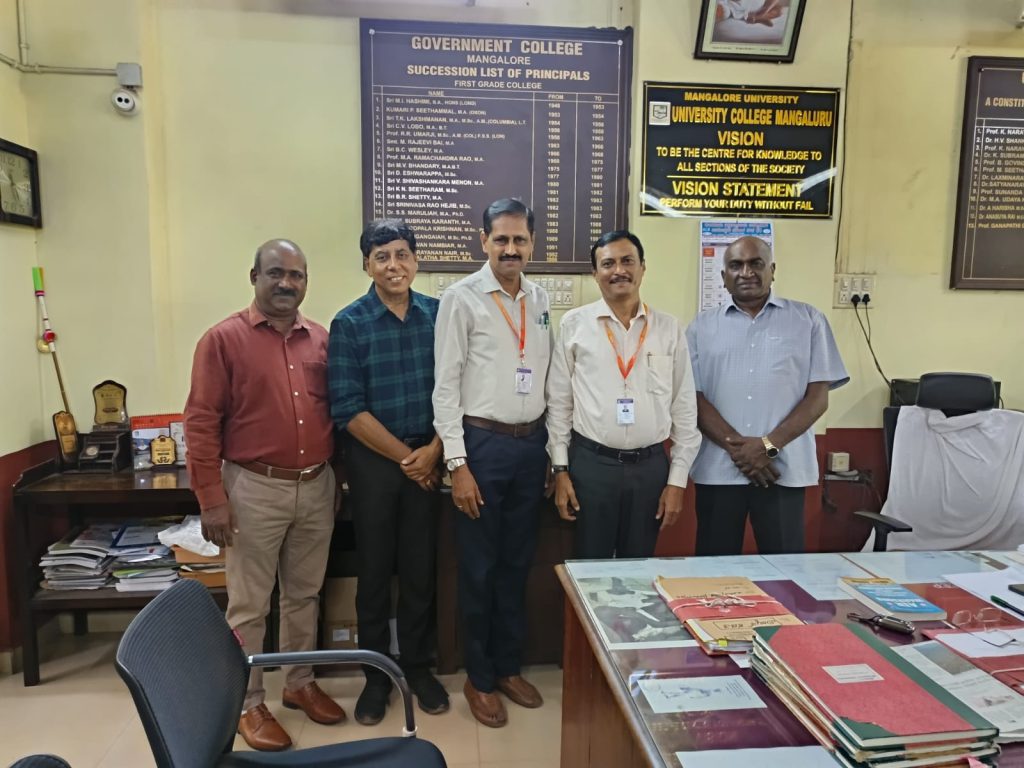
Meeting with Agricultural College Vellayani faculty on BEEMARK-I
His first major academic milestone was the Bachelor of Technology degree at the University of Kerala, completed in 1985. The University of Kerala, with its strong emphasis on foundational sciences and engineering, provided him with a rigorous grounding in electrical and electronic principles. During these formative years, Oommen distinguished himself as a student who combined theoretical mastery with practical ingenuity. He was known among his peers for his ability to translate classroom concepts into working models, often building small prototypes to demonstrate the application of engineering principles. This hands-on approach would later become a hallmark of his teaching and research philosophy.
Becoming a Scientist: The ISRO Years
Dr. Oommen Tharakan’s defining professional journey began in 1985 when he joined the Vikram Sarabhai Space Centre, the heart of India’s launch vehicle program. Fresh from his undergraduate studies, he entered an ecosystem shaped by national urgency, intellectual rigor, and an uncompromising commitment to reliability.
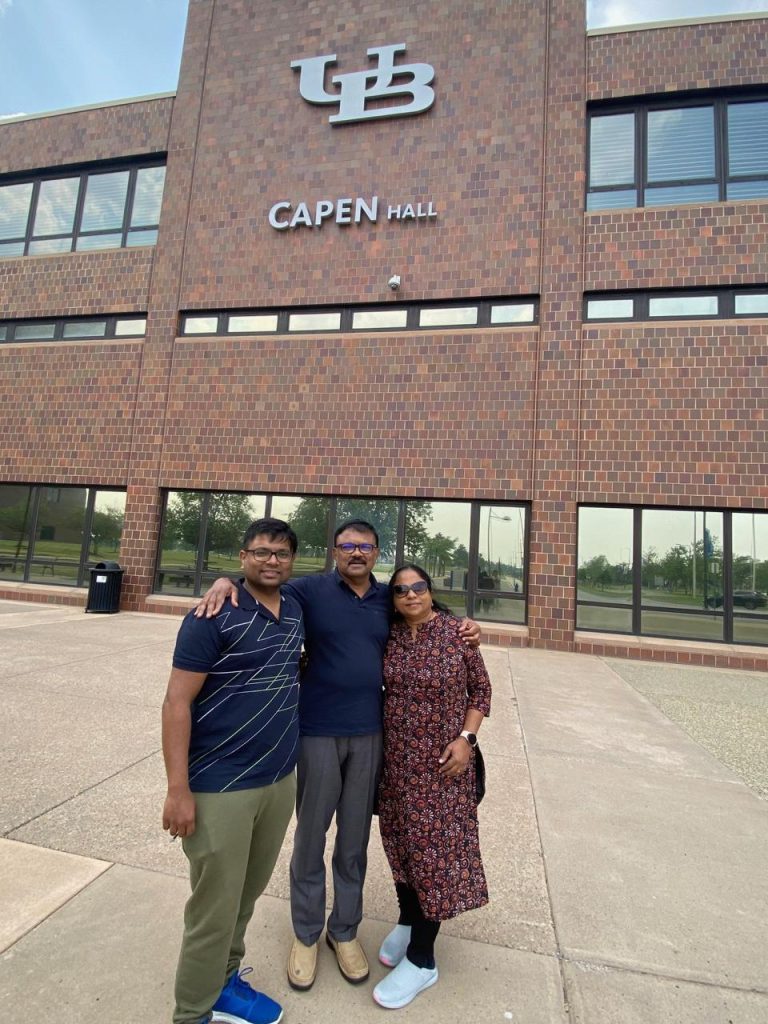
University at Buffalo, New York
These were years when India’s space program operated under severe international technology embargoes. Access to advanced components and test systems was limited, forcing engineers and scientists to innovate with what was available. The challenging times, when looked back on, give tremendous joy to the community of dedicated scientists.
For a young scientist, the challenging environment was demanding and formative. Working on avionics, propulsion related electronics, and reliability engineering, Dr. Oommen Tharakan learned early that in space missions, failure is not an abstract concept; it has consequences measured in lost missions and national setbacks.
Soldering School certificate distribution
The “zero defect” mandate was not a slogan but a lived reality. Each component had to survive vibration, thermal extremes, radiation, and the unforgiving physics of launch. In this crucible, he developed a mindset that would define his career: rigor without shortcuts, creativity grounded in fundamentals, and perseverance under pressure.
He contributed vastly to the indigenisation of electrical, electronic and electromechanical components, helping Indian Space Research Organisation (ISRO) move from dependence on imports toward self-reliance through inspiring Indian industry. We see the echo of this approach in today’s Atmanirbhar Bharat initiatives.
Sriharikota (SHAR) guest house Chennai
Another significant achievement was his involvement in knowledge transfer and training. Recognizing the importance of building capacity within ISRO, Oommen mentored younger engineers and scientists, sharing his expertise in Indigenisation, VLSI design and test, formal verification, avionics production, reliability engineering and systems design. His ability to explain complex concepts in simple terms made him a respected teacher within the organization. Many of his trainees went on to assume leadership roles in subsequent ISRO missions, a legacy that Oommen continues to cherish.
By the time he left ISRO, Oommen had established himself as a scientist whose contributions had directly impacted the success of India’s space program. His work in components screening, VLSI design and test, reliability engineering, and indigenous innovation ensured that India could pursue its space ambitions with confidence. More importantly, his years at ISRO instilled in him a deep sense of national service and scientific responsibility—values that would guide his later transition into academia.
Deepening the Mind: IISc and IIT Bombay
While his professional responsibilities at ISRO grew, Dr. Oommen Tharakan never viewed learning as complete. His pursuit of higher education was not driven by credentialism, but by a need to understand systems more deeply. Completing his M.E. at the Indian Institute of Science (IISc), Bengaluru in 1991 marked a critical intellectual shift.
IISc exposed him to a culture where questioning assumptions was as important as solving problems. The environment at IISc was transformative: surrounded by some of the brightest minds in the country, Oommen was exposed to cutting-edge research and interdisciplinary collaboration. He learned to approach problems not just as technical challenges but as opportunities for innovation. His time at IISc also instilled in him a strong appreciation for research methodology, scientific rigor, and the importance of publishing work that could contribute to the global body of knowledge.
Years later, his doctoral work at IIT Bombay further transformed his approach to engineering and research. IIT Bombay, known for its emphasis on innovation and entrepreneurship, offered him a platform to explore the intersection of engineering and applied research. Here, he honed his skills in systems design, microelectronics, formal verification and communication technologies. The exposure to diverse faculty and international collaborations at IIT Bombay broadened his perspective, reinforcing the idea that engineering was not confined to laboratories but was a tool for solving real-world problems.
Completing a Ph.D. while handling demanding professional tasks required discipline and sacrifice, but it also reinforced a lifelong lesson: serious scholarship is less about brilliance and more about sustained effort. His research in Genetic algorithms, VLSI design and testing, automatic test pattern generation, and fault simulation addressed practical problems at the intersection of design and production areas often overlooked but crucial to system reliability. Throughout his academic journey, he faced challenges that tested his resilience. The transition from Kerala to Bangalore and later to Bombay required him to adapt to new environments, cultures, and academic expectations. Financial constraints and the pressure of excelling in highly competitive institutions were hurdles he had to overcome. Yet, these challenges only strengthened his resolve. He learned to balance rigorous coursework with independent research, often working late into the night to refine his projects and papers.
By the time he completed his advanced studies, Oommen had acquired not only technical expertise but also a vision for how engineering could serve society. His academic formation was marked by a blend of discipline, creativity, and resilience—qualities that would define his later contributions to ISRO and academia. More importantly, his experiences at the University of Kerala, IISc Bangalore, and IIT Bombay instilled in him a lifelong commitment to learning, teaching, and innovation.
For students and young researchers, this phase of his life stands as a powerful reminder that learning is not confined to age or stage. Intellectual growth is a choice to be renewed daily.
A Global Lens, an Indian Core
International exposure played a complementary role in richly shaping Dr. Oommen Tharakan’s worldview. Serious participation in global conferences and workshops in Hong Kong, Seoul, Washington DC, Scarborough (Canada), and other international hubs offered him a firsthand view of how engineering problems were approached across cultures.
These experiences did not dilute his commitment to India; instead, they sharpened it. He observed that while resources and infrastructure varied widely, excellence was ultimately driven by clarity of thought, disciplined processes, and ethical responsibility. Returning to India, he carried with him not just technical insights but a conviction that global standards could and should be pursued within Indian institutions, even in environments far removed from metropolitan privilege.
The Shift: From Spacecraft to Students
After nearly four decades at ISRO, culminating as Group Director at VSSC, Dr. Oommen Tharakan made a transition that surprised many. Moving into academia full time, particularly in a semi-rural setting, was not an obvious next step. Yet for him, it represented continuity rather than change. “At ISRO, we built systems that would leave the Earth,” he reflects. “In academia, we build minds that must learn to escape limitations.” As Dean of Research and Development and Head of Electronics and Communication at Mar Baselios Christian College of Engineering and Technology (MBCET), he encountered a different set of challenges. Limited resources, diverse student preparedness, and the absence of an entrenched research culture could have become constraints. Instead, they became design parameters.
He approached academic leadership much like a complex engineering problem: define objectives clearly, work with available resources, build robust processes, and iterate relentlessly. The result was the emergence of a vibrant research ecosystem, international collaborations, and most visibly, the BASILIAN-01 rocket project; that made everyone proud. We could look on to the sky and reach our dreams over there as well.
Under his guidance, undergraduate students designed, fabricated, tested, and successfully launched a technology demonstrator rocket, the first such achievement by an engineering college in India. More than the launch itself, the project redefined what students believed was possible. It transformed classrooms into living laboratories and replaced passive learning with ownership and accountability.
Success as a Byproduct of Purpose
Dr. Oommen Tharakan’s career is marked by achievements that span institutions and decades, yet he speaks of them with restraint. Completing his Ph.D. later in life remains a personal milestone, not because of the degree itself, but because it reaffirmed his belief in perseverance. His work on test vector generation for VLSI devices and indigenous component reliability has influenced both academic research and mission critical applications.
His Springer Nature book, Electronics Production Defects and Analysis, fills a crucial gap between design theory and manufacturing reality, serving engineers and researchers worldwide. Recognition followed in the form of awards, IEEE Senior Membership, and invitations to global expert panels not as goals pursued, but as acknowledgments of sustained contribution.
Equally telling is his work beyond aerospace. The BEEMARK-I smart beehive monitoring system, which applies aerospace grade sensor logic to agriculture, reflects his conviction that advanced technology must ultimately serve society. By helping farmers monitor bee colony health, the project demonstrates how high-end engineering can address grassroots needs; bringing collaboration offers from premium centres.
Agriculture Universities to Space Research Organisations opens their doors and windows to welcome students and faculties to practice what is being taught; in fact, going beyond the curriculum and its boundaries. The mindset set in the campus has impacted the thought process of the educational ecosystem in the state of Kerala and beyond.
Personal Life and Values
Behind the professional achievements and academic leadership of Dr. Oommen Tharakan Kuttiyil Thomas lies a deeply grounded personal life shaped by family, faith, and enduring values. For him, success has never been measured solely by titles or accolades, but by the balance between professional dedication and personal integrity.
Raised in Kerala, his early life was steeped in the traditions of community, spirituality, and resilience. These foundations instilled in him a sense of humility and service that carried through his career. Even as he worked on mission-critical projects at ISRO or guided students in academia, he remained rooted in the values of honesty, perseverance, and compassion.
Family has always been central to his journey. He often reflects on how the support of his loved ones enabled him to pursue demanding roles across India and abroad. Their encouragement provided strength during moments of challenge, whether it was the long hours at ISRO, the adjustments required in international environments, or the responsibilities of academic leadership. For Dr. Oommen Tharakan, family is not only a source of personal joy but also a reminder of the importance of balance between work and life.
In essence, Dr. Oommen Tharakan’s personal life and values form the bedrock of his professional achievements. They explain his resilience in the face of challenges, his humility despite recognition, and his unwavering commitment to mentorship and service. For him, the true measure of a life well lived is not in accolades but in the values upheld and the lives touched.
Lessons from a Life in Science
Asked about the principles that guide him, Dr. Tharakan is unequivocal: perseverance outweighs perfection. In research, he believes, solutions emerge once one commits fully to the problem. Curiosity, not rote memorization, is the foundation of education. Students must understand the “why” behind every equation and algorithm.
Failure, in his view, is not an endpoint but feedback. Every setback refines judgment and strengthens resolve. Above all, he emphasizes scientific social responsibility, the idea that technology’s true value lies in its capacity to uplift people and empower communities.
These lessons resonate far beyond engineering. They speak to anyone navigating uncertainty, ambition, and change.
Building Futures: The Hardest Engineering
As the echoes of the BASILIAN-01 launch spread into the hills of Idukki, what remained was not just data or headlines, but a shift in mindset. Students who once doubted their place in advanced engineering began to see themselves as contributors, not spectators.
Dr. Oommen Tharakan’s journey reminds us that while launch vehicles rise once, well taught students rise again and again carrying knowledge, confidence, and purpose into the world. In choosing to build futures rather than rest on past achievements, he has undertaken perhaps the most demanding engineering challenge of all. And by every measure that truly matters, he continues to succeed.
The Rotary Club of Organ Donation International presents an impactful brainstorming session on Organ Donation in India, bringing together medical experts, social leaders, recipients, and change-makers committed to saving lives through awareness and action. The session will be led by Dr. Vatsala Dilip Trivedi (MBBS, MS, M.Ch – Urology), Former Professor & Head of the Department of Urology and Transplant Services at LTMGH, Sion Hospital, and Consultant at SL Raheja Hospital and Kohinoor Hospital, Mumbai, along with distinguished Rotary leaders and advocates in the field of organ donation.
The panel includes Rtn Lal Goel, Founder & Charter President; Rtn PHF Ritika Gupta, Inspire President; Rtn Aalok Singhi, Founder & Creator of Mithasha Foundation, Indore; Rtn Harsh Vardhan, kidney recipient and Captain of the Indian Archery Team at the World Transplant Games 2025, Jaipur; Rtn Jyoti Galada, journalist, creative and scriptwriter from Kolkata; Rtn Ruby Agarwal, Inspire Secretary; and Rtn Sunil Gupta, Public Image Chair. This inspiring dialogue will be held on Saturday, 17th January 2026 at 8:00 PM, aiming to spark ideas, share lived experiences, and strengthen India’s organ donation movement.
Are you the one who can deliver? | Or else, can you bring those who can deliver to the forefront? Either way you can be a part of the process.
NV Paulose, Chairman, Global TV +91 98441 82044
The idea behind the number 1299 is simple yet profound. It represents a way of seeing society through the lens of 1 to 99. Miracles do not happen when systems are torn down or when success is punished. They happen when attention shifts. They happen when a society focuses on to the ninety nine percent while everything else continues as it is.
This is not a call to dismantle systems, disrupt growth, or reverse what is existing. Let everything remain as it is. Let excellence be rewarded at every point. Enhance opportunities for the 99% to gain momentum while the one percent continues to flourish further ahead.
The issue is not prosperity of the one percent. The issue is the silent but purposeful neglect of the rest. A nation can live with inequality even to a large extent. But a society cannot live with indifferent approach to the larger chunk of the population. Equity and equal opportunity should be there on fundamental rules, laws and systems. See the nature to get an idea of this. Can you restrict the poor from breathing the air?
How will you measure happiness? Can you claim happy in the midst of plenty? It is the one who had experienced penury turn to become great in the future. Those who had enjoyed plenty had turned to become poor when they had failed to nurture their person and talent.
The Silent Drift Toward the One Percent
In India Today, attention of the systems increasingly flows towards upward. Economic planning, tax cuts, incentives, urban development, education, healthcare, and even public imagination quietly align around the interests of a small wealthy group. This does not always happen by design. It happens by habit. We silently ignore injustice. It is obvious when it comes to matters pertaining to the commoners.
When leaders, institutions, and systems repeatedly look toward the top, resources follow that gaze. Over time, what begins as growth becomes imbalance. The ninety nine percent are not actively harmed, but they are gradually overlooked. That is the more dangerous mistake.
Ignoring does not make noise. It does not create immediate crisis. But it slowly weakens the foundation of the entire society.
The Real Problem Is Not Wealth, But Neglect
Wealth is not the enemy. Achievement is not the problem. The danger lies in allowing large numbers of people to become invisible. When education is designed for a few, potential is wasted. When healthcare is accessible only to those who can afford it, human strength is lost. When employment systems fail to protect dignity, social trust erodes. These losses do not appear on balance sheets, but they shape the future.
Greed behaves like a bottomless bucket. No amount poured into it ever feels sufficient. But this is not a moral accusation. It is a structural truth. When attention stays fixed on the top, demands from the top never end. Unfulfilled demands attribute unhappiness at the top also. Meanwhile, silence grows below. Roof falls if there is no foundation. We should continuously learn lessons from the wisdom of the universe.
The Lesson of the Lily and Solomon
There is a timeless comparison that reveals the heart of this issue in a profound manner. Consider the beauty of a simple lily in the field and compare it with the splendour of Solomon at the height of his glory. Solomon represents wealth, power, and human achievement at its peak and the lily represents fragility, simplicity, short life and what appears to be insignificant. Yet the lily is clothed with a beauty that rivals royal splendour. The lesson is not that Solomon’s glory is wrong.
The lesson from the timeless wisdom is that the divine attention does not stop with the powerful. Care extends even to what seems to be least important. Nothing is dismissed as unworthy of consideration. This is the attitude societies must learn to imitate. If God does not ignore the least, human systems have no justification for doing so.
Enjoy your possessions and positions, but never disgrace the other on your glorious existence.
Attention Is the First Act of Justice
Justice does not begin with laws or budgets. It begins with attention. What we choose to see determines what we choose to fix. The ninety nine percent do not need to replace the one percent. They need to be seen alongside them. They need to be considered in planning, policy, and priority. Even small acts of inclusion create long term balance.
Just as the lily does not compete with Solomon for beauty, the ordinary citizen does not compete with the wealthy for dignity. Both can exist. Both deserve care. Never ever act as poor are at the mercy of the rich; it is not. In fact, all in the world and beyond are at the mercy of the infinite intelligence that governs the conduct of the universe.
How Everyone Benefits When No One Is Ignored
When the 99 percent are acknowledged, supported, and included, society becomes stronger for everyone, including the one percent. A healthy population creates stable systems. Widespread education and skill development produces capable talent. Accessible healthcare to every citizen sustains productivity. Social trust reduces risk and unrest.
Prosperity built on inclusion lasts much longer than prosperity built on exclusion. The one percent does not lose when the ninety nine percent are lifted from neglect. They gain a more stable and sustainable society in which their success can further more endure.
India at a Moment of Choice
India stands today at a decisive moment. The demographic dividend is in our favour. With the size of population and diversity, we cannot afford to let large sections of its population fade into the background.
Economic indicators may rise, cities may shine at the outset, and wealth may accumulate, but none of this guarantee national strength if the majority feels unseen. It is like the volcano underneath.
Refocusing on to the ninety nine percent and reinforcing the systems in their inclusion means investing attention in rural communities, ordinary people, small entrepreneurs, students, and the vulnerable. It means asking a simple question in every decision: who is being left out.
This is not charity. It is responsibility.
Where Miracles Truly Happen
Miracles do not require dramatic upheaval. They occur quietly when ordinary people are no longer invisible.
When a farmer feels supported rather than forgotten.
When a student believes effort will be met with opportunity.
When illness does not mean financial ruin.
When dignity is preserved even at the lowest levels of society.
These are the miracles that transform nations from within.
From Ignoring to Seeing
The message of 1 to 99 is not revolutionary. It is corrective. Let everything remain as it is. Let wealth exist. Let success shine. But let no one be ignored. A society that learns to see the ninety nine percent, including the least among them, aligns itself with a deeper wisdom.
Just as the lily is not forgotten in a world that includes Solomon, people must not be forgotten in a nation that celebrates progress. When attention expands to include everyone, miracles follow naturally.