The journey to the bench and the bar starts today | The new batch of legal minds to Nehru Academy of Law.
NV Paulose, Chairman, Global TV +91 98441 82044
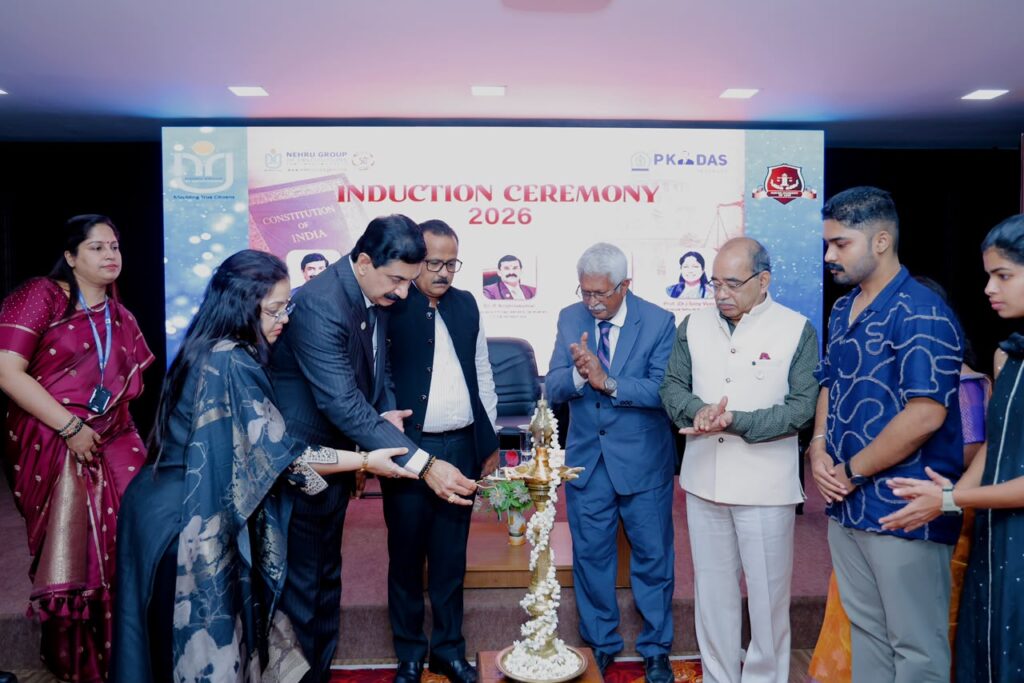
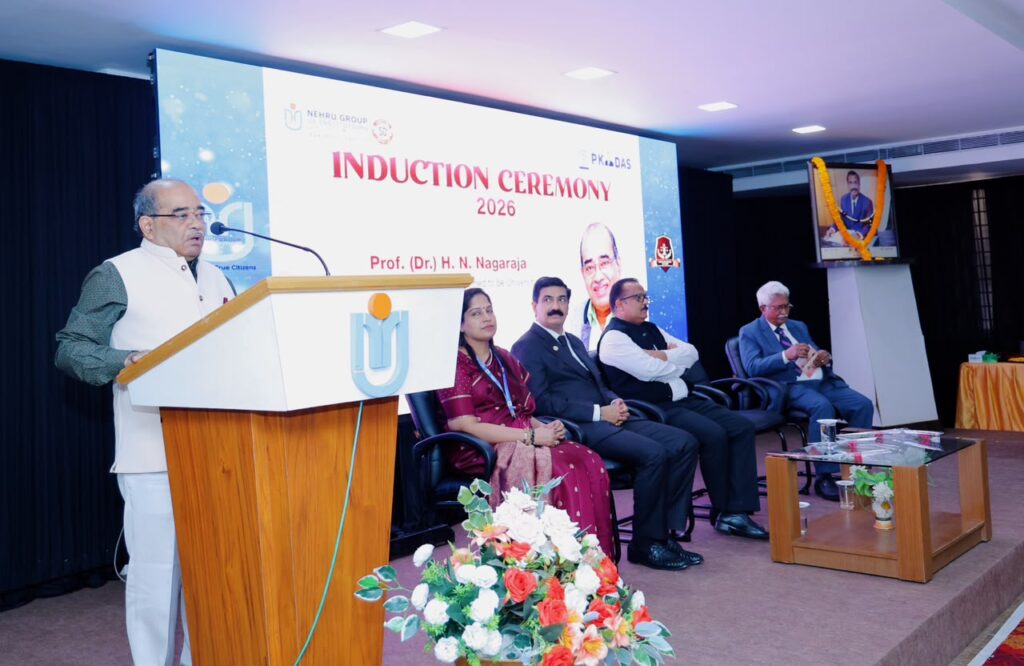
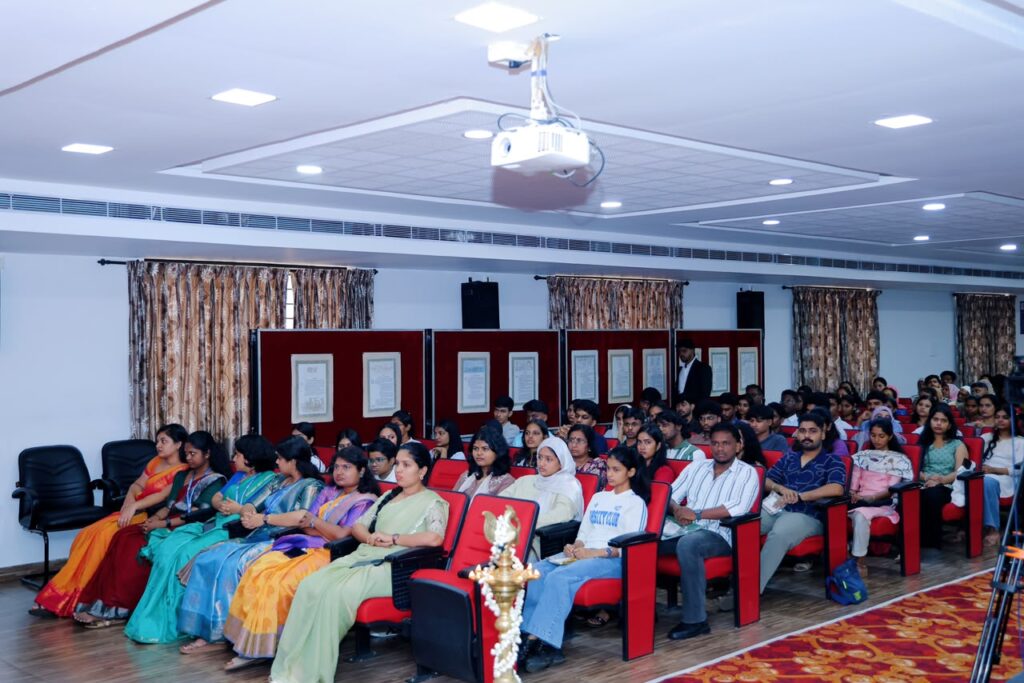
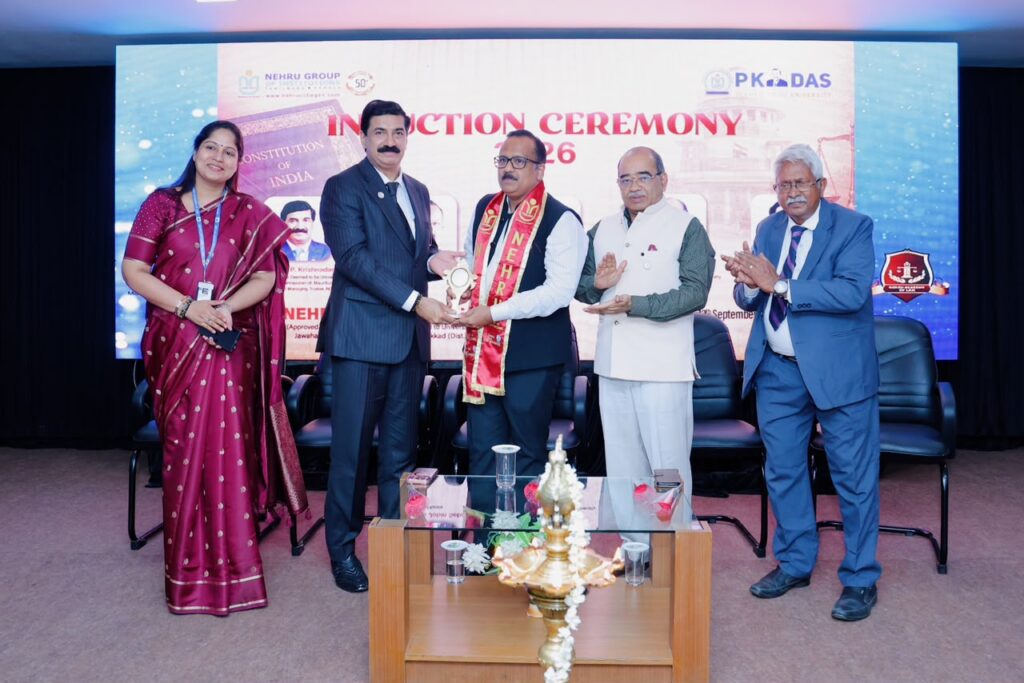
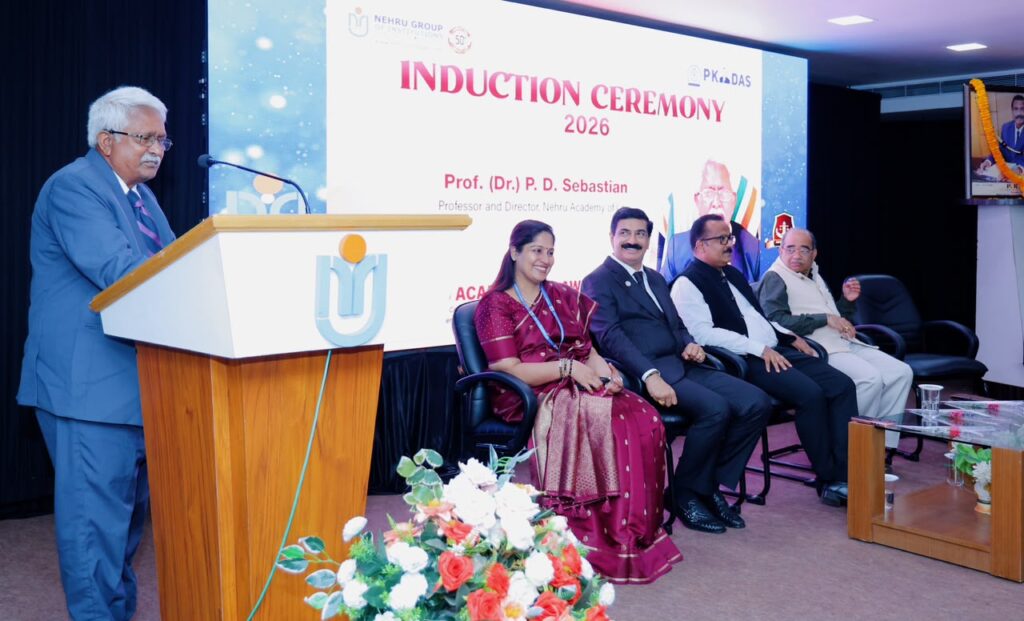
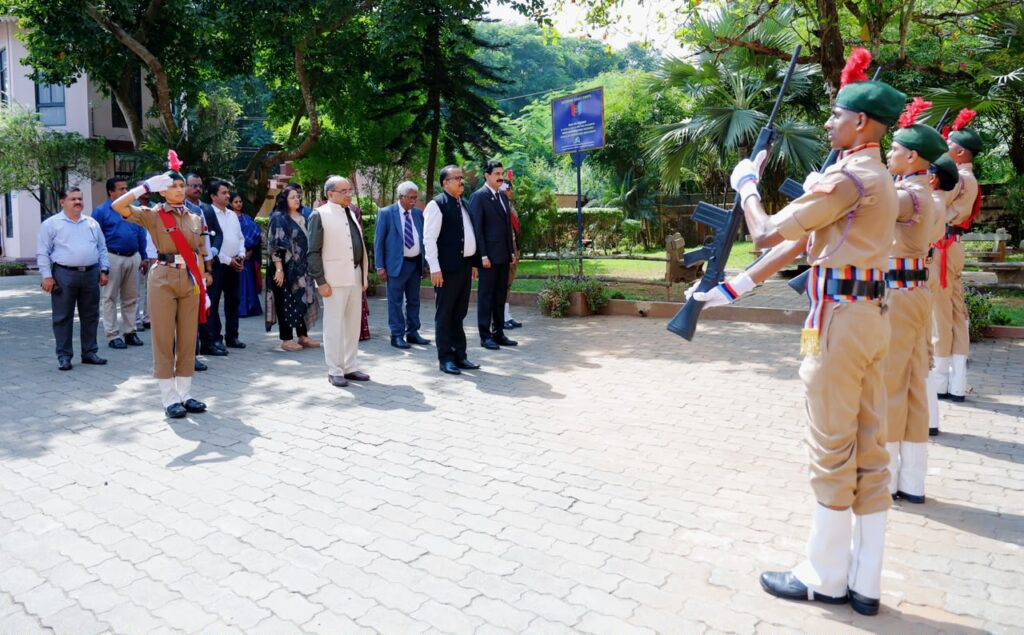
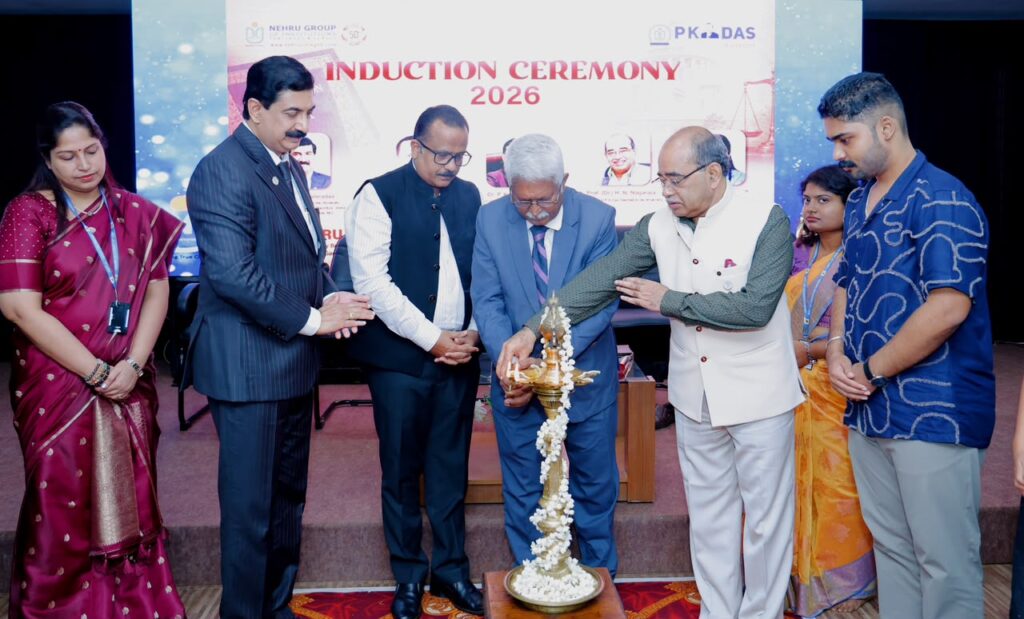
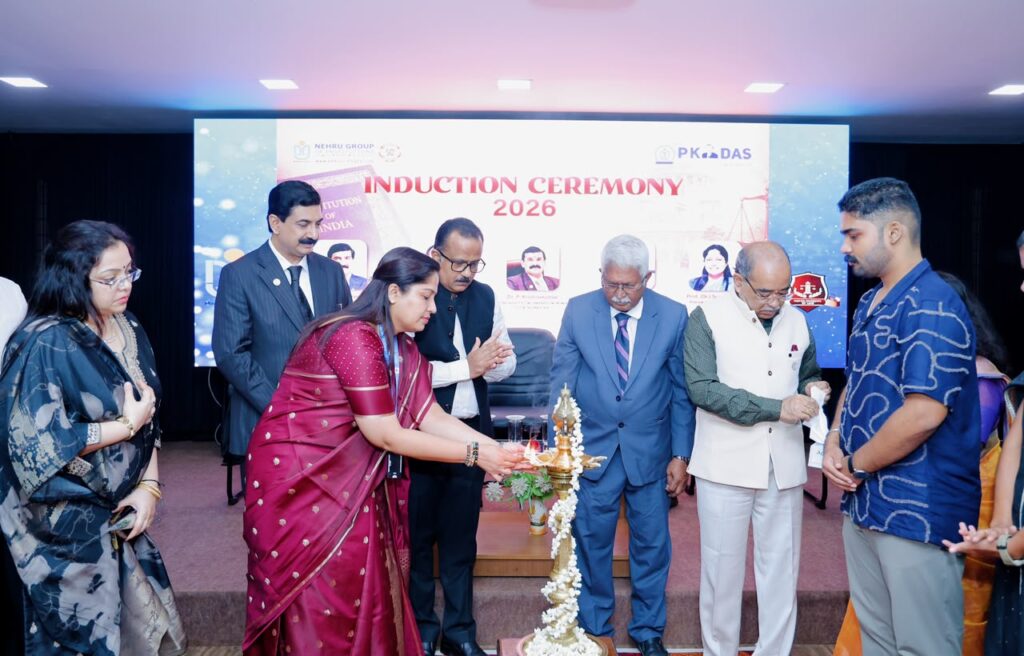
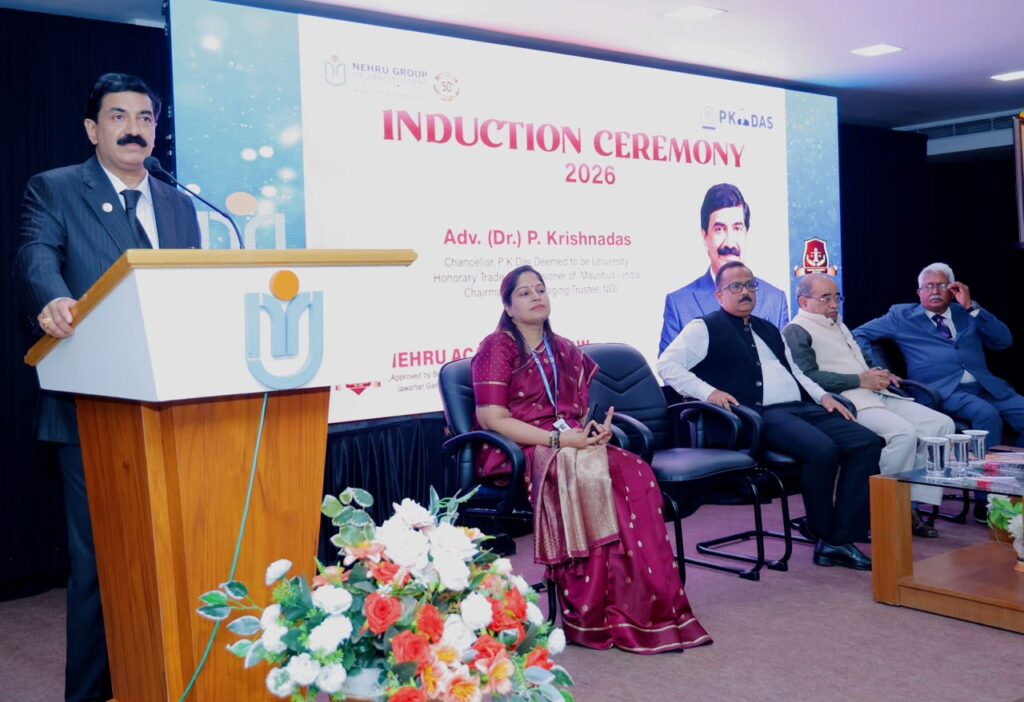
Nehru Academy of Law conducted its Induction Ceremony 2026 at Shasthra Hall, welcoming students to the beginning of their academic journey in legal education. The programme commenced with a one-minute silent prayer in fond memory of the academy’s beloved Founder Chairman, Late Shri P. K. Das, followed by a universal prayer.
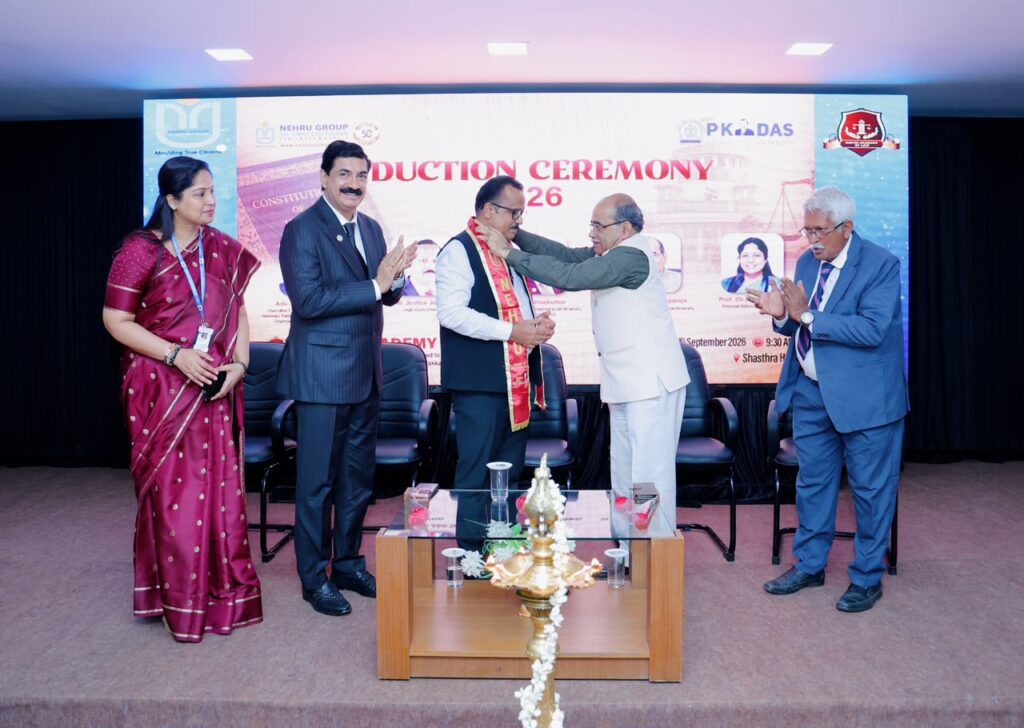
The ceremony was welcomed by Prof. Dr. Sony Vijayan, Principal, Nehru Academy of Law. Adv. Dr. P. Krishnadas, Chancellor, P. K. Das Deemed-to-be University; Honorary Trade Commissioner of Mauritius–India; and Chairman and Managing Trustee, Nehru Group of Institutions, delivered the Presidential Address. The Inaugural Address was delivered by Hon’ble Mr. Justice Jobin Sebastian, High Court of Kerala, while Prof. Dr. H. N. Nagaraja, Vice-Chancellor, P. K. Das Deemed-to-be University, delivered the Special Address. Dr. Sumitha Krishnadas, Correspondent, NGI, joined the gathering along with other dignitaries. Prof. Dr. P. D. Sebastian, Professor, Nehru Academy of Law, delivered the felicitation. The programme concluded with the Vote of Thanks and the National Anthem.
About Nehru Academy of Law
Nehru Academy of Law is committed to nurturing the next generation of legal professionals through a strong foundation in legal education, ethical values, critical thinking, and professional competence. The institution seeks to create an academic environment where students are encouraged to understand the law not merely as a profession, but as an instrument for justice and social transformation.
With a focus on academic excellence and holistic development, the academy provides students with opportunities to engage with legal concepts, contemporary issues, practical learning, and professional perspectives. Its academic approach aims to equip aspiring advocates and legal professionals with the knowledge, confidence, and analytical skills required to navigate the evolving legal landscape.
The academy also places emphasis on developing qualities that extend beyond the classroom, including leadership, communication, research, advocacy, and a strong sense of responsibility towards society. Through interactions with members of the judiciary, legal practitioners, academicians, and other distinguished professionals, students are encouraged to gain a broader understanding of the legal profession.
As a new batch begins its journey, Nehru Academy of Law looks forward to empowering its students to uphold the values of justice, integrity, constitutionalism, and service. The induction ceremony marks not only the beginning of their academic journey, but also their first step towards becoming responsible members of the legal fraternity.
About Nehru Group of Institutions
Nehru Group of Institutions (NGI) is an established educational group with a vision of providing quality education and creating opportunities for students to pursue their aspirations across diverse fields. With a broad academic ecosystem, the group continues to contribute to the development of education and professional learning. Founded on the vision and values of its Founder Chairman, Late Shri P. K. Das, the group has grown with a continued emphasis on academic excellence, innovation, discipline, and social responsibility. Its institutions strive to create learning environments that encourage students to develop both professional competence and strong personal values.
Under the leadership of Adv. Dr. P. Krishnadas, Chairman and Managing Trustee, Nehru Group of Institutions continues to pursue its commitment to empowering young minds through education. The group brings together institutions and academic communities with the shared objective of preparing students to meet the challenges and opportunities of a rapidly changing world.
Through its continuing focus on education, infrastructure, innovation, and student development, NGI remains committed to shaping future professionals, leaders, and responsible citizens. The induction of a new generation of law students at Nehru Academy of Law is another meaningful step in this larger educational journey.
The Mentor Within: Helping People Discover the Strength They Already Carry
The journey of a mentor who helps people discover their hidden potential and turn challenges into possibilities.The Mentor Who Helps You See What You Can Become
NV Paulose, Chairman, Global TV +91 98441 82044
What if the greatest obstacle in a person’s life is not a lack of ability, but the inability to recognize the ability that is already within? It is an idea that runs quietly through the life and work of Dr. Kusum Thantry D’Sa. Again and again, she has found herself entering unfamiliar territory, taking on responsibilities she did not initially believe she was equipped for, and discovering often only after the event that she possessed abilities she had never consciously recognized. Today, that experience has become central to the way she works with people. For Dr. Kusum, mentorship is not about giving people ready-made answers. It is about helping them understand themselves, question what is holding them back, and discover possibilities they may have overlooked. In many ways, she learnt this philosophy by living it herself.
The ability she did not know she possessed
One of the stories from her professional life illustrates this beautifully. She was once asked to interview engineering candidates, although engineering was not her specialist field. Her natural response was not to claim expertise she did not have. Instead, she prepared. She developed a set of questions based on her experience of questioning and evaluating students, had the technical aspects reviewed by someone qualified, and conducted the interviews. She was subsequently asked to interview shortlisted candidates again. What surprised her was not that she had been able to do the job. It was that she had never known she was particularly good at evaluating people. She had simply accepted the responsibility and done what was required. That experience reveals something important about her philosophy: competence is sometimes discovered through action, rather than confidence.
We often wait to feel capable before attempting something. Her life suggests the opposite can also be true. Sometimes we have to attempt something first in order to discover what we are capable of. It is an idea that has repeatedly played out in her own journey, from education and institutional leadership to counselling and personal development.
Questioning the rule behind the rule
Another defining characteristic of Dr. Kusum’s personality is her willingness to question conventions. But she does not describe herself as someone who simply rejects rules. Her deeper concern is with rules that are followed without understanding their purpose. One experience from her early professional life involved the expectation that women should wear sarees in the workplace. Rather than simply accepting it as an unquestionable norm, she checked the relevant regulations. She discovered that what had been treated as a rule was, in fact, more of an unwritten convention.
That distinction stayed with her. For Dr. Kusum, the important question is not merely, “What does the rule say?” It is: “Why does the rule exist, and is following it actually serving the person?” That philosophy later appeared in other areas of her life, including education, where she encountered situations in which rigid application of a regulation could deny a child an opportunity. Her instinct was to look for the purpose behind the system. This is an important quality in a mentor. A mentor does not merely teach people to obey or disobey. A mentor teaches them to think.
When difficulty becomes a teacher
Dr. Kusum’s life has not followed a straight or predictable path. There have been professional disruptions, changes in institutions, family responsibilities, unexpected transitions, and periods when carefully made plans did not unfold as expected. She interprets many of these experiences through a spiritual understanding of karma and the lessons of the soul. That is her personal worldview. But beneath the spiritual explanation lies a remarkably practical principle. When asked what difficulties ultimately do to a person, her answer is essentially: “I will become better.”
That may be one of the most useful lessons in her story. She does not present adversity simply as something to escape. Difficulty can also become training. A person who has faced uncertainty may become more adaptable. Someone who has experienced disappointment may become stronger. Someone who has had to rebuild may become better equipped to help another person rebuild. In that sense, her own difficulties became part of her education. A transformational mentor does not necessarily make life easier for someone. Sometimes, the mentor helps the person become strong enough to meet life differently.
Dr. Kusum is a mentor who believes that life itself is a continuous learning process. Her message is simple yet powerful: difficulties should not become reasons to stop; they should become opportunities to understand, learn, and grow. Through her talks and interactions, she encourages people to look beyond immediate setbacks, question what they do not understand, and develop the willingness to keep learning. In a world where knowledge is increasingly accessible, she believes that people have an unprecedented opportunity to learn, explore new ideas, and consciously shape their lives.
What makes Dr. Kusum’s approach distinctive is her emphasis on practical self-development. She encourages people to observe their own thoughts, understand their difficulties, use practices such as meditation and visualization where appropriate, and develop habits that strengthen their ability to deal with life’s challenges. Rather than presenting herself simply as someone who has all the answers, she encourages people to become active participants in their own growth. Her larger message is one of resilience and possibility: when we learn to understand our difficulties instead of being defeated by them, every challenge can become a stepping stone toward a better version of ourselves. Life is very precious.
The counsellor existed before the title
Perhaps the most revealing part of Dr. Kusum’s journey is that counselling seems to have found her before she formally chose it. People would come to her, sit with her and talk about their personal problems. For a long time, she did not necessarily interpret this as evidence of a particular vocation. It was simply something that happened. Eventually she recognized the pattern. People trusted her enough to tell her things. She listened. She asked questions. She tried to understand what lay beneath the immediate problem.
Later, she formally trained in counselling, including practical work and a substantial number of counselling cases. The training gave structure and discipline to an ability that had already been visible in her life. This distinction matters. Her formal education did not manufacture her interest in people. Rather, it helped her understand and develop something that people had already been coming to her for. In that sense, the profession came after the calling.
Learning how different people need different maps
Her journey did not stop with conventional counselling. Over the years, she explored psychology, spirituality, numerology, astrology, family constellation work and other approaches to understanding human behaviour and experience. Some of these approaches are established psychological practices; others belong to spiritual or metaphysical traditions and remain matters of belief rather than scientifically established mechanisms. Dr. Kusum herself sees them as different ways of understanding a person’s experience. Her approach begins with the individual.
She first tries to understand the person’s psychological and emotional situation. She asks about their beliefs and spiritual background. She then chooses ways of working that she believes the person can understand and engage with. This is perhaps one of the most distinctive aspects of her mentoring philosophy. She does not believe every person needs the same map.
For one person, psychology may provide the language to understand what is happening. For another, faith may provide meaning. For someone else, family relationships may be the key to understanding a recurring pattern. Her role, as she sees it, is to help the person find a framework through which they can begin to make sense of their experience and then take practical steps forward.
From answers to awareness | The unfinished business of life
This is also why the idea of transformation is important. A mentor who simply gives answers can make a person dependent. A mentor who increases awareness can make a person more capable. Dr. Kusum’s stories repeatedly point toward the second model. She encourages people to observe what happens when they try a particular change. She gives them practical steps. She asks them to return and reflect. Over time, she believes, people can develop greater clarity and confidence in their own ability to navigate their lives. The objective is not simply to tell someone what their future will be. It is to help them become more conscious of the choices available to them.
Some of the most moving experiences she describes involve people approaching the end of life. In her counselling work, she has encountered situations involving regret, unresolved relationships, lack of forgiveness and unfinished emotional business. Her focus in such situations is on reducing suffering that may still be within a person’s control: saying what needs to be said, forgiving where possible, resolving relationships, releasing regret and finding peace.
She interprets some of these experiences through her spiritual worldview. Whether one shares that worldview or not, the underlying human lesson is difficult to dismiss: There are things people carry for years that they may never have needed to carry alone. Sometimes transformation does not mean achieving something spectacular. Sometimes it means making peace with something that has been hurting us for decades.
The Hanuman metaphor
There is a particularly powerful metaphor in Dr. Kusum’s thinking: Hanuman. In the traditional story, Hanuman possesses enormous strength but does not fully recognize his own power. It takes another person to remind him of what he is capable of. That metaphor seems to capture something essential about mentorship. Perhaps the finest mentors do not put strength into people. They help people discover the strength that was already there.
The student who thinks she is incapable may need someone to recognize her ability. The professional who has failed may need someone to help him see what the failure has taught him. The person trapped by circumstances may need someone to ask a different question. The individual who has spent years following expectations may need permission to ask, “Is this really the life I want?” And sometimes the person simply needs somebody to say: “Look again. You may be capable of much more than you think.”
A mentor shaped by her own journey
This may ultimately be the most interesting way to understand Dr. Kusum. Her story is not simply a progression from one qualification to another or from one position to another. It is a journey from following systems to questioning systems; from discovering her own abilities to helping others discover theirs; from listening informally to counselling professionally; and from searching for answers to helping people search for meaning. She has repeatedly entered unfamiliar territory and learned by doing.
That experience appears to have shaped the way she now approaches other people’s lives. She knows what it is like not to have all the answers. She knows what it is like to be pushed into circumstances she did not choose. She knows what it is like to discover an ability only after someone else gives her the opportunity to use it. Perhaps that is why her strongest contribution as a mentor may not be any particular technique. It is the ability to make another person pause and reconsider the story they have been telling themselves. Because transformation often begins at precisely that moment.
Not when someone receives an answer. Not when someone is given a solution. But when someone begins to see themselves differently. And perhaps that is the real work of a mentor: not to tell us who we should become, but to help us recognize who we already have the capacity to become.
THE FUTURE BELONGS TO THE MAKERS | BEYOND THE ALGORITHM | THE HUMAN HAND THAT BUILDS THE FUTURE
NV Paulose, Chairman, Global TV +91 98441 82044
We have a strange habit when we look at civilization. We look upward. We look at kings, philosophers, scientists, priests, emperors, entrepreneurs, and inventors. We look at the names written into books and carved into monuments. We search for the great mind who discovered the idea, the genius who invented the system, the institution that gave civilization its direction. But perhaps we have been looking at the wrong end of the machine. Perhaps the real history of civilization is not the history of those who received the credit, but the history of those who did the work. Look downward. Look at the hands. Look at the carpenter measuring a piece of wood. Look at the goldsmith weighing metal. Look at the builder deciding how much material is needed for a roof. Look at the farmer counting seeds. Look at the worker who learns, through repeated practice, what another person may later describe as a mathematical principle.
Rev. Dr. Willy D’Silva makes a provocative argument in his conversation: many of the foundations we associate with formal knowledge may have emerged first from people who simply had to make things work. Before measurement became mathematics, somebody needed to build a house. Before numbers became symbols, somebody needed to count. Before knowledge became an academic discipline, somebody had a practical problem that demanded an answer. And that changes the way we should imagine the future. The technologies may change from wood to carbon fibre, from metal to programmable matter, from notebooks to artificial intelligence. But the fundamental engine remains the same: a human being encounters reality and tries to make something work. Civilization does not begin only with ideas. It begins with problems. Someone needs to cross a river. Someone needs to store grain. Someone needs to build a wall. Someone needs to calculate how much metal is required. Someone needs to preserve a language. Someone needs to know when to plant. Someone needs to repair what has broken. The future will be no different.
THE FIRST TECHNOLOGISTS HAD DUST ON THEIR HANDS
Rev. Dr. Willy D’Silva challenges the familiar tendency to locate the origins of measurement and number systems exclusively in elite intellectual traditions. His argument is deliberately uncomfortable: the people who actually needed to measure were workers—the builders, carpenters, goldsmiths and others whose daily survival depended on accuracy. Consider the carpenter. A carpenter does not begin the morning by asking what philosophy of mathematics will govern the construction of a roof. The carpenter takes wood. The carpenter measures it. The carpenter cuts it. The carpenter puts pieces together. The roof either fits or it does not. Reality becomes the examiner.
Rev. Dr. Willy D’Silva describes the astonishingly physical origins of measurement: fingers, pieces of wood, repeated lengths, practical units and accumulated experience. He describes the goldsmith similarly using seeds and known quantities to establish value and consistency. Whether every historical claim in this reconstruction survives scholarly scrutiny is a question for historians. But the larger idea deserves attention. Knowledge does not always descend from an institution into society. Sometimes it rises from society into institutions.
The worker is therefore not merely someone who executes knowledge created elsewhere. The worker can be its creator. The workshop can be a laboratory. The construction site can be a research centre. The repeated act of solving practical problems can produce knowledge that later becomes formalised, named and taught. What begins as a piece of wood marked by a carpenter can eventually become a unit in a textbook. What begins as a practical calculation can eventually become an abstract system. The abstraction may be elegant, but the problem came first.
That perspective becomes especially important as we enter a technological age in which physical and digital worlds are becoming inseparable. The next great technologies will still have to interact with soil, water, buildings, energy, food, transport, materials and human bodies. The people who understand those realities cannot be treated as secondary to the people who write software about them. The future will require a new respect for practical intelligence—the intelligence that comes from doing, observing, adjusting and doing again.
FROM THE WORKSHOP TO THE MACHINE
The great mistake of the coming technological age would be to imagine that artificial intelligence, robotics and automation will eliminate the importance of human labour. They may eliminate certain forms of labour. They will not eliminate the need for people who understand reality. A machine can calculate the dimensions of a building, but someone still has to understand the ground on which it stands. An algorithm can optimise a supply chain, but someone still has to know what happens when a road floods, when a machine breaks, when a crop fails, or when a community refuses to behave according to the assumptions inside the spreadsheet.
A robot can assemble components, but who decided what should be assembled? Who understands the material? Who notices that something feels wrong? Who invents the next method? The future may therefore belong not to the people who merely operate technology, but to those who combine practical knowledge with technological power. That is why the old division between “thinkers” and “workers” is becoming increasingly absurd. The carpenter was a thinker. The farmer was a data analyst. The goldsmith was a materials specialist. The traditional musician was an acoustic experimenter. The craftsperson was an investigator of materials, tools and human needs.
They may not have used the vocabulary of universities, but they were solving problems through observation, memory, experimentation and repetition. The futuristic society will need to recover this dignity of practical intelligence. It will need engineers who can work with their hands, programmers who understand physical systems, scientists who listen to communities, and workers who are given access to the tools of advanced technology. The next revolution should not make workers invisible. It should make their knowledge visible.
Imagine an artificial intelligence system trained not only on books, academic papers and corporate databases, but also on the accumulated practical knowledge of millions of workers. Imagine a construction worker contributing generations of knowledge about materials to an AI system. Imagine farmers documenting seasonal changes and local ecological patterns that become part of climate models. Imagine artisans preserving techniques in digital form so that future generations can learn from them. That would be a genuinely futuristic knowledge economy—not one in which machines replace human experience, but one in which machines help humanity preserve and extend it.
THE DANGER IS NOT MACHINES. IT IS WHO CONTROLS THE KNOWLEDGE
There is another warning embedded in D’Silva’s conversation. Knowledge can be created by communities and workers, yet ownership and visibility can eventually move somewhere else. He describes the frustration of seeing ideas and research become associated with people who gain recognition, publications or commercial advantage while the underlying knowledge has emerged through years of collective work. The problem is not simply theft in the conventional sense. It is a deeper question of who gets to define, package, name, distribute and profit from knowledge.
This problem becomes even more urgent in the age of platforms and artificial intelligence. D’Silva points to YouTube, Google, algorithms, databases and AI as part of a new information economy in which visibility can increasingly be determined by systems driven by money and data. Imagine what happens when a community preserves a song for centuries, a family refines a recipe over generations, a craftsman spends forty years mastering a technique, or a village carries ecological knowledge that exists nowhere in a textbook. The knowledge is eventually uploaded. The platform discovers it. The algorithm distributes it. The database absorbs it. The machine learns from it.
And suddenly, the community that created the knowledge may become the least visible participant in the system built around it. That is the real futuristic question. Not simply: Will AI become intelligent? But: Whose intelligence will AI contain—and who will benefit from it? If the future is trained on the knowledge of ordinary people, then ordinary people must have a role in determining how that knowledge is preserved, credited, interpreted and used. Otherwise, the future will become another version of the past: the builders disappear while someone else receives the plaque.
This is where technology must be judged not merely by its speed or sophistication, but by the social architecture surrounding it. A powerful algorithm can democratise knowledge or concentrate it. A database can preserve memory or turn living cultures into commodities. Artificial intelligence can amplify the voices of communities or make them invisible beneath the voices of those who possess the platforms. The machine itself is not the moral decision. The real decision lies in who designs the system, who controls access, whose knowledge enters it, and who receives the rewards.
THE NEXT CIVILIZATION WILL BE AN ECOSYSTEM OF MAKERS
Rev. Dr. Willy D’Silva offers another powerful possibility: communities could document their own histories, biological knowledge, languages, traditions and intellectual resources, then connect this work into an ecosystem rather than keeping it trapped inside isolated institutions. That idea feels remarkably futuristic. Imagine a network in which every community becomes a living research centre. Its elders hold memory. Its workers hold practical knowledge. Its artists hold cultural expression. Its farmers hold ecological intelligence. Its young people hold digital skills. Universities provide research methods. Artificial intelligence provides translation, organisation and pattern recognition. Digital archives preserve what was once fragile. But the community remains the source.
Such a system could reverse the traditional flow of knowledge. For centuries, knowledge often travelled upward: from villages to institutions, from workers to experts, from communities to archives, from local experience to official history. The future could allow knowledge to travel in every direction. A village could contribute data to a university. A carpenter could teach an AI system something about materials. A traditional musician could influence the design of new sound technologies. A farmer could contribute observations to climate research. A child speaking a local language could help preserve a linguistic world that might otherwise disappear.
Technology, at its best, should not erase these people. It should amplify them. The futuristic institution, then, may not look like a giant building filled with experts. It may look like a network of millions of people making, measuring, remembering, experimenting and sharing. The most advanced civilisation may be the one that finally understands that intelligence is distributed. It does not live only in laboratories or universities. It lives in workshops, farms, kitchens, fishing boats, construction sites, studios, streets and homes.
The past was not built by abstractions. It was built by hands. Hands lifted stone. Hands shaped wood. Hands planted seeds. Hands measured metal. Hands wrote. Hands sang. Hands repaired. Hands passed knowledge from one generation to another. And now those hands have access to machines that can calculate faster than any human, networks that can communicate across continents, and artificial intelligence that can process enormous bodies of information. That combination could produce something extraordinary. But only if we remember where civilization came from. The future will not be built by technology alone. It will be built by people using technology to extend what human beings have always done: observe, make, test, repair, imagine and build.
The machines will become faster. The algorithms will become more powerful. The robots will become more capable. But somewhere beneath all of it, there will still be a human hand deciding what matters. And perhaps that is the most futuristic idea of all: the next civilization will belong not to those who own the machines, but to those who know what is worth building with them.
WHEN NOBODY IS IN CHARGE: THE RISE OF THE INFORMAL COLLABORATIVE UNIT
1. The Architecture of Control
Almost every establishment we have created (government, corporation, institution, association, bureaucracy, even many community organizations) has been built around a familiar principle: someone must be in charge. There is a hierarchy. At the top sits authority. Below it are layers of management, supervision, and execution. Information travels upward for approval and downward as instruction. Roles are defined, responsibilities are assigned, and behaviour is regulated.
This architecture has served humanity for centuries because it offers something apparently valuable: order. But order comes at a price. The moment authority enters a system, human behaviour begins to orient itself around authority. People learn to perform for the person above them. They learn what can be said, what cannot be said, when to speak and when to remain silent. Transparency becomes selective because information itself becomes a source of power.
The result is an extraordinary paradox. An establishment may have rules demanding transparency while simultaneously creating conditions in which people hide. It may encourage participation while decisions remain concentrated at the top. It may speak about trust while designing systems based fundamentally on surveillance and control.
The problem, therefore, may not be that people are inherently unwilling to collaborate. The problem may be the architecture in which we ask them to collaborate. ICU—Informal Collaborative Units—begins with a radically different premise.
What if collaboration did not require authority? What if there were no permanent centre from which instructions originated, no privileged position from which behaviour was controlled, and no fixed hierarchy determining whose voice mattered most? That does not mean the absence of responsibility. It means replacing authority over people with awareness among people. And that is where “ICU” acquires its deeper meaning: I See You.
2. From “I Control You” to “I See You”
The deepest strength of ICU is not structural. It is human. “I See You” is fundamentally different from “I watch you.” Watching implies surveillance. Seeing implies recognition. When I see you, I recognize that you are present. I recognize your contribution, your concerns, your capacity, your changing circumstances and your right to participate in what is happening around you.
In a conventional hierarchy, visibility often moves through authority. A manager sees the employee. The institution sees the individual. The authority evaluates behaviour. In ICU, everyone is potentially visible to everyone else. There is no privileged observer. Everyone is at watch. But this watchfulness is not intended to produce fear. It is intended to create awareness. The distinction is crucial.
A surveillance system asks: Are you behaving correctly? An ICU asks: What is happening here, and how are we responding to it together? That changes the psychology of participation. If there is no permanent authority to impress, manipulate or fear, people are encouraged to engage directly with reality. The group does not have to wait for permission to notice a problem. It does not have to wait for a superior to validate an idea. It does not need to conceal inconvenient information simply because that information might disturb a hierarchy.
The collective becomes responsible for seeing. And when everyone sees, transparency stops being merely a policy. Transparency becomes a condition of participation. This is why ICU is potentially more than an alternative organizational format. It is a different relationship between human beings.
It says: I do not need power over you to work with you. I do not need to control your behaviour to trust your presence. I do not need to stand above you to recognize your value. I see you, and you see me.
3. Every Moment Is Fresh
Perhaps the most radical idea within ICU is that every moment is fresh. Traditional establishments accumulate structure. Yesterday’s decision becomes today’s policy. Today’s policy becomes tomorrow’s procedure. Procedures become departments. Departments become positions. Positions become authority. Eventually, the organization begins defending structures that were originally created to solve problems that may no longer exist. The past quietly becomes the master of the present. ICU attempts to interrupt that process.
An Informal Collaborative Unit is not necessarily bound to permanent roles, permanent leaders or permanent configurations. Its form can respond to what is happening now. The people involved today may not be the people involved tomorrow. The person who takes initiative in one situation may support someone else’s initiative in another.
Leadership, where it naturally emerges, can be situational rather than positional. This is a profound distinction. A positional leader says, “I have authority because I occupy this place.” An informal leader says, “I can contribute here because I understand, care or have something useful to offer.” Once the situation changes, the relationship can change. This prevents power from becoming permanently attached to a person.
More importantly, it prevents yesterday’s structure from automatically determining tomorrow’s possibilities. Every moment begins with observation. What is happening? Who is present? What is needed? Who can contribute? What should we do now?
The answer does not have to be predetermined. This makes ICU inherently adaptive. Freshness does not mean chaos. It means the courage to respond to reality rather than mechanically obeying accumulated structure. The unit can form, act, learn, dissolve, reform and evolve. Its continuity comes not from permanent authority, but from a continuing willingness to see.
4. A Civilization of People Who See One Another
The ultimate promise of ICU is therefore much larger than creating better meetings or more flexible organizations. It challenges an assumption deeply embedded in modern civilization: that human cooperation requires hierarchy. Perhaps it does not. Perhaps hierarchy is only one historical technology for coordinating human behaviour.
If so, ICU proposes another technology—one based on awareness, voluntary participation, mutual accountability, transparency and continuous collaboration. This does not mean pretending that conflicts will disappear or that every person will automatically behave responsibly. Human beings remain human. There will be disagreement, misunderstanding, competing interests and moments of failure.
But ICU changes where the response begins. Not with punishment. Not automatically with command. Not with someone asking, “Who is responsible for this?”
Instead:
Who sees what is happening? Who cares enough to respond? Who can contribute? Who else needs to see it?
Responsibility becomes distributed. Information becomes shared. Participation becomes fluid. And authority loses its monopoly over coordination. The most powerful feature of such a system may be its simplicity. Nobody needs to be above anyone else for everyone to matter.
That is the deeper meaning of “I See You.” It is not a slogan about kindness. It is a principle of organization. To see another person is to acknowledge their existence in the collective field. To be seen is to know that your presence cannot simply be ignored. When everyone possesses this capacity, the group develops something that hierarchy struggles to produce: mutual consciousness.
ICU therefore asks us to imagine establishments without the permanent architecture of control. Not institutions built around obedience, but communities built around participation. Not systems where a few people watch the many, but systems where everyone watches with everyone.
Not structures frozen by yesterday’s decisions, but living arrangements capable of meeting each moment as it arrives. The future may not belong to organizations that become increasingly sophisticated at controlling people. It may belong to those that become increasingly capable of trusting people to see, respond and collaborate.
That is the invitation of the Informal Collaborative Unit.
No throne.
No permanent centre.
No one above.
Everyone present.
Everyone responsible.
Every moment fresh.
I See You.
You See Me.
Together, We See What Is Happening.
LEO: The Break-Time Breakthrough
Listen. Engage. Operate.
What Do We Do With the Time We Waste?
Every day, we have moments that seem too small to matter. A few minutes before a meeting, a break between two tasks, time spent waiting, travelling, or simply sitting with nothing urgent to do. Often, these moments disappear into our phones, endless scrolling, or passive consumption. We call it free time, but much of it eventually becomes wasted time. But what if we looked at these moments differently? What if the time we would otherwise waste could be used to discover something, connect with someone, or even create a new possibility? This is where LEO — Listen, Engage, Operate — comes in.
From ICU to LEO
The idea connects naturally with Global TV’s ICU — I See You philosophy. ICU is about seeing the person around us, becoming aware of others and moving beyond a mindset of control towards collaboration and participation. LEO takes that thought into our everyday lives. If ICU begins with “I See You,” LEO asks what we do after we see, notice and become aware. We Listen to understand, Engage to connect, and Operate to turn what we discover into action. It is a simple idea, but it can change the way we look at the apparently insignificant spaces in our day.
The Power of Listening
The first step is Listen. Listening is one of the most basic human abilities, yet genuine listening has become increasingly rare. We often listen while preparing our response, while checking our phones, or while waiting for our turn to speak. We hear words without necessarily hearing the person. A break can give us the opportunity to do something different. We can listen to another person’s experience, listen to an idea, listen to a problem, or simply listen to ourselves. Listening does not have to be passive. It can be an act of discovery. Global TV’s emerging thinking around the Listeners Club and E-Wellness reflects this possibility, that listening, emotional support, storytelling and human connection can themselves become meaningful areas of contribution and even new forms of work.
From Listening to Engagement
Listening naturally creates the possibility of Engagement. Once we genuinely hear something, we have a choice about what to do with it. We can ask another question. We can continue a conversation. We can introduce two people. We can explore an idea. We can participate instead of merely observing. Engagement does not have to be complicated. It may be a conversation during a coffee break, an exchange of ideas with a colleague, a discussion with someone from a completely different field, or a few minutes spent helping somebody think through a problem. The important thing is that we move from consumption to participation.
From Engagement to Operation
The third element is Operate. Listening and engagement become meaningful when they lead somewhere. To operate does not necessarily mean working harder or filling every available minute with tasks. It means acting on what we have discovered. An interesting conversation may lead to another conversation. A new idea may lead to an experiment. A problem we hear about may lead us to think about a solution. A person we meet may become a collaborator. Operating is therefore about converting awareness into possibility and possibility into action.
The Break Can Become the Breakthrough
We normally think of a break as a period in which we stop working. And we certainly need rest. But a break does not have to mean that our minds become completely passive. Sometimes stepping away from our routine is exactly what allows us to notice something our routine prevents us from seeing. A person may discover a new career possibility through a conversation. Someone may find a collaborator while exchanging ideas. A young person may discover an ability that was never part of their formal education. A professional may find a completely new direction simply by listening to somebody else’s story. The break, therefore, can become a breakthrough.
The Time Is Already There
We often complain that we don’t have enough time to learn something new, meet people, develop ideas or explore possibilities. But perhaps we should first look at the time we already possess. There are small spaces throughout the day that we routinely surrender to distraction. Ten minutes here, fifteen minutes there, an hour between commitments, the journey between two places, the waiting period before an appointment. LEO does not ask us to eliminate rest or turn every break into productivity. It simply asks a different question: What can we do with the time we would otherwise waste?
A Simple Habit
LEO can become a very simple personal habit. During an otherwise idle moment, we can ask ourselves: Who can I listen to? What can I engage with? What can I operate on? The answer does not have to be a major project. It could be a conversation, a new idea, a connection, a story, a question or one small action. The purpose is not productivity for productivity’s sake. The purpose is to make our time more meaningful.
From Wasted Time to Living Time
Perhaps the real breakthrough is not about making every minute productive. It is about making more of our moments alive. A living break can contain curiosity. It can contain conversation. It can contain listening, imagination and connection. It can give us a chance to notice people and possibilities that our normal routine may overlook. And sometimes, one such moment can become the beginning of something much bigger. LEO is simple: Listen. Engage. Operate. Because the time we would otherwise waste may be exactly the time we need to discover what comes next. Your break doesn’t have to be wasted time. It can be breakthrough time.
Beyond Degrees, Beyond Careers: A Journey Towards Character, Purpose and Excellence
NV Paulose, Chairman, Global TV +91 98441 82044
In a world that often measures success by marks, degrees, designations and paychecks, there is a deeper question that deserves our attention: What kind of person are we becoming?
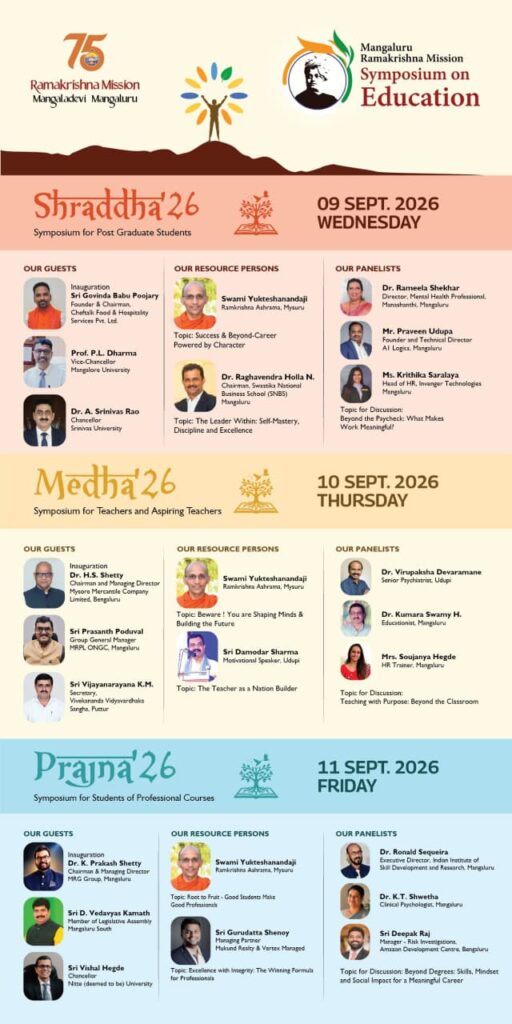
It is this profound question that lies at the heart of Shraddha 26, Medha 26 and Prajna 26, a series of inspiring symposiums being organised by Ramakrishna Mission, Mangaladevi, Mangaluru, from 9 to 11 September 2026. Bringing together postgraduate students, teachers, aspiring teachers and students of professional courses, the three-day programme goes beyond conventional education. It seeks to remind young minds and educators that true education is not merely the accumulation of information or the pursuit of a career. Education is the shaping of character, the awakening of purpose and the preparation of individuals to contribute meaningfully to society.
Shraddha 26 | Success Begins Within
The journey begins on 9 September with Shraddha 26, a symposium for postgraduate students. The inauguration brings together distinguished personalities including Sri Govinda Babu Poojary, Founder & Chairman of Cheftalk Food & Hospitality Services Pvt. Ltd.; Prof. P.L. Dharma, Vice-Chancellor of Mangalore University; and Dr. A. Srinivas Rao, Chancellor of Srinivas University.
The sessions then turn towards a question every young professional eventually confronts: Is career success enough? Swami Yukteshanandaji of Ramakrishna Ashrama, Mysuru, addresses this through “Success & Beyond – Career Powered by Character.” The message is both simple and powerful: a successful career built without character can never provide lasting fulfilment.
Dr. Raghavendra Holla N., Chairman of Swastika National Business School, Mangaluru, explores “The Leader Within: Self-Mastery, Discipline and Excellence.” Before a person can lead an organisation, a team or a community, there is another leadership challenge, to lead oneself.
The day culminates in a panel discussion, “Beyond the Paycheck: What Makes Work Meaningful?”, featuring perspectives from mental health, technology and human resources. Because ultimately, work is not merely about earning a living. It is also about finding meaning in what we do and discovering how our abilities can serve something larger than ourselves.
Medha 26 | Teachers Shape More Than Classrooms
On 10 September, the focus shifts to those who stand at the very foundation of society, the teachers. Medha 26, a symposium for teachers and aspiring teachers, carries a powerful message: every teacher is shaping the future, one mind at a time. The inauguration features Dr. H.S. Shetty, Chairman, Airman and Managing Director of Mysore Mercantile Company Limited, Bengaluru; Sri Prasanth Poduval, Group General Manager, MRPL ONGC, Mangaluru; and Sri Vijayanarayana K.M., Secretary of Vivekananda Vidyavardhaka Sangha, Puttur.
Swami Yukteshanandaji returns with the thought-provoking theme “Beware! You are Shaping Minds & Building the Future.” It is a reminder that teaching is never a routine profession. Every word spoken by a teacher, every value demonstrated and every student encouraged can leave an imprint that lasts a lifetime. Sri Damodar Sharma, motivational speaker from Udupi, explores “The Teacher as a Nation Builder.” The message is timeless: nations are not built only in parliaments, industries and laboratories. They are built quietly in classrooms, through teachers who inspire young people to think, dream, act and live with integrity.
The day’s panel discussion, “Teaching with Purpose: Beyond the Classroom,” brings together voices from psychiatry, education and human resources to explore how educators can influence lives far beyond academic achievement.
Prajna 26 | From Students to Professionals
The third day, 11 September, turns the spotlight towards students pursuing professional courses through Prajna 26. The inauguration features Dr. K. Prakash Shetty, Chairman & Managing Director of MRG Group, Mangaluru; Sri D. Vedavyas Kamath, Member of the Legislative Assembly, Mangaluru South; and Sri Vishal Hegde, Chancellor of Nitte (deemed to be) University.
For today’s students, professional education opens countless opportunities. But opportunity alone does not guarantee excellence. Swami Yukteshanandaji’s theme, “Root to Fruit – Good Students Make Good Professionals,” captures the essence beautifully. The quality of a professional’s work is ultimately connected to the quality of the person behind it.
Sri Gurudatta Shenoy, Managing Partner of Mukund Realty & Vertex Managed, takes the conversation further with “Excellence with Integrity: The Winning Formula for Professionals.” In an increasingly competitive world, integrity may sometimes appear old-fashioned. In reality, it is one of the most enduring foundations of professional success. The concluding panel, “Beyond Degrees: Skills, Mindset and Social Impact for a Meaningful Career,” brings together experts from skill development, psychology and corporate investigations. Its central message is particularly relevant to today’s generation:
A degree may open a door. Skills may help you enter it. But character, mindset and a sense of social responsibility determine what you do after entering.
Education That Goes Beyond Education
The three symposiums; Shraddha, Medha and Prajna, represent three interconnected dimensions of human development.
Shraddha reminds us to build character and discover meaning.
Medha reminds educators of their extraordinary responsibility in shaping minds and society.
Prajna challenges students to transform knowledge into excellence, integrity and social contribution.
Together, they convey a powerful philosophy:
Education should not merely prepare us to make a living. It should prepare us to live meaningfully.
At a time when young people face enormous pressure to succeed quickly, choose the right career and remain competitive, these conversations offer something deeper; a pause to reflect on who we are, why we work, whom we serve and what kind of society we want to build.
The presence of leaders from education, business, technology, healthcare, psychology, human resources and industry makes the symposium especially relevant. Their diverse experiences create an opportunity for students and teachers to see success from multiple perspectives.
The Real Measure of Success
Perhaps the most inspiring message emerging from these three days is that success cannot be reduced to a salary package, a designation, a certificate or a degree. A truly successful person is one who combines competence with character, ambition with responsibility, knowledge with wisdom, and achievement with compassion. And a truly successful educational system is one that produces not merely employable graduates, but responsible citizens, ethical professionals, courageous leaders and compassionate human beings. That is the larger vision behind these symposiums.
As students, teachers and professionals gather at Ramakrishna Mission Mangaladevi, the invitation is not simply to listen to inspiring speakers. It is an invitation to look within, think deeply and act purposefully.
Because careers will change.
Technology will change.
Industries will change.
The world itself will change.
But the need for character, discipline, integrity, wisdom and compassion will never change.
And perhaps that is the greatest lesson these three days can offer:
Build the person first. The profession will follow.
Develop character first. Leadership will follow.
Seek purpose first. Success will find its rightful meaning.
Through Shraddha 26, Medha 26 and Prajna 26, Ramakrishna Mission Mangaladevi is creating more than a series of symposiums. It is creating a space where education meets character, career meets purpose, and individual excellence meets social responsibility. For when education transforms the individual, the individual can transform society
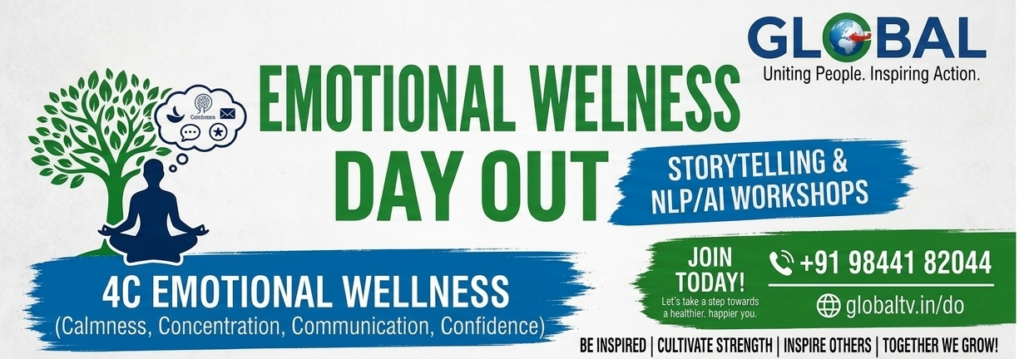
The Power of Emotional Wellness and the Art of Storytelling: Harnessing NLP and Appreciative Inquiry for Personal and Organizational Transformation
NV Paulose, Chairman, Global TV +91 98441 82044
While physical health and professional competence have long been traditional metrics of success, true personal fulfillment relies on a more complete approach: a balanced personality is the seamless combination of physical health and emotional wellness. Our thoughts shape our words, and our words ultimately create our world. By consciously aligning your thoughts and words, you gain the power to transform your mindset, elevate your emotional resilience, and completely redefine your personality.
Emotional wellness is not merely the absence of stress, anxiety, or psychological distress; it is the active awareness, understanding, and constructive management of our internal emotional landscape. It empowers individuals to navigate life’s inevitable challenges with grace, build meaningful relationships, maintain mental clarity, and foster deep resilience. At the core of developing emotional wellness lies a uniquely human capability: the Art of Storytelling, enhanced and guided by the principles of Neuro-Linguistic Programming (NLP) and Appreciative Inquiry (AI).
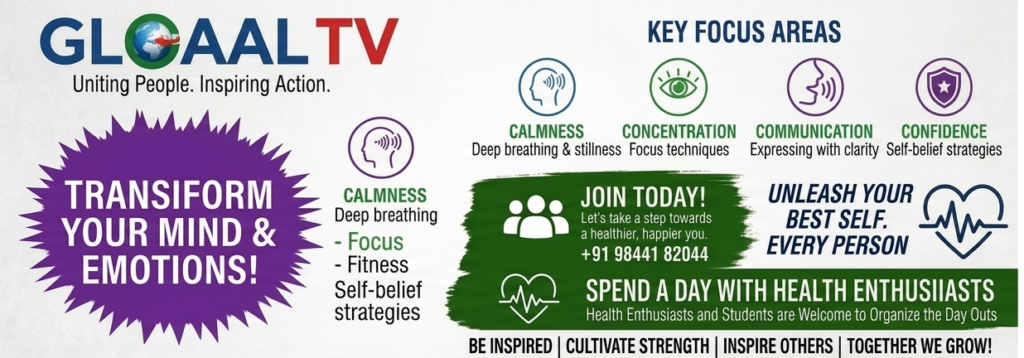
1. Understanding Emotional Wellness: The 4C Framework
To cultivate comprehensive emotional wellness, we can look through the lens of the 4C Model:
Calmness: The foundational ability to quiet the mind, regulate the nervous system, and remain grounded amidst chaos. Calmness provides the emotional space required to respond thoughtfully rather than react impulsively.
Concentration: The capacity to direct focus, sustain attention, and cultivate mental clarity. In a world full of digital distractions, intentional concentration is vital for both emotional stability and cognitive performance.
Communication: The channel through which internal emotional states are expressed and understood. Constructive, compassionate communication builds empathy, resolves conflict, and strengthens social bonds.
Confidence: The inner assurance and self-belief derived from knowing one’s strengths, acknowledging past successes, and trusting one’s ability to navigate future uncertainty.
When these four pillars are aligned, individuals experience a profound sense of harmony and personal empowerment. However, achieving this state requires effective tools to rewire long-standing behavioral patterns, mental frameworks, and narrative habits.
2. The Art of Storytelling as an Emotional Catalyst
Humans are fundamentally narrative creatures. From ancient oral traditions around fires to modern digital media, storytelling has been the primary vessel for sharing knowledge, instilling values, and processing human emotion.
In the context of emotional wellness, the most critical story is the one you tell yourself. The internal narrative dictates how we interpret events, evaluate our self-worth, and project our future possibilities. When individuals are trapped in negative or self-limiting internal narratives, emotional distress naturally follows.
By intentionally mastering the Art of Storytelling, we transition from passive victims of our life events to active authors of our own destiny. Narrative reframing allows us to:
Extract Meaning from Adversity: Transforming personal trials into stories of growth, endurance, and wisdom.
Foster Empathy and Connection: Sharing vulnerable, authentic stories bridges cultural and emotional divides, reminding us that we are not alone in our struggles.
Encourage Positive Action: A compelling narrative creates vision and momentum, inspiring individuals and teams to take proactive steps toward holistic well-being.
3. Rewiring the Mind: Guidance from Neuro-Linguistic Programming (NLP)
While storytelling provides the narrative frame, Neuro-Linguistic Programming (NLP) supplies the psychological mechanisms to restructure how those stories affect our nervous system and emotional state. Developed in the 1970s by Richard Bandler and John Grinder, NLP explores the dynamic relationships between our thoughts (Neuro), language (Linguistic), and behavioral patterns (Programming).
Key NLP Principles in Emotional Storytelling:
Reframing Perspectives: NLP teaches that events themselves are neutral; meaning is created by the frame through which we view them. Through storytelling, a failure can be reframed as valuable feedback, and a obstacle can be reframed as an opportunity to build resilience.
Anchoring Positive States: NLP techniques allow individuals to associate specific emotional states (such as calmness or confidence) with triggers or sensory cues. By pairing rich, vivid storytelling with emotional anchoring, individuals can recall resourceful states on demand.
Language Patterns and Submodalities: The specific words and sensory details (visual, auditory, kinesthetic) we use in our narrative alter our neurochemistry. Shifting from internal language like “I am completely overwhelmed” to “I am currently processing a complex challenge” subtly alters the psychological load, facilitating emotional calm and cognitive focus.
Through NLP-guided storytelling, individuals learn to break free from automated, self-defeating loops and consciously select narratives that foster confidence and mental clarity.
4. Amplifying Strengths: The Role of Appreciative Inquiry (AI)
Where traditional problem-solving methodologies focus heavily on diagnosing faults and analyzing deficiencies, Appreciative Inquiry (AI)—a framework pioneered by David Cooperrider—takes a fundamentally different approach. AI asserts that human systems grow in the direction of what they deeply investigate and appreciate. It focuses on identifying, amplifying, and sustaining what is already working well.
The 4D Cycle of Appreciative Inquiry in Storytelling:
Discovery (Appreciating what gives life): Gathering stories of past triumphs, peak emotional experiences, and moments of exceptional resilience. What was present during your moments of highest calmness and confidence?
Dream (Envisioning what might be): Using hopeful, aspirational storytelling to imagine a future where emotional wellness, high concentration, and clear communication are the norm across communities and workplaces.
Design (Determining what should be): Crafting actionable strategies, routines, and narrative habits that support and nurture the envisioned positive state.
Destiny / Deploy (Sustaining what will be): Co-creating an ongoing culture of appreciation, continuous storytelling, and mutual support.
When combined with storytelling, Appreciative Inquiry shifts the focus away from chronic dwelling on pain toward a generative exploration of human potential. It creates an uplifting environment where individuals feel valued, energized, and inspired.
5. Integrating the Framework: A Path Forward
The convergence of Emotional Wellness, Storytelling, NLP, and Appreciative Inquiry creates a powerful holistic architecture for personal development, community initiatives, and workplace wellness programs.
By organizing interactive programs, retreats, and media-driven initiatives—such as Emotional Wellness Day Out workshops—participants can experience firsthand the transformative synergy of these modalities. Starting with shared experiences, reflective exercises, and guided narrative sessions, individuals learn to master their mindsets and elevate their daily quality of life.
Emotional wellness is not a static destination, but a continuous journey of self-discovery and intentional living. By honoring the power of our personal narratives and guiding them with the structural tools of Neuro-Linguistic Programming and the strengths-based focus of Appreciative Inquiry, we unlock unprecedented capacities for calmness, focus, effective communication, and unshakable confidence. Every mind counts, every story matters, and together, through conscious storytelling, we can cultivate a healthier, happier, and more emotionally resilient world.
Miracles Happen when people are Connected | Contact for Special Rates Suitable for your Requirements | SimpliCity | PriVillage | Heart Health Challenge | E-Wellness Day Out
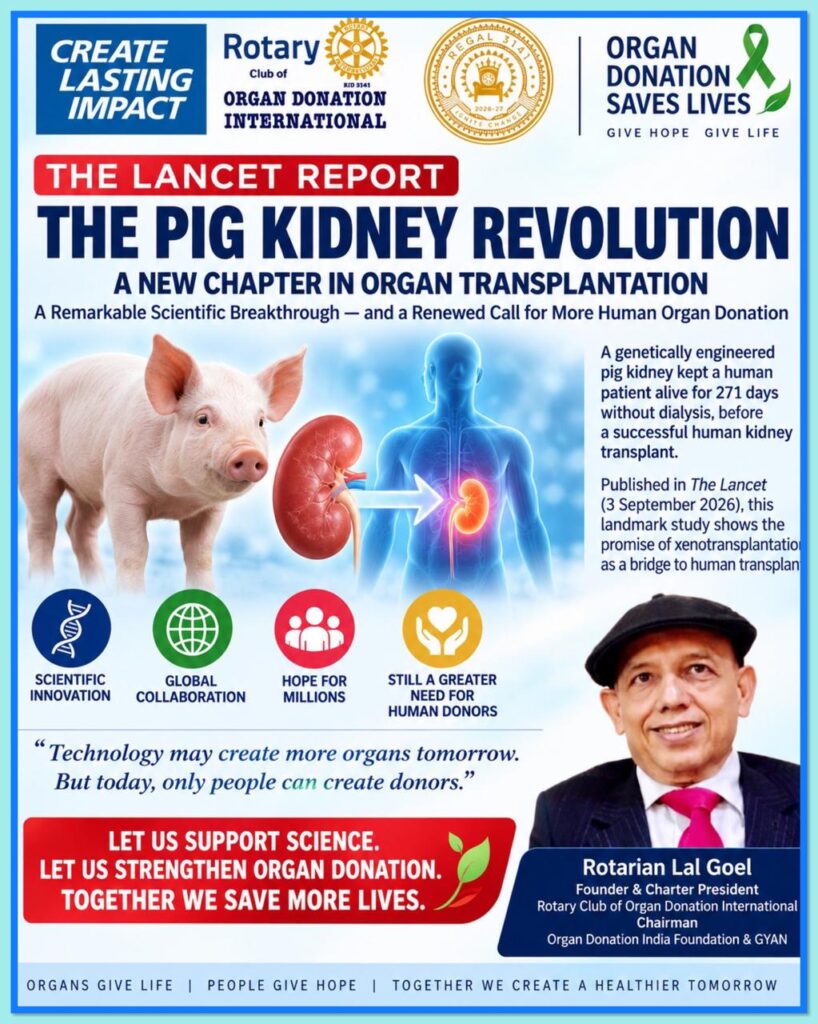
A landmark first-in-human study published in The Lancet has brought xenotransplantation — the transplantation of animal organs into humans — closer to clinical reality.
By Rotarian Lal Goel, Founder & Charter President, Rotary Club of Organ Donation International, Chairman, Organ Donation India Foundation & GYAN
Founded in 1823, The Lancet is one of the world’s oldest and most respected peer-reviewed medical journals, and its rigorous editorial standards lend particular weight to this study’s findings.
Researchers at Massachusetts General Brigham transplanted a genetically engineered pig kidney into a 66-year-old patient. The kidney functioned for 271 days without dialysis — the longest dialysis-free period reported after a pig-to-human kidney transplant. It eventually failed and was removed, and the patient later received a deceased-donor human kidney.
The significance lies not in readiness to replace human kidneys today, but in proof of concept: a bridge that can keep patients alive and off dialysis while they wait for a suitable human donor.
A GLOBAL SCIENTIFIC EFFORT The field is advancing through international collaboration. eGenesis in the United States and PorMedTec in Japan are developing genetically engineered pigs for transplantation research — work that shows xenotransplantation moving from experimental science toward clinical and commercial application.
Substantial challenges remain: immune rejection, infection risk, long-term safety, regulation, ethics, animal welfare, and affordability. Considerable research lies ahead.
INDIA CANNOT AFFORD TO WAIT In India, where demand for kidney transplantation far outstrips the supply of deceased-donor organs, xenotransplantation could eventually be transformative. India should build expertise now in transplant immunology, genetics, biotechnology, infectious-disease surveillance, and regulatory science, while pursuing international research collaboration.
But one message matters equally: XENOTRANSPLANTATION MUST NOT REDUCE OUR COMMITMENT TO HUMAN ORGAN DONATION. Human donation saves lives today. Xenotransplantation may expand the organ supply tomorrow. We need both.
AN OPPORTUNITY FOR ROTARY This emerging technology is also an opportunity for Rotary International. Rotary’s historic role in global polio eradication proved that a humanitarian organisation can unite governments, scientists, healthcare professionals, communities, and donors around a single global health challenge. The Rotary Club of Organ Donation International could propose — through Rotary District Governor 3141, to the Rotary International President — a global Rotary initiative to support awareness, collaboration, and responsible development of xenotransplantation.
If science ultimately produces genetically engineered pig kidneys capable of functioning reliably for five to ten years or longer, with replacement possible when needed, it could become a true game-changer in transplantation. Rotary need not conduct the science; its role can be to connect scientists, clinicians, institutions, and industry — keeping the humanitarian objective at the centre.
TOWARDS ORGAN ABUNDANCE The future may draw on multiple sources of organs: deceased donors, living donors, genetically engineered animal organs, bioengineered organs, and regenerative medicine. The goal is not to choose between them.
THE GOAL IS SIMPLE: NO PATIENT SHOULD DIE BECAUSE A SUITABLE ORGAN IS UNAVAILABLE.
Donate organs today. Support science for tomorrow. Together, we can transform transplantation.
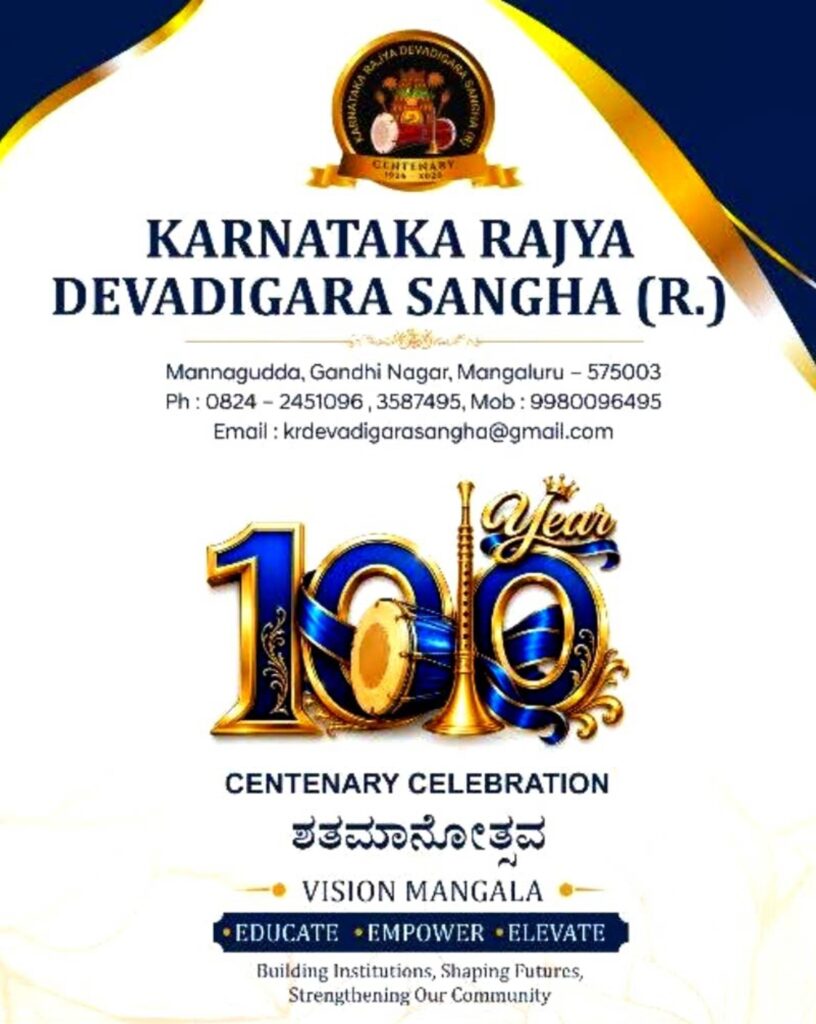
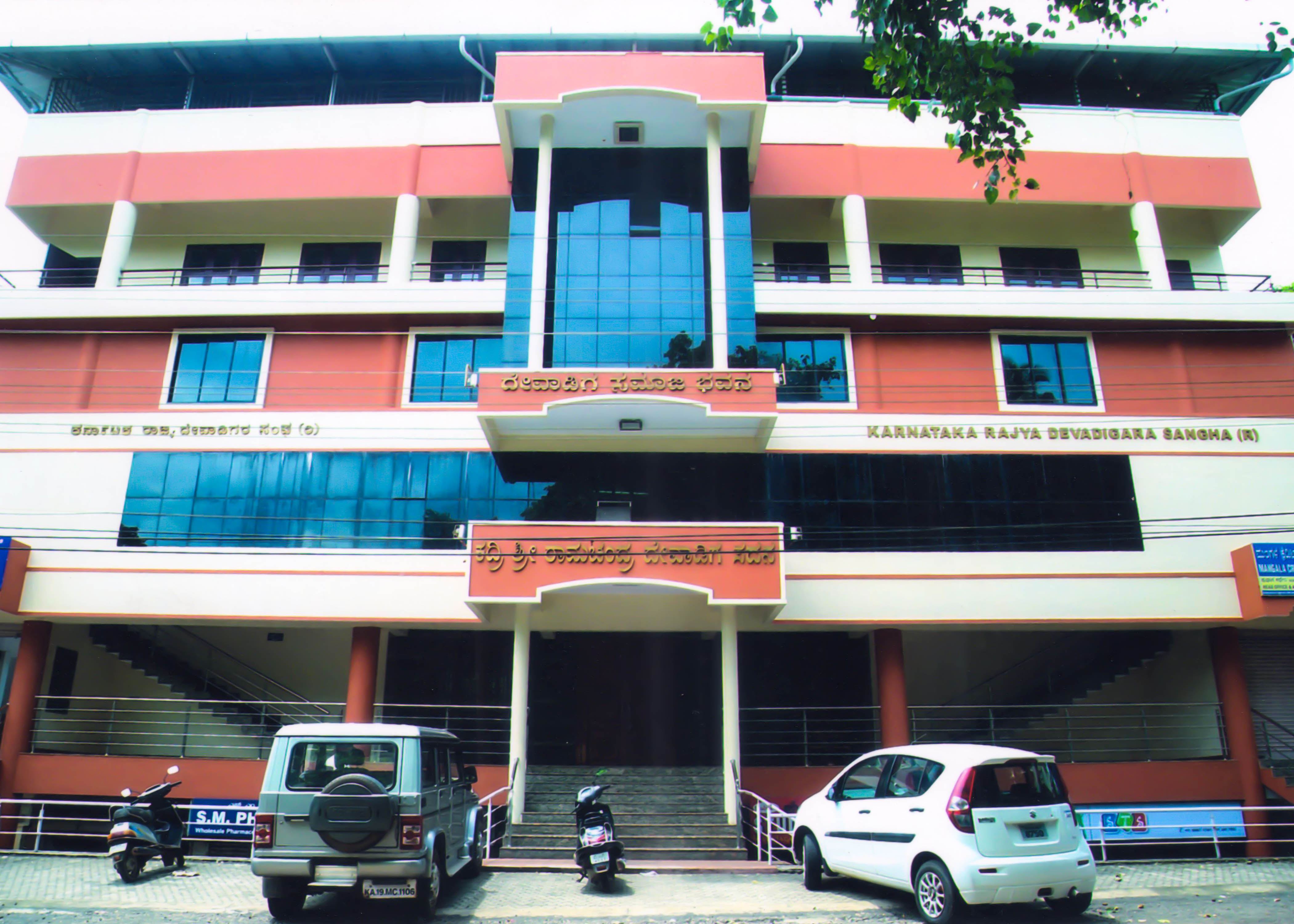
Karnataka Rajya Devadigara Sangha Marks Historic Milestone with Grand Centenary Celebration
NV Paulose, Chairman, Global TV +91 98441 82044
The Karnataka Rajya Devadigara Sangha is getting ready for a massive milestone. The organization will mark its one hundred year journey with a grand centenary celebration on Sunday, September 20, 2026. The full-day event will take place at the TMA Pai International Convention Centre located on MG Road in Mangalore.
The celebration highlights a century of community building, unity, and social progress under the guiding motto of educate, empower, and elevate. Organizers have planned a packed schedule starting at 9:00 AM with breakfast and morning cultural presentations.
The main inauguration ceremony begins at 10:00 AM under the theme A Century of Legacy. Former Chief Minister of Karnataka, Dr. M. Veerappa Moily, will serve as the chief patron and inaugurator alongside Member of Parliament Capt. Brijesh Chowta and other notable community leaders.
The afternoon session kicks off at 3:00 PM with a focus on youth and women empowerment under the banner The Spirit of Tomorrow. Later in the evening at 5:30 PM, the concluding ceremony will feature prominent political figures, university chancellors, and business leaders to honor the long history of the institution. Attendees can also look forward to vibrant cultural highlights, including a traditional instrumental jugalbandi featuring chende, nagaswara, uduke, and dolu, alongside special dance performances and an orchestra.
As part of looking toward the future, the Sangha is promoting Vision Mangala, an ambitious educational initiative. This project aims to build a modern, spacious 2.3 acre campus for Mangala Vidya Kendra to provide affordable, value-based learning and skill-oriented education for coming generations.
The Karnataka Rajya Devadigara Sangha, Mangaluru, is preparing to host a grand event to celebrate one hundred years of continuous service, community unity, and social development. The historic landmark event will take place on Sunday, September 20, 2026, at the TMA Pai International Convention Centre on MG Road in Mangalore. Built around the primary vision to educate, empower, and elevate, the centenary gathering brings together community leaders, public dignitaries, and global members to honor a century of achievements while charting a path for future growth.
A Packed Schedule of Events
The day long program offers a complete schedule of official ceremonies, cultural events, and community meals:
09:00 AM: The morning starts with breakfast alongside initial cultural presentations.
10:00 AM: The official inauguration ceremony titled A Century of Legacy begins.
12:05 PM: Guests will gather for a community lunch and continuous stage performances.
03:00 PM: The afternoon program, titled The Spirit of Tomorrow, showcases the Youth and Women’s Wing.
04:30 PM: A second block of rich cultural programs will take place.
05:30 PM: The formal concluding ceremony, titled A Century of Excellence, brings together primary guests.
08:00 PM: The evening wraps up with a celebration dinner and concluding entertainment.
Dignitaries and Community Leaders
Former Chief Minister of Karnataka, Dr. M. Veerappa Moily, will lead the event as Chief Patron and Inaugurator. Key guests of honor include Member of Parliament Capt. Brijesh Chowta, Health Minister U. T. Khader, and Legislative Assembly Member D. Vedavyas Kamath.
The ceremonies will feature speeches and honors with prominent leaders, including Vishwa Devadiga Mahamandala President Dharmapal U. Devadiga, Former Vice Chancellor Prof. Dr. B. S. Sherigar, and Centenary Celebrations Honorary President Harish Sherigar. Educational leaders such as Chancellor Dr. Yenepoya Abdulla Kunhi, Chancellor Dr. A. Srinivas Rao, and Chancellor Vishal Hegde will also share the platform alongside international representatives from Dubai, Abu Dhabi, and the USA.
Cultural Spectacle
Attendees will experience a rich showcase of local heritage and performance arts throughout the day. A key highlight is a traditional instrumental jugalbandi featuring state award winners Sri Nagendra Kudupu and Sri Uday Sherigar Alevooru along with their ensemble. The performance will combine classic regional instruments, including the chende, nagaswara, uduke, and dolu. The entertainment roster also features a special presentation titled CLAN, alongside a live orchestra performance led by Sri Harish Sherigar.
Vision Mangala: Building for the Next Century
Beyond reflecting on the past hundred years, the Sangha is launching its ambitious new educational initiative called Vision Mangala. Rooted in the belief that quality education is the bedrock of social progress, the project aims to establish a spacious 2.3 acre campus for the Mangala Vidya Kendra. This new facility will provide affordable, value-driven, and skill-oriented learning designed to equip future generations for modern opportunities.
The central organizers, led by Sangha President Ashok Moily and Centenary Celebrations President Karunakar M. H., have extended a warm invitation to all community members, families, and well-wishers to join together in celebrating this monumental historic occasion.
Your Past Is History | Your Convictions Are Destiny | From Past to Purpose | The Making of an Immortal Life | The Past Made You | Your Convictions Will Make You | You Are Not Your Past | You Are Your Convictions | Are You Confused?
NV Paulose, Chairman, Global TV +91 98441 82044
There is a remarkable transformation hidden in two words: immoral and immortal. They differ by only one letter, yet the distance between their meanings represents one of the greatest possibilities of human life. To be immoral is to live in ways that violate one’s moral convictions. To be immortal is to live beyond the limitations of one’s physical existence through the values, actions, and influence one leaves behind.
Between these two words lies transformation. And transformation is possible for everyone. The central truth is simple: Your past will not take you to your future. Your convictions will.
Your Past Is Not Your Destination
Every human being has a past. Some people carry mistakes. Some carry failures. Some carry painful memories. Some carry poor decisions, wasted opportunities, broken relationships, wrong priorities, or years spent searching for direction. Others may have had ordinary beginnings and no remarkable reputation at all. But the past has one important limitation: it is finished.
Your past can teach you, but it cannot walk into your future unless you allow it to. A mistake can become a lesson. Failure can become wisdom. Pain can become compassion. Confusion can become clarity. A wrong direction can become the beginning of a new journey. The question is therefore not, “Who was I?” The more important question is, “Who am I becoming?”
Conviction Changes Direction
A person’s future begins to change when a conviction becomes stronger than a circumstance. Conviction gives direction to life. It tells us what we are willing to stand for when standing becomes difficult. It gives us something deeper than temporary emotion. Feelings change. Circumstances change. Opinions change. But a deeply held conviction can provide an anchor. This is where transformation begins.
A person may have lived without purpose, but can discover purpose. A person may have lived for personal gain, but can discover service. A person may have been controlled by fear, but can discover courage. A person may have been trapped by the past, but can decide to build the future. The transformation does not happen because the past disappears. It happens because the meaning of the past changes.
Gandhi: From Ordinary Life to Extraordinary Legacy
Mahatma Gandhi did not begin his life as the figure history would eventually remember. He was an ordinary human being who experienced uncertainty, fear, weakness, and the process of discovering himself. What transformed his life was the gradual formation of convictions around truth, nonviolence, discipline, and justice. Those convictions eventually became stronger than his personal circumstances.
He did not merely speak about his beliefs. He attempted to live them. That is what transformed a personal story into history. Gandhi’s physical life ended, but the principles he represented continued to travel beyond his lifetime. His immortality is therefore not physical. It is the immortality of influence. His life tells everyone something important: You do not have to begin extraordinary to become significant. You have to discover what you believe is worth living for.
Mandela: When Conviction Outlives Circumstance
Nelson Mandela gives us another powerful example. His circumstances could easily have defined his life. He spent 27 years in prison. Yet imprisonment did not become the final meaning of his existence. His convictions were larger than his circumstances. When he eventually emerged from prison, he became a symbol of freedom, dignity, perseverance, and reconciliation. His life demonstrated that even when circumstances imprison the body, they do not necessarily have to imprison the human spirit.
Mandela’s story became history because he allowed conviction to determine his direction rather than allowing suffering to determine his character. That lesson belongs to everyone. You may not be able to choose everything that happens to you. But you have a profound responsibility for deciding what you will become because of what happens to you.
Augustine: The Past Can Become a Beginning
St. Augustine offers perhaps one of the clearest examples of personal transformation. His own writings reveal a young man deeply engaged with desire, ambition, intellectual uncertainty, and choices he later regarded as morally wrong. Yet his story did not end with those choices. His search for truth eventually led to a profound spiritual transformation. The significance of Augustine’s life is not that he had no past. It is precisely that he had a past and changed. His earlier struggles became part of the story of his transformation. That is an important message for anyone who feels imprisoned by who they once were. Your past can be a chapter without becoming the title of your book.
The Transformation Is Available to Everyone
This is not only the story of great historical figures. It is the story of every human being. A student can change direction. A parent can change. A leader can change. A person who has failed can begin again. Someone who has made serious mistakes can choose responsibility. Someone who has lived without purpose can discover one. Someone who has spent years looking backward can begin looking forward.
The world often labels people according to their past. But transformation begins when a person refuses to accept that label as the final definition of who they are. You are more than your worst decision. You are also more than your greatest achievement. You are a person capable of becoming.
From Story to History
Every person has a story, but not every story becomes history. A story becomes history when the choices of one individual begin to carry meaning for others. Gandhi’s convictions influenced a nation. Mandela’s convictions helped reshape a society. Augustine’s transformation influenced centuries of thought. But their examples should not make us think that immortality belongs only to famous people. A teacher can become immortal through the lives of students. A parent can become immortal through the values given to children. A compassionate person can become immortal through the lives touched by kindness. A leader can become immortal through principles that continue after leadership ends. Immortality, in this sense, is not about fame. It is about impact.
What Will Your Convictions Create?
Eventually, every person must answer a fundamental question:
What will I allow to determine my future? Will it be my past? My failures? My circumstances? Other people’s opinions? My fears? Or will it be my convictions? The past can tell you where you have been. It cannot tell you where you must go. Your circumstances can tell you what you are facing. They cannot tell you what you must become. Your mistakes can tell you what went wrong. They cannot prevent you from choosing what is right today. Your convictions are what give your future direction.
Your Future Is Still Being Written
Perhaps the most powerful thing about human life is that the final meaning of a story is often not visible in its early chapters. A person can begin ordinary and become extraordinary. A person can fall and rise. A person can lose direction and find purpose. A person can make mistakes and discover wisdom. A person can be remembered not for where they started, but for what they chose to stand for. That is the transformation from story to history. That is the deeper meaning behind immoral to immortal.
It is not simply a change of one letter. It is a reminder that a human being can change the direction of a life. So do not allow your past to become your prophecy. Learn from it. Own it. Make peace with it. Then move beyond it. Because your past may explain where you came from, but your convictions will determine where you go. And perhaps, one day, the life you are living now will become a story that gives someone else the courage to transform their own. Your past will not take you to your future. Your convictions will.
You Need Not Repeat What You Have Outgrown
This is a lesson that belongs not only to business families, but to every human being. You need not continue your mistake when you can perform without it now. You need not defend yesterday’s choices simply because they once brought you success. You need not remain loyal to an old identity when your convictions have taken you somewhere higher. Growth means having the courage to say, “What worked for me then is not what I need to become now.” The real measure of transformation is not whether your past was perfect. It is whether your future becomes more purposeful because you have learned from it. The Tatas moved from commerce toward nation building; Gandhi moved from an ordinary life toward a life governed by truth and nonviolence; Mandela transformed suffering into reconciliation; Augustine transformed a troubled past into a lifelong search for truth. Your past may have built your starting point, but your convictions can build your destination. That is how a story becomes history, and how a life becomes a legacy.
From Commerce to Conviction
The early story of the Tata family belongs to the complicated commercial world of nineteenth century India, when international trade connected Bombay, China, Britain, and other markets. The family was involved in trading in commodities, and Jamsetji Tata began his own trading enterprise in 1868. The wider China trade of that era was also deeply entangled with the opium trade, one of the most morally troubling chapters in the history of British imperial commerce. It is therefore important to acknowledge the uncomfortable complexity of the commercial world from which many fortunes emerged.
What is far more significant is what happened afterward. Jamsetji Tata increasingly turned his attention from trading wealth toward creating enduring institutions: textiles, steel, power, scientific education, worker welfare and philanthropy. His vision evolved from making money through commerce to using enterprise as an instrument for building a stronger India. The Tata story therefore offers a powerful lesson in transformation: your beginnings do not have to dictate your destination.
You Do Not Have to Repeat Your Past
This is where the story becomes relevant to every one of us. You need not continue your mistake when you can perform without it now. You do not have to defend an old choice merely because it once benefited you. You do not have to remain faithful to an old way of thinking simply because it once brought success. Growth begins when conviction becomes stronger than habit. The real achievement is not having a flawless past; it is having the courage to change direction when you know better. Jamsetji Tata’s legacy ultimately came to be associated not merely with commerce, but with nation-building, institution-building and philanthropy. The Tata Trusts eventually became central to this tradition, with philanthropic trusts holding a major share of Tata Sons and supporting education, health and social development. The lesson is larger than the Tata story: the past may explain where you began, but it does not command you to remain there. When conviction gives you a better path, you are free to take it. Your past is history. Your convictions are destiny.
Your Past Is Not Your Destiny
The stories of Gandhi, Mandela, St. Augustine and the Tata legacy point to one profound truth: a person’s past does not have to determine the person’s future. Gandhi transformed an ordinary life into a life of conviction through truth and nonviolence. Mandela refused to allow years of imprisonment to become the definition of his life and transformed suffering into reconciliation and leadership. St. Augustine did not remain imprisoned by the choices and desires of his earlier years; his search for truth transformed the direction of his life. The Tata story, emerging from the complex world of nineteenth century commerce in which the opium trade was also deeply embedded, reminds us that the significance of a legacy is ultimately determined by what one chooses to build thereafter. Their journeys are different, but the lesson is common: transformation begins when conviction becomes stronger than the past.
We often make the mistake of believing that because we have lived a certain way for many years, we must continue living that way. We defend yesterday’s decisions because changing them may require admitting that we were wrong. But there is greater courage in correction than in stubbornness. You need not continue your mistake when you can perform without it now. The earlier we recognize our mistake, the better. There is no virtue in repeating what we have already learned to be wrong simply because it belongs to our past. Wisdom is not merely knowing what is right; it is having the courage to change when we know better.
Our past may explain us, but it does not own us. Our failures may have shaped us, but they do not have the right to define us. What finally gives direction to a life is not where we started, but what we choose to stand for. Conviction can turn failure into wisdom, suffering into strength, wealth into service and an ordinary existence into a meaningful legacy. That is the deeper transformation from immoral to immortal: not that a person becomes perfect, but that a person becomes purposeful. We may not be able to rewrite our past, but we can certainly rewrite what our past means by the way we live from this moment onward. Your past will not take you to your future. Your convictions will.
The past is history; conviction is direction. And when that conviction is lived consistently, a personal story can become a lesson for others, a life can become a legacy, and a human being can become “immortal” through the values and influence left behind. Therefore, do not spend your life defending who you were. Have the courage to become who you now know you can be. The best time to correct a mistake is at the earliest moment you recognize it. The next best moment is now.