All posts by admin

About admin

Chairman of Global TV | Excellent Writer | Exceptional PR Skills | Author of Six books | MASTER HEALER | +91 98441 82044 |

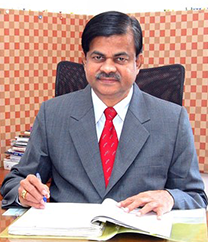
Dr. K. Devaraj | The Art of Building Institutions, Not Just Running Them

Dr. Kankanady Devaraj | Challenging the Challenge straightforward

NV Paulose, Chairman, Global TV +91 98441 82044

There are academics who teach, and administrators who manage. There are a few institution builders who understand that an educational institution is not merely a collection of classrooms, courses, buildings and regulations, but a living ecosystem that must continuously evolve. Dr. K. Devaraj belongs to that category of visionaries who are blessed with the third eye to see what others often miss. His career in education and management showcases an important lesson in what it means to build an institution in India: with conviction, persistence, relationships, practical intelligence, and, above all, a belief that education must prepare people for the real world.

For sixteen years, from 1997 to 2013, Dr. Devaraj served as Principal of SDM College of Business Management in Mangaluru. He subsequently moved into the leadership of its postgraduate management centre and is ever recognised being its Founder Director. His academic and professional qualifications include M.Com., LL.B., FIMA and Ph.D. But titles and qualifications alone do not adequately explain his contribution. The more revealing story lies in the way he thinks about education, institutions, people and the changing world.

Education is not merely about information

One of the strongest ideas that emerges from a conversation with Dr. Devaraj is his insistence that access to information does not automatically produce education. We live in a world where almost everything is available. Libraries are digital, knowledge is searchable, software can perform calculations instantly, and artificial intelligence can generate answers within seconds. Yet the crucial question remains: Do people know what to search for? The educated person is not merely someone who possesses information, but someone who knows what question to ask, where to look, how to evaluate an answer, and what to do with the knowledge obtained.

This distinction is particularly important in management education. The purpose of an institution, in Dr. Devaraj’s view, is not simply to deliver a syllabus but to develop judgement. Students need confidence, practical exposure, interaction with industry and opportunities to test their abilities outside the classroom. The institution must therefore create an environment in which students can practise being managers rather than merely study management as a subject.

The institution must meet the world

Dr. Devaraj’s years at SDM were marked by an emphasis on connecting students with the world beyond the classroom. Management and technology events brought students together in competitive and collaborative settings and connected them with companies and professionals. Such activities were not merely extracurricular entertainment. They were part of an educational philosophy in which students encountered real problems, communicated with others, organized events, and learned to take responsibility. A good college, in this view, cannot remain an island. It must connect students with industry, professionals, entrepreneurs, government, ideas, and society.

This philosophy also explains the importance he places on institutional visibility and publicity. Doing good work is essential, but people must also know about that work. Former students returning to the institution, speaking about their experiences and carrying its reputation into the wider world become part of the institution’s living legacy. The memories students carry long after graduation may ultimately be among the most important measures of an educational institution’s success.

The human being cannot be replaced by the machine

Perhaps the most contemporary part of Dr. Devaraj’s thinking concerns artificial intelligence. His argument is not anti-technology. He recognizes that technology makes difficult tasks easier and has transformed banking, accounting, communication, medicine and countless other fields. Artificial intelligence can assist doctors, writers, researchers, teachers and professionals. But assistance is not the same thing as replacement. A pilot cannot simply disappear from an aircraft because an automated system exists; a surgeon cannot surrender judgement to a machine; and a writer cannot outsource imagination. Technology can augment human ability, but it cannot automatically provide human judgement.

Dr. Devaraj places today’s AI debate in a longer historical perspective. When computers entered banks and offices, people feared that machines would eliminate employment. There were strikes and resistance. Yet computerization also created entirely new industries and millions of new jobs. The lesson is not that technology never destroys jobs—it does. The lesson is that technology changes the definition of work. Some occupations disappear, others are transformed, and new occupations emerge. The responsibility of education, therefore, is not simply to protect people from technology, but to prepare them to work intelligently with it.

The value of the human touch

Interestingly, his faith in technology is accompanied by an equally strong appreciation of the human touch. Technology can make communication faster, clearer and more efficient. A typed letter or document is often preferable because it is easy to read, easy to reproduce and difficult to misunderstand. But efficiency alone does not always get things done. In institutions, particularly large organizations and government offices, personal relationships, direct communication and the ability to understand people can make a significant difference. Dr. Devaraj’s experience suggests that when something matters, one cannot always depend on a file, a letter or a digital message moving through a system. Sometimes it is important to meet the person, explain the matter, build confidence and establish a relationship.

This is not necessarily about bypassing rules or compromising principles. It is about understanding that institutions are ultimately made up of people. A procedure may tell you what should happen, but people determine how effectively that procedure is understood and implemented. Knowing whom to approach, how to communicate, when to follow up and how to maintain a good relationship can help legitimate work move forward in the way it is intended. In this sense, personal touch is not a substitute for systems; it is what makes systems work more effectively. For Dr. Devaraj, this human dimension of administration appears to be an important part of practical intelligence: technology can connect us, systems can guide us, but relationships help us get things done.

Ethics in the real world

One of the most intriguing parts of the conversation is his discussion of the tension between ethics and practical reality. Anyone who has dealt with public institutions knows that the formal system and the lived system can sometimes feel very different. There are relationships, expectations, informal practices and people who can help or obstruct a process. Dr. Devaraj’s stories about inspiring government offices, even to delay his files to inherit seniority to someone else, getting official approvals just in time, reveal a practical understanding of this reality. His lesson is to understand how institutions work, persist when necessary, meet people, communicate clearly, and find legitimate ways through obstacles, without surrendering one’s ethical compass.

Four kinds of intelligence

Listening to Dr. Devaraj’s reflections on education, administration, technology and institution-building, one is struck by the different kinds of intelligence that he appears to bring together. He understands the possibilities of artificial intelligence and technology, while recognizing their limitations. He possesses what might be called bureaucratic intelligence—the practical ability to understand institutions, procedures, people and systems, and to navigate them effectively without losing sight of the objective. He also demonstrates creative intelligence, visible in his ability to imagine new possibilities in education and institutional development. And there is a fourth dimension: intuitive or human intelligence, the confidence to recognize an opportunity, believe that something can be achieved and work towards making it happen.

These qualities rarely come together in one person. Someone may understand technology but struggle with people; another may be an excellent administrator but lack imagination; another may have creative ideas but find it difficult to turn them into reality. Dr. Devaraj’s strength appears to lie in bringing these different forms of intelligence together. He can understand systems, work with people, appreciate technology, think creatively and, perhaps most importantly, have the intuition and conviction to pursue an idea until it becomes a reality. That combination may explain much of his effectiveness as an academic and institution builder. His achievement is not that he belongs to one particular kind of intelligence, but that he is able to draw upon all of them when the situation demands it.

Institution building begins with intention

This may be the deepest connection between Dr. Devaraj’s philosophy and his career. An institution does not become respected merely because someone establishes a building. It becomes respected because generations of people begin to attach meaning to it. Students remember teachers, teachers remember leaders, alumni return, professional networks develop, events become traditions, traditions become culture, and culture becomes reputation. An institution builder therefore works on a timescale longer than his own tenure. He plants things whose full value may become visible only years later.

Leadership is not about occupying the chair

Dr. Devaraj’s career illustrates this distinction particularly well. After serving as Principal for sixteen years, from 1997 to 2013, he continued his engagement with management education rather than simply stepping away from institutional life. He moved into the leadership of the MBA/postgraduate management centre and remained active in professional and management forums. His association with the Mangalore Management Association further reflects his commitment to connecting academic institutions with the wider professional world. Leadership, in this sense, is not defined by occupying a particular chair; it is defined by continuing to contribute after the chair changes.
The Devaraj lesson | What remains after the administrator leaves?

Buildings age. Technology changes. Curricula become obsolete. Job descriptions disappear. Even organizational structures are eventually replaced. But certain things endure: a student who develops confidence, a teacher who discovers a new way of teaching, an alumnus who returns to help the next generation, a culture that encourages curiosity, a reputation for doing things well, and a habit of facing problems instead of avoiding them. These are the invisible assets of an institution, and they are often the hardest to build.

Listening to Dr. K. Devaraj, one gets the sense that he does not see education as an isolated profession. He sees it as a bridge between knowledge and action, between students and industry, between technology and humanity, between institutions and society, and between ambition and ethics. Most importantly, he sees education as a bridge between what exists and what could exist. That is where institution builders live: they look at an ordinary institution and imagine what it could become.

They encounter resistance and continue. They use technology but do not worship it. They understand systems without becoming servants of them. They believe in relationships without confusing relationships with compromise. They value publicity but know that reputation ultimately has to rest on substance. And they understand that education is ultimately about creating people capable of thinking and acting for themselves. That is why Dr. K. Devaraj’s story is worth remembering, not simply because he occupied the principal’s chair for sixteen years, not simply because he helped build management education, and not simply because of his academic and professional qualifications, but because his philosophy points toward a larger definition of leadership: Do not merely run the institution you inherit. Build something that will outlive you. That may be the most meaningful measure of an academic leader, and perhaps the finest definition of an institution builder.

A new chapter: From management to law

His journey has now taken another significant turn, into the legal fraternity. At an important juncture in his career, when the BBA college was being considered for closure and he was expected to move to the Law College, which was already a popular and established institution, Dr. Devaraj chose a different path. Instead of allowing the BBA institution to fade away, he saw its potential and worked to strengthen and develop it. He did not merely preserve what existed; he expanded its possibilities. Under his leadership, the institution grew in stature, and the introduction of the MBA programme opened an entirely new dimension for management education. What might have been seen as an institution nearing closure became an institution with a renewed purpose and a larger academic vision.

Today, as Dr. Devaraj steps into the legal fraternity on a larger platform, this journey acquires a special significance. His move into law is not a departure from his earlier work but another expression of the same institution-building instinct. He has moved from strengthening undergraduate management education, to creating opportunities for postgraduate management education, and now towards contributing to the field of law. The journey reflects a consistent pattern: when presented with an existing structure, he looks beyond its immediate limitations and asks what more it can become. That ability to see possibilities where others may see constraints is perhaps one of the defining qualities of Dr. Devaraj’s long and evolving journey in education and institutional leadership.

GOLDEN HOUR | ONE POWERFUL HOUR TO CREATE MOVEMENT, MOMENTUM AND MASTERY

THE GOLDEN HOUR PRINCIPLE | Divide Your Day into Effective Hours: Create Movement, Energy and Momentum

NV Paulose, Chairman, Global TV +91 98441 82044

In a world filled with constant notifications, endless meetings, digital distractions and repetitive routines, our greatest challenge is no longer the lack of time. It is the lack of intentional attention. We have more information, technology and opportunities than ever before, yet many of us spend our days reacting to whatever demands our attention. One task leads to another, one message leads to another, and one meeting replaces another. At the end of the day, there may be plenty of activity, but surprisingly little meaningful progress.

1. FROM BUSYNESS TO MEANINGFUL MOVEMENT

The Golden Hour Principle offers a simple alternative. A Golden Hour is a deliberately protected period in which we use our best energy, attention and alertness to create meaningful movement in an important area of growth. It is not merely an hour of uninterrupted work, nor is it another rigid productivity formula. Its purpose is much broader. It is about ensuring that at least one valuable part of our life, work or organization moves forward with intention.

The concept begins with a simple question: What deserves my best energy today? Instead of allowing our most alert period to disappear into emails, social media, routine administration or unnecessary interruptions, we deliberately direct it toward something that matters. It could be learning, creating, thinking, exercising, connecting, planning, solving a problem or leading others. The activity may change, but the intention remains the same. Use your best hour to create movement.

This is an important shift from measuring time spent to measuring momentum created. Someone can spend eight hours sitting at a desk and accomplish very little that contributes to long term growth. Another person can spend one highly focused hour developing a skill, solving a difficult problem, creating something valuable or making an important decision and finish the hour significantly further ahead. The difference is not simply the quantity of time. It is the quality, direction and purpose of attention.

The Golden Hour also challenges the idea that productivity means doing the same thing repeatedly for as long as possible. Human beings need variety, renewal and different forms of engagement. Growth is not one dimensional. We need intellectual stimulation, physical movement, creativity, reflection, relationships and meaningful work. A person who spends every hour on one repetitive activity may become efficient, but efficiency without renewal can eventually produce fatigue, boredom and stagnation.

2. PROTECTING YOUR PEAK ALERTNESS

Therefore, the Golden Hour should create rhythm rather than monotony. One day, the hour might be devoted to learning a new skill. The next day, it could be physical exercise or a reflective walk. Another day might be dedicated to writing, designing, planning, strategic thinking or mentoring someone. The objective is not to force every dimension of growth into every day. It is to ensure that, over time, the important dimensions of life receive intentional attention.

At the heart of the principle is alertness. Not every hour of the day feels the same. There are periods when our minds are clearer, our energy is higher and our capacity to think and act is stronger. These periods should not automatically be surrendered to low value activities. If our best mental energy is spent responding to trivial messages, scrolling through information or attending meetings that could have been avoided, we may reach our most important work only after our attention has already been depleted.

The Golden Hour therefore asks us to protect our peak. When the hour begins, unnecessary notifications should be removed, interruptions reduced and the objective made clear. This creates a mental boundary between reactive activity and purposeful activity. We are telling ourselves that this hour matters. It becomes a protected space for engagement, not simply another item on a schedule.

However, the Golden Hour does not mean that everyone must wake up at a particular time or follow the same routine. There is no universally perfect hour. One person may be most alert in the early morning, while another may find their strongest period later in the day. The principle is to understand your own energy and use it intelligently. The right Golden Hour is the period in which you can bring your best available attention to something that deserves it.

3. MOVING ACROSS THE DIMENSIONS OF GROWTH

The most powerful aspect of the Golden Hour appears when we stop thinking of growth as a single activity. Imagine beginning one day with learning, another with creativity, another with physical movement and another with strategic reflection. You remain engaged, but you are not trapped in the same mental pattern every day. This intentional movement keeps growth dynamic and allows different parts of your potential to develop together.

We can think of these areas as seven movements: Learn. Create. Think. Move. Connect. Lead. Improve. Learning develops capability. Creating produces something new. Thinking creates clarity. Physical movement develops energy and vitality. Connecting strengthens relationships. Leading creates direction for others. Improving makes systems, habits and environments better. Not every Golden Hour needs to contain all seven. The goal is to keep life and work moving meaningfully across them.

This approach can transform the way we understand personal development. A successful person should not only become better at their profession. They should also develop their mind, body, relationships, creativity and ability to make wise decisions. The Golden Hour creates space for this broader development. Instead of being trapped in one repetitive activity, we intentionally move between different areas that contribute to a fuller and more capable life.

The same principle applies to institutions and organizations. An organization can become trapped in operational busyness just as easily as an individual can. Meetings multiply, emails accumulate, departments become isolated and urgent matters continuously displace important ones. An institutional Golden Hour can create protected time for strategic thinking, innovation, professional development, cross functional collaboration or solving problems that ordinary routines never allow enough space to address.

4. FROM MOVEMENT TO MOMENTUM

Such an institutional practice can create a different culture. Instead of people simply asking, “What task do I need to complete?” they begin asking, “What needs to move forward?” Teams can use dedicated periods to align around priorities, develop new ideas, learn from one another or remove obstacles. The organization becomes less reactive and more intentional. Energy is directed toward important goals rather than being consumed entirely by the demands of the moment.

The Golden Hour can also become a powerful antidote to mental stagnation. When people remain in the same environment, performing the same type of activity continuously, their attention can gradually decline. Purposeful movement introduces freshness. A difficult intellectual task may be followed by physical activity. A period of individual thinking may be followed by collaboration. Learning may lead to creation. Reflection may lead to action. These transitions can help maintain engagement and keep the individual connected to a larger purpose.

The principle is also simple enough to practice without complicated systems. Begin by identifying the period when you are most alert. Then declare your intention by deciding what you want to move forward. Next, protect the hour by removing avoidable distractions. Then act with full attention. Finally, review the outcome and ask what changed because of the hour. This simple cycle turns an ordinary hour into a deliberate instrument of progress.

The mathematics of consistency makes the idea even more powerful. One intentional hour each day represents 365 hours over a year. That is a substantial investment. But the real value is not simply the number of hours accumulated. It is what those hours can build. A skill can become expertise. A collection of ideas can become a project. Regular exercise can contribute to greater vitality. Strategic reflection can produce better decisions. Consistent mentoring can develop people and strengthen an institution.

This is how movement becomes momentum. A single hour may produce only a small result, but repeated intentional action creates a pattern. Patterns become habits, habits create capability and capability creates confidence and results. The objective is not instant transformation. It is continuous forward movement. The Golden Hour reminds us that extraordinary outcomes are often created through ordinary actions performed with unusual consistency and intention.

Most importantly, the Golden Hour is not an invitation to work more. It is an invitation to live and work more deliberately. The goal is not to fill every hour with productivity. Rest, relationships, reflection and recovery also matter. A person who is constantly busy may not necessarily be progressing. Sometimes the most productive Golden Hour is the one that restores physical and mental energy so that the next important challenge can be approached with greater clarity.

Ultimately, the Golden Hour is about becoming fully engaged with our potential. It asks us to move beyond passive routines and reactive behaviour. It encourages us to consciously decide where our attention goes, what we want to develop and what we want to move forward. Whether we are students, professionals, entrepreneurs, homemakers, leaders or members of an institution, the principle remains relevant. Our best energy should not be left to chance.

The deeper message is simple: Do not merely occupy your time. Activate it. Move your mind through learning and reflection. Move your body through physical activity. Move your skills through practice. Move your ideas through creation. Move relationships through meaningful connection. Move projects through decisive action. Move institutions through collaboration and leadership. When we deliberately create movement across the areas that matter, we prevent ourselves from becoming trapped in monotony and create a more balanced form of continuous growth.

Time is a non renewable resource, but its value depends greatly on how intentionally we use it. We do not need every hour to be extraordinary. We need certain hours to be purposeful. One protected hour can create movement. Repeated movement can create momentum. Sustained momentum can create transformation. The Golden Hour Principle therefore leaves us with one powerful question: What deserves your Golden Hour today? Identify it. Protect it. Give it your best energy. Then move.

V. P. Joy | A Distinguished Administrator, Scholar and Writer

From Space Science to Statecraft: The Remarkable Journey of V. P. Joy

NV Paulose, Chairman, Global TV +91 98441 82044

V. P. Joy, also known as Joy Vazhayil, is a distinguished Indian civil servant, administrator, scholar, poet and writer from Kerala. An officer of the 1987 batch of the Indian Administrative Service (IAS), he served in several important positions in both the Government of Kerala and the Government of India. His career is notable not only for his long contribution to public administration but also for his interests in energy policy, education, philosophy, literature and research.

Born on 30 June 1963 in Ernakulam, Kerala, Joy is the son of Aleyamma and V. V. Pathrose of the Vazhayil family. He studied Electronics and Communication Engineering at the College of Engineering, Thiruvananthapuram. He subsequently obtained an MBA from the University of Birmingham and an M.Phil. from Panjab University, Chandigarh. He later earned a doctoral degree from IIT Delhi for his research on the optimisation of India’s energy strategies for climate-change mitigation. In 2014, he was selected as a Giorgio Ruffolo Post-doctoral Research Fellow in Harvard University’s Sustainability Science Program.

Early Professional Career

Before entering the civil service, Joy worked as a Scientist/Engineer at the Vikram Sarabhai Space Centre (VSSC) beginning in 1985. During his time there, he worked on the control and guidance of launch vehicles and contributed to the development of the guidance algorithm of the Polar Satellite Launch Vehicle (PSLV). His early experience in science and engineering later complemented his work in public policy and administration.

Joy joined the Indian Administrative Service in 1987 and began his administrative career as Sub-Collector of Palakkad in 1989. Over the following decades, he held a wide variety of responsibilities. His Kerala assignments included work in Scheduled Castes Development, Collegiate Education, General Education, Cooperation and Transport. He also served as District Collector and District Magistrate of Ernakulam from 1996 to 1999.

His career subsequently took him to several important positions involving finance, infrastructure, energy and public-sector administration. He served as Chairman of the Kerala State Electricity Board and as Principal Finance Secretary of Kerala. At the national level, he held senior positions in areas including petroleum and natural gas, power, hydrocarbons, social security and Cabinet Secretariat coordination and security.

Service to Kerala and the Union Government

One of the distinguishing features of Joy’s career has been the breadth of his administrative experience. He worked with institutions and organisations including the Kerala State Financial Enterprises, Kerala State Road Transport Corporation, KINFRA and various public-sector enterprises. He also served on the boards of organisations associated with energy, transport, ports, aviation and infrastructure.

At the Union level, his responsibilities included senior positions in the Ministry of Petroleum and Natural Gas, Ministry of Power, Cabinet Secretariat and Prime Minister’s Office. He also served as Director General of Hydrocarbons and as Central Provident Fund Commissioner of the Employees’ Provident Fund Organisation (EPFO).

His work in public administration frequently involved modernising government services and making them more accessible to citizens. His experience in technology and engineering appears to have complemented this emphasis on digital administration.

Chief Secretary of Kerala

A major milestone in Joy’s career came when he became Chief Secretary of Kerala on 28 February 2021. He succeeded Vishwas Mehta and served in the state’s highest-ranking bureaucratic position until June 2023. His tenure coincided with a particularly demanding period for Kerala administration, including the continuing challenges posed by the COVID-19 pandemic. He was involved in the state’s administrative response during the second wave and in efforts aimed at reducing the wider social and economic effects of the crisis.

Another important feature of his tenure was the advancement of e-governance in Kerala. Under his administrative leadership, the state pursued the expansion of digital delivery of government services. Kerala subsequently declared itself a total e-governance state on 25 May 2023, shortly before Joy completed his tenure as Chief Secretary.

This emphasis on digital government was consistent with Joy’s broader professional interest in technology and institutional reform. His earlier work at organisations such as EPFO and the Directorate General of Hydrocarbons also involved significant efforts toward electronic service delivery and administrative modernisation. Joy retired from the post of Chief Secretary on 30 June 2023. In July 2023, the Kerala government appointed him Chairman of the Kerala Public Enterprises Selection and Recruitment Board.

Academic and Research Interests

Beyond administration, V. P. Joy has developed a substantial academic and research profile. His doctoral research at IIT Delhi focused on India’s energy strategies and climate-change mitigation. His research has examined questions concerning energy policy, sustainable development and the equitable distribution of responsibilities for reducing greenhouse-gas emissions.

Among his academic publications are studies on India’s and China’s climate commitments, climate-change mitigation policies, energy-sector strategies and optimisation of India’s power-sector policies. His work demonstrates an interest in bringing analytical and quantitative approaches to complex public-policy questions.

His academic associations have also been extensive. He has served in various capacities with universities and educational institutions, including as a member of university syndicates and senates. He has also been associated with the Indian Institute of Public Administration and has held academic roles including honorary professorships.

Literary Contributions

Perhaps one of the most distinctive aspects of Joy’s personality is the combination of bureaucracy and literature. Under the name Joy Vazhayil, he has written extensively in Malayalam. His literary output includes fourteen poetic works, two novels and four translation works, in addition to numerous articles. His poetry explores themes such as human experience, nature, time, philosophy and introspection. Among his collections are Nimishajalakam, Kaanaamara, Nilaanirjhari, Rithubhedangal, Ramanuthapam, Malayala Gazal and Maunabhasha. His novels include Arivaazham and Bandhanasthanaya Nyayadhipan.

His intellectual interests also extend beyond poetry and fiction. His books include works dealing with the human mind, freedom and the philosophy of education. This combination of administrative experience, scientific training and literary expression gives his career an unusual breadth.

Awards and Recognition

Joy’s literary and academic contributions have received recognition through several awards. His poetry collection Nimishajalakam received the S. K. Pottekkatt Award, while Kaanaamara received the Mahakavi Ulloor Award. He has also received the Chemmanam Chacko Award, Akshaya Literary Award, Malayali Margazhi Sahitya Puraskaram, Chandrotsavam Puraskaram and the Pazhassi Raja Sahityapratibha Puraskaram.

His academic research has also been recognised. A research paper on equitable apportionment of emission-reduction commitments for mitigating global warming received a Highly Commended Award in the Literati Network Awards for Excellence in 2012.

A Multifaceted Public Servant

V. P. Joy’s career stands out because it crosses several traditionally separate fields. He began as an engineer working on India’s space programme, became a senior IAS officer, held major positions in state and central government, served as Chief Secretary of Kerala, contributed to administrative digitisation, researched energy and climate policy, and simultaneously pursued Malayalam literature.

His career therefore illustrates a broader idea of public service, one that combines technology, administration, scholarship and culture. His experience demonstrates how scientific training can inform public administration while intellectual and literary interests can continue alongside a demanding bureaucratic career.

As a senior administrator, his period as Kerala’s Chief Secretary is particularly associated with administrative modernisation and the state’s move toward comprehensive e-governance. As a scholar, he has contributed to discussions surrounding energy and climate policy. And as a writer, he has maintained a significant presence in Malayalam literature. V. P. Joy represents a rare combination of civil servant, technocrat, researcher, and literary figure. His journey from the laboratories of the Vikram Sarabhai Space Centre to the highest levels of Kerala’s civil administration reflects a career shaped by science, public policy and service.

His contribution to Kerala extends beyond his tenure as Chief Secretary. Through administrative reforms, digital governance, academic research and literary works, he has built a multifaceted legacy. His life and career demonstrate that public administration need not be confined to bureaucracy alone; it can also be enriched by scientific curiosity, intellectual inquiry and creative expression.

Live | FROM AWARENESS TO ACTION: ROTARY’S ROLE IN ORGAN DONATION

“Service Above Self” — the motto that inspires every Rotarian to serve with compassion, kindness, and commitment. Rotary Clubs across the world, and particularly in India, have an important role to play in creating awareness and inspiring action for organ donation.

Rotary Club of Organ Donation International invites you to a scheduled Club Zoom Meeting on Sunday, 6th September 2026 at 8 PM IST.

Join Zoom Meeting

https://us02web.zoom.us/j/82955217668?pwd=BUhksyzN9rk3ld9B1bHda8XXrBnJn0.1

Meeting ID: 829 5521 7668
Passcode: 341556

Please join 5 minutes before the Scheduled Time.
Please put your name on your Zoom Profile
Dress Code- Formals/Business/Smart Casuals.
This Zoom meeting link is for Club members & Special Invitees only. If you invite a guest, please inform us in advance.

Join us for an insightful session featuring the Rotary International District Governor of District 3181, along with a renowned medical professional, as they discuss how Rotary can strengthen the movement for organ donation and help save more lives.

Sunday, 6th September 2026
8:00 PM IST

Please share this message widely. Your one forward could inspire someone to pledge their organs — and potentially give the gift of life to others.

DONATE ORGANS. SAVE LIVES. GIVE HOPE.

Fr. Jerome D’Souza, SJ | An Educator and Institution Builder | A Bridge Between Church and Nation

A Jesuit Who Helped Shape Modern India | The Xavier Board: A Lasting Educational Legacy

NV Paulose, Chairman, Global TV +91 98441 82044

There are certain lives that cannot be confined to a single profession, institution, or generation. The life of Rev. Fr. Jerome D’Souza, SJ (1897–1977) is one such life. He was a priest, educator, scholar, administrator, statesman, diplomat, social thinker and, above all, a man deeply committed to the service of India.

Born on 6 August 1897, Fr. Jerome D’Souza belonged to the Mangalorean Catholic community. From his early years he displayed an extraordinary intellectual curiosity and a remarkable gift for languages. He eventually became proficient in several Indian and European languages. His education at St. Aloysius College, Mangalore, St. Joseph’s College, Tiruchirappalli, and the University of Madras laid the foundation for a life that would bring together education, faith and public service.

After completing his studies, Jerome began teaching at St. Joseph’s College, Tiruchirappalli. Yet the influence of the Jesuits upon him gradually awakened a deeper vocation. On 28 May 1921, he entered the Society of Jesus. After his philosophical and theological formation, including studies in Belgium and France, he was ordained a priest on 30 August 1931. His return to India marked the beginning of an extraordinary educational career.

An Educator and Institution Builder

Fr. Jerome soon became a distinguished professor and administrator at St. Joseph’s College, Tiruchirappalli. He eventually became its principal and rector. In 1938 he was appointed rector, becoming the first Indian to hold that position at the institution.

In 1942 he was transferred to Loyola College, Madras, where he again served as rector and principal. His leadership was characterised by intellectual breadth, administrative ability, courage and an unusual capacity to understand people. But Jerome’s vision of education went beyond examinations and degrees. For him, education was a means of forming responsible citizens and building a just society. He believed that educational institutions had a duty to contribute to the common good of the nation. This conviction would soon bring him far beyond the walls of a college campus.

A Jesuit in the Making of the Indian Republic

Perhaps the most extraordinary chapter of his life began in the years immediately preceding Indian independence. Fr. Jerome became acquainted with leading figures of the Indian national movement, including C. Rajagopalachari and Jawaharlal Nehru. His learning, balanced judgement and ability to engage people across political and religious boundaries earned him their respect.

In 1946, he became a member of the Constituent Assembly of India, the historic body entrusted with framing the Constitution of independent India. He served during the crucial period in which the foundations of the Republic were being debated and established. For a Catholic priest and Jesuit to participate in this process was remarkable.

Yet Jerome did not approach the Constituent Assembly merely as a representative of a religious community. His speeches reveal a much broader vision. He was concerned with how India could protect its minorities while simultaneously building a united and integrated nation. He made important contributions to discussions concerning religious freedom and minority rights and played a significant role in the debates surrounding what became Article 25 of the Constitution, which guarantees freedom of conscience and the right freely to profess, practise and propagate religion.

His approach was neither separatist nor defensive. He sought a balance between legitimate minority rights and the larger national interest. That was perhaps one of the great qualities of Fr. Jerome: he could defend the rights of his community without losing sight of the nation as a whole.

A Bridge Between Church and Nation

After independence, his public responsibilities continued to grow. In 1949, Prime Minister Jawaharlal Nehru nominated Fr. Jerome as a member of India’s delegation to the United Nations General Assembly. He eventually attended four sessions: in 1949, 1951–52, 1955 and 1957. He was also involved in matters concerning India’s international relations and questions affecting the Catholic Church in the newly independent nation.

This was an extraordinary position for a Jesuit priest. Yet it reflected the confidence that India’s political leadership placed in his judgement. Jerome was able to move comfortably between worlds that were often difficult to bring together: Church and State, faith and secular democracy, education and public policy, India and the international community.

The Xavier Board: A Lasting Educational Legacy

One of Fr. Jerome’s lesser-known but extremely significant contributions was his role in the establishment of the Xavier Board of Higher Education in India (XBHEI). The Xavier Board’s own historical account records that the organisation was established in May 1951 at St. Joseph’s College, Bangalore. Its purpose was to create a national organisation bringing together Catholic higher-education institutions in India and coordinating their educational efforts. Fr. Jerome D’Souza, SJ is explicitly listed among the pioneering figures who took the lead in this initiative.

The Xavier Board itself identifies Fr. Jerome as one of its pioneers and places his contribution in the context of his wider work in education and nation-building. This connection is particularly significant because it shows that his educational vision was not limited to the administration of individual colleges. He was thinking nationally. He understood that Catholic institutions of higher education needed cooperation, coordination, and a common voice while remaining committed to academic excellence, service, and the values of the Gospel. In this sense, Fr. Jerome helped lay the foundations for a network that continues to represent Catholic higher education in India.

Education for a Changing India

The early 1950s were years of enormous transformation. India had gained political independence, but the country still faced poverty, illiteracy, social inequality and the immense challenge of nation-building. Fr. Jerome believed that education had to respond to these realities.

In 1951, at the request of the Jesuit Superior General, he also helped establish what became the Indian Social Institute, initially in Pune. The institution was conceived as a response to India’s pressing social problems and eventually became an important centre for social research, training and action. Thus, his vision of education expanded again from colleges to national educational coordination, to social transformation.

A Man of Many Worlds

Fr. Jerome’s later years took him beyond India. In 1957, he was elected as one of the Jesuit General Assistants and went to Rome, where he served until 1968. His responsibilities brought him into contact with senior Church leaders from around the world. He also served in several ecclesiastical capacities and participated in international discussions concerning missionary and educational work.

Yet despite the extraordinary positions he held, those who knew him remembered not merely his intellect or achievements but his human qualities. The Xavier Board’s account describes him as a man whose dignity initially inspired awe, but whose youthful simplicity, warmth and friendliness became apparent with deeper acquaintance. That combination of intellectual authority with personal warmth seems to have been one of his greatest gifts anyone can retain throughout their life.

Not a Minister, But Something Quite Remarkable

It is worth returning to an important distinction. Fr. Jerome D’Souza was not a cabinet minister of the Government of India. He did not hold ministerial office in the conventional political sense. But his life demonstrates something perhaps even more interesting.

A Jesuit priest from Mangalore became a trusted participant in India’s constitutional and diplomatic life. He sat in the Constituent Assembly, contributed to debates on fundamental rights, represented India at the United Nations, worked with national leaders, helped establish the Xavier Board of Higher Education and founded an important social institution. His influence therefore cannot be measured simply by an official political title. He exercised influence through education, intellect, relationships, public service and moral conviction.

A Legacy That Continues

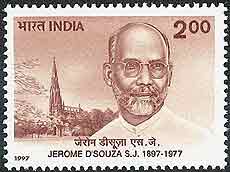
Fr. Jerome D’Souza died on 12 August 1977, leaving behind a remarkable legacy. Two decades later, in 1997, the Government of India honoured him with a commemorative postage stamp on the centenary of his birth. But perhaps the more enduring memorials are the institutions and ideals to which he gave his energy: the educational institutions he strengthened, the Xavier Board he helped establish, the Indian Social Institute he helped create, and the constitutional principles to which he contributed.

His life tells an important story about India itself. The making of modern India was not accomplished only by politicians. It was also shaped by teachers, priests, lawyers, social workers, intellectuals, administrators and countless others who believed that the new nation had to be built through education, dialogue and service. Fr. Jerome D’Souza, SJ belonged to that generation. He was a Jesuit who loved learning, an educator who believed in nation-building, a Christian who understood the importance of religious freedom, and an Indian who could speak confidently to both his country and the wider world. His story deserves to be remembered as the story of an extraordinary Jesuit, and as the story of an Indian who helped his country find its voice in the first years of the Republic.

Rev. Dr. John Vallamattom | A Life of Faith, Education and Compassion

Rev. Dr. John Vallamattom: The Principal Who Opened a Door for Me

NV Paulose, Chairman, Global TV +91 98441 82044

There are some people whom we come to know through history. There are others whom we are fortunate enough to know personally. For me, Rev. Dr. John Vallamattom belongs to both these worlds. Today, when I look back at his life and at the many institutions and causes with which he was associated, I realise how much larger his contribution was than what I could have understood as a student. At that time, I knew him simply as my Principal at Nirmala College, Muvattupuzha. I knew him as the person who presided over the institution in which I studied. More importantly, I remember him as someone who showed me personal consideration and genuine compassion at an important moment in my life.

He gave me admission to the college on personal consideration and compassion. I mention this not to give undue importance to my own experience, but because sometimes the greatness of a person is understood most clearly through small personal encounters. A decision that may have seemed ordinary in the course of his responsibilities became significant in my life. It opened a door for me at a time when that door might otherwise have remained closed. I have never forgotten it. Only later did I begin to appreciate the remarkable breadth of the life of the person who had opened that door for me.

A visionary in education

Rev. Dr. John Vallamattom was not merely an administrator within an educational institution. He was one of the pioneering figures in the development of Catholic higher education in India. Among his important contributions was his association with the founding of the Xavier Board of Higher Education in India. The Board was established in 1951 with the vision of bringing Catholic colleges across the country together for cooperation and the advancement of higher education. Fr. John Vallamattom was among the educationists who played a pioneering role in bringing this vision into reality.

The photograph of the founding visionaries of the Xavier Board is particularly meaningful in this context. It places Fr. John Vallamattom alongside other distinguished pioneers of Catholic higher education in India. It is a reminder that his contribution to education was not confined to a single college or a single diocese. He was part of a larger national effort to strengthen higher education and to create a spirit of cooperation among institutions. He later served as President of the Xavier Board. His association with the Board therefore represents a significant chapter in the history of Catholic higher education in India.

Looking back from the present, it is easy to underestimate the vision required to build institutions and networks in an earlier generation. Educational institutions do not emerge simply from buildings and regulations. They require people who believe in the power of education and are willing to invest their time, energy and conviction in that belief. Fr. Vallamattom was one of those people.

Nirmala College and the Principal I remember

My own association with him was more immediate and personal. He was my Principal at Nirmala College, Muvattupuzha. As students, we rarely understand the full responsibilities carried by a Principal. We see the person in the office, at official functions, during college events and in moments of discipline or administration. We may not know the wider work that occupies his or her life. I certainly did not understand the full dimensions of Fr. Vallamattom’s work at that time.

What I did experience was his human side. When I sought admission to Nirmala College, he considered my circumstances personally and gave me an opportunity to join the college. I remember that decision with gratitude. I do not want to present this as something extraordinary merely because it happened to me. Many students must have had their own experiences of his kindness and understanding. Mine is simply one of those memories that has remained with me over the years. Yet I believe such memories matter. An educational institution is ultimately about people. Behind every admission, every classroom and every academic record there is a human story. A Principal has the authority to administer an institution, but there are moments when that authority can also be exercised with understanding and compassion. That is how I remember Fr. Vallamattom.

The gift of an opportunity

As I look back now, I understand more clearly what that admission meant. Education is often spoken of in terms of examinations, degrees and careers. But for many of us, education begins with something much simpler: someone giving us an opportunity. Sometimes that opportunity comes through a teacher. Sometimes through a parent. Sometimes through an institution. And sometimes through the understanding of a person who happens to be in a position to help. In my case, that person was Fr. John Vallamattom. I cannot claim to know what was in his mind when he made the decision. I can only speak about what I experienced. I experienced his decision as an act of personal consideration and compassion.

That memory has acquired greater meaning with the passage of time. The student who received that opportunity could not have known the full history of the Principal who granted it. I knew him within the limited world of my college life. Only later did I learn about his wider contribution to education, journalism, and public life. The discovery has made my personal gratitude deeper, not because it makes my experience more important, but because it has helped me understand the person behind that experience.

Education as a form of service

The educational work associated with Fr. Vallamattom reflects a larger understanding of education as service. His work with the Xavier Board, his responsibilities in higher education and his leadership in institutions were part of a period when Catholic educational institutions were expanding their contribution to the intellectual and social development of the country. Education has always been one of the most constructive ways of serving society. A school or college does not merely transfer information from one generation to another. It gives young people confidence, discipline, knowledge and the ability to think for themselves. It can change the direction of families and communities. Fr. Vallamattom’s contribution should be viewed in that wider context. His legacy is therefore not limited to the positions he held. It lives in institutions, in educational traditions and, perhaps most importantly, in the lives of students who were given opportunities.

A voice in public life

There was another dimension to Fr. Vallamattom’s life that deserves recognition. He was also involved in journalism and public communication. He was associated with the founding of Indian Currents, a Catholic weekly that sought to engage with issues of importance to the Church and society. This was consistent with his wider approach to public life. Education creates knowledge. Journalism creates a forum for ideas. Public engagement allows communities to participate in the larger life of the nation.

Fr. Vallamattom appears to have understood that the Church could not remain detached from the questions confronting society. Faith had to be expressed not only within religious institutions but also through responsible engagement with the world around it. This aspect of his life is especially relevant today, when communication has become such an important part of public life.

The Supreme Court case

Another important chapter in Fr. Vallamattom’s life was his role as the first petitioner in the case of John Vallamattom and Another v. Union of India. The case concerned Section 118 of the Indian Succession Act, 1925. The provision imposed particular restrictions on certain testamentary bequests by Christians for religious and charitable purposes. Fr. Vallamattom challenged the provision before the Supreme Court. The case ultimately came before a three-member Bench of the Supreme Court and was decided on 21 July 2003. The Court declared Section 118 unconstitutional.

The judgment is important in Indian constitutional law because it examined the question of equality and the unequal burden imposed upon Christians by the provision. The Court found that the provision could not withstand constitutional scrutiny under Article 14. For those who study the judgment from a legal perspective, the case represents an important affirmation of equality before the law.

For those who knew Fr. Vallamattom personally, however, the case can also offer another glimpse into his public character. He was prepared to bring a concern affecting his community before the highest court of the country. He did so through the constitutional process and allowed the matter to be examined through the principles of Indian law. The case therefore became part of the constitutional history of the country.

Faith, charity and equality

There is an especially meaningful aspect of the judgment. The dispute concerned, among other things, restrictions on charitable and religious bequests. The Supreme Court’s discussion recognised the wider significance of charity and compassion. Charity is not confined to one religion. Compassion is not the possession of one community. These are values that belong to humanity. Seen in that light, the Vallamattom case has a significance beyond the immediate legal issue. It reminds us that equality is meaningful only when it is applied to real people and real circumstances. It also reminds us that religious faith can coexist naturally with constitutional principles and democratic institutions. Fr. Vallamattom’s decision to pursue the matter through the Supreme Court was therefore another expression of his engagement with society.

Different dimensions of the same life

When I look at these different chapters of his life, I am struck by how difficult it is to place him in a single category. He was a priest. He was an educationist. He was associated with the Xavier Board of Higher Education in India and was one of its pioneering founders. He served as a Principal. He was involved in journalism. He participated in public life. He became the petitioner in a significant constitutional case.

But behind all these descriptions was a human being. That is the person I remember. I do not pretend to have known every aspect of his life. My experience of him was limited to my years as a student at Nirmala College. Yet sometimes a person’s influence does not require a long association. A single encounter can remain in memory. A single act of kindness can become part of one’s life. A single opportunity can change a person’s direction. For me, his decision to give me admission was one such moment.

The meaning of leadership

As I think about Fr. Vallamattom today, I find myself reflecting on the meaning of leadership. Leadership is often measured by positions, institutions established, offices held and achievements recorded in official histories. Those things matter. But there is another form of leadership that is harder to record. It is the ability to recognise the individual in front of us. It is the willingness to listen. It is the capacity to respond with compassion. It is the ability to use one’s position not merely to administer but also to help. I experienced something of that kind in him. Perhaps this is why his educational contribution has a particular resonance for me. The founder of educational institutions and networks was also, in my experience, a Principal who understood that education begins by giving people an opportunity.

A personal debt of gratitude

I have often thought that people who help us at important moments may never realise how deeply their actions remain with us. Fr. Vallamattom may have considered my admission one among many decisions made during his years of service. For me, it became a lasting memory. My Father and his friend who accompanied me to Rev. Fr. John Vallamattom also delightfully illuminate my memory space. I cannot repay any of them for their kindness in any material sense. The most I can do is remember them it with gratitude and speak of them honestly. That is the reason I wanted to write about them.

I do not want to present an idealised portrait of a person I knew only in one part of his life. Nor do I want to claim knowledge of his inner thoughts or motivations. I simply want to place my small personal memory alongside the larger historical record. The historical record tells us about his contribution to education, his role in the Xavier Board, his involvement in journalism, and his constitutional intervention before the Supreme Court. My memory tells me about a Principal who, at one important moment, showed me compassion. Both belong to the story.

Remembering Rev. Dr. John Vallamattom

Every generation remembers its teachers in its own way. Some are remembered for their lectures. Some for their discipline. Some for their scholarship. Some for the institutions they built. And some are remembered because, at a crucial moment, they gave someone a chance. I remember Fr. John Vallamattom in that last sense. I remember him as my Principal at Nirmala College, Muvattupuzha.

I remember that he gave me admission on personal consideration and genuine compassion. With the perspective that comes only with the passing of years, I have come to see that this personal memory was part of a much larger life devoted to education, the Church and society.

He was among the pioneers of the Xavier Board of Higher Education in India. He contributed to the development of educational institutions. He engaged with the world of journalism and public communication. He was prepared to take a constitutional question before the Supreme Court of India, and the judgment that bears his name has become part of the country’s legal history.

These are achievements that deserve to be recorded. But for me, his greatest significance is more personal. He opened a door. I was fortunate enough to walk through it. And I remain grateful.

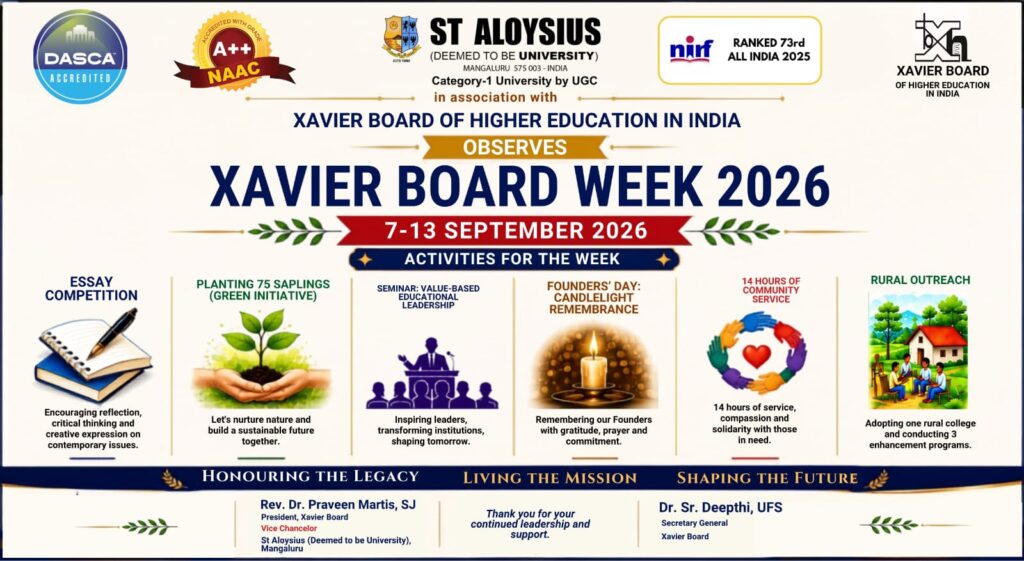
Xavier Board Week 2026 | September 7 to 13 | Living the Vision, Transforming Society

Honouring the Legacy, Living the Mission, and Shaping the Future

NV Paulose, Chairman, Global TV +91 98441 82044

An editorial conversation with Rev. Dr. Praveen Martis, SJ, Vice Chancellor of St. Aloysius (Deemed to be University) and President of the Xavier Board of Higher Education in India, reveals a vision for higher education that goes far beyond academic degrees. Sitting down with him to discuss the upcoming Xavier Board Week 2026, one is immediately struck by his calm conviction. For Dr. Martis, education is not a mere transaction of information or a pathway to professional success. It is a spiritual and moral journey intended to transform human lives.

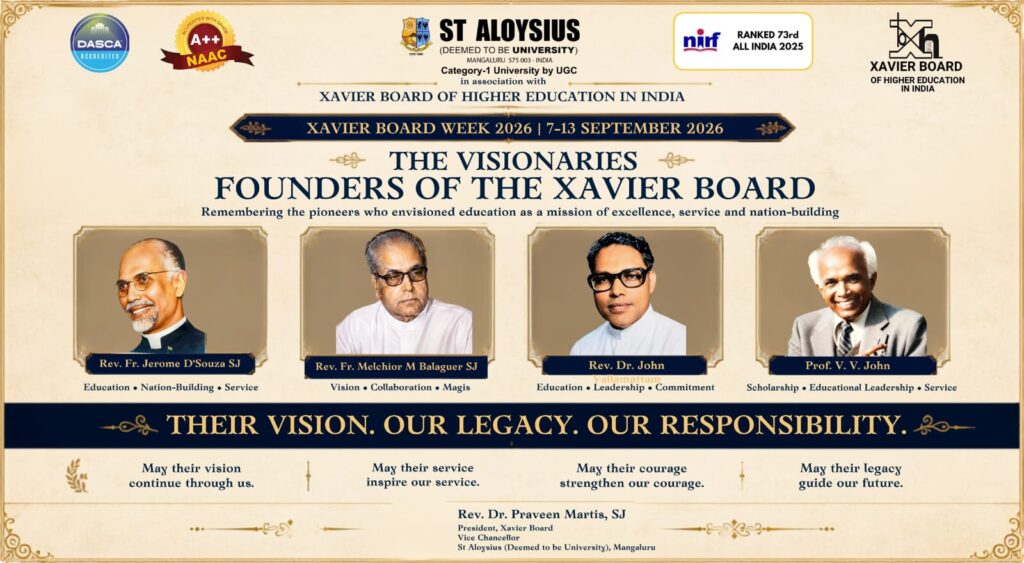
During our discussion, Dr. Martis reflected on the foundational spirit of the Xavier Board. He emphasized that the institution was built by visionaries who saw higher education as a mission of service and nation-building. Leaders such as Father Jerome D Souza, Father Melchior Balaguer, Father John Vallamattam, and Professor V V John did not design institutions simply to award certificates. They sought to nurture men and women who would lead society with integrity, courage, and deep empathy. Dr. Martis pointed out that this founding philosophy remains as relevant today as it was seven decades ago.

In our conversation, the Vice Chancellor spoke passionately about the theme for Xavier Board Week 2026, which runs from September seventh to thirteenth. He noted that honoring a legacy requires active living rather than quiet sentiment. The week is designed around direct community engagement and practical action. Initiatives such as planting seventy five saplings across campuses symbolize a commitment to environmental care and sustainable futures. Furthermore, requiring students to dedicate fourteen hours to community service and rural outreach ensures that learning extends well past the classroom walls. Dr. Martis believes that when students step into rural communities to offer support, they learn invaluable lessons about social responsibility and human dignity.

The discussion also touched upon the rapidly evolving educational landscape, particularly the rise of artificial intelligence and digital innovation. Dr. Martis observed that while technological advancement brings incredible possibilities, it must always be guided by strong moral values. He stressed that higher education must equip young people to navigate modern tools without losing their moral compass. Technology should serve human dignity, foster social justice, and build inclusive peace in a diverse nation.

Ultimately, our interaction with Rev. Dr. Praveen Martis, SJ, highlights the core message of Xavier Board Week. Education fulfills its highest purpose when it inspires individuals to lift others as they climb. By grounding academic excellence in service, faith, and ethical leadership, institutions can continue to shape light bringers who will guide the future of the nation.

National Essay Writing Competition Member institutions hold an essay contest for both faculty and students. Faculty write on “75 Years of Values and Vision: Navigating AI and Educational Reforms through the Xavier Board’s Legacy of Social Justice and Excellence” (2,500–3,500 words). Students address “75 Years of Legacy and Beyond: Empowering Youth as Catalysts for Digital Innovation, Environmental Stewardship, and Inclusive Peace in a Pluralistic India” (1,500–2,500 words). Entries follow APA 7th edition guidelines, require institutional verification, and compete for top essay and top institute awards.

Green Initiative (Planting 75 Saplings) To encourage environmental responsibility, participating campuses organize a tree planting drive. Faculty and students plant 75 saplings on their grounds to promote sustainability and care for nature.

Educational Leadership Seminar Institutions host specialized seminars focused on value-based educational leadership. These sessions aim to guide leaders, transform academic environments, and discuss strategies for shaping value-driven institutions.


Founders’ Day Candlelight Remembrance A solemn candlelight service is conducted to honor the pioneers of the Xavier Board, including Rev. Fr. Jerome D’Souza SJ, Rev. Fr. Melchior M. Balaguer SJ, Rev. Dr. John Vallamattam, and Prof. V. V. John. The event focuses on prayer, gratitude, and a renewed commitment to their original vision.

14 Hours of Community Service & Rural Outreach Students and faculty engage in 14 hours of direct community service to promote compassion and solidarity with marginalized groups. Alongside this, campuses adopt a rural college and carry out three capability enhancement programs to support rural education.

Syrian Orthodox Church in Kerala: Value Conscious; Syrian Catholic Church: Power Conscious

Value Consciousness and Power Consciousness: A Reflection on the Syrian Orthodox and Syrian Catholic Churches in Kerala

NV Paulose, Chairman, Global TV +91 98441 82044

There are moments when the differences between Christian communities are not found in their doctrines, liturgies or ecclesiastical structures, but in the manner in which they conduct themselves in relation to the world around them. In Kerala, where Christianity has existed for centuries and where the Syrian Christian tradition has become deeply woven into society, it is worth asking a more uncomfortable and introspective question. How do our churches relate to power?

I raise this question with humility, because no institution is made up entirely of saints, and no community is entirely free from human weakness. The Syrian Orthodox Church and the Syrian Catholic Church have both contributed enormously to the religious, educational and social life of Kerala. Both have produced people of faith, learning, service and sacrifice. Yet, from an institutional and cultural perspective, one can perceive a difference in their attitude toward worldly power.

My argument is that the Syrian Orthodox tradition in Kerala appears to have retained a stronger sense of value consciousness, while the Catholic establishment can sometimes appear more conscious of institutional power and the opportunities that accompany it. This is not an assertion that Orthodox Christians are always virtuous or that Catholics are always motivated by power. Such a conclusion would be both unfair and intellectually careless. The question is not about the character of individual believers. It is about institutional instinct. It is about what an institution does when it finds itself standing close to political authority, economic influence and social privilege.

There is something significant about the ability of a church to maintain a certain distance from power.

Power is attractive because it offers possibilities. It can open doors, provide resources, strengthen institutions and make difficult things easier. A relationship with a powerful person can produce immediate material benefits. A connection with a political establishment can make it easier to obtain land, permissions, recognition, financial assistance or influence. The temptation is therefore understandable.

Yet precisely because the temptation is understandable, the ability to resist it becomes morally meaningful. The Syrian Orthodox tradition in Kerala, in my observation, has often maintained a certain reserve toward such proximity. Even when relationships with centres of power could potentially produce substantial material advantages, there appears to be a cultural reluctance to make those relationships the foundation of institutional life. There is value in such restraint.

A church does not necessarily become stronger because it becomes closer to powerful people. Sometimes it becomes weaker. There is a subtle transformation that can occur when an institution repeatedly seeks advantage through proximity to power. Friendship can become access. Access can become influence. Influence can become dependence. Eventually, the institution may become reluctant to challenge the very people from whom it receives its advantages.

That is when moral independence begins to disappear.

The issue is not whether churches should have relationships with political leaders, industrialists, administrators or wealthy benefactors. Of course they will. A church that serves society cannot live in complete isolation from society. Nor is there anything wrong with accepting legitimate assistance for schools, hospitals, charitable activities or other works of public benefit.

The question is more fundamental. Can the church remain equally willing to speak the truth when the person standing before it is powerful? Can it refuse an attractive benefit when accepting it would compromise its independence? Can it maintain a friendship with someone powerful without allowing that friendship to determine its principles? Can it accept money without allowing money to influence its moral voice? These are difficult questions because power rarely announces itself as corruption. It often arrives as generosity, friendship, opportunity, or goodwill.

This is where the distinction between value consciousness and power consciousness becomes important. A value-conscious institution begins with the question, “What is right?” A power-conscious institution is tempted to begin with the question, “What is advantageous?” The difference may appear small, but over time it can transform an institution. Values ask for sacrifice. Power asks for accommodation. Values sometimes require saying no. Power rewards saying yes. Values can survive without wealth. Power generally requires resources. A church that places values before advantage may sometimes appear weak, inefficient or even foolish in the eyes of the world. It may lose opportunities. It may possess fewer buildings, fewer influential connections and fewer material resources. But it may retain something far more precious: the freedom to speak without fear.

The Catholic Church in Kerala presents a more complicated picture because of the extraordinary breadth of its institutional presence. Catholic communities have built schools, colleges, hospitals, charitable organisations and other institutions that have served generations of people. Such institutions necessarily require money, administration, political engagement and interaction with people of influence.

This institutional strength is not in itself a moral failure. On the contrary, much of it has served society well.

But institutional strength creates a particular danger. The larger the institution becomes, the greater the temptation to preserve the institution at any cost. When survival, expansion and influence become dominant concerns, values can gradually become secondary. The danger is not that the church has money. The danger is that money begins to determine the direction of the church. The danger is not that the church has influence. The danger is that influence becomes an end rather than a means of service. The danger is not that church leaders meet powerful people. The danger is when access to powerful people becomes a measure of institutional success. This is where I believe the Catholic establishment deserves honest introspection. Has the pursuit of institutional strength sometimes overshadowed the simplicity of the Gospel? Has proximity to political and economic power sometimes become too attractive? Have material possibilities occasionally received greater attention than moral possibilities? And, most importantly, has the church sometimes become more concerned with possessing influence than with preserving the freedom to challenge those who possess influence?

These questions should not be interpreted as hostility toward Catholic Christians. They should be understood as questions that every powerful institution must ask itself. Indeed, the same questions must be directed toward the Syrian Orthodox Church. The Orthodox Church should not assume that historical restraint automatically guarantees moral superiority. Institutions change. Circumstances change. Human beings change. A church that has maintained distance from power in one generation can become attracted to power in another. Therefore, value consciousness cannot be inherited merely through tradition. It must be consciously renewed by every generation.

The real strength of a church is not demonstrated by the number of powerful people who attend its functions, the amount of property it controls, the size of its institutions or the influence it possesses in public life. Its real strength is demonstrated when it can stand before power without becoming dependent upon it. A church should be able to accept assistance without selling its conscience. It should be able to maintain friendship without becoming a client. It should be able to enter the rooms of the powerful without forgetting the people outside those rooms. It should be able to lose a material advantage rather than compromise a moral principle. Perhaps this is the deepest distinction between being value conscious and being power conscious. Power asks, “Who can help us?” Values ask, “Whom are we called to serve?” Power asks, “What can we obtain?” Values ask, “What can we give?” Power asks, “How close are we to those who control things?” Values ask, “How faithfully do we stand with those who have nothing to give us?” For a Christian institution, the second set of questions should always prevail.

The Gospel was not born in the corridors of power. Christ did not build His ministry by cultivating proximity to political authority or accumulating material influence. His authority came from truth, sacrifice, compassion, and moral courage. That is why the greatest danger to a church may not be its lack of power. It may be its excessive desire for power. Perhaps, therefore, the Syrian Orthodox Church has something valuable to preserve in its instinct for distance, restraint and independence. And perhaps the Syrian Catholic Church, precisely because of its considerable institutional strength and social influence, has an even greater responsibility to examine how it uses that strength. But the lesson ultimately belongs to both.

The question is not which church is better. The question is what kind of church we want to become.

A church can possess little and still be spiritually rich. Another can possess enormous resources and still become spiritually poor. Buildings can be rebuilt. Institutions can expand. Financial resources can be accumulated again. But once a church loses the courage to stand independently before power, recovering that moral independence is far more difficult. Perhaps the most valuable possession of any church is therefore not its wealth, influence or institutional reach. It is the ability to say no. To say no when money demands silence. To say no when influence demands compromise. To say no when friendship demands obedience. And to say no even when saying yes would be materially beneficial. That is not weakness. That is freedom. And perhaps, in an age increasingly fascinated by power, freedom from power is one of the most important Christian values a church can preserve.

Dr. Janet Dotty Lobo | Championing Knowledge, Libraries and Lifelong Learning

From an Unexpected Career Choice to a Lifelong Commitment to Knowledge

NV Paulose, Chairman, Global TV +91 98441 82044

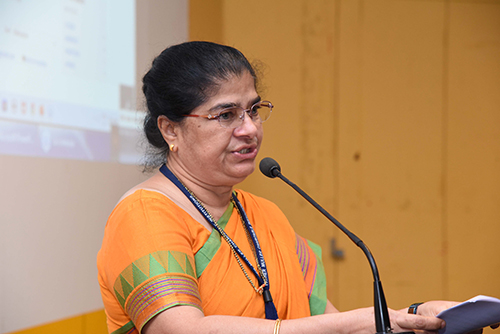
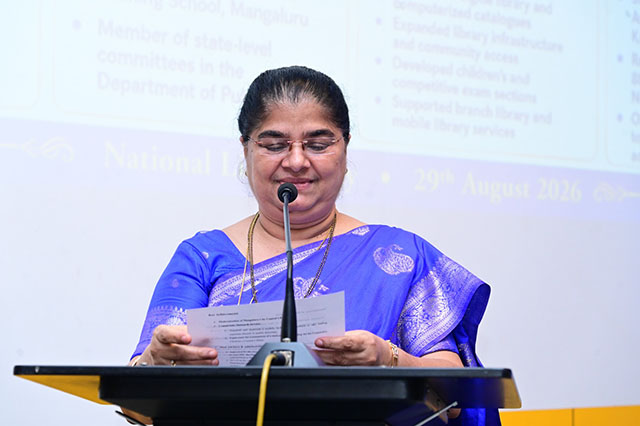
Dr. Janet Dotty Lobo, Chief Librarian of Father Muller Charitable Institutions, Mangaluru, exemplifies how dedicated stewardship can transform an academic library from a repository of books into a thriving hub of learning and research. Throughout her career, her contribution has extended far beyond traditional administrative and technical responsibilities, leaving a lasting mark on the institution’s educational landscape. By modernizing information access, facilitating research initiatives, and fostering a collaborative learning environment, she quietly shapes the academic culture around her.

Her efforts create vital opportunities for students, faculty, and researchers alike, ensuring that knowledge is not merely stored, but actively connected to the people who need it most. Through her years of service, she has witnessed the changing face of libraries and has remained committed to one enduring belief: knowledge becomes meaningful when people are encouraged to seek it, understand it and use it.

Dr. Lobo holds qualifications including B.Com., M.L.I.S. and Ph.D. and serves as the Chief Librarian of the Father Muller Central Library. The library, which began functioning in 1985, has developed considerably over the years. In 2011, the institution established the Father Muller Knowledge Centre with modern facilities to meet the changing needs of its academic community. Behind this transformation has been the work of professionals like Dr. Lobo, whose responsibilities extend from managing resources to guiding students and faculty towards effective use of information.

Her journey into librarianship was not entirely planned. Born and brought up in Puttur, DK District, she was studying at St. Philomena College when circumstances presented her with a possible career path. She applied for two courses, one of them being library science. At the time, she had thought that a qualification in library science might give her an opportunity to work at her former college. She attended an interview at Mangalore university and was selected on the same day. What began as a practical career decision eventually became a profession to which she devoted much of her working life. Looking back, she says that otherwise she might have become a teacher. Librarianship allowed her to become a teacher of a different kind. One of the aspects she values most about her profession is the opportunity to meet people from different disciplines.

A principal or specialist may interact mainly with people from particular academic areas, but the library brings everyone together. Students from different courses, faculty members and researchers all pass through its doors. Over the years, this has enabled Dr. Lobo to meet countless people and build relationships across the institution. Former students sometimes recognise her in public places even when she does not immediately recognise them, a reminder of how lasting the relationship between a librarian and a student can become. For Dr. Lobo, the library is much more than a building containing books. It is a place of peace, concentration and positive energy. She compares the atmosphere of a library to a form of meditation because people come there with the intention of acquiring knowledge. This environment, she believes, also influences the people who work there. A librarian should be calm, approachable, and welcoming. Students should never feel that they are entering a place where they will be reprimanded. When someone comes to the library to read, that effort should be respected because it reflects a desire to learn.

Keeping Reading Alive in an Age of Digital Information

Her concern about reading has become even stronger in an age dominated by mobile phones and digital information. Although students today have access to an enormous amount of information, Dr. Lobo believes that access alone does not guarantee knowledge. Information found online may not always be authenticated, reliable, or supported by evidence. Students therefore need guidance in identifying credible sources. This is one reason she believes librarians continue to have an important role. A librarian does not merely provide information but helps people understand what to read, where to find it, and how to evaluate it. She strongly believes that reading remains essential for personal and professional growth. In her view, it is difficult to identify successful people who have completely avoided reading and learning throughout their lives. Reading requires attention and reflection. Information that is casually consumed on a mobile phone can easily disappear from memory if it is not properly understood and processed. For her, reading is therefore not simply an academic activity. It is a process through which people develop their ability to think, question, and understand the world around them.

At the same time, Dr. Lobo does not believe that libraries should remain only silent spaces where individuals read in isolation. She sees the modern library as a vibrant centre for knowledge sharing. Reading should lead to thinking, and thinking should lead to action. Group discussions, storytelling and collaborative learning can help people take knowledge beyond the pages of a book. She suggests that even a single book can become the basis for collective learning if different people read different chapters and discuss what they have understood. In this way, the library becomes a place where knowledge is shared and transformed into ideas. This philosophy is reflected in her professional activities. Dr. Lobo has conducted orientation programmes, faculty development programmes and user awareness sessions to help students and faculty understand the resources available through the library. These programmes introduce users to library services, catalogues, electronic resources, remote access facilities and research support tools. Her work therefore extends beyond the traditional responsibility of maintaining books and journals. She helps users become independent and confident in navigating the academic information environment.

The transformation of the library into a digital information centre has been an important part of this work. Students and faculty can access subscribed electronic resources using usernames and passwords even when they are away from the campus. They can check the library catalogue before visiting, find out whether a particular book is available, and identify the location of physical resources. Digital resources can also be accessed from home or from other parts of the world. For Dr. Lobo, this has given the library a global dimension. The physical library remains important, but its services can now reach people far beyond its walls.

Her role has also involved supporting research and academic development. Students and faculty need reliable literature, scholarly journals, research databases and appropriate tools when they undertake academic work. Dr. Lobo has been involved in programmes that introduce users to electronic resources, online literature searches and research support services. She has also participated in initiatives related to scholarly publishing, plagiarism detection and the effective use of academic information. Through these activities, the librarian becomes an academic facilitator who helps researchers find and use information more effectively.

Her professional responsibilities have extended across several institutions and programmes within the Father Muller system. She has been involved in the centralised purchase of books and journals and has worked with medical, nursing and allied health institutions. She has also faced the demanding preparation required for inspections and accreditation processes. Various regulatory and academic bodies have inspected institutional facilities and documentation, requiring extensive preparation and coordination. These responsibilities reveal another side of librarianship that is rarely visible to students. Behind a functioning library is a substantial amount of planning, organisation, documentation, and professional responsibility.

Despite these administrative demands, Dr. Lobo remains focused on the people who use the library. She believes that a library should welcome those who come seeking knowledge. Instead of creating an atmosphere of fear, librarians should encourage students to feel comfortable in the library. This simple change in attitude can influence whether young people develop a lasting relationship with reading. For her, promoting reading is not about forcing students to open a book. It is about creating an environment in which they understand the value of doing so.

Dr. Lobo also sees the librarian as a custodian of knowledge. In an age of fake news and unverified digital content, this responsibility has become increasingly significant. A book entering a library collection is not normally accepted without some form of evaluation and selection. Librarians examine resources and consider their relevance and credibility. The same spirit of careful evaluation is necessary when people navigate digital information. Technology has made information easier to access, but it has also made it easier for inaccurate information to spread. Professional judgement therefore remains essential.

Her belief in the importance of qualified librarians is closely connected to this responsibility. She suggests that the quality of a library depends greatly on the knowledge and competence of the people managing it. Simply placing information in a room or making digital resources available does not automatically create a strong library. There must be professionals who understand how information is organised, evaluated, and made accessible. In her view, the librarian should be an essential part of the academic structure of an institution rather than someone whose role is considered secondary.

For Dr. Lobo, the library can be described as the brain of an institution. It connects different academic disciplines through information and provides a common space where students, teachers and researchers can seek knowledge. A vibrant campus, she believes, should have a vibrant library. The library should not exist separately from academic life. It should be connected to teaching, learning, research and the wider intellectual development of students. Its purpose is not merely to store knowledge but to ensure that knowledge reaches those who need it.

Editor’s Note: Some of our most meaningful professional lessons have also come through observing teachers and students. During an FDP, participants were asked to make a paper plane and, before flying it in the classroom, to write the name of a teacher who had influenced them on one of the wings of the paper plane. When the papers were picked back randomly and read aloud, it explained why those teachers had made an impact in their lives. Their reasons were often not simply related to classroom teaching. They remembered teachers who had supported them during difficult times, encouraged them, gave them confidence, and believed in their abilities. Education is not only about transferring information; it is also about supporting a generation, and a librarian carries a similar responsibility through the power of knowledge.

Building a Library That Connects People, Knowledge and Possibility

Over the years, Dr. Lobo has seen many students pass through the library and move on to successful professional lives. Some of them continue to remember the people who helped them during their student years. These relationships form an important but often invisible part of a librarian’s legacy. A library can measure books, journals, databases and programmes, but the deeper impact is found in the people who used those resources to learn and grow. Every student who discovers a useful book, finds an important research article or learns how to search for reliable information represents another small success.

Her professional journey has also been shaped by mentors and opportunities. She recalls an early instance in which the former Director, Rev. Fr. Baptist Menezes, told her that one day she would become recognised in the history of the institution. Today, she looks back on those words with gratitude. Her visibility in the academic and professional community has grown through years of effort, programmes, initiatives and service. She believes that recognition does not come simply from holding a position. It comes from the willingness to work, organise programmes, support people and contribute consistently.

After more than two decades of professional service, Dr. Janet Dotty Lobo represents a generation of librarians who have witnessed the transformation from traditional collections to digital information environments. Yet the fundamental purpose of her profession has remained unchanged. Whether a student is turning the pages of a printed book or accessing a scholarly database from home, the objective is the same: to help that person discover reliable knowledge. Her career demonstrates that the librarian of today is not merely a custodian of books but a guide, educator, information specialist, research supporter, and mentor.

Dr. Janet Dotty Lobo shares a simple message. Reading should never disappear. Libraries should remain welcoming spaces where people can learn, think, and exchange ideas. Technology should expand access to knowledge without replacing the need for critical thinking. Most importantly, knowledge should not end with reading. It should lead to thought, and thought should lead to action. Through her service at Father Muller Charitable Institutions, Dr. Janet Dotty Lobo has sought to keep that cycle alive. Her journey is a reminder that behind every meaningful library is a dedicated professional who believes that every book opened, every question answered, and every student guided can contribute to creating a more informed and intellectually empowered society.

Manu Oommen | Rising into the League of Reputed Artists | From Passion to Precision

Art from the Heart | Where Precision Meets Emotion on Canvas | An enduring Passion

NV Paulose, Chairman. Global TV +91 98441 82044

At 42, Manu Oommen has already journeyed through a life enriched by discipline, leadership, sport, engineering and creativity. The son of Dr. Oommen Mammen, Manu is an engineer by profession and is based in the UAE. He currently serves as the Chief Operating Officer of Protect Plast LLC. A passionate cricketer in his younger years, he played in the competitive Dubai league before eventually retiring from the sport. Yet, beyond his professional accomplishments and sporting journey, Manu has discovered another remarkable form of expression through painting.

His paintings reveal a distinctive artistic personality. They carry a rare combination of precision and emotion, discipline and freedom. His brush seems to move with the precision of a fighter pilot, where every movement is purposeful, measured, and controlled. Yet, within that precision, there is remarkable warmth. His strokes flow naturally, allowing emotions to emerge gently on the canvas.

What makes Manu’s paintings particularly appealing is his ability to translate emotions into soothing and positive expressions. His work does not merely seek to impress the eye. It speaks quietly to the heart. Each painting appears to carry an emotion, a thought or a moment of reflection. The viewer is invited to pause, observe and connect with the feeling behind the colours and forms.

There is a sense of serenity in his work. In an increasingly restless world, Manu’s paintings offer moments of calm. His colours and strokes seem to create a peaceful space where the viewer can step away from everyday concerns and experience something more personal. The paintings invite contemplation without demanding it.

Perhaps this quality comes naturally from a life shaped by different disciplines. Engineering has given Manu an appreciation for accuracy and structure. Corporate leadership has taught him responsibility, patience and decision making. Cricket has demanded concentration, timing, resilience and an understanding of movement. Painting gives him another language through which all these experiences can find expression.

There is also courage in his approach to the canvas. A painting requires more than technical ability. It requires the confidence to place one’s emotions in full view. Manu’s work demonstrates that confidence. His strokes are assured, yet they retain an appealing softness. His paintings possess structure without losing spontaneity and emotion without becoming overwhelming.

Every canvas tells its own story. Some may speak through colour, others through movement, while others communicate through the quiet atmosphere they create. What remains constant is the emotional sincerity that seems to lie beneath the surface. His paintings encourage the viewer to look beyond what is immediately visible and discover the feeling that inspired the work.

Manu Oommen’s artistic journey is therefore a fascinating extension of his personality. The engineer, the corporate leader and the former cricketer coexist with the artist within him. Each facet of his life seems to contribute something to his creative expression. The precision of engineering, the discipline of cricket and the responsibilities of leadership find a different kind of freedom on his canvas.

His paintings are not simply objects to decorate a room. They are expressions to experience, appreciate and cherish. They deserve a place where they can be admired not only for their beauty but also for the emotions they evoke.

Manu’s art reminds us that creativity can emerge at any stage of life and from the most unexpected places. His journey demonstrates that a person can move confidently between the worlds of engineering, business, sport and art while remaining authentic to himself.

Ultimately, the greatest charm of Manu Oommen’s paintings lies in their ability to make emotions visible. His precise strokes create harmony, his colours create comfort and his compositions create moments of reflection. Each painting carries a quiet invitation to stop, feel and appreciate.

Manu Oommen does not merely paint pictures. He paints emotions, transforms feelings into colour and turns moments of reflection into something beautiful enough to be admired and cherished.