Building a Meaningful Career and Organization: The RBI Framework
By NV Paulose
Chairman, Global TV (+91 98441 82044)
Core Principle: Growth Without Losing Your Values
Building a successful career or organization does not require you to sacrifice your core values. Inspired by the LILIES philosophy (“Consider the lilies of the field, how they grow…”), true progress comes from growing naturally, maintaining your ethics, and striving for High Excellence and a Better World.
To achieve this, progress relies on the RBI Framework (Referral Circles, Business Circles, and Inner Circles).
1. The Inner Circle (The Foundation)
What it is: The bedrock of your personal life, career, or organization.
How to build it: Surround yourself with people who share your core values, offer mutual support, and contribute genuine trust and time.
The Connection to LILIES: A strong Inner Circle reflects values like Ownership, Responsibility, Independence, and Love. When your foundation is anchored in shared purpose, you can navigate any challenge with stability and confidence.
2. The Referral Circle (Expanding the Reach)
What it is: The layer built around goodwill, shared information, and connecting people to opportunities.
How to build it: Engage people openly without expecting immediate rewards or placing pressure on them.
The Connection to LILIES: Growth in this circle happens when you embrace Freedom and Simplicity, allowing relationships to grow organically. As members show deeper alignment and commitment, they may naturally move into your Inner Circle.
3. The Business Circle (Creating Impact and Prosperity)
What it is: The broader network of partners, clients, professionals, entrepreneurs, and economic opportunities.
How to build it: Monitor these connections carefully to ensure all business activities stay aligned with your primary values.
The Connection to LILIES: This stage represents the Career & Service journey. By turning your passion into service for humanity and the universe, the Business Circle creates sustainable value, financial health, and real-world impact.
The Natural Growth Journey (The FLOURISH Pattern)
The RBI Model and the LILIES philosophy follow a clear step-by-step path:
Passion: Discover what truly sets your soul on fire.
Service: Put your skills and uniqueness in the service of humanity.
Career & Success: Build a premium, high-value career that brings Freedom, Independence, and long-term prosperity.
Movement across all three circles is flexible. A client in your Business Circle can become a valued partner in your Referral Circle, and eventually, a trusted pillar in your Inner Circle. When these circles work together with trust and discipline, individuals grow stronger, operations run smoother, and organizations achieve lasting success.
Global TV Platform & Editorial Mentors
Supported by expert guidance and practical learning, the Global TV initiative empowers the next generation through global vision and real-world impact.
Principal Mentors: Wg Cdr Arijit Ghosh (Retd), CA Annu John, Prof. Dr. Oommen Mammen, NV Paulose, Dr. Santosh Kumar Pattanayak.
Contact: +91 98441 82044 | LILIES by Global TV — Building Brilliant Careers. Building a Better World.
RBI Principles for Progress of Individuals, Institutions and Organisations
NV Paulose , Chairman, Global TV +91 98441 82044
The RBI Principles provide a simple framework for building strong individuals, installations and organisations. Here, R stands for Referral Circles, B stands for Business Circles, and I stands for Inner Circles. The Inner Circle is the foundation of the entire system. People who build their Inner Circle carefully and strengthen it through trust, shared values, commitment and mutual support are like those who build their homes on a rock foundation. When the foundation is strong, challenges can be faced with greater confidence and stability. The Inner Circle should therefore be developed with people who genuinely believe in the purpose, contribute their time and knowledge, and are prepared to stand together during both opportunities and difficulties.
The next layer is the Referral Circle, which can be developed by welcoming and engaging another group of participants who may not yet belong to the Inner Circle. The purpose of this circle is to create connections, introduce new people to opportunities, share information and expand the reach of the initiative. At this stage, the relationship should not be built around an expectation of remuneration or reward. The strength of a Referral Circle comes from goodwill, trust and the willingness to connect people with useful opportunities. As relationships deepen, some members of the Referral Circle may naturally demonstrate greater commitment and responsibility and can gradually be invited into the Inner Circle. In the same way, people from the wider community can be encouraged to participate without pressure, allowing the network to grow organically.
Once the Inner Circle and Referral Circle are firmly established, the Business Circle can prosper immensely. The Business Circle represents the wider network of customers, partners, entrepreneurs, professionals, service providers and economic opportunities connected to the organisation or community. This circle should be monitored carefully so that relationships remain healthy, productive and aligned with the larger purpose. At the same time, the movement between circles should remain open: a person who begins in the Business Circle may demonstrate exceptional commitment and can be upgraded into the Referral Circle or eventually the Inner Circle. In this way, the RBI model becomes a living system of growth—the Inner Circle provides the foundation, the Referral Circle expands the network, and the Business Circle creates opportunities and prosperity. When these three circles work together with discipline and trust, individuals become stronger, installations become more effective, and organisations become capable of sustained progress.
ROTARY CLUB OF ORGAN DONATION INTERNATIONAL ATTENDS SOTTO KARNATAKA EXECUTIVE COMMITTEE MEETING
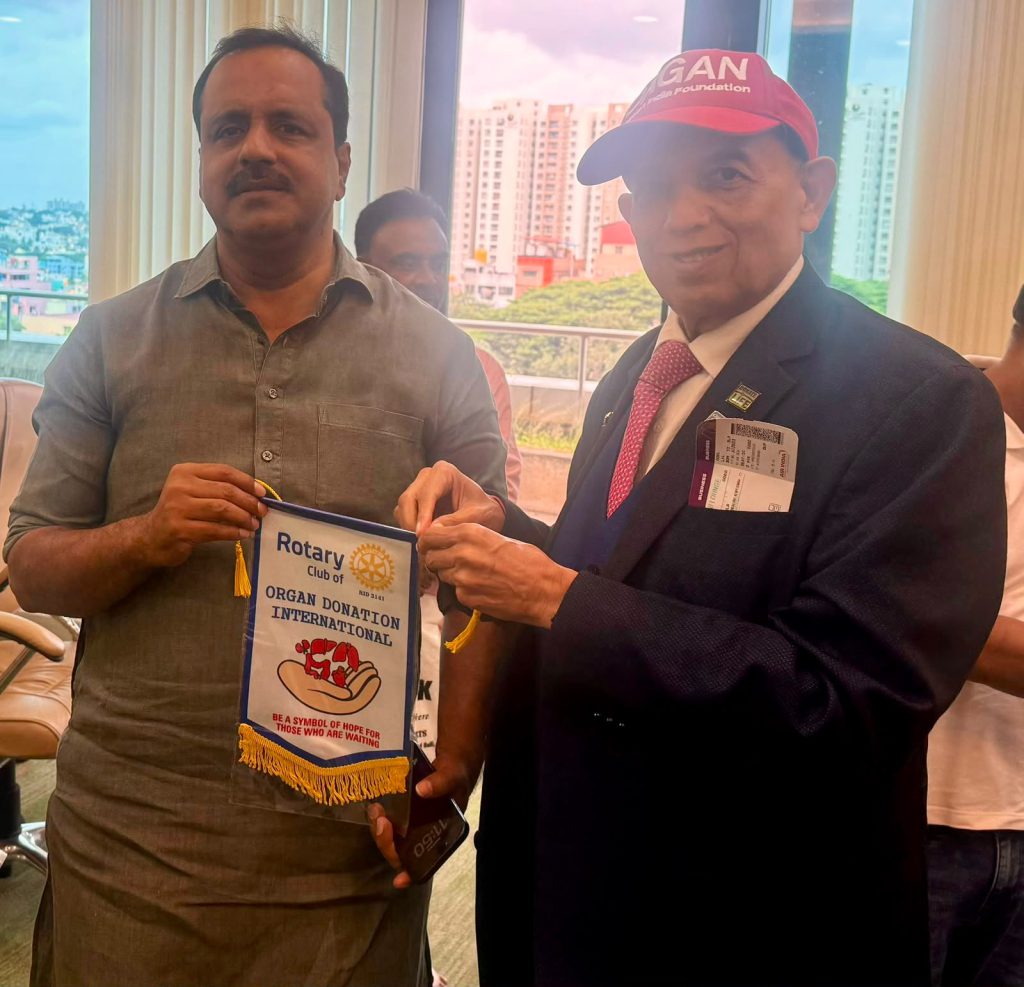
Bengaluru, 3 August 2026: Rtn Lal Goel, Founder & Charter President of the Rotary Club of Organ Donation International and Chairman of the Organ Donation India Foundation and GYAN, attended the Executive Committee Meeting of the State Organ & Tissue Transplant Organisation (SOTTO) Karnataka and Jeevasarthakathe at the office of the Hon’ble Minister for Health & Family Welfare, Government of Karnataka.
Rtn Lal Goel presenting the Rotary’s flag to the Hon’ble Minister of Health & Family Welfare, Government of Karnataka, Mr U T Khader
The meeting was attended by senior officials from the Department of Health & Family Welfare, SOTTO Karnataka, Jeevasarthakathe, and other key stakeholders involved in organ donation and transplantation.
During the meeting, Rtn Lal Goel stressed that every Revenue District Headquarters in Karnataka should have at least one Organ Retrieval Centre. He explained that strengthening the state’s organ retrieval infrastructure would significantly improve access to deceased organ donation and substantially increase the organ donation rate across Karnataka.
As a mark of Rotary’s commitment to humanitarian service, Rtn Lal Goel presented the Rotary Flag to the Hon’ble Minister, symbolising Rotary’s unwavering dedication to “Service Above Self” and its continued support for advancing organ donation awareness and saving lives.
Appreciating the suggestions, the Hon’ble Minister requested Rtn Lal Goel to prepare and submit a comprehensive roadmap outlining strategic measures to enhance organ donation and transplantation in Karnataka.
Dr. Oommen Mammen, Principal Chief Editor, Global TV – Keralam +91 96336 78896
Education is rapidly evolving, yet access to quality teaching remains uneven. Students often travel long distances for coaching, institutions struggle to recruit expert faculty, and many talented teachers are unable to reach learners beyond their local communities. Advances in digital technology now make it possible to bridge these gaps through a new educational model.
The proposed Cinematic Learning Centre (CLC) is an innovative, technology-enabled learning ecosystem that combines the impact of a classroom, the experience of a digital theatre, and the flexibility of online education. It creates a network of physical learning centres where students can attend professionally delivered classes on large interactive screens while engaging with expert faculty through live sessions and interactive discussions. Rather than replacing teachers, this model extends their reach and brings quality education closer to students.
The Cinematic Learning Centre Concept
A Cinematic Learning Centre is designed as a modern learning hub equipped with large display screens or projection systems, high-speed internet, quality audio systems, interactive communication tools, and comfortable seating for students. The environment provides an engaging educational experience that is far more effective than conventional online learning. Students gather at the centre to participate in scheduled classes delivered by experienced educators. Lessons may be presented live, recorded in advance, or offered through a combination of both, ensuring flexibility while maintaining academic quality.
Live Teaching Combined with Recorded Excellence | Initial Academic Focus
One of the strongest features of this model is the integration of professionally recorded lessons with live interaction. Core lessons can be recorded using high production standards, allowing the best educators to teach thousands of students across multiple locations. Following each lesson, students participate in live question-and-answer sessions where they interact directly with faculty members. This blended approach ensures consistent teaching quality while preserving the personal engagement that students value. The model also allows classes to be repeated, revised, or accessed later for reinforcement, improving learning outcomes.
The first phase of implementation should concentrate on subjects where students consistently seek additional academic support, particularly Physics, Chemistry, Mathematics, and Science.
Once the model is established, it can expand into higher education, including Engineering, postgraduate studies, Statistics, Data Science, Artificial Intelligence, Quantum Technologies, and other specialised disciplines. Professional certification programmes, competitive examination coaching, skill development courses, and lifelong learning initiatives can also become part of the platform.
A Scalable Learning Network | Franchise and Investment Model
Each learning centre can comfortably accommodate approximately fifty students for an interactive session. Where demand exceeds capacity, additional batches or parallel sessions can be conducted using separate links or faculty members. This modular approach enables unlimited expansion while maintaining meaningful interaction between students and instructors. Instead of constructing large campuses, educational services can be replicated efficiently through a network of standardised centres. The Cinematic Learning Centre operates on a franchise or partnership model.
Each centre requires a relatively modest investment, estimated at approximately ₹2 to ₹4 lakh, depending on the scale and quality of infrastructure. The investment covers essential facilities such as large display screens or projection systems, computers and networking equipment, high-speed internet connectivity, audio and video systems, student seating, furniture, and a well-planned interior. Compared with establishing a conventional educational institution, this investment is considerably lower while offering significant opportunities for expansion.
Content and Operational Support | Revenue Sharing
The central organisation develops and supplies the academic content, manages technology platforms, provides faculty support, coordinates scheduling, and ensures consistent quality standards across all centres. Local franchise partners focus on operating the centres, managing students, maintaining facilities, and promoting admissions within their communities. This clear division of responsibilities allows each partner to concentrate on its strengths while maintaining uniform educational standards. Students register for courses and pay their fees in advance according to the programme structure.
Revenue generated through enrolments is shared between the operating centre and the central organisation. One possible arrangement is sixty percent for the operating centre and forty percent for the central organisation. Another option is sixty-five percent for the operating centre and thirty-five percent for the central organisation. The final structure can be determined after evaluating operational costs, technology investments, content development, and marketing requirements.
Beyond Academic Education | Marketing and Expansion Strategy
Although the initial focus is on school and college education, the Cinematic Learning Centre is designed as a multipurpose digital knowledge platform. The same infrastructure can support professional development programmes, teacher training, corporate learning, government awareness programmes, workshops, seminars, entrepreneurship training, career guidance, skill development courses, and cultural or creative learning initiatives. This flexibility allows each centre to remain active throughout the year while serving learners from different age groups and professional backgrounds. Growth of the network will rely primarily on digital marketing supported by local outreach and institutional partnerships.
Social media campaigns, educational webinars, student success stories, demonstrations, and collaborations with schools, colleges, and community organisations can create awareness and attract learners. Professional associations, educators, and respected senior professionals can also contribute by promoting the initiative within their networks. The model is designed to expand systematically from selected pilot centres to district headquarters, major cities, state capitals, and eventually to communities across India.
Education in Multiple Languages | Institutional Collaboration
India’s linguistic diversity presents an opportunity rather than a challenge. Educational content can be produced in multiple Indian languages, enabling students to learn in the language they understand best. This approach significantly expands the reach of the platform and allows quality education to become accessible across regions with different linguistic backgrounds. Universities, educational institutions, government agencies, and industry partners can become strategic collaborators in developing the Cinematic Learning Centre network.
Partnerships may include curriculum delivery, certification programmes, faculty participation, research collaborations, and specialised training initiatives. Such collaborations enhance credibility while ensuring that programmes remain relevant to academic and industry needs.
The Road Ahead
The immediate priority is to prepare a comprehensive project proposal detailing the infrastructure requirements, technology architecture, academic framework, investment model, operational guidelines, revenue sharing arrangements, marketing strategy, and phased expansion plan. Pilot centres should be established to validate the concept, refine operational processes, and demonstrate educational outcomes. Lessons learned from the pilot phase can then guide expansion into a nationwide network. The Cinematic Learning Centre represents more than a new tuition model. It is a scalable educational ecosystem that combines technology, expert teaching, and local accessibility.
By integrating professionally produced learning content with real-time interaction, affordable infrastructure, and a sustainable partnership model, it has the potential to transform the way education is delivered. With careful planning, strong partnerships, and a commitment to quality, this initiative can create a nationwide network of technology-enabled learning centres that brings excellent education within reach of every learner, regardless of location.
Extensive experience in technical education | Decades of engagement with emerging technologies | Innovation and Higher Education
NV Paulose, Chairman, Clobal TV +91 98441 82044
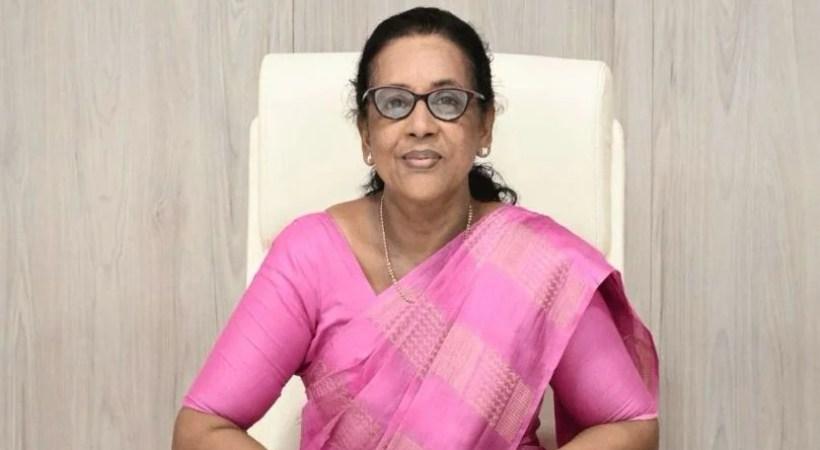
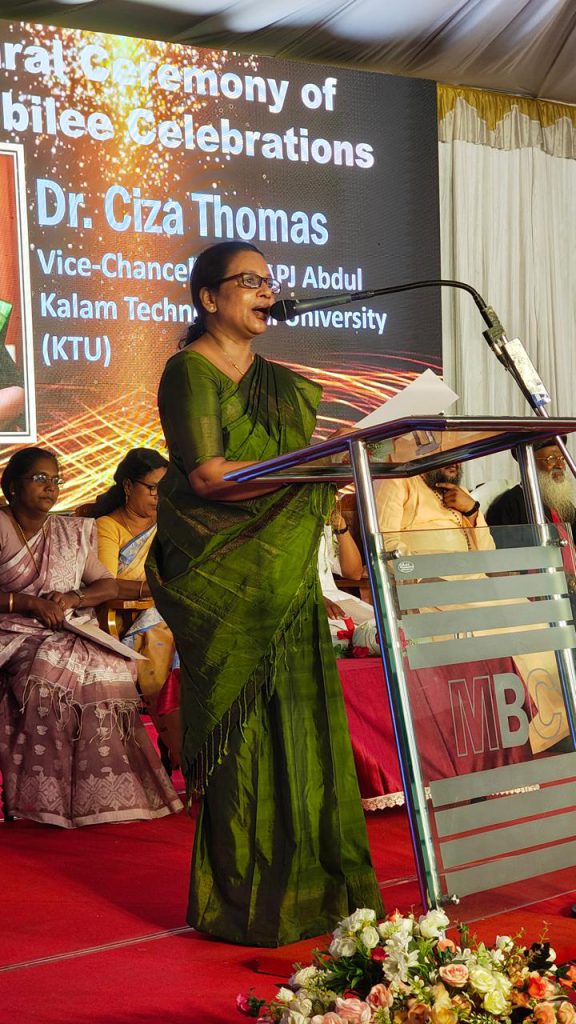
Prof. Dr. Ciza Thomas represents a distinctive generation of academic leaders in Kerala, professionals whose careers have evolved from teaching and research into institutional leadership, public administration and the governance of some of the state’s most important universities. With a background in engineering, a Ph.D. from the Indian Institute of Science, extensive experience in technical education and decades of engagement with emerging technologies, Dr. Thomas has built a career at the intersection of engineering education, cybersecurity, artificial intelligence, digital transformation and higher education administration.
Today, her position as Vice Chancellor of Kerala University of Digital Sciences, Innovation and Technology, widely known as Digital University Kerala, places her at the centre of an institution closely connected to Kerala’s ambitions in digital technology, innovation, research and the knowledge economy. Her leadership responsibilities extend beyond a single institution. She is also serving as Vice Chancellor of APJ Abdul Kalam Technological University, giving her a particularly significant role in Kerala’s higher education landscape. In March 2026, she was additionally entrusted with the charge of Sree Sankaracharya University of Sanskrit. These responsibilities reflect not only the breadth of her experience but also the importance of academic leadership at a time when universities are being called upon to respond to rapid technological, social and economic change.
From Engineering Education to University Leadership
Dr. Thomas’s professional journey is rooted in engineering education. She completed her B.Tech. and M.Tech. at the College of Engineering, Trivandrum, before earning her Ph.D. from the Indian Institute of Science in Bengaluru. Her academic preparation was complemented by a long career in Kerala’s government engineering education system, where she progressed through positions including Assistant Professor, Associate Professor, Professor, Principal and senior administrative roles.
Her academic career included leadership responsibilities at the College of Engineering, Trivandrum, where she served as Professor and Head in Electronics and Communication Engineering and also in Computer Applications. She subsequently served as Principal of Government Engineering College, Barton Hill, and held senior responsibilities within the Directorate of Technical Education, Government of Kerala. This progression is important in understanding Dr. Thomas’s approach to university leadership. She has experienced higher education from several perspectives. She has been a teacher working directly with students, a researcher engaged with emerging areas of technology, a department head responsible for academic programmes, a principal responsible for an institution and a senior administrator involved in the wider technical education system. The Vice Chancellor’s office brings many of these responsibilities together. Her professional journey has therefore given her an unusually broad understanding of higher education, extending from the classroom and laboratory to curriculum development, institutional administration, public policy and university governance.
Leading Digital University Kerala
Her position at Digital University Kerala is particularly significant because of its close alignment with her academic and professional background. The university was established with a mandate centred on digital sciences, innovation and technology. Its ecosystem brings together academic research, industry engagement, entrepreneurship, government initiatives and emerging areas of technology. In such an environment, the role of the Vice Chancellor extends well beyond conventional university administration.
It involves creating an academic culture in which research, innovation, entrepreneurship and education can reinforce one another. For Dr. Thomas, this represents a natural continuation of her professional interests. Her research expertise includes areas such as cybersecurity, artificial intelligence, image processing, pattern recognition and data mining. These fields have become increasingly important to modern society and are now closely connected with national security, economic development, public administration, healthcare, financial systems and digital governance. A university dedicated to digital sciences therefore requires leadership capable of understanding both the technical foundations of these fields and the institutional structures necessary to develop them. Dr. Thomas’s career places her at precisely that intersection.
A Researcher Who Understands Technology
Before becoming a university administrator, Dr. Thomas established herself as a researcher and educator. Her academic work has extended across cybersecurity and related areas of computing and engineering. Her professional profile identifies research interests that include cybersecurity, artificial intelligence, image processing, pattern recognition and data mining. Her research career also reflects a broader understanding of the relationship between technology and education. Engineering education cannot remain static while technology changes rapidly around it.
The emergence of artificial intelligence, increasingly sophisticated cyber threats, data driven decision making and digital infrastructure has fundamentally altered the skills required of engineers and researchers. Universities therefore have to continually reconsider their curricula, research priorities and relationships with industry. This challenge is particularly relevant to a Vice Chancellor leading an institution dedicated to digital sciences. The university must not simply teach technologies that are already established. It must prepare students and researchers to work with technologies that are still emerging. That requires an institutional culture that encourages curiosity, experimentation, interdisciplinary collaboration and research.
From Academic Leadership to Public Administration
One of the most significant aspects of Dr. Thomas’s career is her transition from academic leadership to public administration. She served as Senior Joint Director and later as Director in charge of the Directorate of Technical Education, Government of Kerala. She also served as Principal of Government Engineering College, Barton Hill. These positions exposed her to higher education on a system-wide scale.
A university department can concentrate primarily on its students, faculty and research programmes. A principal must think about an entire institution. A senior technical education administrator must consider a much larger ecosystem involving institutions, faculty, students, infrastructure, examinations, technology, policy and government priorities. The Vice Chancellor’s position brings these dimensions together.
Dr. Thomas therefore entered university leadership with experience extending well beyond conventional academic credentials. Her career has given her an understanding of both academic institutions and the administrative structures through which higher education is planned and delivered.
Her Leadership at APJ Abdul Kalam Technological University
Her association with APJ Abdul Kalam Technological University has been another important chapter of her career. Dr. Thomas first came to national attention in connection with KTU when she was appointed Vice Chancellor in charge in 2022. The Kerala High Court subsequently upheld her qualification for the role, noting her seniority and credentials under the applicable regulations. Her relationship with KTU was subsequently shaped by a prolonged institutional and legal debate surrounding Vice Chancellor appointments in Kerala.
Beyond the immediate controversy, this period formed part of a larger discussion concerning university autonomy, statutory authority, the role of the Chancellor and the relationship between governments and universities. In December 2025, after a prolonged impasse, Dr. Thomas was formally appointed Vice Chancellor of KTU. Her continued leadership of KTU places her at the centre of one of Kerala’s largest engineering education ecosystems. The university has an important responsibility in shaping the academic and professional preparation of thousands of engineering students. Its decisions concerning curriculum, academic standards, research, examinations and institutional development have consequences across the state. Her experience in technical education and engineering administration therefore becomes particularly relevant in this role.
Leadership During a Period of Change
Universities today operate in an environment of rapid and sometimes unpredictable change. They must maintain academic standards while responding to technological transformation. They must expand research while demonstrating relevance to society and industry. They must prepare graduates for professional environments that may themselves be transformed by artificial intelligence and automation. At the same time, public universities must function within complex regulatory, financial and administrative frameworks. The Vice Chancellor consequently becomes much more than the ceremonial head of an institution. The position requires a balance between academic freedom, institutional accountability, research excellence, student interests, government policy, industry expectations and long term strategic planning.
Dr. Thomas’s career has provided experience across many of these dimensions. Her background allows her to approach university administration not only from the perspective of governance, but also from an understanding of what happens inside academic departments, laboratories and classrooms.
Responsibility Beyond a Single University
Dr. Thomas’s additional responsibilities at Sree Sankaracharya University of Sanskrit in 2026 added another dimension to her leadership profile. The university is fundamentally different from a technology focused institution. Its academic identity is rooted in Sanskrit, humanities, culture and traditional knowledge. Yet Dr. Thomas was entrusted with additional charge of the university while serving as Vice Chancellor of KTU. This provides an interesting illustration of the broader nature of university administration. Effective leadership of a university is not limited to subject expertise. It also requires the ability to understand institutions, people, systems, regulations and organisational change.
The responsibilities associated with university leadership therefore demand qualities that extend beyond a particular academic discipline. They require judgement, administrative experience, accountability and the ability to work with diverse academic communities.
A Career Built Around Technology and Education
The common thread running through Dr. Thomas’s career is the relationship between technology and education. She began as an engineer and academic at a time when electronics and computing were transforming education and industry. She moved into research as these technologies became increasingly sophisticated. She then entered institutional and public administration as technology became more deeply embedded in the education system. Today, she leads universities dealing directly with the next stage of that transformation. Her responsibilities encompass questions about artificial intelligence, cybersecurity, digital education, research, innovation, entrepreneurship and the future of engineering.
Her career can therefore be understood as a progression through several interconnected roles. She understands technology as a researcher. She understands education as a teacher. She understands institutions as an administrator. And she understands university governance through experience at the highest level.
Recognition and Professional Contributions
Dr. Thomas’s professional achievements have also received recognition through several awards and honours. Her curriculum vitae records an appreciation award from Kerala’s Higher Education Department in 2010 for implementing an institutional repository and e learning system across government engineering colleges and polytechnics in the state. She also received Kerala’s E learning IT Award in 2014, Best Paper Awards at four international conferences and the Catholicate Best Scientist Award in 2023.
These recognitions reflect different aspects of her career, including technology implementation, research, scientific contribution and educational innovation. They also illustrate a recurring feature of her professional work: an interest in using technology to improve education.
The Opportunity Before the Vice Chancellor
The most important question today is not simply what positions Dr. Ciza Thomas has held. It is what she can accomplish through them. Kerala has a strong tradition of public education and high levels of educational achievement. At the same time, its universities face many of the challenges confronting higher education around the world. Artificial intelligence is changing professional education. Cybersecurity threats are expanding. Industry requires graduates with new combinations of technical and interdisciplinary skills. Research institutions are increasingly expected to translate knowledge into innovation. Universities are also being asked to contribute more directly to economic and social development. For Digital University Kerala, these challenges create significant opportunities.
The university can become a platform connecting research, entrepreneurship, artificial intelligence, cybersecurity, advanced computing, digital governance and industry. For KTU, the challenge is broader still. It serves a large engineering education ecosystem and must continually adapt its academic programmes and institutional structures to changing technological and professional requirements. The leadership of both institutions therefore carries implications well beyond their individual campuses.
Building Institutions for the Future
The role of a Vice Chancellor is ultimately about institution building. It involves creating systems that can survive beyond individual personalities and administrations. It means strengthening academic standards, supporting faculty, encouraging research, expanding opportunities for students and creating partnerships that can bring new knowledge and resources into the university. It also means making difficult decisions when institutional interests require them. For a technology focused university, institution building also means anticipating what the next decade will demand. The technologies that dominate higher education today may not be the technologies that define the next generation.
Universities must therefore develop the capacity to learn continuously. That requires investment in people as much as infrastructure. It requires faculty development, interdisciplinary research, international collaboration and meaningful engagement with industry. It requires students to become not merely users of technology but creators, researchers and responsible innovators. This is where Dr. Thomas’s combination of technical expertise and administrative experience becomes particularly relevant.
An Academic Leader for a Digital Generation
Prof. Dr. Ciza Thomas’s professional journey reflects the evolution of engineering education and the expanding role of technology in society. She began her career as an engineer and academic. She developed expertise as a researcher. She assumed institutional leadership as a principal. She moved into public administration through the Directorate of Technical Education. She subsequently took on responsibilities at the level of university governance.
Today, she stands at the helm of institutions dealing directly with the future of technology and higher education. Her position as Vice Chancellor of Digital University Kerala places her at an important point in Kerala’s digital transformation. Her leadership of APJ Abdul Kalam Technological University places her within one of the state’s most significant engineering education networks. Her additional responsibility at Sree Sankaracharya University of Sanskrit demonstrates the breadth of institutional trust placed in her administrative experience. Together, these roles represent a remarkable convergence of technology, education, research and public service.
The significance of her present position therefore extends beyond the title of Vice Chancellor. It places her in a position where decisions concerning curriculum, research, innovation, faculty development, student opportunities and institutional partnerships can influence the next generation of professionals and researchers. Her legacy will ultimately be measured not by the number of positions she has occupied, but by the institutions she strengthens, the researchers she enables, the students she inspires and the academic culture she helps create. At a time when Kerala’s higher education system is being called upon to become more innovative, digitally capable, research oriented and globally connected, Prof. Dr. Ciza Thomas brings to the task a career shaped by engineering, scholarship, administration and public service.
Her journey from the engineering classroom to the Vice Chancellor’s office is, in many ways, a reflection of the journey of technology itself. And the most consequential chapter of that journey may well be the one she is writing now.
ERA OF MAGIC: Creating a Culture Where People Enrol, Act, Grow, and Continue
NV Paulose, Chairman, Global TV +91 98441 82044
The Era of Magic represents a new way of thinking about people, organizations, communities, and personal growth. Magic, in this context, does not mean something mysterious or supernatural. It refers to the extraordinary results that become possible when people feel connected to a meaningful purpose, understand their role, take purposeful action, receive appreciation, experience joy, and remain motivated to continue.
In any successful movement, institution, workplace, classroom, or community, results do not happen simply because a plan exists. Results happen when people choose to participate. They enrol in an idea, accept meaningful roles, transform intention into action, build momentum, recognize one another’s contributions, experience joy in the journey, receive incentives that strengthen motivation, and ultimately create continuity. The Era of Magic is therefore a journey from participation to transformation. It is about creating an environment where ordinary people can produce extraordinary outcomes because the system around them encourages ownership, energy, recognition, and sustained commitment.
1. Enrol: Beginning with Belonging
Every meaningful journey begins with enrolment. Enrolment is more than registration or joining a program. It is the moment when a person says, “I want to be part of this.”
People enrol when they see purpose. They need to understand why their participation matters and how their contribution connects to something larger than themselves. A strong vision can turn passive observers into active participants. True enrolment also requires trust. People are more willing to commit when they feel respected, heard, and included. Leaders must therefore communicate clearly, welcome different perspectives, and make participation accessible. The goal is not merely to increase numbers. The goal is to create committed participants. When people enrol emotionally as well as formally, they begin to develop ownership. That ownership becomes the foundation for everything that follows.
2. Role Creation: Giving Everyone a Place
Once people enrol, they need to know what they can contribute. This is where role creation becomes important. A role gives direction to participation. It answers the question: “What can I do here?” An effective role should match a person’s abilities, interests, experience, and potential for growth.
Role creation should not be limited to traditional positions or titles. A person can be a mentor, organizer, communicator, creator, problem-solver, supporter, innovator, or coordinator. Multiple forms of contribution allow more people to discover their strengths. Well-designed roles also create accountability. When people understand their responsibilities, expectations become clearer, and collaboration improves.
Most importantly, role creation communicates a powerful message: everyone matters. When people see that their abilities have a place within the larger mission, participation becomes more meaningful.
3. Action: Turning Intention into Results
Enrolment creates commitment, and roles create direction, but action creates results. Ideas have value only when they are translated into practice. The Era of Magic therefore encourages people to move from “What should we do?” to “What can we do now?” Action does not always have to be dramatic. Small, consistent actions often produce the greatest long-term changes.
A student completing one additional task, a team member helping a colleague, a leader listening carefully, or a community organizing one successful activity can become the beginning of something much larger. Action also produces learning. Not every attempt will succeed, and that is acceptable. Failure can reveal weaknesses, while experimentation can reveal new possibilities. The important principle is to avoid becoming trapped in endless planning. Progress requires movement. When people act, they create evidence, experience, learning, and confidence.
1. Momentum: Making Progress Multiply
One successful action can create another, and that is the beginning of momentum. Momentum is the energy generated when progress becomes visible and people begin to believe that greater progress is possible. It transforms isolated efforts into a growing movement. For example, one successful project can encourage another team to participate. Their success can attract more people, and those people can create new ideas. Gradually, individual achievements begin reinforcing one another.
Leaders can strengthen momentum by celebrating progress, removing unnecessary barriers, communicating results, and encouraging quick but meaningful wins. Momentum is fragile in the beginning. Delays, confusion, negativity, or lack of recognition can weaken it. Therefore, organizations must protect early progress and turn it into a continuous rhythm of action. When momentum becomes established, people no longer need to be pushed constantly. The movement begins to generate its own energy.
2. Appreciation: Recognizing the Human Contribution
People want to know that their effort matters. Appreciation provides that recognition. Appreciation is not simply giving awards. It can be a sincere thank-you, public acknowledgment, constructive feedback, a message of encouragement, or an opportunity to take greater responsibility. Recognition has a powerful psychological effect. When people feel that their contribution is noticed, they are more likely to remain engaged. Appreciation also strengthens relationships because it communicates respect.
However, appreciation must be genuine. Empty praise can have the opposite effect. Recognition should identify the specific contribution and explain why it mattered. A culture of appreciation changes the atmosphere of an organization. Instead of focusing only on mistakes and deficiencies, people also learn to notice effort, improvement, creativity, teamwork, and courage. In the Era of Magic, appreciation is therefore not an occasional activity. It becomes part of the culture.
3. Joy: Making the Journey Worthwhile
Success without joy can become exhausting. The Era of Magic recognizes that joy is an important source of energy. Joy does not mean that every task must be entertaining. It means creating an environment where people can experience satisfaction, connection, creativity, discovery, and celebration. Teams that share moments of happiness often develop stronger relationships. Students learn more effectively when curiosity is encouraged. Employees contribute more enthusiastically when they feel psychologically safe. Communities become stronger when people celebrate achievements together.
Joy also helps people deal with challenges. Difficult periods are easier to navigate when individuals have positive relationships and meaningful experiences to balance the pressure. A joyful environment does not eliminate discipline. Instead, it makes discipline sustainable. People are more willing to work hard when the journey itself contains moments of fulfilment.
4. Incentive: Strengthening Motivation
While purpose, appreciation, and joy are powerful, appropriate incentives can further strengthen motivation. An incentive is something that encourages desired behaviour or continued participation. It may be financial, symbolic, professional, educational, or social. A certificate, opportunity, promotion, special responsibility, learning experience, or public recognition can all serve as incentives.
The best incentive systems do not encourage unhealthy competition. They reinforce behaviours that support the larger purpose. Incentives should also be fair and transparent. If people believe that rewards are arbitrary or biased, motivation can decline. Clear criteria help participants understand how their efforts connect with recognition. The deeper principle is that incentives should complement intrinsic motivation rather than replace it. People should not participate only because they expect a reward. They should understand the value of the work itself. When purpose and incentives work together, motivation becomes stronger and more sustainable.
5. Continuity: Turning Magic into a Legacy
The final element is continuity. Without continuity, even the most inspiring movement can disappear. Continuity means ensuring that progress survives beyond a single person, event, project, or moment of enthusiasm. It requires systems, traditions, documentation, mentoring, leadership development, and the willingness to prepare the next generation. A successful organization should ask not only, “What did we achieve?” but also, “How will this continue?” Continuity is created when experienced members teach newcomers, when successful practices are recorded, when responsibilities are shared, and when new leaders are given opportunities to grow. This transforms achievement into legacy. The complete journey of the Era of Magic can therefore be understood as a cycle:
Enrol → Create Roles → Take Action → Build Momentum → Appreciate → Experience Joy → Incentivize → Continue.
This cycle does not end. Continuity creates new opportunities for enrolment, new roles create new action, action creates new momentum, and the process begins again. The real magic is not found in one extraordinary event. It is found in the ability to repeatedly transform participation into progress.
The Era of Magic is to build environments where people do not merely attend, work, study, or participate; they belong, contribute, grow, celebrate, and carry the mission forward. When people are given a reason to enrol, a role to play, an opportunity to act, encouragement to build momentum, appreciation for their contribution, joy in the journey, incentives that reinforce commitment, and a pathway for continuity, ordinary efforts can become extraordinary achievements. That is the true Era of Magic: a culture in which human potential is activated, shared, celebrated, and sustained.
Finishing Lines is an autobiography and a piece of Kerala’s cultural history and the personal testimony of a cartoonist who spent his life making people think while making them smile.
NV Paulose, Chairman, Global TV +91 98441 82044
The life of C. J. Yesudasan, one of Kerala’s most celebrated cartoonists, belongs to the category of legends. For generations of readers, his cartoons were amusing drawings along with sharp observations of politics, society and everyday life, expressed with wit, intelligence and remarkable simplicity.
Finishing Lines, the autobiography of Yesudasan, offers readers a rare opportunity to step behind those cartoons and discover the man who created them. It is the story of an artist who spent decades observing the world around him and transforming its contradictions, characters and absurdities into unforgettable images. The book brings together memories, experiences and reflections from an extraordinary career in Indian cartooning.
Yesudasan began his journey as a cartoonist at a remarkably young age. His talent soon carried him from Kerala to Delhi, where he worked with the legendary cartoonist Shankar and gained experience in one of India’s most important traditions of political cartooning. Over the years, his distinctive style became familiar to Malayalam readers, and his cartoons became part of the cultural and political memory of Kerala. His contribution went far beyond newspaper cartoons. Yesudasan was an editor, writer, satirist and creative force who helped shape the cartooning tradition in Kerala. His memorable characters and fearless political observations earned him a special place among Indian cartoonists. He also played an important role in nurturing the next generation of cartoonists and was closely associated with the Kerala Cartoon Academy.
What makes Finishing Lines especially valuable is that it allows us to hear the story directly from the cartoonist himself. The man who spent his life looking at society through a humorous and critical lens now turns that gaze inward. His autobiography gives us an intimate glimpse into his childhood, his artistic journey, his professional experiences and the people and events that shaped his remarkable career. The title Finishing Lines carries a beautiful meaning. A cartoonist lives through lines. A single line can create a face, suggest a personality, expose a political truth or make an entire nation laugh. Yesudasan spent a lifetime mastering those lines. In this book, he leaves behind another kind of line, the written record of a life devoted to art, journalism, humour and observation.
For anyone interested in Kerala, Indian journalism, political history, literature, art or simply the story of an extraordinary human being who followed his calling, this is a book worth having. It is also an important opportunity for younger readers to discover how much intelligence and courage can be contained within a simple cartoon. There is something deeply inspiring about Yesudasan’s journey. He reminds us that talent becomes meaningful when it is combined with perseverance, curiosity and the courage to speak in one’s own voice. His career demonstrates that an artist does not merely entertain society. An artist can question it, challenge it, preserve its history and sometimes hold up a mirror that society desperately needs.
Finishing Lines is an autobiography and a piece of Kerala’s cultural history and the personal testimony of a cartoonist who spent his life making people think while making them smile. If you appreciate great storytelling, intelligent humour and the history of Indian cartooning, this is a book that deserves a place in your collection. Buy it, read it and preserve it. Future generations should be able to open these pages and discover the extraordinary world of C. J. Yesudasan through the eyes of the man who drew it.
A great cartoon may take only a moment to draw, but the life behind those lines can take a lifetime to understand. Finishing Lines gives us that lifetime.
The world needs more people moving into meaningful and rewarding actions | Global TV
NV Paulose, Chairman, Global TV +91 98441 82044
Across communities, institutions and organizations, there are countless people with ideas, strengths, resources and goodwill. What is often missing is a platform that can connect these strengths, create opportunities and turn individual intentions into collective action. This is where the idea of Unit and Unique Partnership Initiatives becomes important. The central theme is simple:
Putting people into rewarding actions is the way forward.
The initiatives being announced through Global TV, including Home Editions, STD Hubs and other emerging partnership models, are part of a larger vision. They are not merely programmes or media activities. They are attempts to create new spaces where people can participate, contribute, collaborate and experience the satisfaction of creating positive change.
Transformation Through Storytelling
Every transformation begins with a story. Stories help us see possibilities where statistics often cannot. A person who overcomes a difficulty, an institution that finds an innovative solution, a young person who creates an opportunity for another, or a community that comes together to solve a local problem can inspire action. Media therefore has a responsibility beyond simply reporting what happens. Media can help transform what is possible by telling stories that invite participation. Transformation through storytelling means identifying strengths, celebrating constructive action and making good examples visible. When people see someone like themselves taking initiative, they begin to believe that they too can contribute. Global TV seeks to become a platform, a space where stories do not end with applause, but lead to relationships, partnerships and action.
Appreciative Inquiry: Starting With What Works
One of the important approaches behind these initiatives is Appreciative Inquiry. Instead of beginning every conversation by asking what is wrong, we can begin by asking what is already working, who is doing something meaningful, what strengths are available, and what can be built together. Appreciative Inquiry Meetings can create exactly this kind of environment. Individuals, institutions and organizations can come together not merely to identify problems, but to discover strengths and imagine what can be achieved through collaboration. This changes the nature of development. People are no longer treated merely as beneficiaries waiting for solutions. They become contributors, creators and partners.
Strength-Based Development
The same principle applies to development. Every person has strengths. Every institution has resources. Every community has knowledge. Every organization has relationships and capabilities. The challenge is to bring these strengths together in ways that create value. Strength-based development does not ignore challenges. It simply refuses to define people and communities only by their problems.
A young person may have technology skills. A retired professional may have experience. A school may have infrastructure. A social organization may have community networks. A media organization may have the ability to tell the story. A business may have resources or expertise. Individually, these assets may have limited impact. Together, they can create something much larger. This is why the future requires massive and collective collaboration models.
Partnership Requires Honest Conversations
True collaboration does not mean that everyone agrees with everyone else. The Global TV Challenge points to an important leadership principle: progress begins when people stop trying to please everyone and start expressing their minds honestly. A healthy team does not require constant agreement. It requires clarity, trust, accountability and the freedom to disagree constructively.
This principle is equally important for partnerships. When different people and institutions come together, there will naturally be different opinions, expectations and approaches. That is not a weakness. It can become a source of strength. Productive tension can make ideas better. It can expose risks, challenge assumptions and encourage people to think more deeply. The objective is not to eliminate disagreement. The objective is to make disagreement productive. A strong partnership allows people to say, “I disagree,” without becoming divided. It allows ideas to be challenged without attacking people. It allows difficult conversations to take place while preserving respect. When expectations are clear and people are accountable for their commitments, collaboration becomes much stronger. Accountability is not punishment. It is a declaration that the work, the mission and the people involved matter.
From Partnership to Participation
A partnership should not be understood merely as sponsorship or financial support. A meaningful partnership is an opportunity to participate. Global TV welcomes individuals, institutions and organizations to work together around initiatives that create opportunities for people. The objective is to build an ecosystem in which everyone has something to contribute, and everyone can benefit from meaningful engagement. This is the spirit behind Unit and Unique Partnership Initiatives: creating flexible models of collaboration around people, ideas, stories, resources, and opportunities. The emphasis is not on creating one large solution for everyone. It is on creating many small points of participation that can collectively produce a greater impact. Small acts can create greater impact when they are connected.
The Role of Media
Media has a key role to play in this transformation. A media platform can connect people who would otherwise never meet. It can recognize invisible contributions, highlight possibilities, introduce partners, document experiments, and inspire others to participate. The real power of media is not only in reaching millions of people. It is in helping one person discover another person, one institution discover another institution, and one idea find the resources required to become reality. That is why Global TV sees media as a platform for connection, recognition and action. The invitation is therefore open. Individuals can bring their skills, time, ideas and experience. Institutions can bring their infrastructure, knowledge and networks. Organizations can bring resources, expertise and opportunities. Together, these contributions can become partnerships that create lasting value.
Creating Opportunities Is the Best Opportunity
Perhaps the most important principle is this: Creating opportunities for others is the best opportunity in the world. When we create an opportunity for another person to learn, work, participate, lead, create or contribute, we are not simply helping that individual. We are strengthening the larger ecosystem around us. The future will belong to communities that learn how to collaborate across boundaries and convert goodwill into action. Unit and Unique Partnership Initiatives are an invitation to do exactly that. Let us tell better stories. Let us listen to strengths. Let us meet appreciatively. Let us speak honestly. Let us challenge ideas constructively. Let us connect people with possibilities. Let us build partnerships that turn intentions into rewarding actions. The goal is not simply to announce initiatives.
The goal is to put people into action and to make that action meaningful, rewarding, and impactful. That is where transformation begins.
Progress in leadership begins when you stop trying to please everyone.
NV Paulose, Chairman, Global TV +91 98441 82044
That statement may sound uncomfortable, but effective leadership has never been about keeping everyone comfortable. It is about creating the conditions in which people can perform, challenge assumptions, take responsibility, and produce meaningful results. A leader who is constantly seeking approval eventually becomes reluctant to speak honestly, reluctant to challenge poor decisions, and reluctant to address difficult issues. The team may appear harmonious, but beneath that harmony can be frustration, avoidance, mediocrity, and declining performance.
Strong leadership requires something different: the courage to speak your mind, the clarity to express expectations, and the discipline to create productive tension. When leaders avoid disagreement, they often believe they are protecting relationships. In reality, they may be weakening them. When expectations remain unspoken, people are left to guess what matters. When difficult conversations are postponed, problems become larger. When everyone agrees simply because disagreement feels uncomfortable, the organization loses one of its most valuable assets: honest thinking. A healthy team does not need constant agreement. It needs clarity, trust, accountability, and the freedom to disagree constructively.
Stop Confusing Harmony With Performance
One of the most common mistakes in leadership is assuming that a good team is one where everyone gets along all the time. That is not necessarily true. A team can be pleasant and still be ineffective. People can smile in meetings, nod their heads, avoid confrontation, and leave the room without being committed to the decision. They may privately disagree but publicly remain silent. They may see risks that nobody discusses. They may know that a colleague is underperforming but avoid addressing it because they do not want to create tension. This is not harmony. It is avoidance.
Real teamwork requires people to be able to say, “I disagree.” It requires a leader to be able to hear, “I don’t think this will work.” It requires a team member to be able to say, “We are not meeting the standard.” And it requires everyone involved to understand that disagreement is not automatically disrespect. Disagreement can be a sign that people care about the outcome. The danger begins when leaders interpret every disagreement as a threat to authority. A leader who cannot tolerate challenge eventually surrounds themselves with people who tell them what they want to hear. The result is predictable: fewer difficult conversations, fewer new ideas, less accountability, and weaker decisions. Leadership becomes much easier when nobody challenges you. Performance, however, usually becomes much worse.
Speak Your Mind and Make Expectations Clear
People cannot consistently deliver against expectations that have never been clearly communicated. If a leader expects initiative, say so. If quality matters, define what quality means. If deadlines are important, establish them. If accountability is non-negotiable, make that standard visible. Too many leadership problems are created by expectations that exist in the leader’s head but never reach the team. Then, when people fail to meet those invisible expectations, the leader becomes frustrated. The team, meanwhile, may genuinely believe it has done what was asked. Clear leadership removes that ambiguity.
Speaking your mind does not mean being aggressive, insensitive, or unnecessarily blunt. It means being honest enough to say what needs to be said. It means replacing vague signals with clear communication. A leader should be able to say: “This is the standard.” “This is what I expect.” “This is where we are falling short.” “This is what needs to change.” “And this is why it matters.” That level of clarity gives people something useful to respond to. Without it, frustration accumulates silently.
What Happens When You Disagree?
This is where leadership becomes interesting. What happens when you disagree? Tension mounts. That tension is not necessarily a problem. In fact, the right kind of tension can be extremely productive. When two capable people disagree about a strategy, a policy, an initiative, a decision, or the direction of a project, something valuable can happen. They are forced to examine their assumptions. They have to explain their reasoning. They discover information the other person may not have considered. Weak arguments become visible. Strong arguments become stronger.
The objective is not to eliminate tension. The objective is to make tension productive. There is a major difference between destructive tension and productive tension. Destructive tension is personal. It attacks character, creates fear, encourages politics, and damages trust. Productive tension is purposeful. It challenges ideas, exposes risks, raises standards, and pushes people toward better decisions. The leader’s responsibility is to create an environment where the second type is possible. A team should be able to disagree without becoming divided. People should be able to challenge an idea without attacking the person presenting it. A manager should be able to hold someone accountable without humiliating them. We should learn the art of holding ourselves responsible as well. And once a decision has been made, the team should be capable of moving forward together even when everyone did not initially agree. That is maturity in leadership.
Tension Can Increase Performance
There is a reason performance often improves when tension mounts. Tension creates pressure. Pressure creates attention. Attention creates action. When people know that their work will be examined, challenged, and measured against a meaningful standard, they are more likely to focus. They prepare more carefully. They think more deeply. They take ownership. This does not mean leaders should create fear. Fear may produce short-term compliance, but it rarely produces sustained excellence. Productive tension is different. It communicates that the work matters. A leader who says, “This is important, and I expect us to get it right,” is creating healthy pressure.
A leader who asks, “Is this really our best work?” is creating productive tension. A leader who says, “I disagree with this approach. Convince me,” is inviting better thinking. The message is not, “I am trying to make your life difficult.” The message is, “The outcome matters enough for us to challenge ourselves.” That distinction matters. High-performing teams are rarely built around the absence of pressure. They are built around meaningful standards and the belief that people are capable of meeting them.
People Will Do Their Best When They Know They Are Accountable
When tension mounts in the right environment, people often rise to the occasion. They prepare. They communicate. They solve problems. They ask better questions. They become more deliberate about their decisions. That is performance. A leader should not underestimate the power of accountability. People generally want to know that their contribution matters. They want to understand what success looks like. They want feedback that helps them improve. They also need to know that poor performance will not simply be ignored. If high performers see that weak performance carries no consequences, their motivation eventually suffers. Why should someone repeatedly exceed expectations if someone else can consistently underperform without being challenged?
That is how resentment enters a team. Accountability is therefore not merely about correcting poor performers. It is also about protecting the motivation of people who are performing well. When leaders establish clear standards and consistently uphold them, they send an important message: everyone’s contribution matters, and everyone is responsible for the result.
Stop Seeking Value From Everyone
There is another important leadership lesson: you cannot produce your best results in an environment where your contribution is consistently undervalued. This does not mean a leader should expect constant praise. Leadership is not about being admired. It is about being effective.
But there is a difference between not receiving praise and being systematically ignored, undermined, or prevented from contributing. When people repeatedly experience an environment where their ideas are dismissed, their efforts are taken for granted, or their responsibilities exceed their authority, performance eventually suffers. People need some combination of trust, recognition, autonomy, and meaningful responsibility. If those conditions are absent for too long, even talented people begin to disengage. That is why leaders must pay attention to the environment they create. Are people comfortable telling you the truth? Do they know what you expect? Do they understand how their work contributes to the larger objective? Do they receive recognition when they deliver? Do they receive direct feedback when they fall short? Can they disagree with you without being punished for it? These questions reveal much more about a team’s health than whether everyone appears happy in meetings.
The Leader’s Job Is Not to Remove Every Tension
A mature leader understands that some tension is necessary. The goal is not to create a workplace where nobody is uncomfortable. The goal is to create a workplace where people are uncomfortable for the right reasons. They should be uncomfortable with mediocrity. Uncomfortable with missed commitments. Uncomfortable with weak reasoning. Uncomfortable with poor customer outcomes. Uncomfortable with the gap between what the team says it wants and what it actually does. That discomfort can become energy. It can push a team to improve.
But the leader must manage it carefully. Productive tension requires psychological safety and mutual respect. People need to know that disagreement will be evaluated on its substance rather than punished because it challenges authority. The strongest teams can have intense debates and still trust one another afterward. They can disagree strongly about the decision and remain aligned around the mission. They can challenge the leader and still respect the leader. That is not dysfunction. That is organizational strength.
Speak Clearly. Expect More. Let People Rise.
Leadership requires courage. You will disappoint people when you set standards. You will create disagreement when you speak honestly. You will experience tension when you hold people accountable. You cannot avoid these realities and still expect consistent high performance. The answer is not to become harsh. It is to become clear. Tell people what matters. Tell them what you expect. Tell them when the standard is not being met. Invite disagreement. Challenge assumptions. Then, everyone listens carefully. You can then make decisions and hold yourself and the team accountable for execution.
Do not confuse being liked with being respected, and do not confuse the absence of conflict with the presence of trust. A team that never disagrees may simply be a team that has stopped speaking honestly. A team that can disagree, debate, challenge one another, and then works together toward a decision is far more powerful. Progress begins when people stop performing for approval and start contributing honestly. It begins when leaders stop trying to eliminate every uncomfortable moment and start using tension as a tool for growth. And it reaches its highest level when people understand that accountability is not punishment—it is a declaration that the work, the mission, and the people doing it matter. Productive tension is therefore not the enemy of performance. Used with clarity, respect, and purpose, it is one of the forces that creates it.
The environment around us is teaching us all the time | The people around us are constantly providing patterns for us to absorb | Global TV
NV Paulose, Chairman, Global TV +91 98441 82044
When we think about learning, we usually imagine a classroom. A teacher stands in front of students, explains something, and the students consciously listen, understand, and remember. We imagine learning as something deliberate. Someone teaches, someone learns, and at the end of the process, both know what has happened. But some of the most powerful learning in our lives does not happen this way. We learn from what people say, but also from how they behave. We learn from the stories our parents tell us, the decisions our teachers make, the way our leaders respond to difficult situations, and the values they demonstrate when nobody is watching. We may not understand the lesson at the time. We may not even remember the conversation. Yet something may remain inside us. Years later, we may discover that a sentence, a gesture, or a story from our childhood has quietly influenced the way we make decisions.
This is why I often think about my mentor. He was my mentor when I was in the seventh standard. At that age, I did not fully understand many of the things he told me about the establishment, management, conflicts, and values. But he repeatedly told me something that stayed with me: “I will never compromise on my values.” I did not know then that I was learning something that would influence my entire life. My conscious mind may not have understood the lesson, but something deeper was absorbing it. Years later, when my mentor complained that my progress was slower than it should have been, I told him, “If my progress is low, you are responsible.” He asked why. I reminded him that he had planted those values in me when I was a seventh-standard student. He had influenced me without asking my permission. And I was happy that he had.
There is a beautiful traditional story from the Mahabharata that gives us an extraordinary metaphor for this idea. Abhimanyu, the son of Arjuna and Subhadra, is traditionally said to have heard his father explaining the Chakravyuha, the complex military formation used in the Kurukshetra war, while he was still in his mother’s womb. In the popular telling of the story, Arjuna explains how to enter the formation while Subhadra is listening. She eventually falls asleep before Arjuna explains how to come out, and therefore Abhimanyu is said to have learned how to enter but not how to exit. The story later becomes tragic when Abhimanyu enters the Chakravyuha during the war and becomes trapped inside it. The story is often repeated as an illustration of learning before birth. It should be treated as a traditional account rather than a settled historical or scientific claim, and versions of the story differ.
Yet whether we approach it as mythology, cultural wisdom or metaphor, there is a profound idea inside it: the environment around us is teaching us all the time. The people around us are constantly providing patterns for us to absorb. A child watches how a parent responds to failure and learns something about failure. A young employee watches how a manager treats a junior colleague and learns something about power. A student observes how a teacher responds when a student makes a mistake and learns whether mistakes are dangerous or whether they are opportunities to learn. Nobody may have delivered a formal lesson. Yet learning has taken place. The story of Abhimanyu reminds us to think beyond the classroom. Perhaps the question is not only, “What are we teaching?” Perhaps the more important question is, “What are people learning from being around us?”
This is where ideas associated with Neuro Linguistic Programming, or NLP, can provide an interesting conceptual lens, provided we are careful about what we claim. NLP is often described as an approach that pays attention to language, patterns of behaviour, perception and the way people construct their experience. Its presuppositions are not established scientific laws, but some of them can be useful as practical questions about communication and learning. One particularly useful way to think about this is through modelling. People often learn not only from instructions but from observing patterns. If a child repeatedly watches a parent respond to difficulty by saying, “This is impossible,” that child may begin to associate difficulty with helplessness. If the child instead hears, “This is difficult, but let us see what we can do,” a different possibility is being modelled. The same applies in organizations. If leaders respond to mistakes by searching for someone to blame, people learn to hide problems. If leaders respond by asking, “What can we learn from this?” people learn that speaking about problems is safer and more useful. Language matters because language frames experience.
The questions we repeatedly ask can influence what people notice. The labels we repeatedly use can influence how people see themselves. If we keep telling a young person, “You are careless,” we may gradually make carelessness part of the identity they carry. If we instead say, “You are capable of being responsible, and I want you to take ownership of this,” we are communicating a different expectation. This does not mean that words magically reprogram the brain, and we should be cautious about the stronger claims sometimes made in the name of NLP. The scientific evidence for NLP as a therapeutic intervention is limited. But the broader and much more defensible lesson remains important: the language and behaviour surrounding people can shape what they notice, what they expect and what they believe is possible.
This connects naturally with Appreciative Inquiry, which begins from a very different question from the one we often ask when something goes wrong. Instead of beginning with, “What is wrong with this person?” or “Why are these young people irresponsible?” Appreciative Inquiry encourages us to look for what is already working, what gives life to people and organizations, and what possibilities can be created from those strengths. This way of thinking is particularly powerful when working with young people. Consider the difference between telling a young person, “You are irresponsible,” and asking, “Tell me about a time when you took responsibility for something important.” The first statement gives the person an identity. The second invites them to remember evidence of their own capability.
The first closes the conversation. The second opens it. This is one reason I find the story of my daughters so meaningful. I could have continued to see them as the children who did not want to wake up early. But when they began working, they were ready at seven in the morning. They were waking up at five thirty or six because something had become meaningful and responsible to them. The question was not whether they were capable of discipline. They had demonstrated that they were. The question was whether the environment and responsibility had called that capability forward. Appreciative Inquiry asks us to notice these moments of strength and build from them. It shifts our attention from deficiency to possibility. It does not mean ignoring problems. It means refusing to define a person entirely by the problem. When we appreciate what is already working, we create a foundation on which something better can be built.
This is perhaps the responsibility of every parent, teacher, mentor and leader: to become conscious of the learning environment we create around other people. We are teaching even when we are not teaching. Our children are watching how we speak to people who cannot help us. Our employees are watching how we behave when something goes wrong. Our students are watching whether we respect questions. Young people are watching whether we practice the values we speak about. People learn from our reactions more powerfully than from our instructions. That is why my mentor’s words from seventh standard remained with me for so many years. He did not know exactly what would happen to those words. He simply lived by a principle and spoke about it. Somewhere along the way, that principle became part of me. Perhaps that is the deeper lesson behind the story of Abhimanyu too.
Whether or not we interpret the traditional account literally, it gives us a powerful image of learning beginning before conscious understanding. We may never know which of our words will remain in another person’s mind for twenty, thirty or forty years. We may never know which small gesture will become a turning point in someone’s life. We may never know which question will change the way a young person sees themselves. Therefore, we should be careful about what we repeatedly communicate. More importantly, we should deliberately communicate possibility. Instead of asking only, “What is wrong with you?” ask, “When have you done this well?” Instead of saying, “You cannot do this,” ask, “What would make this possible?” Instead of defining people by their weaknesses, help them discover their strengths. We are all leaving messages in the minds of people around us. Some will be forgotten. Some will remain. And some may become part of the person they eventually become. The unconscious mind may not announce that it is learning, but it is always listening. So the question is not whether we are teaching. The question is what we are teaching without realizing it.